
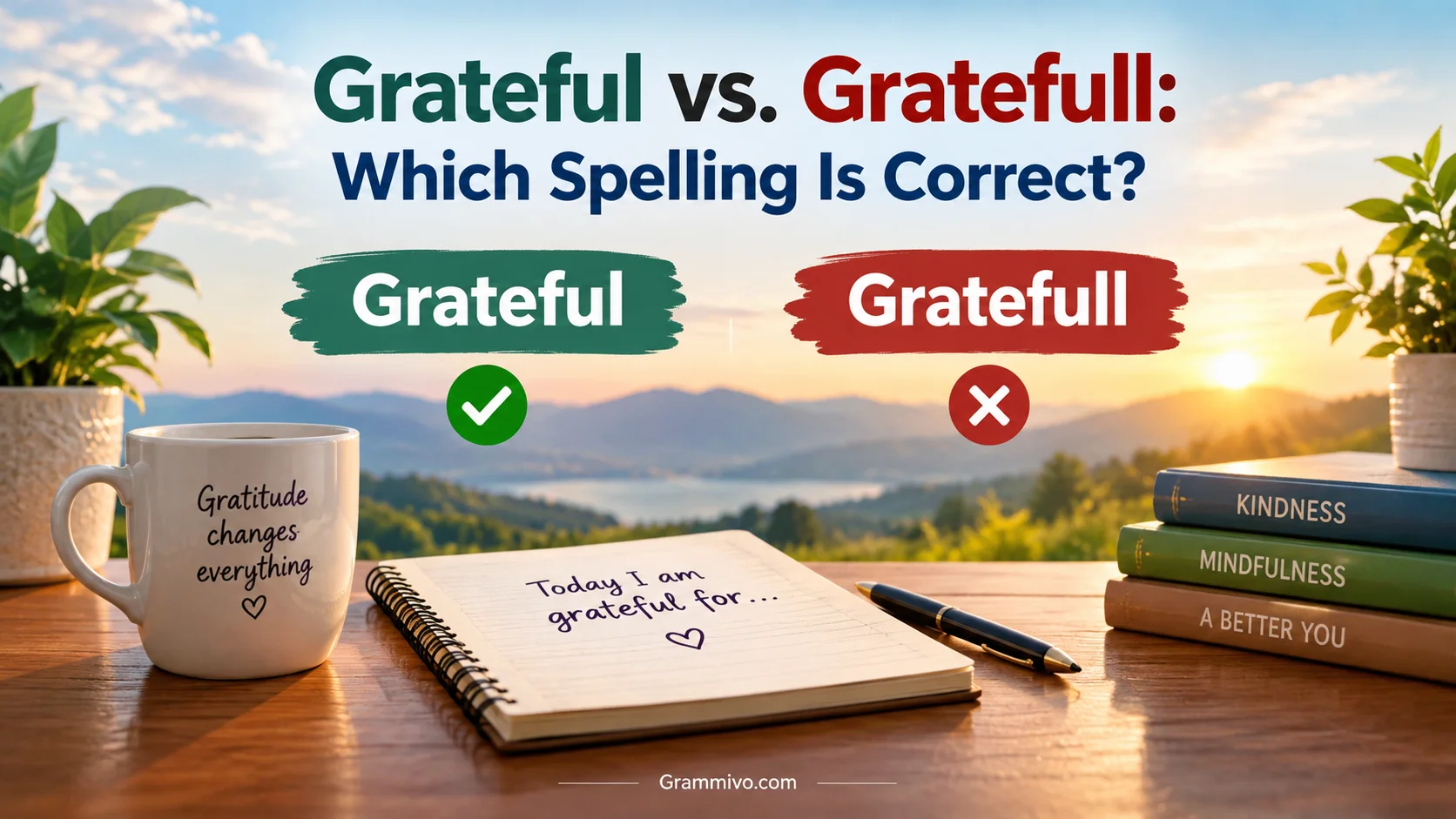
If you’ve ever hesitated between grateful and gratefull, you’re not alone. The two spellings look almost identical, and the extra l can seem logical because the word is connected to the idea of being “full” of gratitude.
However, there’s a simple answer: grateful is the correct spelling in modern standard English. The spelling gratefull isn’t used as the standard modern form.
The confusion usually comes from the suffix -ful. English has many words that end in -ful, including helpful, thankful, careful, and beautiful. Although the suffix sounds similar to the separate word full, it normally contains only one l.
Quick Answer
Grateful is the correct modern spelling.
Gratefull is not the standard modern spelling, although historical forms of the word can be found with different spellings in older English.
| Spelling | Modern standard English? | Meaning | Example |
| grateful | Yes | Thankful or appreciative | “I’m grateful for your help.” |
| gratefull | No | Historical spelling, not standard today | Avoid in modern writing |
The easiest way to remember the difference is this:
grate + ful = grateful
Not:
grate + full = gratefull
The word grateful functions as an adjective. It describes someone who feels or expresses appreciation for something received, experienced, or done by another person.
For example:
- “She’s grateful for the opportunity.”
- “I’m grateful to my parents.”
- “We’re grateful that everyone arrived safely.”
- “He felt grateful for their support.”
If you’re writing in contemporary American English, choose grateful every time.
What Does Grateful Mean?
Grateful means feeling or showing thanks because someone has helped you, given you something, supported you, or provided a positive experience.
It usually describes a positive emotional response to a benefit or kindness.
For example, if a friend helps you move into a new apartment, you might say:
“I’m grateful for your help.”
You aren’t simply acknowledging that your friend helped. You’re expressing appreciation for that help.
The word can describe both an internal feeling and an outward expression of thanks. Someone may feel grateful, or they may express their gratitude through words or actions.
The most common patterns include:
- grateful for something
- grateful to someone
- grateful to someone for something
- grateful to do something
- grateful that something happened
Consider the difference between these sentences:
- “I’m grateful for the advice.”
- “I’m grateful to Sarah.”
- “I’m grateful to Sarah for the advice.”
All three are grammatical. The first emphasizes what you appreciate. The second emphasizes the person. The third identifies both.
Cambridge Dictionary defines grateful in terms of feeling or showing thanks toward someone for something they have done or provided. Merriam-Webster likewise defines the word around the idea of being appreciative or thankful.
Why Is Gratefull Incorrect?
The spelling gratefull looks reasonable because English speakers already know the word full.
That creates a common mental connection:
grateful → full of gratitude → gratefull
The problem is that English spelling doesn’t build the word that way.
In grateful, the ending is the suffix -ful, not the standalone word full.
This distinction matters because -ful normally has one l.
Compare these words:
| Correct word | Ending |
| helpful | -ful |
| useful | -ful |
| careful | -ful |
| hopeful | -ful |
| thankful | -ful |
| grateful | -ful |
| beautiful | -ful |
Notice the pattern. You don’t write helpfull, usefull, or thankfull in standard modern English.
The same spelling principle applies to grateful.
So while gratefull may look as though it means “full of gratitude,” modern English uses grateful instead.
Grateful vs. Gratefull Spelling Difference
The spelling becomes much easier to remember when you look at the word’s structure.
Grateful contains:
grate + ful
The final l belongs to the suffix -ful.
It does not need another l.
By contrast, full is an independent adjective meaning containing as much as possible or filled to capacity.
For example:
- “The glass is full.”
- “The theater was full.”
- “She felt grateful.”
These words may sound related, but their spelling and grammatical roles differ.
A useful memory trick is to treat -ful as a special spelling unit. Once you recognize it, the extra l becomes easier to avoid.
A Simple Spelling Test
When you’re unsure, replace grateful with another -ful word.
Would you write:
- helpful or helpfull?
- thankful or thankfull?
- useful or usefull?
- grateful or gratefull?
The first option works in every case.
That pattern gives you a practical rule rather than requiring you to memorize one isolated spelling.
Is Gratefull Ever a Correct Word?
There’s an important historical detail here.
Gratefull has appeared as an older spelling, so it isn’t simply a modern invention created by someone making a random typo. Historical English spelling varied considerably, and words often appeared in forms that modern readers would consider unusual.
That historical fact, however, doesn’t make gratefull an acceptable standard spelling today.
Modern English has settled on grateful as the conventional form.
This distinction matters when reading older documents, historical literature, manuscripts, or discussions about the development of English spelling. You may encounter forms that differ from what contemporary dictionaries recommend.
Think of it this way:
Historical existence ≠ modern standard usage.
If you’re writing an email in 2026, use grateful.
If you’re analyzing an old text and encounter gratefull, the spelling may reflect historical usage rather than a modern spelling mistake.
For everyday writing, there’s no practical reason to choose gratefull.
Grateful Meaning and Pronunciation
In American English, grateful is commonly pronounced approximately like GRAYT-fuhl.
The pronunciation has two syllables:
grate-ful
The second syllable is relatively weak. It doesn’t sound exactly like the separate word full when spoken carefully in ordinary conversation.
That can actually help explain why the spelling sometimes causes confusion. The ending -ful and the word full are related historically and semantically, but they don’t function identically in modern spelling.
A useful comparison looks like this:
| Word | Approximate pronunciation | Function |
| grateful | GRAYT-fuhl | Adjective |
| full | FUHL | Adjective |
| gratitude | GRAT-uh-tood | Noun |
| gratefully | GRAYT-fuh-lee | Adverb |
How to Use Grateful Correctly
Knowing the spelling is only half the job. You also need to know which preposition or sentence structure naturally follows grateful.
The good news is that the main patterns are easy to learn.
Grateful to Someone
Use grateful to when you want to identify the person who deserves your thanks.
Examples:
- “I’m grateful to my parents.”
- “She’s grateful to her mentor.”
- “We’re grateful to everyone who volunteered.”
- “He remains grateful to his teacher.”
Here, to points toward the person receiving the appreciation.
Grateful for Something
Use grateful for when you want to identify the thing, experience, opportunity, or action you appreciate.
Examples:
- “I’m grateful for your advice.”
- “She’s grateful for the opportunity.”
- “We’re grateful for your support.”
- “He was grateful for the extra time.”
Here, for introduces the thing that caused the feeling of gratitude.
Grateful to Someone for Something
You can combine both patterns when you want to be specific.
For example:
“I’m grateful to you for helping me.”
This sentence tells the reader both who deserves appreciation and why.
Another example:
“We’re grateful to our customers for their continued support.”
This structure works particularly well in professional communication.
Grateful to Do Something
You can also use grateful to + verb.
Examples include:
- “I’m grateful to have another chance.”
- “She was grateful to receive the invitation.”
- “We’re grateful to work with such a talented team.”
This construction often emphasizes an opportunity or circumstance.
Grateful That…
You can follow grateful with a clause beginning with that.
Examples:
- “I’m grateful that you came.”
- “She’s grateful that everything worked out.”
- “We’re grateful that everyone is safe.”
This construction focuses on the situation rather than simply naming a person or object.
Grateful vs. Thankful
Grateful and thankful overlap heavily. In many everyday sentences, either word can work.
Still, they can carry slightly different shades of meaning.
Grateful often emphasizes appreciation for a benefit, kindness, opportunity, or person.
Thankful can express gratitude too, but it commonly appears when someone feels relief that something unpleasant or dangerous did not happen.
Compare these examples:
“I’m grateful for your support.”
This focuses on appreciation.
“I’m thankful that nobody was injured.”
This can suggest relief as well as gratitude.
The distinction isn’t absolute. Native speakers often use grateful and thankful interchangeably.
Cambridge Dictionary discusses this distinction and notes that thankful can particularly express relief that something bad did not happen.
A quick comparison helps:
| Word | Common emphasis | Example |
| Grateful | Appreciation | “I’m grateful for your kindness.” |
| Thankful | Gratitude or relief | “I’m thankful that we got home safely.” |
Grateful vs. Appreciative
Grateful and appreciative also overlap, but they aren’t always interchangeable.
Grateful usually carries a stronger sense of thanks for something received or done.
Appreciative can emphasize recognizing the value, quality, effort, or importance of something.
For example:
“I’m grateful for everything you did.”
This sounds deeply thankful.
Meanwhile:
“I’m appreciative of your attention to detail.”
This emphasizes recognition of someone’s quality or effort.
The difference becomes particularly noticeable in professional settings.
You might say:
- “I’m grateful for your support during the project.”
- “We’re appreciative of your attention to detail.”
Neither word is automatically better. The right choice depends on what you want to emphasize.
Common Misspellings of Grateful
The correct spelling is easy once you recognize the pattern. Yet several incorrect forms appear because people associate the word with great or full.
Here are some common errors:
| Incorrect spelling | Correct spelling |
| gratefull | grateful |
| greatful | grateful |
| greatfull | grateful |
| greateful | grateful |
| greatefull | grateful |
Two mistakes deserve special attention.
Gratefull
This version adds an unnecessary l.
The mistake probably comes from connecting -ful with the independent word full.
Remember:
grateful, not gratefull.
Greatful
This spelling swaps grate for great.
The error makes sense visually because great is a familiar English word. However, grateful comes from a different word history and has its own established spelling.
If you’re writing quickly, greatful can slip onto the page before you notice it.
A spell-checker may catch it, but understanding the correct spelling is more reliable.
Read More: Friend vs Freind: Correct Spelling, Meaning, and Examples
Easy Ways to Remember the Spelling
A good memory trick should be simple enough to use when you’re writing quickly.
The most useful rule is:
Grateful has one L.
You can also remember:
grate + ful = grateful
The ending is -ful, just as it is in:
- thankful
- helpful
- useful
- hopeful
- careful
Another useful trick is to remember the phrase:
“One L is enough for grateful.”
It’s short, and it directly targets the most common spelling mistake.
If you regularly confuse grateful with greatful, focus on the middle letters:
G R A T E F U L
The word begins with grate, not great.
Grateful in Everyday Sentences
Seeing the word in different contexts makes its usage much easier to remember.
Personal Relationships
- “I’m grateful for everything you’ve done.”
- “She’s grateful to her sister for the advice.”
- “We’re grateful to have friends like you.”
Work
- “I’m grateful for the opportunity to join the team.”
- “We’re grateful for your continued support.”
- “The manager was grateful to the staff for their hard work.”
School
- “I’m grateful to my teacher for the extra help.”
- “She felt grateful for the scholarship.”
- “The students were grateful for the additional time.”
Professional Correspondence
- “I would be grateful if you could send the documents.”
- “We’re grateful for your prompt response.”
- “I’m grateful for your consideration.”
Everyday Conversation
- “I’m really grateful for this.”
- “You have no idea how grateful I am.”
- “I’m grateful that everything worked out.”
Notice how the sentence structure changes while the central meaning stays consistent.
That flexibility makes grateful useful in both casual and formal English.
Grateful in Formal and Professional Writing
Grateful works well in professional writing because it communicates appreciation without sounding excessively emotional.
For example:
“I’m grateful for the opportunity to discuss this position.”
That sentence sounds polished but natural.
Another common structure is:
“I would be grateful if you could provide the requested information.”
This construction is especially common in formal requests.
However, context matters. In a casual email, saying “Thanks for your help” may sound more natural than “I would be grateful for your assistance.”
Neither sentence is grammatically wrong. They simply create different tones.
| Situation | Natural wording |
| Casual | “Thanks for helping me.” |
| Warm | “I’m grateful for your help.” |
| Professional | “I’m grateful for your assistance.” |
| Formal request | “I would be grateful if you could respond by Friday.” |
The key is to match the wording to your relationship with the reader.
FAQs:
Is it grateful or gratefull?
Grateful is the correct spelling in modern standard English.
The word ends in -ful, which contains one l.
Is gratefull a real word?
Gratefull has appeared as a historical spelling, but it isn’t the standard spelling used in modern English.
For contemporary writing, use grateful.
Why does grateful have only one L?
Because the word ends with the suffix -ful, not the separate word full.
The suffix -ful is normally spelled with one l, as in helpful, useful, thankful, and careful.
Is grateful an adjective?
Yes.
Grateful is an adjective because it describes a person’s emotional state or attitude.
For example:
“She is grateful.”
Here, grateful describes she.
What is the noun form of grateful?
Two related nouns are gratitude and gratefulness.
Gratitude is generally the more common choice.
For example:
“He expressed his gratitude.”
Conclusion:
The correct modern spelling is grateful. Gratefull is not the standard spelling used in contemporary English, even though historical texts may contain older forms of the word. So when you’re writing a thank-you email, a professional message, a school assignment, or a simple note to someone you appreciate, choose grateful.
