
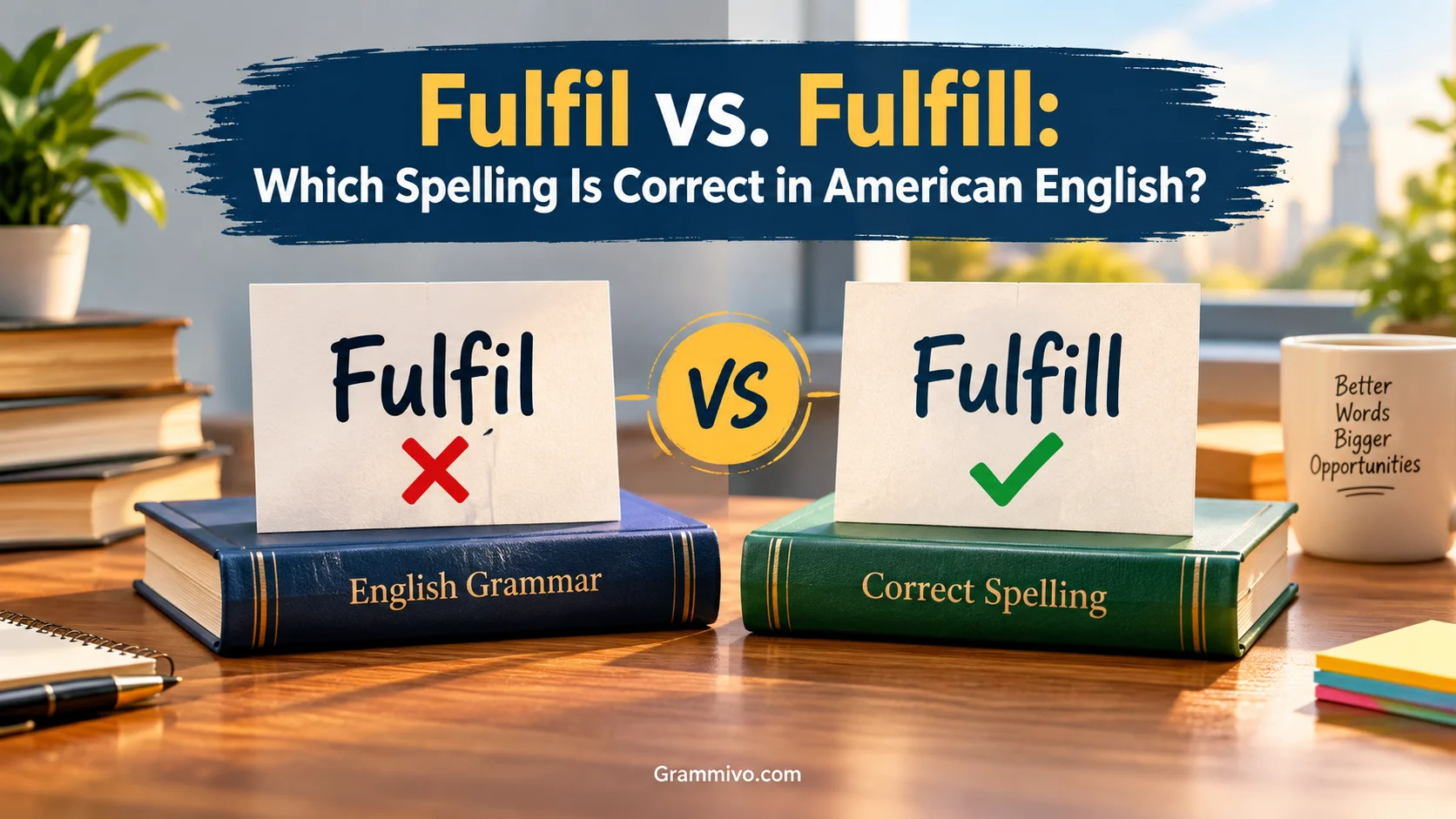
If you’ve ever paused over fulfil vs. fulfill, you’re not alone. The two spellings look almost identical, carry the same meaning, and sound the same when spoken. So why does English use both?
The answer is surprisingly simple: fulfill is the standard spelling in American English, while fulfil is the standard spelling in British English and several other varieties of English.
Neither spelling changes the meaning of the word. The difference comes down to regional spelling conventions. If you’re writing for readers in the United States, fulfill is the form you’ll normally want. If you’re following British English conventions, choose fulfil.
The difference also appears in related words. American English generally uses fulfillment, while British English uses fulfilment. However, forms such as fulfilled and fulfilling follow a slightly different pattern and are spelled the same in both varieties.
Quick Answer:
Fulfill is the standard American English spelling, while fulfil is the standard British English spelling.
| Spelling | Standard variety | Example |
| fulfill | American English | She hopes to fulfill her dream. |
| fulfil | British English | She hopes to fulfil her dream. |
| fulfillment | American English | The work gives him a sense of fulfillment. |
| fulfilment | British English | The work gives him a sense of fulfilment. |
| fulfilled | American and British English | She fulfilled her promise. |
| fulfilling | American and British English | Teaching can be a fulfilling career. |
The easiest rule to remember is:
US English: fulfill
UK English: fulfil
What Does Fulfill or Fulfil Mean?
At its core, fulfill or fulfil means to complete, satisfy, achieve, or carry out something that is expected, promised, required, or desired.
The exact meaning depends on the context.
For example, you can fulfill a promise, fulfill a requirement, or fulfill a dream. These phrases look different on the surface, yet they share the same basic idea: something reaches the outcome that was expected or intended.
Common uses include:
- Fulfill a promise — do what you promised to do.
- Fulfill a requirement — meet a stated condition.
- Fulfill an obligation — carry out a responsibility.
- Fulfill a dream — achieve something deeply desired.
- Fulfill a need — provide what someone or something requires.
- Fulfill a goal — accomplish an intended objective.
- Fulfill an order — process and provide goods that a customer requested.
- Fulfill a role — perform the duties associated with a position.
So, whether you write fulfil or fulfill, the underlying meaning remains unchanged.
Fulfill vs. Fulfil: What Is the Main Difference?
The main difference between fulfill and fulfil is spelling convention.
American English favors the double l form:
fulfill
British English generally uses the single l form:
fulfil
This distinction fits a broader pattern in English. American English often developed or standardized spellings that differ from British conventions. However, not every word follows one simple rule.
For instance, American English uses color, while British English uses colour. American English generally prefers center, while British English uses centre.
The same regional principle applies to fulfill and fulfil.
The important thing is consistency. If you’re writing an American English article, don’t alternate between fulfill and fulfil. Pick the form that matches your audience and stick with it.
Is Fulfill or Fulfil Correct in American English?
If you’re writing in American English, use fulfill.
That spelling is appropriate for US-based websites, business documents, school assignments, emails, reports, marketing copy, and general writing.
Here are some natural American English examples:
- The student must fulfill all course requirements.
- She worked hard to fulfill her lifelong dream.
- The company promised to fulfill the customer’s order.
- You must fulfill your contractual obligations.
- This position could fulfill your professional goals.
- The treatment may fulfill an important medical need.
Notice that the double l stays in the base form.
If your audience primarily lives in the United States, fulfill should be your default choice.
Is Fulfil or Fulfill Correct in British English?
If you’re following British English, use fulfil.
British publications, organizations, and writers commonly use the single-l spelling.
For example:
- The student must fulfil all course requirements.
- She worked hard to fulfil her lifelong ambition.
- The company promised to fulfil the customer’s order.
- You must fulfil your contractual obligations.
- The role may fulfil your professional goals.
- The policy must fulfil certain legal requirements.
British readers won’t usually struggle to understand fulfill. However, fulfil is the conventional spelling when you’re deliberately following British English standards.
This distinction matters particularly in formal writing. A British university assignment, UK government document, or British publication may expect British spelling throughout.
Fulfillment vs. Fulfilment
The spelling difference doesn’t stop with the verb.
The related noun also changes depending on the variety of English:
- American English: fulfillment
- British English: fulfilment
The noun generally refers to the act or state of fulfilling something. It can describe satisfaction, completion, achievement, or the successful carrying out of an obligation.
American English: Fulfillment
Examples include:
- She found fulfillment through her work.
- Customer fulfillment is an important part of e-commerce.
- Personal fulfillment can come from meaningful relationships.
- The company improved its order fulfillment process.
British English: Fulfilment
British writing generally uses:
- She found fulfilment through her work.
- Customer fulfilment is an important part of e-commerce.
- Personal fulfilment can come from meaningful relationships.
- The company improved its order fulfilment process.
This creates a useful pattern:
| American English | British English |
| fulfill | fulfil |
| fulfillment | fulfilment |
If you’re targeting a US audience, use fulfill and fulfillment together. For a UK audience, use fulfil and fulfilment.
Fulfilled vs. Fulfilled: Is There a Difference?
Here’s where things get interesting.
Although the base forms differ, the past-tense and past-participle form is normally spelled fulfilled in both American and British English.
So you write:
She fulfilled her promise.
You don’t normally write:
She fulfiled her promise.
The double l appears in fulfilled regardless of whether you otherwise follow American or British spelling.
This can surprise writers who assume that British fulfil should produce fulfiled. Standard English doesn’t work that way.
Correct Forms
| Form | American English | British English |
| Base form | fulfill | fulfil |
| Past tense | fulfilled | fulfilled |
| Past participle | fulfilled | fulfilled |
| Present participle | fulfilling | fulfilling |
| Noun | fulfillment | fulfilment |
This table captures one of the most useful spelling rules in the entire comparison.
Fulfill vs. Fulfil: What About Fulfilling?
The correct spelling is fulfilling in both American and British English.
You should not normally write fulfiling.
For example:
- Teaching children can be fulfilling.
- She has a fulfilling career.
- Volunteering proved surprisingly fulfilling.
- The experience was challenging but fulfilling.
The spelling fulfilling follows the double-l pattern.
This is an easy mistake to make because writers sometimes try to build the British form mechanically:
fulfil + ing = fulfiling
That logic produces the wrong result.
The standard spelling is:
fulfill + ing = fulfilling
Even when the base verb appears as fulfil in British English, the participle is still conventionally written fulfilling.
Fulfill vs. Fulfil Examples in Sentences
Seeing the two spellings side by side makes the distinction much easier.
| Context | American English | British English |
| Promise | I will fulfill my promise. | I will fulfil my promise. |
| Requirement | You must fulfill the requirement. | You must fulfil the requirement. |
| Dream | She hopes to fulfill her dream. | She hopes to fulfil her dream. |
| Obligation | They must fulfill their obligations. | They must fulfil their obligations. |
| Need | The service should fulfill the customer’s needs. | The service should fulfil the customer’s needs. |
| Order | The warehouse will fulfill the order. | The warehouse will fulfil the order. |
| Role | He fulfilled his role successfully. | He fulfilled his role successfully. |
| Experience | It was a fulfilling experience. | It was a fulfilling experience. |
The meaning stays exactly the same. Only the regional spelling of the base verb changes.
Common Phrases With Fulfill and Fulfil
Certain expressions appear frequently in everyday, professional, academic, and business writing.
Fulfill or Fulfil a Promise
To fulfill a promise means to do what you said you would do.
American:
She always tries to fulfill her promises.
British:
She always tries to fulfil her promises.
The phrase often carries a sense of trust and reliability.
Fulfill or Fulfil a Requirement
This expression commonly appears in education, employment, contracts, and regulations.
American:
Applicants must fulfill all eligibility requirements.
British:
Applicants must fulfil all eligibility requirements.
Here, the word means meet or satisfy a condition.
Fulfill or Fulfil an Obligation
An obligation is something you’re expected or required to do.
American:
The company must fulfill its contractual obligations.
British:
The company must fulfil its contractual obligations.
This phrase frequently appears in formal and legal contexts.
Fulfill or Fulfil a Dream
This expression usually describes achieving a personal ambition.
American:
Moving abroad helped her fulfill a lifelong dream.
British:
Moving abroad helped her fulfil a lifelong dream.
This usage has a more emotional tone than fulfill a requirement.
Fulfill or Fulfil a Need
Here, the verb means to satisfy or provide something necessary.
American:
The new program helps fulfill a growing need in the community.
British:
The new programme helps fulfil a growing need in the community.
This phrase works in both personal and professional contexts.
Fulfill or Fulfil an Order
In retail and logistics, fulfill an order means to process a customer’s request and arrange the requested goods or services.
American:
The warehouse can fulfill thousands of orders each day.
British:
The warehouse can fulfil thousands of orders each day.
The meaning remains identical.
Fulfill vs. Fulfil in Business Writing
Business writing makes spelling consistency especially important.
Imagine a US company uses fulfill on its website but switches to fulfil in customer emails. Readers will understand both forms, yet the inconsistency can make the company’s writing look poorly edited.
A UK company faces the opposite situation.
For professional content, choose your English variety based on your audience, organization, and style guide.
Use Fulfill When:
- Your company operates primarily in the United States.
- Your customers are mainly American.
- Your website follows US English.
- Your internal style guide specifies American spelling.
- You’re writing for a US publication.
Use Fulfil When:
- You’re writing for a British audience.
- Your organization follows UK English.
- Your publication uses British spelling.
- Your document follows a British style guide.
- Your primary market is the United Kingdom.
A simple rule works well:
Match the spelling to the audience, then keep it consistent.
That principle matters more than trying to decide which spelling is somehow “more correct.”
Fulfill vs. Fulfil in Academic Writing
Academic writing requires the same regional awareness.
A student writing for an American institution will generally use fulfill. A student writing under British English conventions will generally use fulfil.
Consider these examples:
American English:
The study aims to fulfill three major research objectives.
British English:
The study aims to fulfil three major research objectives.
Neither sentence has a different meaning. The spelling simply reflects the chosen English variety.
When an instructor, university, journal, or publisher provides a style guide, follow it. Consistency matters throughout the paper.
The same principle applies to related spelling choices such as organization/organisation, color/colour, and center/centre.
Common Fulfill and Fulfil Spelling Mistakes
The biggest mistakes usually happen when writers add or remove letters incorrectly.
| Incorrect spelling | Correct spelling |
| fullfill | fulfill / fulfil |
| fullfil | fulfill / fulfil |
| fulfiled | fulfilled |
| fullfilled | fulfilled |
| fulfiling | fulfilling |
| fullfilling | fulfilling |
Fullfill vs. Fulfill
Fullfill is incorrect.
The correct American spelling is:
fulfill
The word does not contain full followed by another fill. Treating it that way creates an extra l.
Fulfiled vs. Fulfilled
Fulfiled is incorrect in standard modern English.
Use:
fulfilled
For example:
She fulfilled every requirement.
Fulfiling vs. Fulfilling
Fulfiling is not the standard spelling.
Use:
fulfilling
For example:
The work was challenging but fulfilling.
These errors are worth checking because spell-checkers may catch some forms but not every contextual mistake.
Why Does Fulfill Have Two Spellings?
The difference comes from the broader development of English spelling.
The verb traces back through Middle English forms to Old English. Merriam-Webster gives Old English fullfyllan among its historical roots. The modern forms developed through centuries of changes in English spelling and usage.
American and British English later developed distinct spelling preferences in a number of words.
The fulfil/fulfill distinction fits that larger pattern.
It isn’t a difference created because the two words developed separate meanings. They didn’t. Fulfil and fulfill remain the same verb with the same core senses.
The spelling simply reflects different standards.
That distinction matters because people sometimes assume that one spelling represents an older or more sophisticated meaning. It doesn’t.
FAQs:
1. Is “fulfil” or “fulfill” correct?
Both fulfil and fulfill are correct spellings. Fulfil is commonly used in British English, while fulfill is the standard spelling in American English.
2. What does “fulfil” mean?
Fulfil means to complete or achieve something, such as a duty, promise, requirement, goal, or expectation. For example: “She worked hard to fulfil her ambitions.”
3. What does “fulfill” mean?
Fulfill has the same meaning as fulfil. It is the preferred spelling in American English. For example: “He hopes to fulfill his dream of becoming a writer.”
4. Which spelling should I use in American English?
Use fulfill in American English. The double l is the standard American spelling.
5. Is “fulfilled” spelled with one or two Ls?
In both varieties of English, the past tense is spelled fulfilled, with two l’s at the end. For example: “She fulfilled all the requirements.”
Conclusion:
Fulfil and fulfill are both correct; the difference is mainly regional. Use fulfil for British English and fulfill for American English. Whichever spelling you choose, stay consistent with the variety of English you are using.
