
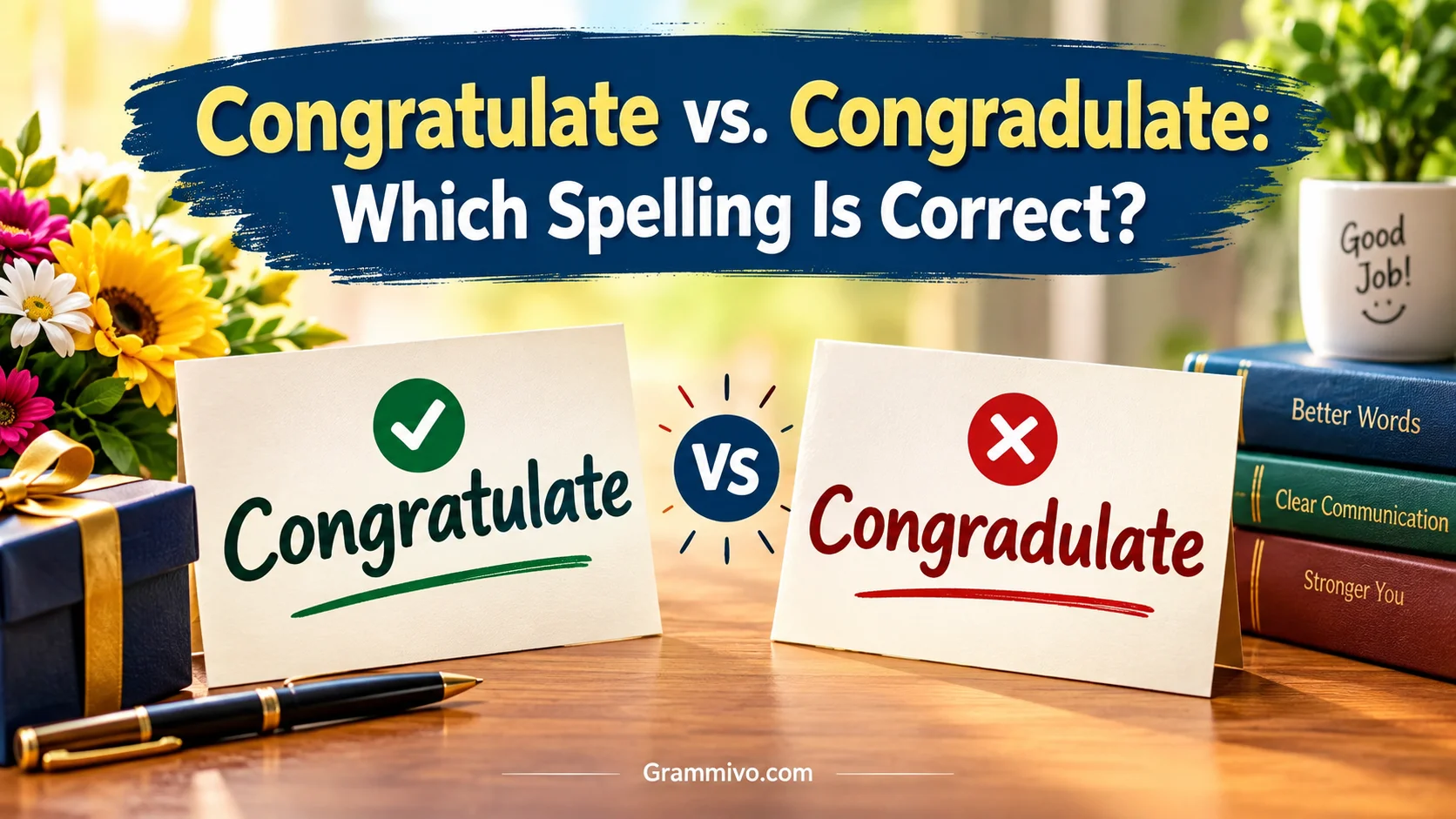
Have you ever typed “congradulate” and wondered whether it was actually correct? You’re not alone. The two spellings look remarkably similar, and the mistake becomes especially easy to make when you’re thinking about graduation, where the words often appear in the same conversation.
Here’s the important distinction: congratulate is the correct spelling. Congradulate is a common misspelling and isn’t the standard English form. If you’re writing an email, greeting card, social media post, school message, or professional note, use congratulate.
The confusion usually comes from the middle of the word. Congratulate contains “grat,” not “grad.” That small difference matters. Once you know what to look for, the spelling becomes much easier to remember.
Quick Answer
Congratulate is correct, while congradulate is incorrect.
| Spelling | Correct? | Meaning | Example |
| Congratulate | Yes | To express praise or pleasure about someone’s achievement | I want to congratulate you on your promotion. |
| Congradulate | No | Common misspelling of congratulate | I want to congradulate you. |
The correct word is congratulate, with “grat” in the middle.
You can also remember its related forms:
- Congratulate — verb
- Congratulated — past tense
- Congratulating — present participle
- Congratulations — noun or celebratory expression
- Congrats — informal shortening of congratulations
So, if you’re deciding between congratulate vs. congradulate, there’s no real contest. Congratulate wins.
What Does Congratulate Mean?
Congratulate is a verb that means to express pleasure, approval, praise, or good wishes because someone has achieved something.
For example, if your friend gets a new job, you might say:
“I want to congratulate you on your new position.”
The word works in both personal and professional situations. You can congratulate someone for an exciting life event, an academic accomplishment, a career milestone, a competition victory, or another achievement.
Common situations include:
- Getting a promotion
- Graduating from school or college
- Winning a competition
- Getting married
- Having a baby
- Passing an examination
- Receiving an award
- Completing a difficult project
- Reaching an important personal goal
- Being selected for a new position
The word focuses on recognizing someone’s success. It doesn’t necessarily mean that you personally helped them achieve it.
For instance:
“Everyone congratulated Maria on winning the scholarship.”
Maria earned the scholarship. The people around her simply expressed their happiness and admiration for her achievement.
Is Congradulate a Word?
No. “Congradulate” is not the standard English spelling of the verb.
People sometimes write congradulate because the spelling feels intuitive. The mistake becomes even more understandable when the person has recently been thinking about words such as graduate, graduation, or grad.
However, English spelling doesn’t always follow the pronunciation or the surrounding context. The correct spelling remains congratulate.
Consider these examples:
- I congradulate you on your success.
- I congratulate you on your success.
- We congradulated the winner.
- We congratulated the winner.
- She wants to congradulate her brother.
- She wants to congratulate her brother.
The incorrect spelling doesn’t create a different meaning. It simply represents a spelling error.
Why Do People Spell Congratulate as Congradulate?
The main confusion comes from the similar-looking and related-sounding words people encounter around achievements.
Graduate has a d:
graduate
Congratulate does not:
congratulate
When someone graduates, people commonly say:
“Congratulations on your graduation!”
That connection can make the brain blend the two words. Before you know it, congratulate becomes congradulate.
There’s another reason the error feels natural. The middle of congratulate isn’t pronounced exactly as each individual letter might suggest to a learner. English contains many words where spelling and pronunciation don’t line up perfectly.
The solution isn’t to memorize a complicated pronunciation rule. Instead, remember the spelling family:
congratulate → congratulated → congratulating → congratulations
Every one of these forms keeps the “grat” sequence.
Graduate and Congratulate Are Different Words
It’s useful to separate the two ideas.
| Word | Meaning | Example |
| Graduate | A person who completes a course of study, or the act of completing it | She will graduate in May. |
| Graduation | The ceremony or completion of an academic program | His graduation is next week. |
| Congratulate | To express praise or pleasure about an achievement | I congratulated him on graduating. |
| Congratulations | An expression of praise or good wishes | Congratulations on your graduation! |
The words can appear together in a sentence, but their spellings remain different.
“I want to congratulate you on your graduation.”
That’s perfectly correct.
How Do You Spell Congratulate Correctly?
The easiest way to remember the spelling is to focus on the middle:
CONGRATULATE
The important sequence is:
CON + GRAT + ULATE
The word contains GRAT, not GRAD.
Compare them:
- CONGRATULATE
- CONGRADULATE
The same pattern appears in the related word:
- CONGRATULATIONS
- CONGRADULATIONS
A useful memory trick is to connect congratulate with congratulations. If you know how to spell congratulations, you already have the key part of congratulate.
Another helpful reminder is this:
Graduates get congratulations, but you congratulate them.
That sentence separates graduate from congratulate while putting both ideas together.
How Do You Pronounce Congratulate?
In standard US English, congratulate is commonly pronounced approximately:
kuhn-GRATCH-uh-late
Cambridge gives the US pronunciation as /kənˈɡrætʃ.ə.leɪt/.
The stress falls on the second syllable:
con-GRAT-u-late
The exact sound can vary somewhat among speakers, especially in fast conversational speech. That’s one reason spelling the word from memory can feel tricky.
However, pronunciation shouldn’t lead you toward the incorrect d spelling. The correct written form remains congratulate.
If you’re unsure while writing, don’t try to reconstruct the spelling from how the word sounds. Think of its written family instead:
congratulate → congratulations
Congratulate Meaning and Word Forms
Knowing the different forms of the word makes the spelling much easier to recognize.
| Word Form | Function | Example |
| Congratulate | Base verb | I want to congratulate you. |
| Congratulates | Third-person singular | She congratulates every winner. |
| Congratulated | Past tense | We congratulated him yesterday. |
| Congratulating | Present participle | They are congratulating the team. |
| Congratulation | Singular noun | He offered a congratulation. |
| Congratulations | Plural noun/common expression | Congratulations on your achievement! |
In everyday English, congratulations is much more common than the singular congratulation when you’re directly celebrating someone’s success.
For example:
Congratulations on your new job!
You wouldn’t normally write:
Congratulation on your new job!
The plural form is the conventional expression.
How to Use Congratulate in a Sentence
The verb congratulate commonly takes a person as its object.
A simple structure is:
congratulate + person
For example:
“I congratulated Sarah.”
You can then add the achievement using on:
congratulate + someone + on + achievement
For example:
“I congratulated Sarah on her promotion.”
This pattern works in countless situations.
Professional Examples
Professional communication often uses congratulate to recognize career achievements.
- I would like to congratulate you on your promotion.
- We congratulate the entire team on completing the project.
- The company congratulated James on his outstanding performance.
- Please join us in congratulating Lisa on her new role.
- She called to congratulate her colleague on the award.
These examples work because the word communicates recognition without sounding overly dramatic.
Academic Examples
Academic achievements also commonly call for congratulations.
- I want to congratulate you on passing your exam.
- The professor congratulated the students on their excellent results.
- We congratulated Daniel on graduating with honors.
- Her parents congratulated her on earning the scholarship.
- The school congratulated the graduating class.
Notice the recurring structure:
congratulate someone on something
That pattern is one of the most useful pieces of grammar to remember.
Personal Examples
In everyday conversation, congratulate can sound warm and natural.
- I called to congratulate you on your new job.
- Everyone congratulated the couple on their engagement.
- She congratulated her brother on winning the race.
- We congratulated our friend on reaching her goal.
- He congratulated me on finishing the marathon.
Congratulate Someone On or For?
When you’re talking about an achievement, congratulate someone on something is the standard and most natural construction.
Examples include:
“I congratulated her on her promotion.”
“We congratulated him on passing the exam.”
“They congratulated us on our anniversary.”
“She congratulated Sarah on winning the competition.”
This is worth remembering because learners sometimes wonder whether for should follow congratulate.
In standard usage, on is the normal preposition when you identify the achievement or occasion.
Why “On” Works So Well
Think of on as introducing the specific success you’re recognizing.
congratulate someone on a promotion
congratulate someone on an award
congratulate someone on graduating
congratulate someone on a victory
The pattern becomes automatic after you see enough examples.
Read More: Fulfil vs. Fulfill: Which Spelling Is Correct in American English?
Congratulate vs. Congratulations
Although these words come from the same word family, they don’t perform the same grammatical job.
Congratulate is a verb.
“I congratulate you on your success.”
Congratulations is generally used as a noun or as a standalone expression of praise and good wishes.
“Congratulations on your success!”
Here’s the distinction in a table:
| Word | Role | Example |
| Congratulate | Verb | I congratulate you. |
| Congratulated | Past-tense verb | I congratulated her yesterday. |
| Congratulating | Verb form | We are congratulating the winners. |
| Congratulations | Celebratory expression/noun | Congratulations on your promotion! |
| Congrats | Informal shortened form | Congrats on the new job! |
This distinction matters because congratulate and congratulations aren’t interchangeable in every sentence.
You can say:
“I want to congratulate you.”
But you wouldn’t normally replace it with:
“I want to congratulations you.”
That construction is incorrect because congratulations doesn’t function as the verb there.
Common Mistakes With Congratulate
The most common spelling mistake is adding a d after congra-.
Here are several forms to watch:
| Incorrect | Correct |
| congradulate | congratulate |
| congradulates | congratulates |
| congradulated | congratulated |
| congradulating | congratulating |
| congradulation | congratulation |
| congradulations | congratulations |
The key is consistency. Once you know that the word family uses grat, the different forms become easier to spell.
Common Sentence Corrections
Incorrect:
I want to congradulate you on your promotion.
Correct:
I want to congratulate you on your promotion.
Incorrect:
Please congradulate the winners.
Correct:
Please congratulate the winners.
Incorrect:
Congradulations on your graduation!
Correct:
Congratulations on your graduation!
Incorrect:
She congradulated me on passing.
Correct:
She congratulated me on passing.
These errors are easy to fix once you recognize the pattern.
An Easy Trick to Remember Congratulate
Here’s the simplest spelling trick:
Remember “GRAT,” not “GRAD.”
Write these two words side by side:
CONGRATULATE
CONGRATULATIONS
Both contain GRAT.
Now compare the common mistake:
CONGRADULATE
That extra D doesn’t belong.
You can also use this sentence as a quick memory cue:
“Congratulations” starts with the same “congrat-” as “congratulate.”
If you can spell congratulations, you can usually reconstruct congratulate correctly.
Another useful association is gratitude. The spelling connection can help you remember the letters grat, although congratulate and gratitude aren’t interchangeable words or forms of the same word.
FAQs:
Is it congratulate or congradulate?
Congratulate is the correct spelling. Congradulate is a misspelling.
Is congradulate a real word?
Congradulate isn’t the standard English word for expressing praise or good wishes about someone’s achievement. Use congratulate instead.
How do you spell congratulate?
The correct spelling is C-O-N-G-R-A-T-U-L-A-T-E.
The important part to remember is “grat,” not “grad.”
How do you spell congratulations?
The correct spelling is congratulations.
It contains “grat” after con-:
C-O-N-G-R-A-T-U-L-A-T-I-O-N-S
What does congratulate mean?
Congratulate means to express pleasure, praise, approval, or good wishes because someone has achieved something.
Conclusion:
When comparing congratulate vs. congradulate, the answer is straightforward: congratulate is correct, and congradulate is a misspelling. The easiest way to remember the difference is to focus on the middle letters. Congratulate contains “grat,” just like congratulations. It does not contain the “grad” found in graduate. And when you’re talking about academic completion, keep graduate and graduation in their own word family.
