
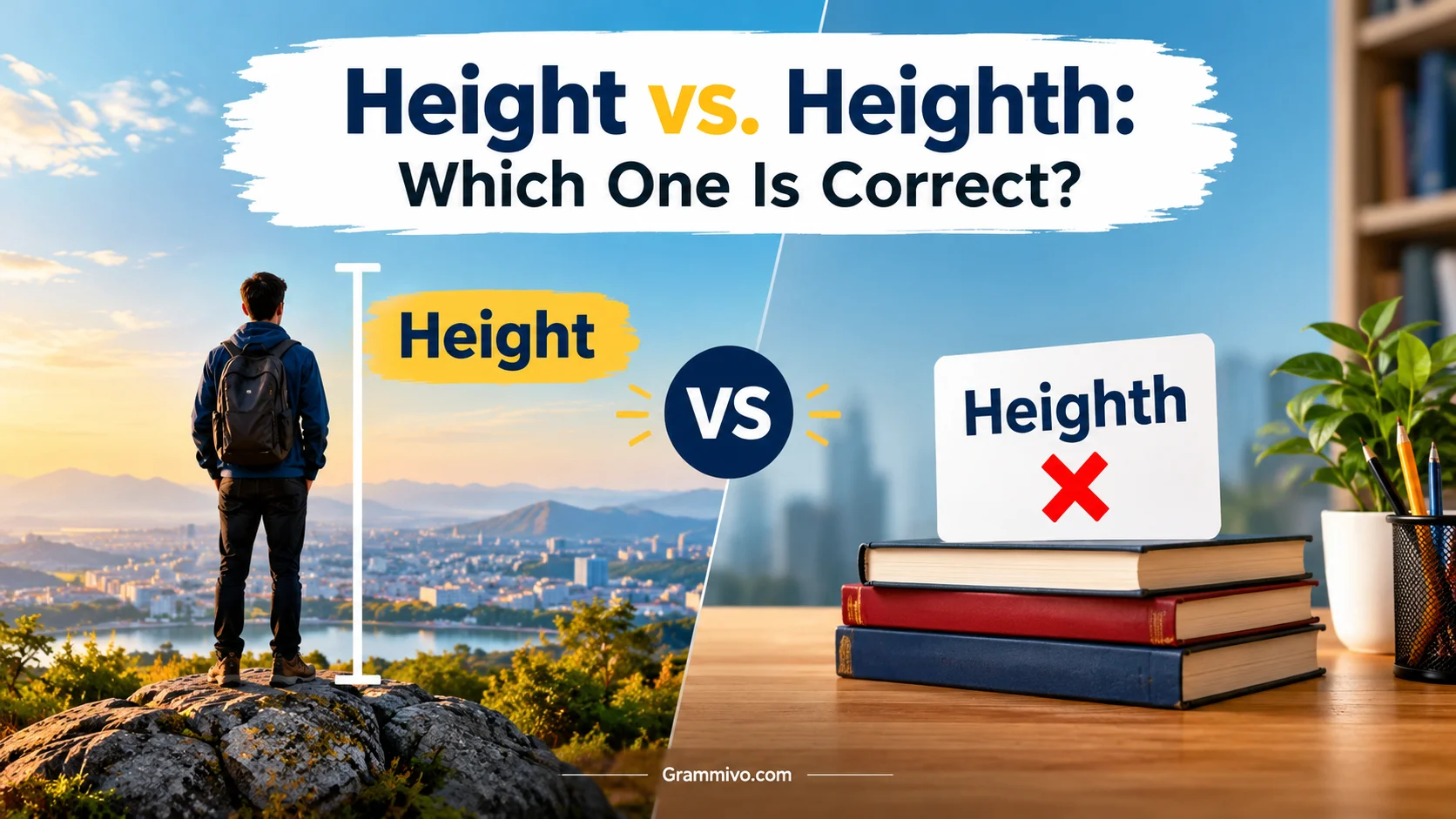
If you’ve ever hesitated between height and heighth, you’re not alone. The two forms look closely related, and heighth can seem especially tempting because English has words such as length, width, and depth. Still, standard modern English makes the choice quite simple.
Height is the correct and standard spelling. Heighth exists as a historical or dialectal variant, but it isn’t the normal form used in contemporary standard English.
That distinction matters when you’re writing an essay, article, email, report, résumé, school assignment, or professional document. In those settings, height is the form you should choose.
The confusion becomes more interesting when you look at the history of the word. Height has a long linguistic history, and its unusual spelling reflects centuries of changes in English pronunciation and spelling. In other words, the word isn’t following the neat pattern that its appearance might suggest.
Quick Answer
Height is the correct spelling in standard modern English. It refers to the vertical measurement of a person, object, structure, or place. It can also describe a high point, level, or peak of intensity. Heighth is a less common historical or dialectal variant. You may encounter it in older texts or regional usage, but it isn’t the preferred spelling in contemporary standard English.
Correct: The height of the building is 150 feet.
Nonstandard in modern general writing: The heighth of the building is 150 feet.
The easiest rule to remember is:
When you mean how tall or high something is, use “height.”
Comparison Overview
| Word | Standard spelling? | Primary meaning | Modern usage | Pronunciation |
| Height | Yes | Vertical measurement, high point, or peak | Common and standard | /haɪt/ |
| Heighth | Generally no in standard English | Variant of height | Historical, dialectal, or nonstandard | Varies by usage |
The difference isn’t about two words with completely separate meanings. Instead, heighth developed as a variant associated with the same basic word as height.
For everyday modern writing, there’s no need to debate which one sounds more logical. Height wins.
Main Differences Between Height and Heighth
The biggest difference is standard usage. Height belongs to ordinary contemporary English, while heighth has a much narrower role.
Height Is the Standard Modern Form
Height is the noun you use when discussing vertical measurement.
For example:
- “What is the height of the door?”
- “The height of the tower is 300 feet.”
- “His height makes him easy to spot in a crowd.”
- “The tree has reached a height of 40 feet.”
You can use height with people, buildings, animals, plants, furniture, mountains, walls, waves, and countless other subjects.
Heighth Is a Variant Form
Heighth isn’t simply an alternative spelling that you can freely swap with height in modern standard English.
Historical and dialectal forms of heighth have appeared in English. The form makes sense from a word-formation perspective because speakers can naturally associate height with other nouns ending in -th.
However, standard written English settled on height.
That means heighth can be worth recognizing when you’re reading older material or encountering regional speech. It doesn’t make it the preferred choice for your own formal writing.
Why the Extra “H” Causes Confusion
The spelling heighth looks almost as though it should be correct.
Consider these familiar words:
- long → length
- wide → width
- deep → depth
- high → height
The first three examples can make heighth seem like a logical formation from high. Yet English spelling doesn’t always develop according to a single predictable formula.
That’s one of the quirks of English. Sometimes the pattern helps you spell a word. Other times, history gets in the way.
What Does Height Mean?
Height has several closely connected meanings. Its most common meaning concerns vertical measurement.
Height as a Physical Measurement
When you measure the distance from the bottom of something to its top, you’re measuring its height.
For example, imagine buying a bookshelf. The product description might give three dimensions:
- Height: 72 inches
- Width: 30 inches
- Depth: 12 inches
Here, height tells you how far the bookshelf extends vertically.
The same principle applies to a person. If someone is six feet tall, their height is six feet.
Height for People
We commonly use height when talking about how tall someone is.
Examples include:
- “She is five feet four inches in height.”
- “His height gives him an advantage in basketball.”
- “The doctor recorded the child’s height during the examination.”
- “People of different heights stood in line.”
In everyday conversation, English speakers often say “How tall are you?” rather than “What is your height?” Both communicate the same basic measurement, although height sounds more natural in measurement-related contexts.
Height for Buildings and Structures
Architects, engineers, builders, real estate professionals, and city planners regularly use height to describe structures.
For example:
“The tower has a height of 250 meters.”
You might also see measurements such as:
- building height
- ceiling height
- wall height
- roof height
- bridge height
- fence height
These phrases all describe vertical dimensions.
Height for Natural Features
The word doesn’t apply only to manufactured objects. Natural features also have measurable heights.
You can discuss the height of:
- mountains
- trees
- cliffs
- waterfalls
- waves
- hills
- rock formations
For example, Mount Everest rises to 8,848.86 meters above sea level. In a sentence, you could say:
“Mount Everest has an elevation of 8,848.86 meters above sea level.”
In less technical contexts, people may also talk about the mountain’s great height.
Height as a High Point
Height can also refer to the highest point reached by something.
For instance:
“The rocket reached a considerable height before beginning its descent.”
This meaning connects naturally with physical elevation. Something rises and reaches a particular level.
Height in a Figurative Sense
English also uses height figuratively.
In this sense, it can describe the greatest degree, most intense stage, or peak of something.
Consider:
“The team was at the height of its success.”
This doesn’t mean the team physically moved upward. It means the team had reached its peak level of success.
Other examples include:
- “At the height of the celebration, the lights went out.”
- “The company expanded rapidly at the height of the technology boom.”
- “She achieved the height of her career in her thirties.”
The word works much like peak in these expressions.
What Does Heighth Mean?
Heighth refers to the same basic concept as height, but its status differs.
The spelling has appeared in historical English and in some dialectal or regional usage. It can also show up when people spell the word according to a perceived pattern rather than the standard modern form.
This makes heighth an interesting word for language study. It isn’t meaningless. Nor did someone simply invent it yesterday as a typo.
However, that doesn’t mean you should use it in ordinary modern writing.
A useful distinction is:
Recognizing a word doesn’t mean you should use it.
You may encounter heighth and understand exactly what the writer means. Yet if you’re writing for a broad modern audience, height remains the safe and standard choice.
Why Is Height Spelled Without the Extra H?
The spelling of height has a complicated history.
Modern English developed from several earlier forms of Germanic English. Over many centuries, pronunciation and spelling changed. The word now written as height has roots in Old English, where forms such as hēahþu and related spellings represented the idea of highness or height.
As English evolved, vowels shifted and consonants changed. Written forms also changed as scribes, printers, and later standardization practices shaped English spelling.
The modern spelling height preserves elements of this long history.
This is why trying to create heighth by simply adding -th to high doesn’t give you the standard modern form.
English contains plenty of similar historical oddities. Eight, weight, brought, and though all demonstrate how modern spelling can preserve traces of older pronunciation and spelling patterns.
So the spelling isn’t arbitrary. It’s the result of linguistic history.
Height and the Word High
The relationship between high and height is easy to recognize.
- High is primarily an adjective.
- Height is the related noun.
For example:
“The wall is high.”
becomes:
“The wall has considerable height.”
Likewise:
“The bird flew high.”
can be connected with:
“The bird reached a great height.”
The relationship is straightforward in meaning even though the spelling isn’t perfectly predictable.
Height vs. Heighth Pronunciation
The standard pronunciation of height is /haɪt/.
It sounds like “hite.”
That pronunciation can surprise learners because the spelling contains gh. In this word, however, the gh doesn’t create a separate audible sound.
Compare:
- height → “hite”
- high → “hi”
- eight → “ate”
- weight → “wait”
These words show how English spelling can retain letter combinations that don’t correspond neatly to modern pronunciation.
Is Height Pronounced “Heighth”?
No standard pronunciation requires an extra spoken th sound at the end.
The normal pronunciation is simply:
height → /haɪt/
Adding a separate th sound produces a pronunciation associated with the nonstandard or dialectal form heighth, not the standard pronunciation of height.
Height vs. Heighth Examples in Sentences
Seeing the words in context makes the difference easier to remember.
Correct Examples With Height
1. “The height of the ceiling makes the room feel spacious.”
Here, height describes a vertical dimension.
2. “The basketball player is known for his impressive height.”
Here, the word refers to a person’s physical stature.
3. “The airplane reached an altitude of 35,000 feet.”
Although altitude is more precise in aviation, height can also describe vertical elevation in suitable contexts.
4. “The tree has grown to a height of nearly 30 feet.”
The word describes the tree’s vertical measurement.
5. “She has always been afraid of heights.”
Here, heights refers to elevated places rather than a specific measurement.
6. “At the height of the storm, the roads became dangerous.”
This example uses height figuratively to mean the most intense stage.
7. “The height of the wall prevents people from seeing over it.”
The meaning is physical and measurable.
8. “The company reached the height of its popularity during the early 2000s.”
Here, height means the peak or strongest period.
Examples With Heighth
Because heighth isn’t the standard modern form, it should generally be treated as a variant rather than your normal spelling.
For example:
“The heighth of the fence is six feet.”
In standard modern English, write:
“The height of the fence is six feet.”
Another example:
“The heighth of the building was difficult to estimate.”
Standard version:
“The height of the building was difficult to estimate.”
The meaning doesn’t change. The spelling does.
Common Mistakes With Height
The word height creates several predictable spelling and usage problems.
Writing Heighth Instead of Height
This is the central spelling mistake.
If you’re unsure, remember that the standard spelling ends with:
-ght
not:
-ghth
Correct:
height
Incorrect in standard modern usage:
heighth
Confusing Height and Heights
Height is singular.
Heights is plural.
Compare:
- “The height of the building is 100 feet.”
- “The buildings have different heights.”
The plural form also appears in the expression “afraid of heights.”
For example:
“My brother is afraid of heights.”
This doesn’t necessarily mean he’s afraid of a particular measurement. It means elevated places make him uncomfortable or frightened.
Confusing Height With Length
These measurements describe different dimensions.
Imagine a rectangular box standing upright.
- Height measures from bottom to top.
- Length usually measures the longest horizontal dimension.
- Width measures from side to side.
- Depth measures how far something extends backward or inward.
The exact convention can vary depending on the object and industry. Still, this distinction works well for everyday writing.
Read More: Guarantee vs. Guarentee: Which Spelling Is Correct?
Height vs. Length vs. Width vs. Depth
| Word | Basic meaning | Example |
| Height | Vertical measurement | The height of the door is 80 inches. |
| Length | Measurement from one end to another | The length of the table is 6 feet. |
| Width | Measurement from side to side | The width is 3 feet. |
| Depth | Distance from the front toward the back or inward | The cabinet has a depth of 18 inches. |
These words often appear together in product specifications.
For example:
Dimensions: 72 inches high × 36 inches wide × 18 inches deep
A product listing might use height, width, and depth to give shoppers a clear picture of the item’s size.
Height in Common Expressions
The word height has become part of several familiar English expressions.
At the Height of
At the height of means during the peak or most intense period of something.
Example:
“At the height of the festival, thousands of visitors filled the streets.”
The phrase can describe popularity, activity, excitement, conflict, success, or intensity.
The Height of Summer
The height of summer refers to the middle or most intense part of summer.
Example:
“The garden needs regular watering during the height of summer.”
The Height of Absurdity
This expression means something has reached an extremely unreasonable or ridiculous level.
Example:
“Claiming that rain is caused by people opening umbrellas would be the height of absurdity.”
Here, height means the highest degree of something.
Afraid of Heights
Afraid of heights is a common expression for fear or discomfort associated with high places.
Example:
“He’s afraid of heights, so he avoids tall observation decks.”
Notice the plural heights, not height.
Height of Fashion
The height of fashion is an established expression meaning the peak of fashionable style.
Example:
“That style was once considered the height of fashion.”
It’s somewhat more literary or old-fashioned today than everyday alternatives such as very fashionable or extremely stylish.
FAQs:
Is “heighth” a correct word?
Heighth is a historical or dialectal variant associated with height, but it isn’t the standard spelling for modern general English. Use height in contemporary formal and informal writing.
Is height the only standard spelling?
Yes. Height is the standard modern spelling for the noun referring to vertical measurement, elevation, or a figurative peak.
Why do people spell height as heighth?
The spelling heighth likely seems natural because English has many nouns formed with -th, including length, width, and depth. The pattern can lead writers to add an extra h to height.
How do you pronounce height?
Height is pronounced /haɪt/. It sounds like “hite.”
What is the plural of height?
The plural is heights.
For example:
“The buildings have different heights.”
The word heights also appears in phrases such as “afraid of heights.”
Conclusion:
When choosing between height and heighth, the answer is straightforward: use height. Height is the standard modern English noun. It describes how tall or high something is, the vertical measurement of an object or person, a physical elevation, or the peak of something in a figurative sense.
Heighth, meanwhile, survives mainly as a historical, dialectal, or nonstandard variant. It can appear in older material or regional usage, which explains why you may occasionally encounter it. However, that doesn’t make it the right choice for ordinary contemporary writing.
