
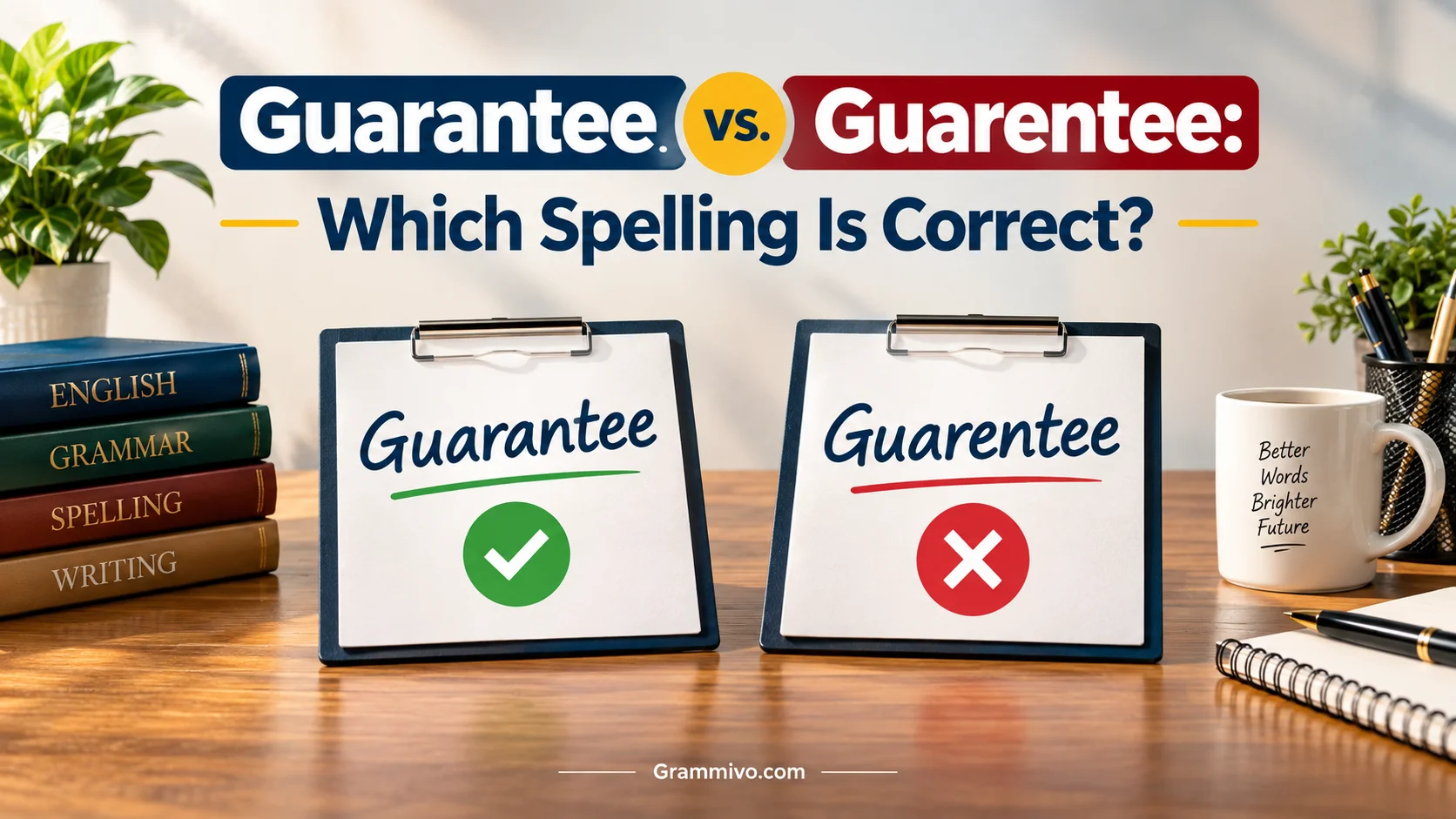
If you’ve ever hesitated between guarantee vs. guarentee, you’re not alone. This word catches people off guard because its pronunciation doesn’t make the spelling especially obvious. You may know exactly what you want to say, yet your fingers still type guarentee instead of guarantee. Here’s the good news: there’s a clear answer.
The word guarantee can function as both a noun and a verb. It can describe a promise that something will happen, an assurance about quality or performance, or a commitment to take responsibility for something. You’ll see it in everyday conversations, advertising, contracts, business writing, and legal contexts.
The confusion becomes easier to understand once you look at the word closely. The correct spelling contains “guarantee”, ending with -tee, not -tee after an extra “e” in the middle as in guarentee.
Quick Answer:
Guarantee is the correct spelling in standard English. Guarentee is an incorrect spelling.
| Spelling | Correct? | Meaning |
| Guarantee | Yes | A promise, assurance, or commitment |
| Guarentee | No | A misspelling of guarantee |
| Guaranty | Yes | A real word with a related but more specialized meaning |
For example:
- Correct: The store offers a money-back guarantee.
- Incorrect: The store offers a money-back guarentee.
- Correct: I guarantee that you’ll enjoy the experience.
- Incorrect: I guarentee that you’ll enjoy the experience.
The easiest rule to remember is simple:
Guarantee is correct. Guarentee is not.
Why Is “Guarantee” the Correct Spelling?
The spelling guarantee contains these letters:
G-U-A-R-A-N-T-E-E
The tricky part is the middle of the word. When people hear guarantee, they may mentally reconstruct the spelling as guarentee. That version feels plausible because English pronunciation often doesn’t provide a perfect roadmap for spelling.
However, standard English uses guarantee.
One useful way to break it apart is:
guar + an + tee
That isn’t necessarily a formal linguistic syllable division. It’s simply a visual memory aid. Seeing the word as a sequence of recognizable chunks can make it easier to reproduce correctly.
The final -ee matters too. The word ends in tee, giving the written form:
guarantee
not:
guarentee
When in doubt, type the word slowly. The correct sequence is g-u-a-r-a-n-t-e-e.
What Does “Guarantee” Mean?
Guarantee generally refers to a promise or assurance that something will happen, remain true, work properly, or be provided.
Its exact meaning depends on context.
For example, if a company guarantees a product, it may promise to repair, replace, refund, or otherwise address a problem under stated conditions.
If someone says, “I guarantee it,” the person is expressing strong confidence that something is true or will happen.
The word can therefore cover both everyday promises and formal commitments.
Guarantee as an Assurance
A guarantee can simply mean an assurance.
Consider this sentence:
“I guarantee that you’ll receive an answer by Friday.”
The speaker makes a firm commitment. They’re not merely saying that Friday seems likely. They’re presenting the outcome as something they promise.
Other examples include:
- I guarantee you’ll remember this recipe.
- She guaranteed that the package would arrive today.
- The manager guaranteed excellent service.
- Nothing can guarantee success.
- The company guarantees customer satisfaction.
The strength of the word makes it useful when ordinary expressions such as probably or hopefully aren’t strong enough.
Guarantee in Business
Businesses frequently use guarantee when describing products and services.
You might encounter phrases such as:
- money-back guarantee
- satisfaction guarantee
- lifetime guarantee
- quality guarantee
- performance guarantee
- service guarantee
- price guarantee
These phrases can reassure customers by reducing uncertainty.
For example, a money-back guarantee usually means a seller promises to return a customer’s money if specified conditions are met. The exact terms can vary, so the phrase itself doesn’t automatically tell you what the refund policy covers.
That distinction matters.
A guarantee in advertising isn’t necessarily an unlimited promise. Always check the actual terms when money, contracts, or warranties are involved.
Is “Guarentee” a Word?
No. Guarentee is not the standard spelling of the English word guarantee.
People commonly produce this spelling because they hear the word and spell it according to how they think it sounds. That’s especially easy to do with English words whose pronunciation doesn’t map neatly onto their written forms.
You might see guarentee in:
- informal messages
- social media posts
- comments
- search queries
- user-generated websites
- spelling mistakes in business documents
Its appearance in those places doesn’t make it an accepted spelling.
For formal writing, academic work, professional communication, websites, resumes, contracts, and published material, use guarantee.
Incorrect and Correct Examples
| Incorrect | Correct |
| I guarentee you’ll love it. | I guarantee you’ll love it. |
| This comes with a guarentee. | This comes with a guarantee. |
| We guarentee fast delivery. | We guarantee fast delivery. |
| The company offers a guarentee. | The company offers a guarantee. |
| Nothing is guarenteed. | Nothing is guaranteed. |
Notice that the mistake can continue into related forms. Once you learn guarantee, it’s worth learning its other forms as well.
Guarantee as a Noun
Guarantee works as a noun when it refers to a promise, assurance, or commitment.
For example:
The product comes with a two-year guarantee.
Here, guarantee names the assurance offered by the seller.
You can also use the word in phrases such as:
- a guarantee of quality
- a guarantee of safety
- a money-back guarantee
- a written guarantee
- a lifetime guarantee
- a personal guarantee
- no guarantee
- under guarantee
Consider these examples:
- The manufacturer provides a five-year guarantee.
- There’s no guarantee that the plan will succeed.
- The restaurant offers a satisfaction guarantee.
- Her promise isn’t a guarantee of future results.
- The agreement includes a written guarantee.
The noun can describe something informal or highly formal. Context determines how serious the commitment is.
Guarantee as a Verb
Guarantee also works as a verb.
As a verb, it means to promise or assure that something will happen, exist, work, or be true.
For example:
The company guarantees its products.
Here, guarantees describes the company’s action. The company makes a promise concerning its products.
Common structures include:
guarantee + noun
- The company guarantees its work.
- They guarantee the quality of every product.
guarantee + that-clause
- I guarantee that you’ll notice the difference.
- She guaranteed that the work would be completed.
guarantee + person + something
- The contract guarantees customers a refund under certain conditions.
- The agreement guarantees employees certain benefits.
be guaranteed to + verb
- This method is guaranteed to save time.
- The result isn’t guaranteed to last.
Cambridge Dictionary identifies guarantee as both a noun and verb, with the verb carrying the sense of promising or assuring that something will happen or exist.
Read More: Equipment vs. Equiptment: Which Spelling Is Correct?
Guarantee, Guaranteed, Guarantees, and Guaranteeing
Learning the base spelling becomes much easier when you understand its related forms.
| Form | Use | Example |
| guarantee | Base form | We guarantee our work. |
| guarantees | Third-person singular | The company guarantees quality. |
| guaranteed | Past tense/past participle | The refund is guaranteed. |
| guaranteeing | Present participle | They’re guaranteeing delivery. |
| guarantees | Plural noun | The contract includes several guarantees. |
The spelling can look intimidating when suffixes enter the picture. Yet the basic structure remains recognizable.
For instance:
guarantee → guaranteed
guarantee → guaranteeing
The final e behaves differently when certain endings are added. That’s a normal English spelling pattern rather than a reason to change the base word.
How to Spell “Guaranteed”
The correct spelling is:
G-U-A-R-A-N-T-E-E-D
Example:
Your payment is guaranteed.
Not:
Your payment is guarenteed.
The incorrect version usually comes from carrying the same spelling mistake from guarentee into the past-tense form.
How to Spell “Guaranteeing”
The correct spelling is:
G-U-A-R-A-N-T-E-E-I-N-G
Example:
The company is guaranteeing delivery within five business days.
This form can look unusual because English spelling rules remove the final silent e from many words before adding -ing. However, guarantee already ends in -ee, so the resulting form is guaranteeing.
Guarantee vs. Guaranty
This is where things get more interesting.
Guaranty is a real English word. It’s not simply another incorrect spelling of guarantee.
The two words share related meanings, but guaranty tends to appear in more specialized legal and financial contexts.
A simplified comparison looks like this:
| Word | Typical use | Example |
| Guarantee | Common everyday and business English | The product has a money-back guarantee. |
| Guaranty | Specialized legal or financial contexts | The agreement included a guaranty of the debt. |
In modern everyday American English, guarantee is far more common.
That means you shouldn’t replace guarantee with guaranty simply because you want a different spelling.
For example:
- Natural: The company offers a satisfaction guarantee.
- Unnecessarily unusual: The company offers a satisfaction guaranty.
However, legal and financial documents may use guaranty deliberately because the term can carry a more specific meaning.
Guarantee vs. Warranty
Another common source of confusion is guarantee vs. warranty.
The two words overlap, especially when companies discuss products. They aren’t always interchangeable, though.
A guarantee generally communicates a promise or assurance.
A warranty usually refers to a more specific promise concerning the condition, quality, or performance of a product or service, often within defined terms and a particular period.
For example:
The manufacturer offers a three-year warranty on the refrigerator.
That’s a specific product-related commitment.
Meanwhile:
The store offers a 30-day money-back guarantee.
That’s an assurance concerning the customer’s purchase and refund rights.
The distinction can become important when you’re reading a contract or buying an expensive product. Don’t assume that every guarantee and warranty provides identical protection.
Guarantee Pronunciation
The pronunciation of guarantee helps explain why people sometimes misspell it.
In American English, the word is commonly pronounced roughly like:
GAR-un-TEE
The exact pronunciation can vary somewhat by speaker and region.
The important point is that the spoken form doesn’t necessarily reveal the written sequence -antee.
That’s a classic English spelling trap. English contains many words whose pronunciation doesn’t make their spelling obvious. When people write from sound alone, errors can creep in.
That’s why someone can confidently know the meaning of guarantee while still writing guarentee.
The solution isn’t to rely on pronunciation. Learn the visual pattern:
guarantee
Once that spelling becomes familiar, the pronunciation issue largely stops mattering.
How to Remember the Spelling of Guarantee
The simplest memory trick is to focus on the ending.
Guarantee ends with “-tee.”
Think:
guaran + tee = guarantee
Another useful method is to connect the spelling with a familiar phrase:
money-back guarantee
You’ve probably seen this phrase countless times. If guarantee appears in your memory as part of money-back guarantee, you’ll be less likely to insert the extra e that creates guarentee.
You can also use a visual comparison:
GUARANTEE
GUARENTEE
The second version may look close, but the internal letters are wrong.
When you’re unsure, don’t guess based on sound. Type guarantee slowly:
G → U → A → R → A → N → T → E → E
That gives you the complete spelling.
Common Misspellings of Guarantee
The most common problem is guarentee, but it’s not the only spelling error people may produce.
| Common error | Correct form |
| guarentee | guarantee |
| garantee | guarantee |
| guarente | guarantee |
| guarenteed | guaranteed |
| guarenteeing | guaranteeing |
These errors generally come from trying to spell the word phonetically.
There’s an important exception worth remembering:
Guaranty is not a spelling mistake.
It’s a legitimate word. The issue is that it has a more specialized use and shouldn’t automatically replace guarantee.
Common Uses of Guarantee in Everyday English
You encounter guarantee in more situations than you might realize.
Shopping
Retailers commonly use the word when describing return or refund promises.
Examples include:
- money-back guarantee
- satisfaction guarantee
- price guarantee
- quality guarantee
Example:
The store offers a 30-day money-back guarantee.
Business
Businesses use guarantee when making commitments about services, results, or performance.
We guarantee same-day processing for qualifying orders.
Personal Conversations
The word also works perfectly well in casual speech.
I guarantee you’ll laugh at that movie.
Here, the speaker isn’t necessarily making a legally enforceable promise. They’re expressing strong confidence.
Contracts and Agreements
In formal contexts, guarantee can describe a serious commitment.
The agreement includes a personal guarantee.
Because legal meaning depends heavily on wording and jurisdiction, readers shouldn’t assume that a casual guarantee has the same legal effect as a contractual guarantee.
FAQs:
Is “guarantee” the correct spelling?
Yes. Guarantee is the standard spelling.
Is “guarentee” correct?
No. Guarentee is a misspelling of guarantee.
How do you spell guarantee?
The correct spelling is:
G-U-A-R-A-N-T-E-E
What does guarantee mean?
Guarantee means a promise, assurance, or commitment that something will happen, remain true, work properly, or be provided.
Is guarantee a noun or a verb?
Guarantee is both a noun and a verb.
As a noun:
The product comes with a guarantee.
As a verb:
The company guarantees its products.
Conclusion:
The word can serve as both a noun and a verb, which explains why you’ll see it in phrases such as money-back guarantee, guarantee quality, guaranteed results, and guaranteeing delivery. One related word deserves special attention: guaranty. Unlike guarentee, it isn’t a mistake. It’s a real word that appears mainly in specialized legal and financial contexts.
