
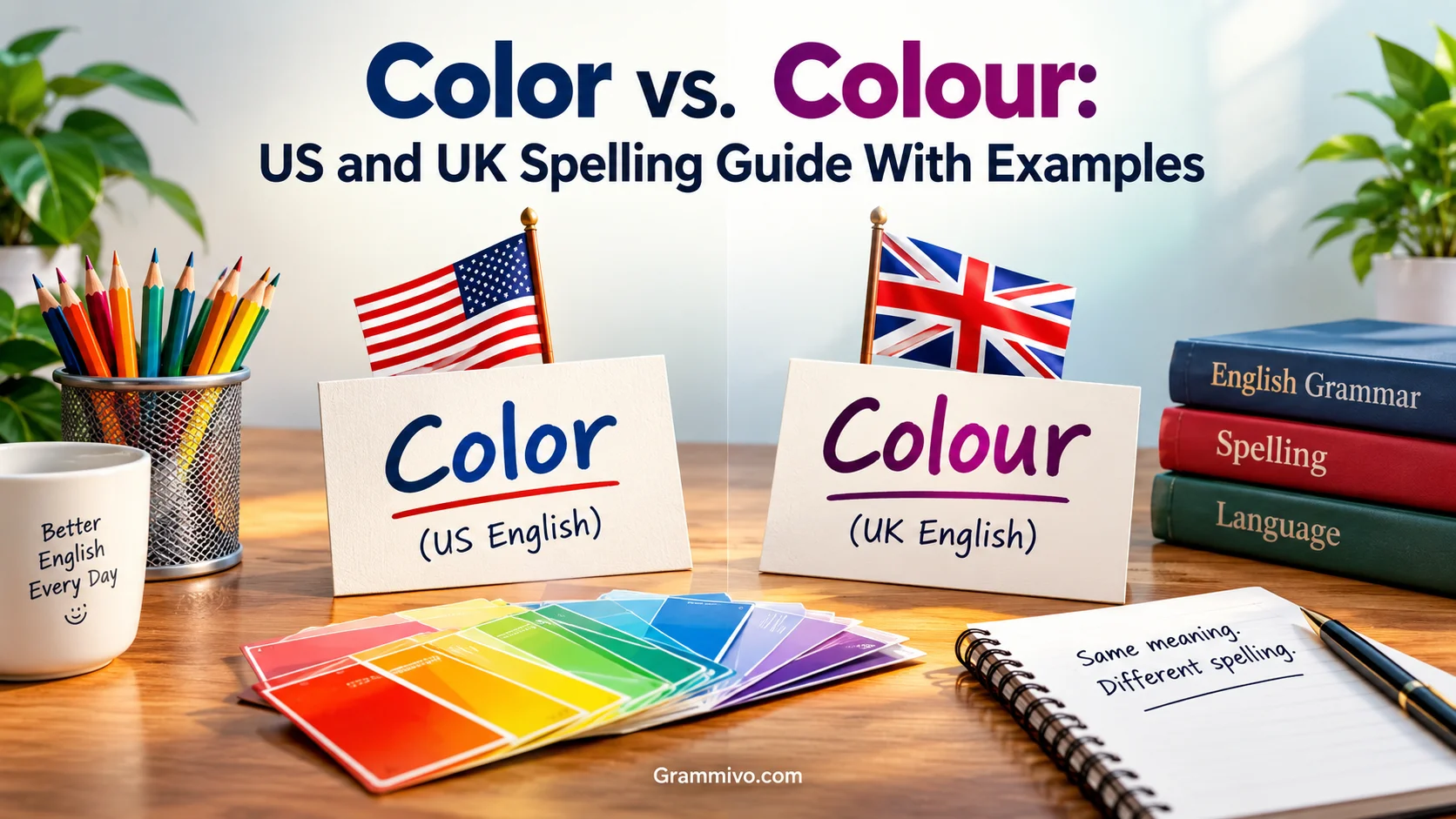
Color vs. colour is a classic example of how English spelling changes across regions. If you write for an American audience, you’ll usually see color. If you write for a British audience, colour is the standard form.
The interesting part is that neither spelling is wrong. They represent different spelling conventions within the English language. The meaning, pronunciation, and grammatical role remain the same.
You might notice the difference in books, websites, school assignments, newspapers, software, product descriptions, and everyday conversations. For example, an American writer may ask, “What is your favorite color?” A British writer would normally write, “What is your favorite colour?”
Quick Answer
Color is the standard spelling in American English, while colour is the standard spelling in British English. Both words have the same meaning and are pronounced the same way in ordinary English.
| Spelling | English variety | Example |
| Color | American English | What is your favorite color? |
| Colour | British English | What is your favorite colour? |
If you’re writing for readers in the United States, choose color. If you’re following British English conventions, choose colour.
Neither form is universally superior. The correct choice depends on the variety of English you’re using.
Comparison Overview
The difference between color and colour is mainly a spelling difference. Both forms refer to the visual quality that objects have because of the way they reflect, emit, or absorb light.
| Feature | Color | Colour |
| Standard variety | American English | British English |
| Meaning | Same | Same |
| Pronunciation | Same | Same |
| Number of letters | 5 | 6 |
| Extra letter | None | U |
| Common adjective | Colorful | Colourful |
| Common negative adjective | Colorless | Colourless |
| Common use | US writing | UK writing |
The distinction becomes especially important when you’re writing for a specific country. A US newspaper, school, or business would normally use color. A British publication or organization would generally use colour.
Canada, Australia, and New Zealand generally favor colour as well. However, their spelling systems contain other conventions that don’t always match British English word for word.
Main Differences Between Color vs. Colour
The main difference between color vs. colour is the letter u. American English removes the u, while British English retains it.
Color in American English
Color is the standard American spelling.
Here are a few natural examples:
- The walls are painted a light blue color.
- Red is my favorite color.
- Which color would you choose?
- The artist used several bright colors.
- The sunset added color to the sky.
American English uses the same shorter pattern in many related words. For instance, Americans generally write colorful, colorless, and discoloration.
Colour in British English
Colour is the standard British spelling.
Examples include:
- The walls are painted a light blue colour.
- Red is my favorite colour.
- Which colour would you choose?
- The artist used several bright colours.
- The sunset added colour to the sky.
British English retains the u in related forms such as colourful, colourless, and discolouration.
The Meaning Doesn’t Change
Despite the spelling difference, color and colour mean the same thing.
The word can describe a particular visual hue:
The dress was a deep purple color.
It can also describe visual variety or attractiveness:
The flowers brought color to the garden.
The word has figurative uses too:
Her stories added color to the history lesson.
In that sentence, color doesn’t refer literally to red, blue, green, or another hue. It means vivid detail or interest.
British English simply changes the spelling:
Her stories added colour to the history lesson.
The underlying meaning remains unchanged.
What Does Color or Colour Mean?
At its most basic level, color/colour describes how humans perceive different wavelengths of visible light.
When light reaches an object, the object’s physical properties determine which wavelengths it absorbs and which it reflects. Your eyes detect the reflected light. Your brain then interprets that information as a perceived color.
Common color terms include:
- Red
- Orange
- Yellow
- Green
- Blue
- Purple
- Pink
- Brown
- Black
- White
- Gray or grey
The word also has several broader meanings.
Color as a Visual Property
This is the most common meaning.
Example:
The color of the ocean looked unusually dark.
Here, the word identifies the visual appearance of the ocean.
Color as Variety or Vividness
Color can also describe something that makes a scene more lively or interesting.
Example:
The market was full of color and movement.
The sentence doesn’t simply describe paint or light. It suggests energy, variety, and visual richness.
Color in Figurative Language
The word appears in several familiar expressions.
For example:
- Show your true colors — reveal your real character or intentions.
- Add color to a story — make a story more vivid or interesting.
- Local color — distinctive features of a particular place or culture.
- Lose color — become pale or less vibrant.
These expressions work with either spelling. Only the regional form changes.
Why Does American English Spell It “Color”?
The story behind color vs. colour reaches back through several stages of English and French influence.
English borrowed many words from French following the Norman Conquest of England in 1066. French spelling patterns influenced English vocabulary for centuries. Words associated with the Latin root color developed forms such as colour in English.
The -our ending eventually became common in British English.
American English later developed its own spelling preferences. One major figure in this process was Noah Webster, an American lexicographer and spelling reformer.
Webster promoted simpler and more distinctive American spellings. His dictionaries helped establish forms that differed from traditional British conventions.
This included several words ending in -our in British English.
| British English | American English |
| colour | color |
| honour | honor |
| favour | favor |
| labour | labor |
| neighbour | neighbor |
| behaviour | behavior |
| humour | humor |
| rumour | rumor |
| odour | odor |
It would be misleading to say that Webster personally invented every American spelling. English spelling was already changing in North America. However, his dictionaries played a major role in documenting and promoting American conventions.
The result is the spelling contrast you see today.
Where Is “Color” Used?
Color is most strongly associated with American English.
You’ll encounter it throughout US writing, including:
- Newspapers
- Books
- School assignments
- Business documents
- Government publications
- Advertising
- Websites
- Product descriptions
- Technical documentation
- Software interfaces
Consider an American product description:
Choose your preferred color before adding the item to your cart.
A British retailer would typically write:
Choose your preferred colour before adding the item to your cart.
Neither sentence is grammatically better. Each one follows a different regional convention.
Color in American Academic Writing
If you’re studying at a US school or university, color will normally fit the expected spelling system.
For example:
The researcher examined how color influences visual perception.
Using colour in an otherwise American English paper wouldn’t necessarily make the sentence incomprehensible. It would create a regional spelling inconsistency.
That distinction matters more in formal writing than in casual conversation.
Where Is “Colour” Used?
Colour is the traditional spelling in British English.
You’ll commonly find it in writing from the United Kingdom, including:
- British newspapers
- UK educational materials
- British books
- Government documents
- Professional publications
- UK business websites
- British product packaging
For example:
The designer selected a warm colour palette.
In American English, the equivalent would be:
The designer selected a warm color palette.
The pronunciation remains the same.
Color vs. Colour in Other English-Speaking Countries
English doesn’t divide neatly into only American and British varieties. Other countries have developed their own spelling standards.
| Country or variety | Common form |
| United States | color |
| United Kingdom | colour |
| Canada | colour generally |
| Australia | colour |
| New Zealand | colour |
| Ireland | colour |
Canadian English deserves special attention. It often follows British spelling for words such as colour, while also using some American conventions in other areas.
That means you shouldn’t assume that every Canadian spelling will match either British or American English perfectly.
Regional spelling is a system rather than a collection of isolated words.
Color vs. Colour Examples in Sentences
Seeing the two forms side by side makes the distinction much easier.
| American English | British English |
| What is your favorite color? | What is your favorite colour? |
| The color of the car is unusual. | The colour of the car is unusual. |
| She wore a bright color. | She wore a bright colour. |
| The painting uses warm colors. | The painting uses warm colours. |
| This shirt comes in several colors. | This shirt comes in several colours. |
Everyday Example
US:
I love the color of your new jacket.
UK:
I love the colour of your new jacket.
School Example
US:
The students used different colors to label the map.
UK:
The students used different colours to label the map.
Professional Example
US:
The company changed its brand colors.
UK:
The company changed its brand colours.
Descriptive Example
US:
The autumn landscape was full of color.
UK:
The autumn landscape was full of colour.
Notice the pattern. The sentence structure doesn’t need to change. Usually, only the spelling does.
Read More: Possession vs. Posession: Which Spelling Is Correct?
Color vs. Colour in Related Words
The difference doesn’t stop with the basic noun. Several related words also preserve the regional spelling.
| American English | British English |
| color | colour |
| colorful | colourful |
| colorless | colourless |
| coloration | colouration |
| discolor | discolour |
| discoloration | discolouration |
| multicolor | multicolour |
Some derivatives deserve extra care because English spelling doesn’t always behave like a simple mathematical formula.
For example, coloration and colouration follow the regional pattern. However, specialized terminology can vary by discipline or dictionary.
Colorful vs. Colourful
This is one of the most common related-word differences.
American English:
The festival was colorful and energetic.
British English:
The festival was colourful and energetic.
The suffix -ful doesn’t create a new pronunciation difference. The spelling simply preserves the regional form of the root word.
Colorless vs. Colourless
The same pattern appears with colorless and colourless.
American English:
The liquid was colorless.
British English:
The liquid was colourless.
Both mean that the liquid lacks visible color.
Common Expressions With Color and Colour
The word appears in many fixed phrases. These expressions can be useful when you’re learning the difference.
True Colors or True Colours
This phrase means someone’s genuine character or intentions.
US:
The experience showed his true colors.
UK:
The experience showed his true colours.
Add Color or Add Colour
This means to make something more vivid, interesting, or lively.
US:
The anecdotes added color to the presentation.
UK:
The anecdotes added colour to the presentation.
Local Color or Local Colour
Local color refers to distinctive characteristics associated with a particular place or community.
Example:
The novel captures the local color of the coastal town.
In British spelling:
The novel captures the local colour of the coastal town.
Color vs. Colour in Technology
Technology creates an interesting exception to ordinary spelling expectations.
A British developer may write an article using colour. Yet certain technical terms still use color because the spelling forms part of the technical syntax.
For example, web development uses the CSS property color.
A British developer doesn’t change the property to colour. Technical languages have their own fixed vocabulary.
This distinction matters because natural-language spelling and programming syntax aren’t the same thing.
The same principle applies to software commands, programming functions, database fields, file formats, and standardized terminology.
If a technical specification says color, changing it to colour could make the term invalid.
Color vs. Colour and Gray vs. Grey
The color/colour distinction often appears alongside another famous regional spelling difference: gray vs. grey.
American English generally prefers:
- color
- gray
British English generally prefers:
- colour
- grey
For example:
US:
The gray color of the building looked dull.
UK:
The grey colour of the building looked dull.
This combination isn’t absolute in every context. However, it provides a useful illustration of broader regional spelling patterns.
FAQs:
Is “color” or “colour” correct?
Both are correct. Color is standard American English while colour is standard British English and is also common in several other English varieties.
Is “color” American or British?
Color is the standard American English spelling.
Is “colour” British or American?
Colour is the standard British English spelling. It is also widely used in countries such as Australia, New Zealand, and Canada.
Do color and colour mean the same thing?
Yes. They normally have exactly the same meaning. The primary difference is regional spelling.
Are color and colour pronounced differently?
Usually, no. The two spellings generally have the same pronunciation in standard English.
Conclusion:
The color vs. colour debate isn’t really about right versus wrong. It’s about which variety of English you’re using. Choose color when you’re writing in American English. Choose colour when you’re following British English conventions.
The same distinction extends to related words such as colorful/colourful, colorless/colourless, and discolor/discolour. Once you understand the pattern, these differences become much easier to recognize.
