
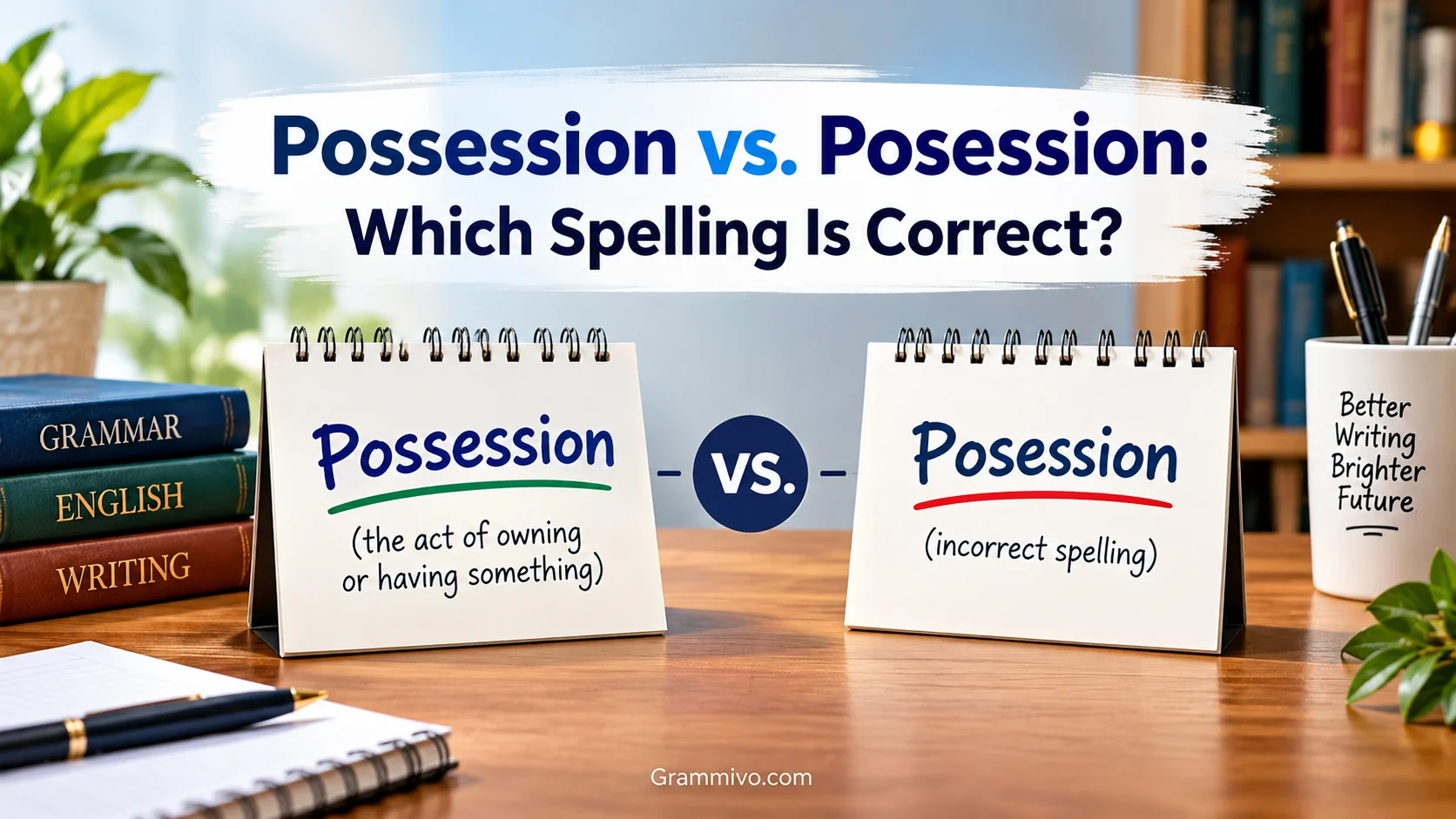
Have you ever typed “posession” and wondered whether you had spelled it correctly? You’re not alone. This is a common English spelling mistake because the pronunciation of possession doesn’t clearly reveal all the letters needed to write it.
The confusion usually centers on the repeated s sounds and letters. When you say the word aloud, you hear something close to “puh-ZESH-un.” The written form, however, contains two separate ss sequences.
The correct spelling is possession. The spelling posession is incorrect in standard English.
This distinction matters because possession appears in everyday conversations, legal writing, sports commentary, academic writing, and many other contexts. You might talk about your personal possessions, someone being in possession of an object, or a soccer team maintaining possession of the ball.
Understanding the spelling becomes much easier once you connect possession with the verb possess. That relationship provides a useful clue that can help you avoid the common misspelling.
Quick Answer
Possession is the correct spelling. Posession is incorrect.
The correct word contains two sets of double s:
P-O-S-S-E-S-S-I-O-N
The incorrect version removes one s:
P-O-S-E-S-S-I-O-N
| Word | Correct Spelling? | Meaning |
| Possession | Yes | Something owned, held, or controlled |
| Posession | No | Incorrect spelling of possession |
For example:
She packed all her possessions before moving to her new apartment.
You should always use possession in standard English writing.
Comparison Overview
The main difference between possession and posession isn’t a difference in meaning. There is only one standard English word: possession.
| Feature | Possession | Posession |
| Standard English word | Yes | No |
| Correct spelling | ||
| Pronunciation | /pəˈzɛʃən/ | Not a standard alternative |
| Word type | Noun | Misspelling |
| Related verb | Possess | — |
| Plural | Possessions | Posessions |
| Common use | Property, control, sports, legal contexts | Spelling error |
The easiest way to remember the correct form is to look at possess.
Possess → possession
The double s in possess provides an important spelling clue for the noun possession.
Main Differences Between Possession vs. Posession
The biggest difference is simple: possession is correct while posession is a misspelling.
Possession Is the Correct Spelling
Possession is a standard English noun. It can describe something that someone owns, something someone physically holds, or control over something.
For example:
- Her necklace is a valuable possession.
- The documents are currently in his possession.
- The team regained possession of the ball.
- The buyer took possession of the property.
The word works in many settings because its meaning extends beyond simple ownership.
Posession Is Incorrect
Posession isn’t an accepted spelling of the noun in standard English.
The problem is easy to spot when the words appear side by side:
Correct: possession
Incorrect: posession
The incorrect version drops one of the s letters found in the correct spelling.
Why People Spell It “Posession”
The mistake makes sense from a pronunciation standpoint. English spelling often doesn’t provide a perfect map of how a word sounds.
When people pronounce possession, they don’t clearly hear every individual s. The middle of the word sounds roughly like “ZESH.” That can make the written sequence difficult to reconstruct.
Another reason involves the related word possess. Some writers remember the base word but don’t carry its spelling accurately into the noun.
The solution is to treat possess and possession as a word family.
What Does Possession Mean?
The noun possession has several closely related meanings. In general, it involves having, holding, owning, or controlling something.
The exact meaning depends on the context.
Possession as Something You Own
One common meaning refers to something that belongs to you.
A possession can be almost anything that you own or keep.
For example:
- A laptop can be a personal possession.
- A wedding ring can be a treasured possession.
- A collection of books can be someone’s possessions.
- A family photograph can be a valuable possession even if it has little financial worth.
This meaning often appears in the plural form possessions.
Her most important possessions were the photographs she inherited from her grandmother.
Notice that a possession doesn’t have to be expensive. Sentimental value can make an ordinary object extremely important to someone.
Possession as Physical Control
Possession can also mean having something physically with you or under your control.
For example:
The keys are currently in my possession.
This sentence doesn’t necessarily mean that the speaker legally owns the keys. It simply says that the speaker has them.
That distinction becomes important in legal and everyday situations.
Possession in Legal Contexts
Legal writing often uses possession to describe control or custody of property.
However, possession doesn’t always mean ownership.
Someone can possess something without being its owner. A person renting a house, for example, may have possession of the property while the landlord retains ownership.
Similarly, someone might temporarily hold another person’s laptop without becoming its owner.
This is why legal discussions often distinguish between possession, ownership, custody, and control.
Possession in Sports
Sports provide another familiar use.
In soccer, basketball, hockey, and other sports, possession can describe which team controls the ball or puck.
For example:
The team dominated possession throughout the second half.
Here, possession has nothing to do with owning the ball permanently. It refers to control during play.
In soccer statistics, possession is commonly expressed as a percentage. If one team has 60% possession and another has 40%, the figures describe the share of playing time during which each team controlled the ball according to the match’s statistical method.
Possession in Religious and Cultural Contexts
The word also appears in phrases such as spirit possession and demonic possession.
In this context, possession refers to the belief or cultural concept that a supernatural entity controls or inhabits a person.
This meaning differs sharply from possession as personal property, yet the same noun connects both ideas through the concept of control.
Why Is Possession the Correct Spelling?
The spelling possession becomes easier to remember when you look at its related forms.
The most useful connection is:
possess → possession
The verb possess means to have, own, or hold something. The noun possession describes the state of possessing something or something that is possessed.
Breaking Down the Spelling
The full spelling is:
P-O-S-S-E-S-S-I-O-N
A useful visual breakdown is:
PO + SS + E + SS + ION
The important point is that the word contains two pairs of consecutive s letters.
Compare the forms:
- possess
- possession
- possessions
That repeated ss pattern helps explain why posession is missing an important letter.
The Connection With Possess
Consider these examples:
They possess several valuable paintings.
The paintings are among their most valuable possessions.
The noun grows from the same word family as the verb. Remembering possess can therefore act as a spelling anchor.
If you write posession, ask yourself:
“How do I spell possess?”
Once you remember possess, the correct form possession becomes much easier to reproduce.
Why Is Posession Incorrect?
Posession is incorrect because it leaves out one of the s letters required in possession.
The difference may look small, but spelling accuracy matters in professional and academic writing.
Compare:
The police found several items in his posession.
The police found several items in his possession.
The second sentence uses the standard spelling.
The Missing Letter
The error can be understood visually:
posession
possession
The correct version contains an additional s after the initial po.
That extra letter isn’t optional. It forms part of the established spelling of the word.
How to Pronounce Possession
In US English, possession is commonly pronounced:
puh-ZESH-uhn
Its IPA pronunciation is:
/pəˈzɛʃən/
The stress falls on the middle syllable.
Pronunciation Breakdown
You can think of the word as roughly:
puh + ZESH + uhn
The pronunciation explains why spelling the word can be tricky. The two ss sequences don’t produce two clearly separate “s” sounds.
In fact, the middle sound is closer to the “zh” sound heard in words such as measure.
This is a good example of why pronunciation alone isn’t always enough to determine English spelling.
Possession as a Noun
Possession functions primarily as a noun.
It can describe:
- Something that someone owns
- The state of having something
- Physical control of an object
- Legal control or custody
- Control of a ball or playing object in sports
- A supernatural or cultural state of being controlled by an entity
The meaning changes with context, but the spelling remains the same.
Related Forms of Possession
| Word | Part of Speech | Meaning |
| Possess | Verb | To have, own, or control |
| Possession | Noun | Something possessed or the state of possessing |
| Possessions | Plural noun | Multiple things owned or held |
| Possessed | Verb/adjective form | Had, owned, controlled, or affected |
| Possessing | Present participle | Having or owning |
Understanding this word family can help you recognize the correct spelling in different grammatical situations.
Possession vs. Ownership: What’s the Difference?
Although possession and ownership are closely related, they aren’t identical.
Ownership generally concerns the right to own something. Possession can refer to physical control, custody, or simply having something.
Consider a rented apartment.
A tenant may have possession of the apartment because they live there and control its everyday use. However, the landlord may retain ownership of the property.
The same distinction works with borrowed objects.
If a friend lends you a camera, the camera may be in your possession even though your friend remains its owner.
| Term | Main Idea | Example |
| Possession | Having or controlling something | The keys are in her possession. |
| Ownership | Having recognized rights over something | She owns the car. |
| Custody | Having care or control of something | The museum has custody of the artifact. |
This distinction becomes especially important in legal, financial, and property-related writing.
Read More: Hierarchy vs. Heirarchy: Which Spelling Is Correct?
Possession in Grammar: Possessive Forms
The word possession is closely related to possessive, but the two terms have different grammatical functions.
A possessive form shows a relationship of possession or association.
For example:
- Sarah’s phone
- the dog’s collar
- James’s notebook
- the students’ classroom
The apostrophe helps indicate the relationship between the noun and what follows.
Possession vs. Possessive
These words shouldn’t be used interchangeably.
Possession is a noun:
The watch was one of his prized possessions.
Possessive can function as an adjective or noun in grammar:
The possessive form of “Sarah” is “Sarah’s.”
The distinction is straightforward once you focus on what each word does.
Common Phrases With Possession
You’ll encounter possession in several established phrases.
Take Possession Of
Take possession of means to begin having control or custody of something.
The buyer took possession of the house after the closing.
In Possession Of
In possession of means having something in your control or custody.
The traveler was found in possession of several documents.
Come Into Possession Of
This phrase describes acquiring something or receiving it into your control.
The museum came into possession of the letter through a private donation.
Personal Possessions
This phrase refers to things belonging to an individual.
Passengers should keep their personal possessions with them.
Valuable Possessions
This usually refers to objects that have significant financial or emotional value.
She kept her most valuable possessions in a secure place.
Possession of the Ball
This is common in sports.
The team maintained possession of the ball for several minutes.
These phrases show how frequently the word appears in everyday and professional English.
Possession vs. Posession in Example Sentences
Seeing the correct spelling in context makes it easier to remember.
Correct Examples
- His collection of rare books is his most treasured possession.
- The documents remained in her possession throughout the investigation.
- The soccer team quickly regained possession of the ball.
- The buyer took possession of the property last Friday.
- Please keep your personal possessions with you.
- The museum now has possession of several historic artifacts.
- The ring became one of her most meaningful possessions.
- Police officers discovered the item in his possession.
Incorrect Example
She packed all her posessions before leaving the apartment.
Corrected Example
She packed all her possessions before leaving the apartment.
The plural form is particularly useful because it reveals another common spelling error.
Possession → possessions
Not:
Posession → posessions
Possession vs. Posession: Common Spelling Mistakes
The same spelling pattern can cause several related errors.
Dropping One “S”
The most common mistake is:
posession
Correct:
possession
Misspelling the Plural
Some writers correctly identify the noun but make the same mistake when adding the plural ending.
posessions
possessions
The plural is formed by adding s to the correctly spelled noun:
possession + s = possessions
Confusing Possession With Possessive
These words are related but serve different purposes.
Possession refers to something owned, held, or controlled.
Possessive refers to a form that expresses possession or a tendency to claim ownership or control.
For example:
The book is her possession.
“Her” is a possessive determiner.
Relying Only on Pronunciation
Another trap is spelling the word exactly as it sounds.
English contains many words whose spelling isn’t obvious from pronunciation. Possession is one of them.
Learning its written pattern is more reliable than trying to reconstruct every letter from its sound.
FAQs:
Is “posession” a correct spelling?
No. Possession is the correct spelling in standard English. Posession is a misspelling.
How do you spell possession?
The correct spelling is:
P-O-S-S-E-S-S-I-O-N
A useful pattern to remember is PO + SS + E + SS + ION.
Why is possession spelled with two sets of “ss”?
The spelling is connected to the word possess and reflects the historical development of the English word. The modern standard spelling contains two separate ss sequences.
What is the plural of possession?
The plural is possessions.
Example:
She stored her possessions in several boxes.
Don’t write posessions.
Is possession the same as ownership?
Not always. Possession can mean having physical control or custody of something, while ownership generally refers to having recognized rights over it.
A tenant can possess a rented house without owning it.
Conclusion:
When it comes to Possession vs. Posession, only one spelling is correct: possession. The incorrect form posession leaves out an important s and should be avoided in both formal and everyday writing.
Whether you’re discussing personal belongings, legal control, property, or a team’s control of the ball, always use possession. Once you remember the two ss pairs, this commonly misspelled word becomes much easier to write correctly.
