
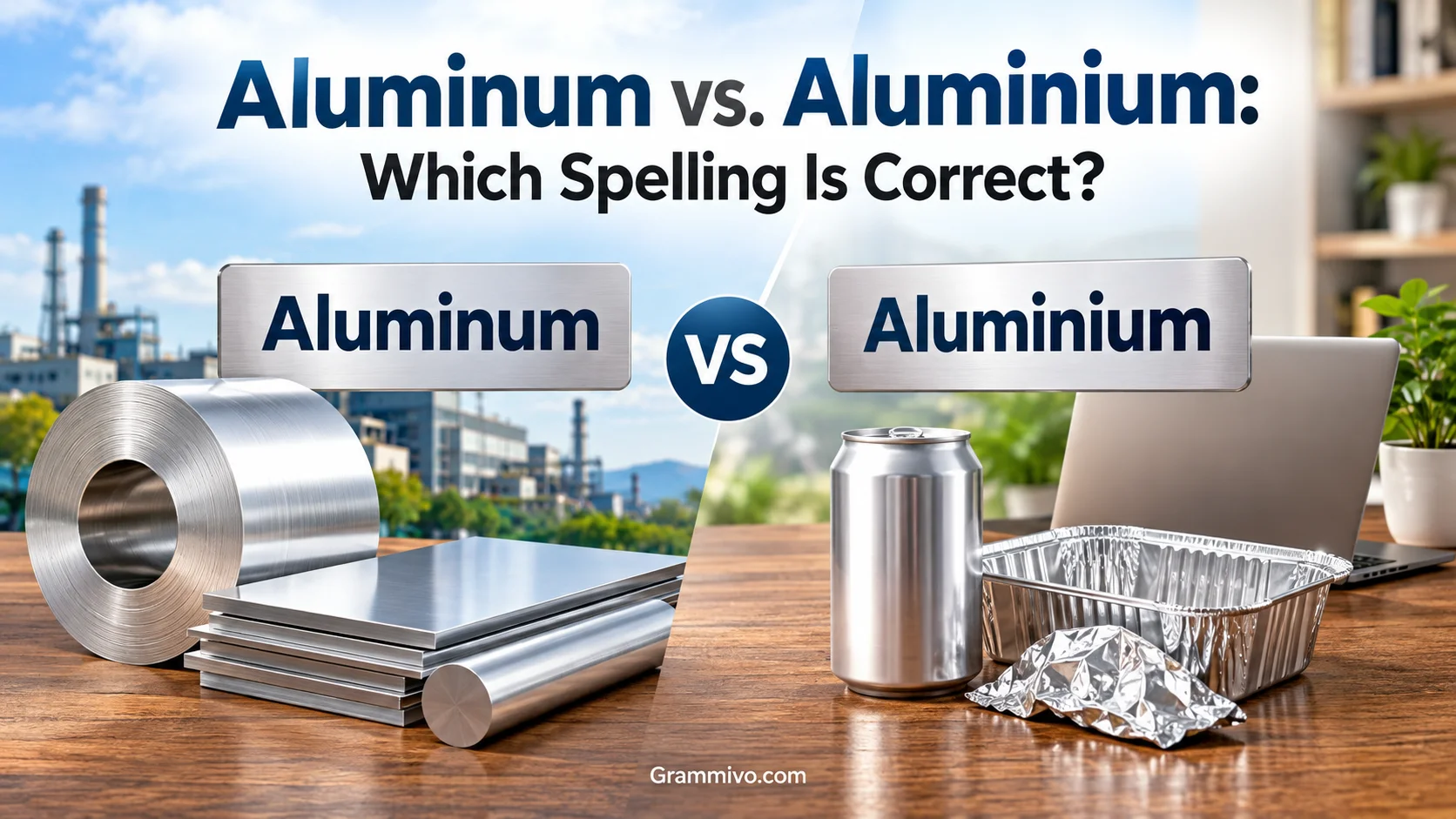
If you’ve ever read both aluminum and aluminium, you may have wondered whether they describe two different metals. They don’t. Both words name the same chemical element, with the symbol Al and atomic number 13.
The difference comes from regional English spelling. American English generally uses aluminum, while British English and several other varieties use aluminium. The difference may look small, but it reflects an interesting piece of language history that stretches back more than two centuries.
You’ll encounter these spellings everywhere. They appear on product descriptions, engineering documents, school assignments, scientific papers, packaging, and everyday conversations. A US manufacturer may advertise an aluminum frame, while a British company may sell an aluminium frame.
Neither spelling means a different grade, alloy, or chemical form. The metal remains the same.
So, which spelling should you use? The answer depends mainly on which variety of English you’re writing in and who will read your content.
Quick Answer
Aluminum is the standard spelling in American English.
Aluminium is the standard spelling in British English and is also widely used in countries such as Australia and New Zealand.
Both spellings refer to the same chemical element:
- Chemical symbol: Al
- Atomic number: 13
- Standard atomic weight: approximately 26.98
- Element name in American English: aluminum
- Element name in British English: aluminium
- Element category: post-transition metal
For example:
- US English: The aircraft contains lightweight aluminum components.
- British English: The aircraft contains lightweight aluminium components.
The spelling changes, but the material, chemical symbol, and meaning remain the same.
Comparison Overview
| Feature | Aluminum | Aluminium |
| Standard US spelling | Yes | No |
| Standard British spelling | No | Yes |
| Chemical symbol | Al | Al |
| Atomic number | 13 | 13 |
| Same element? | Yes | Yes |
| Pronunciation | Usually 4 syllables | Usually 5 syllables |
| Common in American writing | Very common | Uncommon |
| Common in British writing | Uncommon | Very common |
| Common in Australian English | Less common | Common |
| Common in New Zealand English | Less common | Common |
| Refers to a different metal? | No | No |
The easiest rule is simple: use aluminum for American English and aluminium for British English.
However, the story behind these two forms is more complicated than simply adding or removing one letter.
Main Differences Between Aluminum vs. Aluminium
The most obvious difference is spelling. Aluminum ends in -um, while aluminium ends in -ium.
That difference also affects pronunciation.
In American English, aluminum is generally pronounced with four syllables: uh-LOO-muh-num.
In British English, aluminium is generally pronounced with five syllables: al-yoo-MIN-ee-um.
Despite that difference, both names identify the same element.
Aluminum in American English
American English favors aluminum.
You’ll see this spelling in American newspapers, dictionaries, textbooks, product descriptions, engineering documents, and everyday speech.
For example:
The new building uses aluminum panels to reduce weight.
An American writer would normally choose aluminum, even in highly technical writing.
Aluminium in British English
British English favors aluminium.
The same sentence would normally appear as:
The new building uses aluminium panels to reduce weight.
This form is also widely used in Australian and New Zealand English.
The Difference Is Linguistic, Not Chemical
Here’s the key point: aluminum and aluminium aren’t two versions of the metal.
They don’t have different atomic structures. They don’t have different atomic numbers. They aren’t separate substances.
Both names refer to element 13.
If a scientist writes Al, there is no spelling issue at all. The chemical symbol remains the same regardless of the English variety being used.
Why Is It Called Aluminum in American English?
The history of the word begins with alum, a group of compounds that people had known and used long before anyone isolated metallic aluminum.
English chemist Sir Humphry Davy played an important role in the element’s naming history during the early 19th century. He initially proposed forms connected to alumium and later used aluminum.
The naming process wasn’t perfectly settled at first. Several forms appeared during the early history of the word.
American English eventually settled on aluminum.
That spelling became firmly established in American dictionaries, scientific writing, education, manufacturing, and general usage. Once a spelling becomes deeply rooted in a language community, changing it can be surprisingly difficult.
Language tends to favor familiarity.
That’s why Americans don’t generally feel that aluminum is missing anything. To a US reader, aluminum looks completely normal.
Why Is It Called Aluminium in British English?
British English eventually favored aluminium.
The -ium ending fit a broader pattern used for many element names, including words such as sodium, potassium, and magnesium.
As British scientific usage developed, aluminium became the established form.
The difference therefore reflects two paths of English usage rather than a disagreement about what the element actually is.
This is similar to other American and British spelling differences:
| American English | British English |
| Aluminum | Aluminium |
| Color | Colour |
| Center | Centre |
| Theater | Theatre |
| Organize | Organise |
| Traveling | Travelling |
The aluminum/aluminium distinction is particularly noticeable because the extra i also influences pronunciation.
Aluminum vs. Aluminium: Which Spelling Is Correct?
Both spellings are correct within their appropriate regional varieties of English.
The better question isn’t “Which spelling is universally correct?”
Instead, ask:
“Which English standard am I following?”
Is Aluminum Correct?
Yes.
Aluminum is the standard American English spelling.
Use it when writing for a primarily US audience, especially in:
- American school assignments
- US business documents
- American websites
- US product descriptions
- American newspapers
- US technical writing
- American marketing materials
Example:
The manufacturer produces aluminum cans for beverage companies.
Is Aluminium Correct?
Yes.
Aluminium is the standard British English spelling.
It is also widely used in several other English-speaking countries.
Example:
The manufacturer produces aluminium cans for beverage companies.
The meaning hasn’t changed. Only the regional spelling has.
Are Both Spellings Accepted?
Yes. Major English varieties have their own established conventions.
Problems usually arise when a writer mixes regional standards without a reason.
For instance, an article that consistently follows American English should normally use aluminum rather than switching between aluminum and aluminium.
Consistency makes writing look intentional and professional.
Aluminum vs. Aluminium Pronunciation
Spelling isn’t the only difference.
The words are commonly pronounced differently depending on the English variety.
How Americans Pronounce Aluminum
American English generally pronounces aluminum with four syllables.
A simplified pronunciation guide is:
uh-LOO-muh-num
The emphasis falls around the second syllable.
How British Speakers Pronounce Aluminium
British English generally pronounces aluminium with five syllables.
A simplified guide is:
al-yoo-MIN-ee-um
The additional -i- sound contributes to the extra syllable.
Why Does the Pronunciation Differ?
The pronunciation developed alongside the spelling conventions.
Once aluminum became established in American English, its pronunciation became part of ordinary American speech. British English retained the longer aluminium form.
Neither pronunciation changes the identity of the element.
Aluminum vs. Aluminium in American and British English
Regional usage becomes particularly important when you’re writing for a specific audience.
United States
Aluminum is overwhelmingly the expected form in standard American English.
A US reader would normally see:
The ladder is made from lightweight aluminum.
United Kingdom
Aluminium is the standard British form.
A British reader would normally see:
The ladder is made from lightweight aluminium.
Australia and New Zealand
Aluminium is commonly used in both Australian and New Zealand English.
These varieties generally follow the British spelling tradition for this word.
Canada
Canadian English can show variation because it sits between British and American English influences.
Aluminium is widely established in Canadian usage, particularly in formal and technical contexts. However, American influence can make aluminum appear as well.
The important point is that usage can vary by publication, organization, industry, and context.
The History of the Word Aluminum and Aluminium
The history of these spellings is closely connected to the history of the element itself.
Aluminum is derived from alum, a term associated with aluminum-containing compounds known for centuries. However, metallic aluminum wasn’t isolated as a pure element until the 19th century.
In 1825, Danish physicist and chemist Hans Christian Ørsted reported producing aluminum. Later work by other chemists helped establish methods for obtaining the metal more reliably.
The element’s name went through several forms during this period.
Sir Humphry Davy proposed names related to alumium and aluminum. The competing aluminium form eventually became dominant in British scientific usage.
This history explains why today’s two spellings look almost identical. They developed from the same naming tradition.
A Useful Historical Timeline
| Period | Development |
| Before the 19th century | Alum and related compounds were already known |
| Early 1800s | Scientists investigated the metal associated with alum |
| 1808 | Humphry Davy proposed names for the newly recognized element |
| 1825 | Hans Christian Ørsted reported producing aluminum |
| 19th century | Different English naming forms continued to develop |
| Later British usage | Aluminium became established |
| American usage | Aluminum became established |
| Today | Both forms remain standard in different English varieties |
The spelling debate therefore has deep historical roots. It’s not a modern internet argument.
Aluminum vs. Aluminium in Science and Chemistry
From a chemical standpoint, aluminum and aluminium are identical.
The element has:
- Atomic number: 13
- Symbol: Al
- Relative atomic mass: about 26.98
- Atomic number of protons: 13
- Typical oxidation state: +3
- Category: post-transition metal
- Appearance: silvery metallic
Aluminum is relatively light compared with many structural metals. It also conducts heat and electricity well and can form a protective oxide layer when exposed to air.
That oxide layer contributes to its strong resistance to corrosion under many ordinary conditions.
Read More: Aerofoil vs. Airfoil: Which Spelling Is Correct?
Why Aluminum Is So Useful
The metal combines several useful properties.
Low density makes it attractive where reducing weight matters.
Malleability allows manufacturers to shape it into sheets and other forms.
Ductility allows it to deform without immediately breaking.
Electrical conductivity makes it useful in electrical applications.
Thermal conductivity makes it useful for heat-transfer applications.
Corrosion resistance helps it perform well in many outdoor and industrial environments.
However, pure aluminum isn’t always the material engineers choose for demanding structures. Manufacturers frequently use aluminum alloys to improve strength and other properties.
Common Uses of Aluminum and Aluminium
Walk through an airport, kitchen, construction site, or factory and you’ll probably encounter aluminum products.
Aircraft and Aerospace
Weight matters enormously in aviation.
Aluminum alloys have historically played an important role in aircraft construction because they offer a useful combination of low density, strength, and manufacturability.
Modern aircraft also use substantial amounts of composite materials and other metals. Aluminum remains important, though its role varies by aircraft design.
Cars and Transportation
Automakers use aluminum and aluminum alloys in components such as:
- Wheels
- Engine components
- Body structures
- Heat exchangers
- Suspension components
- Transmission parts
Reducing vehicle weight can help improve efficiency and performance.
Construction
Construction uses aluminum in:
- Window frames
- Door frames
- Curtain walls
- Roofing components
- Cladding
- Railings
- Structural components
Its corrosion resistance and ease of fabrication make it particularly useful for architectural applications.
Packaging
Aluminum is widely used in packaging.
Common examples include:
- Beverage cans
- Food containers
- Foil
- Pharmaceutical packaging
Its ability to form thin sheets and complex shapes makes it valuable for packaging applications.
Electrical Applications
Aluminum can carry electrical current efficiently while weighing less than copper for the same volume.
That’s one reason it appears in electrical transmission and distribution systems, particularly where weight and cost matter.
Aluminum vs. Aluminium Examples in Sentences
Seeing both spellings side by side makes the distinction easier to remember.
American English Examples
- The company manufactures aluminum window frames.
- The aircraft uses lightweight aluminum alloys.
- Please recycle the aluminum cans.
- The pan has an aluminum body.
- Engineers selected aluminum to reduce the component’s weight.
British English Examples
- The company manufactures aluminium window frames.
- The aircraft uses lightweight aluminium alloys.
- Please recycle the aluminium cans.
- The pan has an aluminium body.
- Engineers selected aluminium to reduce the component’s weight.
Notice something important: the grammar doesn’t change.
Only the spelling of the element’s name changes.
FAQs:
Is aluminum and aluminium the same thing?
Yes. Aluminum and aluminium are two regional names for the same chemical element. Both have the chemical symbol Al and atomic number 13.
Which spelling is correct, aluminum or aluminium?
Both are correct. Aluminum is standard in American English, while aluminium is standard in British English and several other varieties.
Why do Americans say aluminum instead of aluminium?
American English retained and standardized the aluminum form during the development of American scientific and general vocabulary.
Why do British people spell it aluminium?
British English adopted aluminium, influenced in part by the naming pattern of other elements ending in -ium.
Is aluminum American or British English?
Aluminum is the standard American English spelling.
Conclusion:
Aluminum vs. aluminium isn’t really a battle between right and wrong. It’s a difference between regional English conventions. If you’re writing in American English, choose aluminum. If you’re writing in British English, Australian English, or New Zealand English, aluminium is generally the preferred form. Both names describe the same chemical element: Al, atomic number 13. The metal has the same properties, uses, and chemical identity regardless of which spelling appears on the page.
