
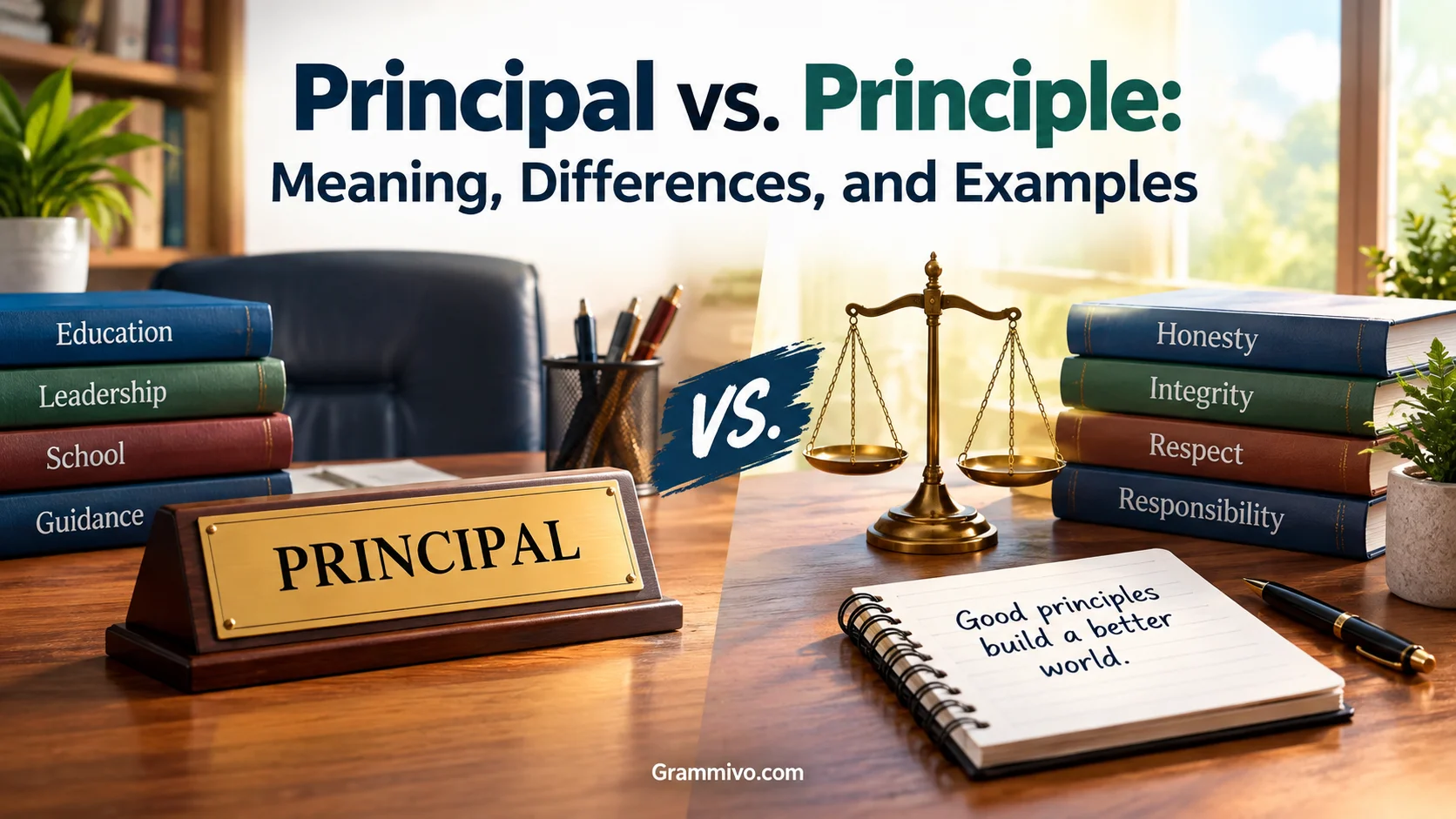
Principal vs. principle is one of those word pairs that can trip up even careful writers. The two words sound almost identical in everyday American English, yet their meanings are completely different. A single letter changes the word and can change the entire meaning of a sentence.
The confusion becomes easier to understand when you look at how widely principal is used. It can describe the head of a school, something that matters most, or the original amount of money in a loan or investment. Principle, on the other hand, refers to a rule, belief, value, or fundamental idea.
For example, you might say, “The principal explained the new school policy.” Here, principal means the person who leads a school. You could also write, “Honesty is an important principle.” In that sentence, principle means a guiding value.
Quick Answer
Principal and principle have different meanings.
- Principal can mean a school leader, the main or most important thing, or the original amount of money borrowed or invested.
- Principle means a fundamental rule, belief, value, or standard that guides behavior or explains an idea.
A useful shortcut is:
Principal = person, primary, or money.
Principle = rule, belief, or value.
Principal Examples
- The principal welcomed the new students.
- Safety is the principal concern.
- She made a large payment toward the loan principal.
Principle Examples
- Fairness is an important principle.
- He refused to compromise his principles.
- The machine works according to a basic scientific principle.
If you mean the main thing, choose principal. If you mean a rule or belief, choose principle.
Comparison Overview
| Word | Part of Speech | Main Meaning | Example |
| Principal | Noun | Head of a school | The principal spoke to the parents. |
| Principal | Adjective | Main or most important | This is the principal reason for the change. |
| Principal | Noun | Original amount of money borrowed or invested | The payment reduced the loan principal. |
| Principle | Noun | Fundamental rule or standard | The principle of fairness matters here. |
| Principle | Noun | Personal belief or moral value | She acted according to her principles. |
| Principle | Noun | Fundamental idea or law | The device operates on a simple principle. |
The easiest way to separate the words is to focus on meaning rather than sound.
When principal describes something as primary or most important, think of words such as main, chief, and leading. When principle refers to an idea that guides conduct or explains how something works, think of rule, standard, belief, or foundation.
Main Differences Between Principal vs. Principle
The biggest difference between principal vs. principle comes down to what each word represents.
Principal often points to a person, a primary thing, or money. Principle points to an idea, rule, belief, or standard.
Consider these two sentences:
- The principal called a meeting.
- The principle of honesty guided her decision.
The first sentence refers to a person. The second refers to an abstract idea.
Principal Can Mean “Main”
One of the most important uses of principal is as an adjective meaning main, chief, or most important.
For example:
- The principal reason for the delay was heavy traffic.
- Her principal goal is to improve customer service.
- The principal concern was public safety.
- The principal cause of the problem was poor planning.
In each case, you could replace principal with main without changing the basic meaning.
Principal reason = main reason
Principal goal = main goal
Principal concern = main concern
That gives you a powerful memory clue. If the sentence means “main,” principal is usually the correct choice.
Principal Can Mean a School Leader
In American English, principal commonly refers to the person who manages or leads a school.
For example:
- The school principal met with the teachers.
- The principal announced the new attendance policy.
- Parents spoke with the principal after the meeting.
- The elementary school principal welcomed the new students.
This is one of the most familiar uses of the word.
A common mistake is writing principle when referring to a school administrator. That spelling is incorrect.
You can remember this with the popular mnemonic:
The principal is your pal.
The phrase connects principal with a person at school.
Principal Has a Financial Meaning
The word principal also has a specific meaning in finance.
When you borrow money, the principal is the original amount you borrow. Interest is the additional amount charged for borrowing that money.
Suppose you take out a $10,000 loan. The original $10,000 is the principal. If the lender charges interest, your total repayment will generally be higher than $10,000.
As you make payments, part of the money may go toward interest while another part reduces the principal balance.
For example:
| Financial Term | Meaning |
| Principal | Original amount borrowed or invested |
| Interest | Cost of borrowing money or return earned on money |
| Principal balance | Amount of principal still unpaid |
| Principal payment | Amount that directly reduces the principal |
This financial meaning has nothing to do with a moral or ethical principle.
Principle Means a Rule or Standard
Principle is a noun that commonly describes a fundamental rule or standard.
For example:
- The company operates according to strict safety principles.
- Equality is an important democratic principle.
- The design follows basic engineering principles.
- Respect should be a guiding principle in every workplace.
A principle can guide actions. It can also describe a basic idea behind a system or process.
Think of it as an invisible guideline that helps determine what should happen or how something should work.
Principle Can Mean a Personal Belief
People also use principle to describe a belief or value they consider important.
For example:
- She refused the offer on principle.
- He wouldn’t lie because honesty was one of his core principles.
- They made the decision based on their personal principles.
- She stood by her principles even when doing so was difficult.
When someone says they did something on principle, they mean they acted according to a belief or standard they consider important.
That expression is especially useful because it clearly shows the difference between the two words.
You can say:
“He refused on principle.”
You can’t use principal in that expression.
What Does Principal Mean?
The word principal has several established meanings. Context determines which meaning applies.
Principal as a Noun
As a noun, principal can refer to a person who holds a leading position.
In education, the word usually means the head of a school.
It can also refer to a person who has a leading role in certain professional or business contexts. However, the school-related meaning is especially common in American English.
Principal as an Adjective
As an adjective, principal means main, chief, or primary.
For example:
The principal objective of the project is to reduce waste.
Here, principal doesn’t refer to a school administrator. It means the project’s main objective.
Other examples include:
- principal advantage
- principal challenge
- principal source
- principal purpose
- principal factor
- principal responsibility
Principal in Finance
In financial language, principal refers to the original amount of a loan or investment.
For an investment, the term can refer to the original sum of money placed into an account or financial product. For a loan, it refers to the amount borrowed before interest and other charges.
This distinction becomes particularly important when reading loan documents.
If your mortgage balance falls from $250,000 to $240,000, the $10,000 reduction represents a reduction in principal, assuming the figures refer strictly to the loan principal.
What Does Principle Mean?
Principle has a more abstract meaning than principal. It generally refers to a basic rule, belief, value, or foundational idea.
Principle as a Moral Rule
A moral principle guides how someone believes people should behave.
Common examples include:
- honesty
- fairness
- respect
- responsibility
- integrity
For example:
Honesty is a basic principle of trustworthy communication.
The word describes the guiding standard rather than a specific action.
Principle as a Personal Value
A person can have principles that shape decisions throughout life.
Someone might say:
“I don’t accept dishonest business practices because they go against my principles.”
Here, principles means deeply held standards or values.
The word often appears in discussions involving ethics, leadership, law, politics, education, and professional conduct.
Principle in Science and Other Fields
Principle doesn’t only refer to morality.
It can also mean a fundamental idea that explains how something works.
For example:
- principles of physics
- principles of mathematics
- principles of design
- principles of economics
- principles of engineering
A scientific principle describes a foundational concept or relationship within a field.
The important point remains the same: principle refers to an underlying idea or rule.
Read More: Who vs. Whom: Meaning, Differences, and Easy Ways to Choose
Principal vs. Principle Examples
Seeing the words in real sentences makes the distinction much clearer.
Examples With Principal
- The principal addressed the students during the morning assembly.
- The principal approved the new school program.
- Her principal concern was the safety of the children.
- The principal reason for the cancellation was severe weather.
- The bank applied the payment directly to the loan principal.
- The project’s principal objective is to improve efficiency.
- The principal investigator reviewed the research findings.
Examples With Principle
- Honesty is one of his strongest principles.
- The company follows the principle of equal treatment.
- She refused to participate because it violated her principles.
- The machine operates according to a basic scientific principle.
- Fairness is an important principle in the workplace.
- He wouldn’t accept the money on principle.
- The teacher explained the basic principle behind the experiment.
Tricky Examples
Some sentences become easier when you replace the word mentally.
Example:
The principal reason for leaving was the long commute.
Replace principal with main:
The main reason for leaving was the long commute.
The sentence still works perfectly. Therefore, principal is correct.
Now consider:
She refused to lie because it violated her principles.
You can’t replace principles with “mains.” The sentence refers to personal values. Therefore, principles is correct.
Another example:
The principal spoke to the parents.
The word refers to a school leader. Therefore, principal is correct.
Principal or Principle: Which One Should You Use?
When you’re unsure, identify the meaning before choosing the spelling.
Ask yourself these questions:
- Is it a school leader? Use principal.
- Does it mean main or most important? Use principal.
- Does it refer to money borrowed or originally invested? Use principal.
- Does it mean a rule, standard, belief, or value? Use principle.
- Does it describe a fundamental idea behind something? Use principle.
This approach works better than relying on pronunciation.
A Simple Decision Guide
Person in charge of a school → Principal
Main or primary → Principal
Original loan or investment amount → Principal
Moral or ethical rule → Principle
Personal belief or value → Principle
Fundamental idea or rule → Principle
The trick is to ask what the sentence means. Don’t choose the spelling based only on how the word sounds.
How to Remember Principal vs. Principle
A few memory tricks can make this distinction stick.
Principal Is a Person
For the school meaning, remember:
The principal is your pal.
Both principal and pal refer to a person in this mnemonic.
It isn’t a definition. It’s simply a useful spelling trick.
Principal Means Primary
Another helpful connection is:
Principal → Primary → Main
If you mean the most important or primary thing, principal is usually the word you need.
For example:
The principal purpose of the meeting was to discuss safety.
You can mentally translate that as:
The primary purpose of the meeting was to discuss safety.
Principle Means a Rule
For principle, think about rules and values.
A principle can tell you what matters or how something should operate.
For example:
Respect is a guiding principle.
The principle acts like a standard that guides behavior.
Common Mistakes With Principal and Principle
Because the two words sound alike, mistakes often happen when people write quickly.
Mistake: Using Principle for a School Leader
Incorrect:
The school principle announced the new schedule.
Correct:
The school principal announced the new schedule.
A school leader is a principal.
Mistake: Using Principal for a Moral Rule
Incorrect:
Honesty is an important principal.
Correct:
Honesty is an important principle.
The sentence describes a value or guiding standard.
Mistake: Confusing Financial Principal With Principle
Incorrect:
I made a payment toward the loan principle.
Correct:
I made a payment toward the loan principal.
Financial principal refers to the amount borrowed or invested.
Mistake: Assuming Principal Always Refers to a Person
This mistake comes from becoming too familiar with the school meaning.
Consider:
The principal cause of the accident was poor visibility.
No school administrator appears in this sentence. Principal means main or primary.
FAQs:
Is a school principal or principle?
A school leader is a principal.
For example:
The principal spoke to the students after lunch.
Principle refers to a rule, belief, value, or fundamental idea.
What is the difference between principal and principle?
Principal can mean a school leader, something main or primary, or the original amount of money borrowed or invested.
Principle means a fundamental rule, belief, value, or standard.
Does principal mean main?
Yes. Principal can function as an adjective meaning main, chief, or most important.
For example:
The principal cause of the problem was a lack of planning.
Here, principal means “main.”
Does principle mean a rule?
Yes. A principle can mean a basic rule or standard that guides behavior or decisions.
For example:
Respect is an important principle in a healthy workplace.
What does principal mean in finance?
In finance, principal generally refers to the original amount of money borrowed or invested.
For a loan, payments may reduce the principal while also covering interest.
Conclusion:
The difference between principal vs. principle becomes much easier once you stop focusing on pronunciation and start focusing on meaning. Principal has three major uses to remember. It can mean a school leader, something main or primary, or the original amount of money in a loan or investment.
