
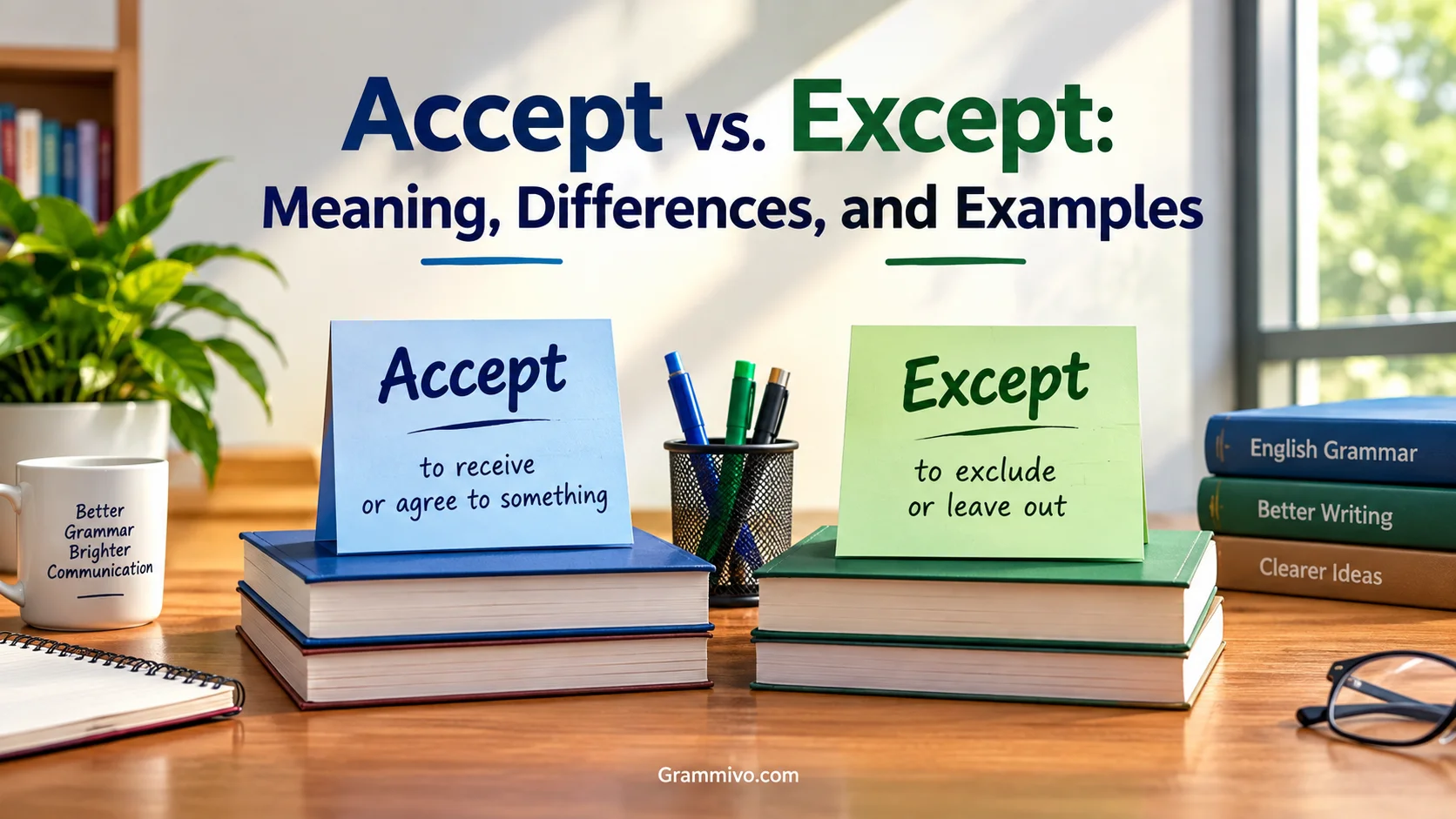
If you’ve ever paused over accept vs. except, you’re not alone. These two words look and sound remarkably similar, yet they perform very different jobs in a sentence. One is about receiving or agreeing, while the other is about excluding or making an exception.
That small difference matters. Writing “Everyone accept Sarah came to the meeting” changes a simple sentence into a spelling and grammar mistake. The correct version is “Everyone except Sarah came to the meeting.”
The good news? Once you connect each word with its core meaning, the confusion becomes much easier to avoid. This guide explains accept vs. except in detail, including their meanings, grammatical roles, pronunciation, common phrases, examples, mistakes, and an easy memory trick.
Quick Answer
Accept is a verb that means to receive, agree to, approve, or acknowledge something.
Except usually means excluding someone or something. It can also introduce an exception.
- Accept: Maria accepted the job offer.
- Except: Everyone accepted the invitation except Maria.
- Accept: He accepted the apology.
- Except: The museum is open every day except Monday.
A simple rule makes the distinction easier:
Accept = receive or agree.
Except = exclude or leave out.
If the sentence involves getting, agreeing to, approving, or acknowledging something, accept is usually the right choice. If it involves leaving someone or something out, choose except.
Comparison Overview
| Word | Main Function | Meaning | Example |
| Accept | Verb | To receive or agree to something | She accepted the invitation. |
| Accept | Verb | To approve or acknowledge | He accepted responsibility. |
| Accept | Verb | To recognize something as true or valid | They accepted the results. |
| Except | Preposition | Excluding someone or something | Everyone came except James. |
| Except | Conjunction | Introducing an exception | I would go except I have work. |
| Except | Verb | To exclude | The rule excepts certain cases. |
The easiest way to separate the words is to focus on meaning rather than spelling or sound.
When you accept something, you take it, agree to it, approve it, or recognize it.
When you use except, you remove something from a larger group or identify an exception.
Main Differences Between Accept vs. Except
The central difference between accept vs. except is simple: accept deals with receiving or agreeing, while except deals with excluding.
Accept Is a Verb
Accept primarily functions as a verb. It describes an action or mental response.
For example:
- I accepted the package.
- She accepted the invitation.
- They accepted the offer.
- He accepted responsibility.
- We accepted the explanation.
In each sentence, someone is doing something. The person receives, agrees to, approves, or acknowledges something.
The word can therefore appear in many situations involving decisions and responses.
Except Commonly Shows Exclusion
Except commonly works as a preposition. It tells you that someone or something doesn’t belong to the group being discussed.
Consider this sentence:
Everyone attended except David.
The sentence says that everyone attended, with one person excluded from that statement: David.
Another example makes the same idea clear:
The store is open every day except Sunday.
Here, Sunday is excluded from the group of days when the store is open.
Accept and Except Have Different Jobs
Although the words differ by only one letter at the beginning, they aren’t interchangeable.
Compare:
- She accepted the award.
- Everyone attended except Sarah.
In the first sentence, accepted describes receiving something.
In the second, except identifies someone who wasn’t included.
Think of it this way: accept brings something in, while except leaves something out.
What Does “Accept” Mean?
Accept has several closely related meanings. Its exact sense depends on the context, but the basic idea involves receiving, agreeing, approving, or acknowledging.
Accept Means “Receive”
One common meaning of accept is to receive something willingly.
For example:
He accepted the gift from his friend.
The person didn’t merely receive the gift physically. The verb suggests that he was willing to take it.
You can also use accept with:
- Gifts
- Invitations
- Payments
- Packages
- Awards
- Donations
- Applications
- Offers
Examples:
- She accepted the scholarship.
- The restaurant accepts credit cards.
- He accepted the award on behalf of his team.
- The company accepted my application.
The word doesn’t always describe a physical object. It often describes an opportunity or arrangement.
Accept Means “Agree To”
Accept can also mean agreeing to something that someone proposes or offers.
For example:
Daniel accepted the job offer.
Daniel agreed to take the job.
Similarly:
- They accepted the proposal.
- She accepted the invitation.
- We accepted the terms.
- He accepted the challenge.
This use appears frequently in business, education, relationships, and everyday communication.
Accept Means “Approve”
Sometimes accept means that something meets the required standards or receives approval.
For example:
The committee accepted the research paper.
Here, the committee approved the paper or agreed to recognize it as satisfactory.
Other examples include:
- The court accepted the evidence.
- The editor accepted the article.
- The university accepted her application.
- The bank accepted the payment.
Accept Means “Acknowledge or Recognize”
Accept can also describe recognizing a fact, condition, result, or situation.
For example:
He finally accepted the fact that he was wrong.
The sentence doesn’t mean that he physically received anything. Instead, he acknowledged something as true.
Other examples:
- She accepted the reality of the situation.
- They accepted the results.
- He accepted that the plan had failed.
- You have to accept the consequences of your decision.
This meaning often appears when someone comes to terms with something they may initially have resisted.
What Does “Except” Mean?
Except generally means excluding. It identifies a person, thing, time, place, or situation that doesn’t belong within a broader statement.
Except as a Preposition
The most common use of except is as a preposition.
For example:
Everyone passed except Mark.
The sentence means that everyone passed with Mark excluded.
More examples:
- I like all vegetables except broccoli.
- Everyone was invited except Jake.
- The office is closed every day except Friday.
- She knows everyone except me.
- The children ate everything except the salad.
A useful pattern is:
group + except + excluded person or thing
For example:
All the students except Lisa completed the assignment.
The larger group is all the students. Lisa is the exception.
Except as a Conjunction
Except can also connect an exception to a statement or clause.
For example:
I would call you except I don’t have your number.
The first part expresses an intention. The second part explains the exception preventing it.
Another example:
The plan would work except we don’t have enough money.
The plan might otherwise succeed, but one condition creates a problem.
Except as a Verb
The verb except is less common in everyday conversation. It means to exclude or to leave something out.
For example:
The new rule excepts emergency vehicles from the restriction.
In ordinary writing, however, people more often use exclude when they want this meaning.
For most readers, the important uses to remember are except as a preposition and except as a conjunction.
Accept vs. Except Examples
Examples make this distinction much easier to recognize because context usually reveals the intended word.
Examples With Accept
- I accepted the invitation to dinner.
- She accepted the job offer.
- The store accepts cash and credit cards.
- He accepted the award with a smile.
- They accepted our proposal.
- She accepted his apology.
- The teacher accepted my explanation.
- We accepted responsibility for the mistake.
- He eventually accepted the truth.
- The university accepted her application.
Notice the common thread. Each sentence involves receiving, agreeing, approving, or acknowledging.
Examples With Except
- Everyone came except John.
- I eat every fruit except grapefruit.
- The library is open every day except Sunday.
- Nobody knew the answer except Emma.
- All the rooms were clean except the kitchen.
- The entire team agreed except Mark.
- She invited everyone except her former coworker.
- We have everything except enough chairs.
- Nothing was damaged except the front door.
- The restaurant serves breakfast every day except Monday.
Here, except removes one person or thing from a larger group.
Read More: Principal vs. Principle: Meaning, Differences, and Examples
Accept vs. Except in Common Sentences
Putting the words side by side makes the contrast even clearer.
| Sentence | Correct Word | Why? |
| She ___ the invitation. | accepted | She agreed to receive or attend it. |
| Everyone came ___ Tom. | except | Tom was excluded. |
| He ___ responsibility for the mistake. | accepted | He acknowledged responsibility. |
| I like every flavor ___ mint. | except | Mint is excluded. |
| They ___ the terms of the agreement. | accepted | They agreed to the terms. |
| Nobody ___ Sarah knew about the plan. | except | Sarah is the exception. |
| The store ___ debit cards. | accepts | The store receives them as payment. |
| The office is open every day ___ Saturday. | except | Saturday is excluded. |
The trick is to ask what the sentence is actually doing.
Is someone receiving or agreeing? Use accept.
Is something being left out? Use except.
Common Phrases With “Accept”
Because accept is a common verb, you’ll encounter it in many fixed phrases and everyday combinations.
Accept an Offer
She accepted the company’s offer.
This means she agreed to the offer.
Accept an Invitation
He accepted the invitation to the wedding.
He agreed to attend or participate.
Accept Responsibility
The manager accepted responsibility for the mistake.
This means the manager acknowledged responsibility rather than denying it.
Accept an Apology
She accepted his apology.
This means she agreed to receive or acknowledge the apology.
Accept Payment
Does this store accept mobile payments?
Here, accept means the store allows or receives that form of payment.
Accept the Truth
It took him time to accept the truth.
In this context, accept means acknowledge or come to terms with something.
Other useful combinations include:
- accept a challenge
- accept a decision
- accept a gift
- accept an application
- accept the consequences
- accept the results
- accept a compromise
- accept a condition
Common Phrases With “Except”
Except often appears when a statement applies broadly but has one or more exclusions.
Everyone Except
Everyone except Nina attended the meeting.
Nina is excluded.
All Except
All except two students finished the test.
Two students didn’t finish it.
Nothing Except
The box contained nothing except old photographs.
Only old photographs were in the box.
No One Except
No one except Daniel knew the password.
Daniel was the only person who knew it.
Except For
The vacation was excellent except for the weather.
The vacation was generally excellent, but the weather was a negative exception.
With the Exception Of
With the exception of has essentially the same exclusion idea as except.
The entire building was renovated with the exception of the basement.
The basement wasn’t renovated.
“Except” vs. “Except For”
The expressions except and except for often overlap, but their sentence patterns can differ.
Compare these examples:
Everyone passed except John.
The trip was enjoyable except for the rain.
The first sentence excludes John from a group.
The second identifies rain as a drawback or exception to an overall assessment.
Except for works especially well when you’re making a general statement and then pointing out one detail that qualifies it.
For example:
The apartment is perfect except for the small kitchen.
The apartment is generally considered perfect. The kitchen is the one significant exception.
Another example:
The report was complete except for the final section.
The report was almost entirely complete, but one section remained unfinished.
FAQs:
Is “accept” the opposite of “except”?
Not exactly. Accept means to receive, agree, approve, or acknowledge. Except means to exclude or identify an exception.
They can create contrasting ideas in some sentences, but they aren’t direct grammatical opposites.
What is the difference between accept and except?
Accept means to receive, agree to, approve, or acknowledge something. Except means to exclude someone or something from a statement or group.
For example:
She accepted the offer.
Everyone attended except James.
Is it “accept” or “except” an apology?
The correct phrase is accept an apology.
She accepted his apology.
An apology is something you receive or acknowledge, so accept is the correct word.
Is it “everyone accept” or “everyone except”?
When you mean that one person or thing is excluded, use everyone except.
Everyone except Maria attended.
Accept would be incorrect in this sentence because the word doesn’t express exclusion.
How can I remember accept and except?
Use this simple rule:
Accept = receive or agree.
Except = exclude.
You can also remember:
Accept lets something in. Except leaves something out.
Conclusion:
Understanding accept vs. except becomes much easier when you focus on what each word means. Accept is a verb that means to receive, agree to, approve, or acknowledge something. Except means to exclude someone or something from a group, statement, or situation.
The simplest way to remember the difference is this: accept means to take in, while except means to leave out. For example, “She accepted the invitation” means she agreed to it, while “Everyone attended except James” means James was excluded.
