
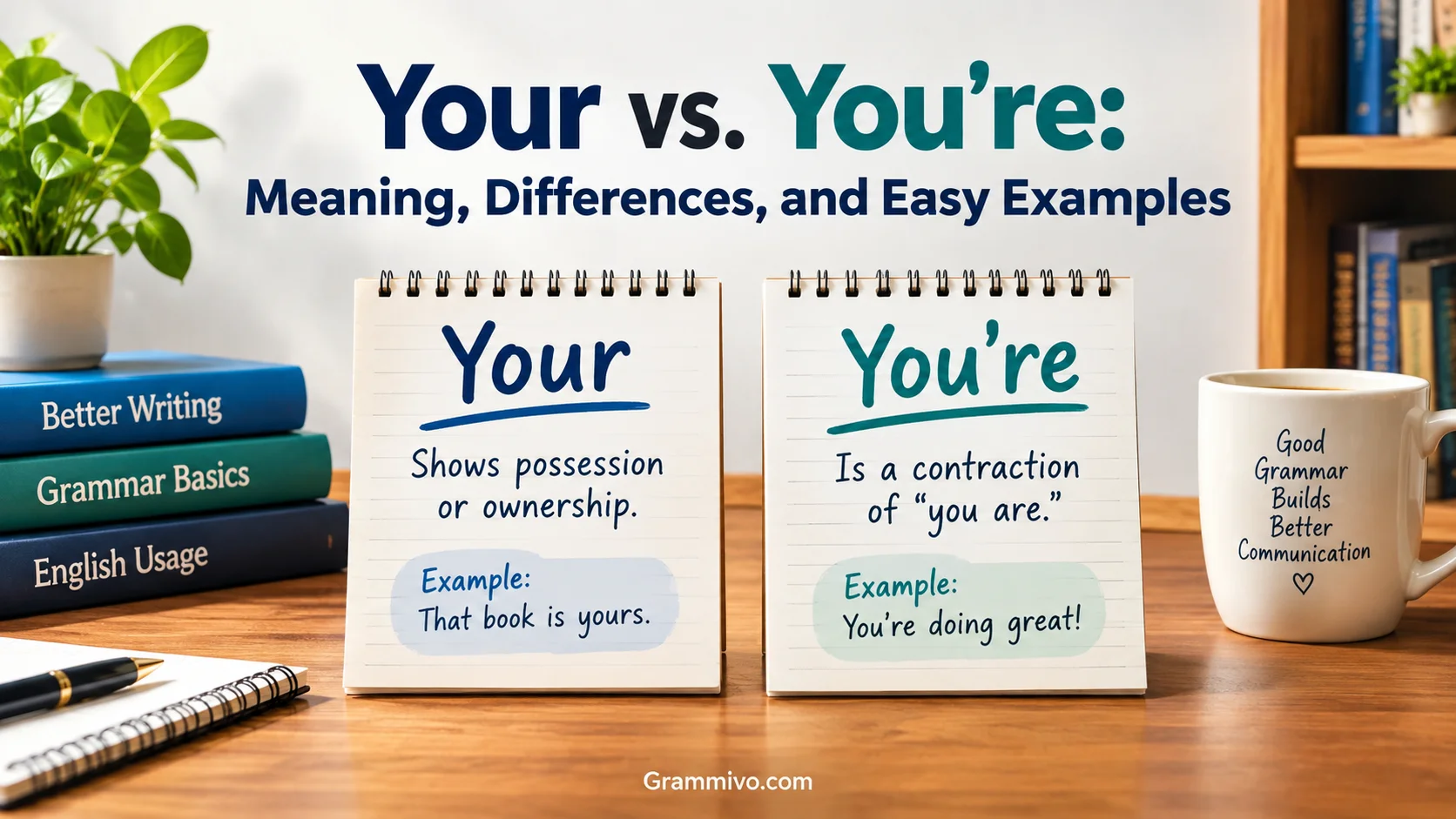
Have you ever typed “your welcome” and then wondered whether something looked wrong? You’re not alone. Your vs. you’re is one of the most common grammar mix-ups in English because the two words sound almost identical in everyday speech.
The spelling, however, tells a very different story.
Your shows possession or a connection to the person being addressed. You’re is simply the shortened form of you are. Once you understand that basic difference, choosing the right word becomes much easier.
The confusion often appears in quick messages, emails, school assignments, social media posts, and even professional writing. A single apostrophe can completely change the grammatical function of a word.
Consider these two sentences:
- Your presentation was excellent.
- You’re giving an excellent presentation.
The first sentence talks about something associated with you. The second means you are giving a presentation.
This guide explains your vs. you’re in detail, including their meanings, grammar rules, common mistakes, memory tricks, examples, and a practical test you can use whenever you’re unsure.
Quick Answer
Your is a possessive determiner that shows something belongs to or is associated with you.
You’re is a contraction of you are.
The easiest way to tell them apart is to expand you’re to you are. If the sentence still makes sense, you’re is correct.
For example:
- Your phone is ringing. → The phone belongs to or is associated with you.
- You’re holding the phone. → You are holding the phone.
A simple rule to remember is:
Your = belonging to you
You’re = you are
Comparison Overview
| Word | Meaning | Grammatical Function | Example |
| Your | Belonging to or associated with you | Possessive determiner | “Where is your jacket?” |
| You’re | You are | Contraction | “You’re wearing a jacket.” |
Although your and you’re sound similar, they perform completely different jobs.
Your normally appears before a noun or noun phrase. It tells the reader who owns something or who has a particular relationship with it.
For example:
- your house
- your sister
- your opinion
- your computer
- your decision
You’re, on the other hand, contains a verb. It combines you with are.
For example:
- You’re happy.
- You’re working.
- You’re a student.
- You’re in the right room.
That grammatical difference is the key to mastering your vs. you’re.
Main Differences Between Your vs. You’re
The biggest difference between your and you’re is their grammatical purpose.
Your indicates possession, association, or a relationship. It doesn’t mean that you legally own something in every situation. Instead, it identifies something as connected to the person being addressed.
You’re means you are. It contains a subject and a form of the verb to be.
Compare:
Your answer is correct.
Here, your describes the answer as belonging to or being associated with you.
Now consider:
You’re correct.
This means:
You are correct.
The difference is small in spelling but enormous in grammar.
Your Shows Possession or Association
The word your is a possessive determiner. It tells readers that something belongs to, relates to, or is connected with the person being addressed.
Examples include:
- Your car is outside.
- I like your idea.
- Please check your email.
- Where did you put your keys?
- Your brother called earlier.
Possession can be literal. If someone owns a car, you can call it your car.
However, possession can also describe a relationship or association.
For example:
- your mother
- your teacher
- your country
- your team
- your favorite movie
- your responsibility
You don’t necessarily own these things. The word your simply establishes a connection with you.
You’re Means You Are
You’re is a contraction. It combines you and are.
The apostrophe represents letters that have been omitted.
You + are = you’re
Examples:
- You’re late. → You are late.
- You’re ready. → You are ready.
- You’re my friend. → You are my friend.
- You’re working hard. → You are working hard.
The contraction is extremely common in everyday English because it makes speech and writing sound more natural.
The You Are Test
The most reliable shortcut for your vs. you’re is the “you are” test.
Whenever you’re unsure, replace you’re with you are.
If the sentence remains grammatical and keeps its intended meaning, you’re is correct.
For example:
You’re doing well.
Replace it:
You are doing well.
The sentence works, so you’re is correct.
Now try:
I like you’re new shoes.
Replace it:
I like you are new shoes.
That clearly doesn’t work.
The correct sentence is:
I like your new shoes.
This test works because you’re always represents you are.
Read More: Accept vs. Except: Meaning, Differences, and Examples
What Does “Your” Mean?
Your is used before a noun to show possession, association, or a relationship with the person being addressed.
It’s the second-person possessive determiner.
Your Before a Noun
The most common structure is:
your + noun
Examples:
- your book
- your desk
- your name
- your answer
- your house
- your children
- your manager
- your opinion
Consider:
Please bring your passport.
The word your tells us whose passport is being discussed.
Likewise:
I agree with your opinion.
The opinion belongs to or comes from the person being addressed.
Your With Singular Nouns
Your works with singular nouns.
Examples:
- your phone
- your friend
- your job
- your car
- your question
Notice that the form of your doesn’t change.
Your phone is new.
The noun is singular.
Your With Plural Nouns
The same word also works with plural nouns.
Examples:
- your phones
- your friends
- your jobs
- your cars
- your questions
For example:
Your friends are waiting outside.
The word your remains unchanged even though friends is plural.
Your With Abstract Ideas
Your can describe things that can’t be physically owned.
Examples:
- your confidence
- your patience
- your knowledge
- your opinion
- your responsibility
- your experience
- your future
For example:
Your confidence has improved significantly.
Nobody literally owns confidence like a physical object. Still, your identifies that quality as associated with you.
Your in Questions
You’ll frequently see your in questions.
Examples:
- What is your name?
- Where is your office?
- What is your opinion?
- When is your birthday?
- Did you finish your work?
The same possession or association rule applies.
What Does “You’re” Mean?
You’re means you are.
That’s it. The apostrophe isn’t decorative. It signals that part of are has been removed.
You’re With Adjectives
A common pattern is:
you’re + adjective
Examples:
- You’re happy.
- You’re tired.
- You’re clever.
- You’re patient.
- You’re ready.
- You’re responsible.
In each case, you are can replace you’re.
You’re ready.
You are ready.
Both versions are grammatically correct.
You’re With Nouns
You’re can also appear before a noun or noun phrase.
Examples:
- You’re a good friend.
- You’re an excellent writer.
- You’re the right person for the job.
- You’re a talented musician.
For example:
You’re a great teacher.
Expanding the contraction gives:
You are a great teacher.
The meaning remains unchanged.
You’re With -ing Verbs
Another common structure is:
you’re + verb ending in -ing
Examples:
- You’re learning.
- You’re reading.
- You’re improving.
- You’re working.
- You’re making progress.
For example:
You’re learning quickly.
This means:
You are learning quickly.
The word you’re introduces the verb phrase.
You’re With Prepositional Phrases
You’re can also appear before a prepositional phrase.
Examples:
- You’re at home.
- You’re in the right place.
- You’re on the correct page.
- You’re near the entrance.
- You’re under a lot of pressure.
Again, expanding the contraction confirms the meaning.
You’re in the right place.
becomes:
You are in the right place.
Your vs. You’re Examples
Seeing the words in context makes the difference much easier to recognize.
Everyday Examples
- Your shoes are by the door.
- You’re wearing your shoes.
- Is this your bag?
- You’re carrying my bag.
- I like your new haircut.
- You’re looking great today.
- Where is your phone?
- You’re using my phone.
School Examples
- Did you finish your homework?
- You’re doing well in class.
- Check your answer again.
- You’re almost finished.
- Bring your textbook tomorrow.
- You’re ready for the exam.
Workplace Examples
- Please send your report by Friday.
- You’re responsible for the final review.
- I appreciate your feedback.
- You’re doing an excellent job.
- Please update your profile.
- You’re listed as the project manager.
The context changes, but the grammatical distinction stays exactly the same.
Your and You’re in the Same Sentence
Sometimes both words appear naturally in one sentence. This is an excellent way to see the contrast.
You’re going to need your passport.
Break it apart:
- You’re = you are
- your = belonging to you
Expanded:
You are going to need your passport.
Another example:
If you’re finished with your work, you can leave.
Here:
- you’re = you are
- your = associated with you
One more:
You’re responsible for bringing your own lunch.
The two words may sit right next to each other in meaning, but they perform different grammatical jobs.
A Useful Pattern
When you see both words, ask two separate questions:
Does the word mean “you are”?
Use you’re.
Does it describe something belonging to or associated with you?
Use your.
That simple distinction handles most situations.
FAQs:
Is “your” a contraction?
No. Your isn’t a contraction. It’s a possessive determiner used to show that something belongs to or is associated with the person being addressed.
Is “you’re” a possessive word?
No. You’re means you are. It doesn’t show possession.
For possession, use your.
Your laptop is on the desk.
Is “you’re” short for “you are”?
Yes. You’re is the standard contraction of you are.
You’re ready. = You are ready.
Can your and you’re be used interchangeably?
No. They have different grammatical functions.
Your car is fast.
is different from:
You’re driving fast.
The first sentence identifies the car as yours or associated with you. The second means you are driving fast.
Why do your and you’re sound similar?
English pronunciation often reduces unstressed words and syllables in natural speech. As a result, your and you’re can sound very similar depending on the speaker and sentence.
That’s why spelling and grammar matter in writing.
Conclusion:
Understanding your vs. you’re is much easier when you focus on what each word means rather than how it sounds. Your shows possession, association, or a relationship with someone. You’re is the contraction of you are.
When you’re unsure, use the simple “you are” test. If you can replace the word with you are and the sentence still makes sense, you’re is correct. If the word describes something belonging to or connected with you, use your.
