
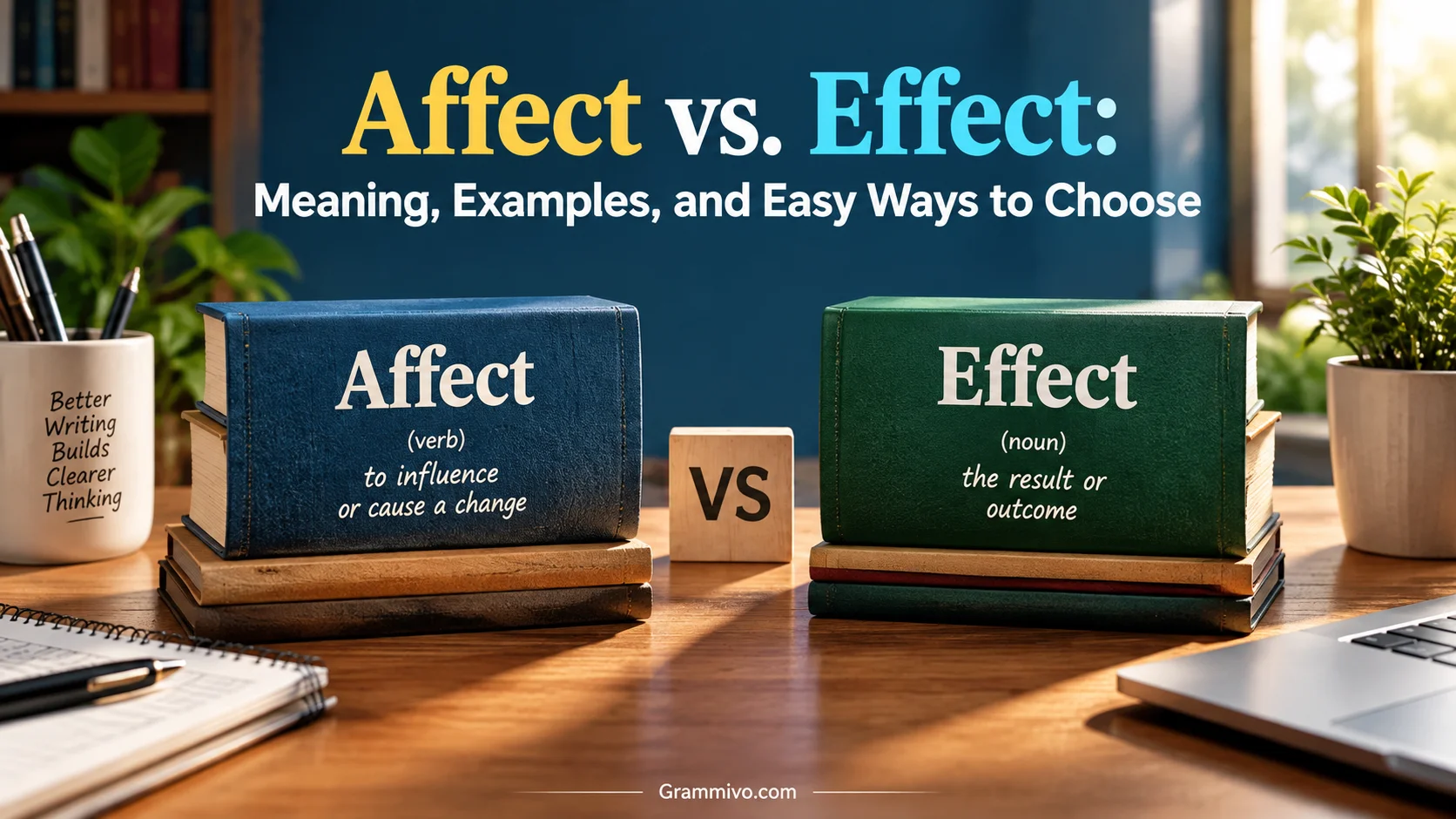
If affect vs. effect has ever made you pause while writing a sentence, you’re not alone. These two words look and sound similar, yet they usually play different grammatical roles. One typically describes an influence or change, while the other usually names the result of that influence.
The confusion becomes greater because effect can also work as a verb, while affect can occasionally work as a noun. That means the simple rule of “affect is a verb and effect is a noun” works most of the time, but it doesn’t cover every situation.
The good news is that you don’t need to memorize dozens of complicated grammar rules. Once you understand what each word means and recognize a few common sentence patterns, choosing between affect and effect becomes much easier.
Quick Answer
Affect is usually a verb meaning to influence, change, or have an impact on something.
The lack of sleep affected her concentration.
Effect is usually a noun meaning a result, consequence, or outcome.
The lack of sleep had a negative effect on her concentration.
A simple memory trick is:
Affect = Action or influence. Effect = End result.
However, there are two important exceptions:
- Effect can be a verb meaning to bring about or cause something to happen.
- Affect can be a noun in psychology meaning a person’s observable emotional expression.
For everyday writing, remember this basic pattern:
Affect → influence
Effect → result
Comparison Overview
| Word | Usual Part of Speech | Main Meaning | Example |
| Affect | Verb | To influence or change | Noise can affect your concentration. |
| Effect | Noun | A result or consequence | Noise can have an effect on concentration. |
| Effect | Verb | To bring about or cause | The reform effected major changes. |
| Affect | Noun | Observable emotional expression | The patient showed a flat affect. |
The first two uses account for the overwhelming majority of situations you’ll encounter in everyday writing.
Think of affect as something happening to another thing. Think of effect as what comes out of that situation.
For example:
Heavy rain affected the game.
Here, the rain influenced the game. Therefore, affected is correct.
Now look at this sentence:
The rain had a major effect on the game.
Here, effect identifies the result of the rain’s influence. Therefore, effect is correct.
The same situation can use both words:
The economic downturn affected small businesses and had a significant effect on local employment.
That distinction is the key to understanding affect vs. effect.
Main Differences Between Affect vs. Effect
The easiest way to separate these words is to focus on influence versus result.
Affect Usually Means “To Influence”
When affect functions as a verb, it describes an action that influences something or someone.
It can mean to change, influence, alter, or have an impact on a person, object, situation, or outcome.
Consider these examples:
- Lack of sleep can affect your memory.
- Rising prices affected household spending.
- The storm affected several flights.
- Stress can affect your physical health.
- Your decision may affect the final outcome.
In each sentence, something influences something else.
A useful question is:
“Is something influencing or changing something?”
If the answer is yes, affect will usually be the right choice.
Effect Usually Means “A Result”
When effect functions as a noun, it refers to the result or consequence produced by an action, event, or condition.
For example:
The medicine had an immediate effect.
The effect is the result produced by the medicine.
More examples include:
- The new policy had a positive effect.
- Exercise can have a powerful effect on your mood.
- The storm caused serious effects across the region.
- The side effects disappeared after a few days.
- The decision had an unexpected effect on sales.
Here, you’re naming the outcome rather than describing the act of influencing.
The Simplest Question to Ask
When you’re unsure, don’t stare at the two words and hope one suddenly looks right. Instead, examine the sentence.
Ask:
Is the word describing an influence or action?
→ Use affect in most cases.
Is the word naming a result or consequence?
→ Use effect in most cases.
For example:
Social media can ___ your attention span.
Social media can influence your attention span.
Therefore:
Social media can affect your attention span.
Now change the structure:
Social media can have an ___ on your attention span.
You need a noun after “an.” The intended meaning is a result or impact.
Therefore:
Social media can have an effect on your attention span.
The sentence structure often gives you the answer.
What Does Affect Mean?
Affect most commonly functions as a verb. Its central meaning is to influence or produce a change in something.
The influence doesn’t have to be dramatic. Even a small change can be described with affect.
Affect as a Verb
Here are some everyday examples:
Cold weather can affect your car’s battery.
A noisy environment can affect your ability to concentrate.
The teacher’s feedback affected how she approached the assignment.
One bad review can affect a restaurant’s reputation.
The delay affected hundreds of passengers.
Notice the pattern. The subject performs an action that influences an object.
Subject + affect + object
For example:
Stress affects sleep.
Stress is the subject. Affects is the verb. Sleep is the object.
You can also use different forms:
- affect
- affects
- affected
- affecting
Examples:
The decision may affect sales.
The decision affects sales.
The decision affected sales.
The decision is affecting sales.
The basic meaning remains the same.
Affect as a Noun
The noun affect is a specialized term used mainly in psychology, psychiatry, medicine, and related fields.
In this context, affect refers to the observable expression of a person’s emotional state.
For example:
The patient displayed a flat affect during the interview.
A flat affect describes limited or reduced outward emotional expression.
This use can confuse readers because it breaks the common rule that affect is a verb. However, it’s a legitimate noun with a specialized meaning.
In ordinary conversation, you’ll rarely need this noun unless you’re discussing psychology, clinical observations, or related subjects.
What Does Effect Mean?
Effect most commonly functions as a noun. It refers to a result, consequence, or outcome.
If an action creates a change, that change can be called its effect.
Effect as a Noun
Consider this example:
The new study schedule had a positive effect on her grades.
The schedule influenced her studying. The improvement in her grades represents the result.
Common examples include:
- The medication had a noticeable effect.
- The announcement had an immediate effect.
- Exercise has many health effects.
- The change had little effect on productivity.
- The law could have a major effect on businesses.
The word often appears with on:
The decision had an effect on the company.
Lack of sleep has an effect on memory.
Weather conditions can have an effect on travel.
This pattern provides a useful clue. If you’re writing “___ effect on”, you’re almost certainly looking for effect.
Effect as a Verb
Here’s where the easy rule gets more interesting.
Effect can function as a verb meaning to bring about, produce, or cause something to happen.
This use is less common and tends to appear in formal, academic, legal, political, or business writing.
For example:
The new policy effected significant changes.
This means the policy brought about significant changes.
Compare that with:
The new policy affected significant changes.
This sentence usually means the policy influenced those changes.
The distinction is subtle but important.
Affect something = influence it.
Effect something = bring it about.
Consider another example:
The negotiations affected the agreement.
The negotiations influenced the agreement.
The negotiations effected an agreement.
The negotiations brought an agreement into existence.
That’s a small grammatical distinction with a big difference in meaning.
Affect vs. Effect Examples
Seeing the words side by side makes the difference much easier to recognize.
| Affect | Effect |
| Noise can affect your concentration. | Noise can have an effect on concentration. |
| The storm affected traffic. | The storm had a major effect on traffic. |
| Stress can affect your sleep. | Stress can have a negative effect on sleep. |
| The news affected her mood. | The news had an emotional effect on her. |
| The price increase affected customers. | The price increase had an effect on customers. |
| The teacher’s advice affected his decision. | The advice had a strong effect on his decision. |
The important point is that the meaning stays connected while the grammar changes.
Compare:
Exercise affects your health.
with:
Exercise has an effect on your health.
Both sentences communicate a similar idea. The first uses affect as a verb. The second uses effect as a noun.
Read More: Your vs. You’re: Meaning, Differences, and Easy Examples
Affect vs. Effect in Common Phrases
Certain expressions make the correct choice almost automatic.
Common Phrases With Affect
You’ll often see affect followed directly by an object:
- affect your health
- affect your mood
- affect performance
- affect the outcome
- affect a decision
- affect the economy
- affect behavior
- affect productivity
- affect the environment
- affect someone’s ability
Examples:
Poor lighting can affect productivity.
The experience affected her confidence.
Higher temperatures may affect crop production.
Common Phrases With Effect
Effect appears in several familiar expressions:
- have an effect on
- take effect
- come into effect
- side effect
- cause and effect
- adverse effect
- positive effect
- negative effect
- lasting effect
- immediate effect
- ripple effect
Examples:
The new rules will take effect next month.
The medicine caused several side effects.
The decision had a lasting effect on the organization.
The law will come into effect in January.
These expressions are worth learning as complete phrases. Doing so makes your writing faster and more accurate.
How to Remember Affect vs. Effect
Grammar doesn’t have to feel like a memory contest. A couple of practical tricks can help.
The A = Action Trick
Remember:
Affect = Action
When affect means influence, it’s usually doing the work of a verb.
For example:
The heat affected the equipment.
The word affected describes what the heat did.
The E = End Result Trick
Remember:
Effect = End result
An effect is generally the result produced by something else.
For example:
The heat had a damaging effect on the equipment.
The damaging result is the effect.
The RAVEN Memory Device
Another popular memory aid is RAVEN:
Remember
Affect
Verb
Effect
Noun
This works well for the most common uses.
However, don’t treat it as an absolute law. English has exceptions, which is why effect can also be a verb and affect can also be a noun.
The better approach is to use RAVEN as a starting point and then consider the meaning of the sentence.
Common Affect vs. Effect Mistakes
Even experienced writers occasionally mix these words up. The following errors appear frequently.
“The Weather Effects My Mood”
Incorrect:
The weather effects my mood.
Correct:
The weather affects my mood.
Why? The weather influences your mood. You’re describing an action, so affects is the correct verb.
“This Had a Big Affect on Me”
Incorrect:
The experience had a big affect on me.
Correct:
The experience had a big effect on me.
Why? The phrase “had a ___ on” requires a noun. You’re talking about the result or impact of the experience.
“The Side Affects Were Severe”
Incorrect:
The medicine caused several side affects.
Correct:
The medicine caused several side effects.
Side effect is a fixed and extremely common phrase. It means an additional or unintended result produced by a treatment, medication, or other intervention.
“The Policy Will Effect Consumers”
This sentence may be wrong depending on the intended meaning.
If you mean the policy will influence consumers, write:
The policy will affect consumers.
If you mean the policy will bring about consumers or somehow produce them, the sentence needs a different structure. Effect as a verb doesn’t simply mean “influence.”
That’s why replacing affect with effect based only on how formal it sounds can create errors.
FAQs:
Is affect a verb or a noun?
Affect is most commonly a verb meaning to influence or change something. It can also be a specialized noun in psychology referring to observable emotional expression.
Is effect a verb or a noun?
Effect is most commonly a noun meaning a result or consequence. It can also function as a verb meaning to bring about or cause something to happen.
What is the easiest way to remember affect vs. effect?
Use Affect = Action and Effect = End result. When something influences something else, choose affect. When you’re naming the resulting outcome, choose effect.
Is it “affect on” or “effect on”?
The standard phrase is “effect on.”
The decision had an effect on sales.
When you use the verb affect, you generally don’t need on:
The decision affected sales.
Is it “affected by” or “effected by”?
Affected by is correct in ordinary situations where something has been influenced or changed.
The town was affected by the storm.
Effected by is much less common because the verb effect means to bring something about.
Conclusion:
Understanding affect vs. effect becomes much simpler when you focus on what each word means in the sentence. Affect usually works as a verb and means to influence, change, or have an impact on something. Effect usually works as a noun and refers to a result, consequence, or outcome.
A quick way to remember the difference is Affect = Action and Effect = End result. For example, Stress can affect your sleep, while Stress can have a negative effect on your sleep. Both sentences describe the same general idea, but each word has a different grammatical role.
