
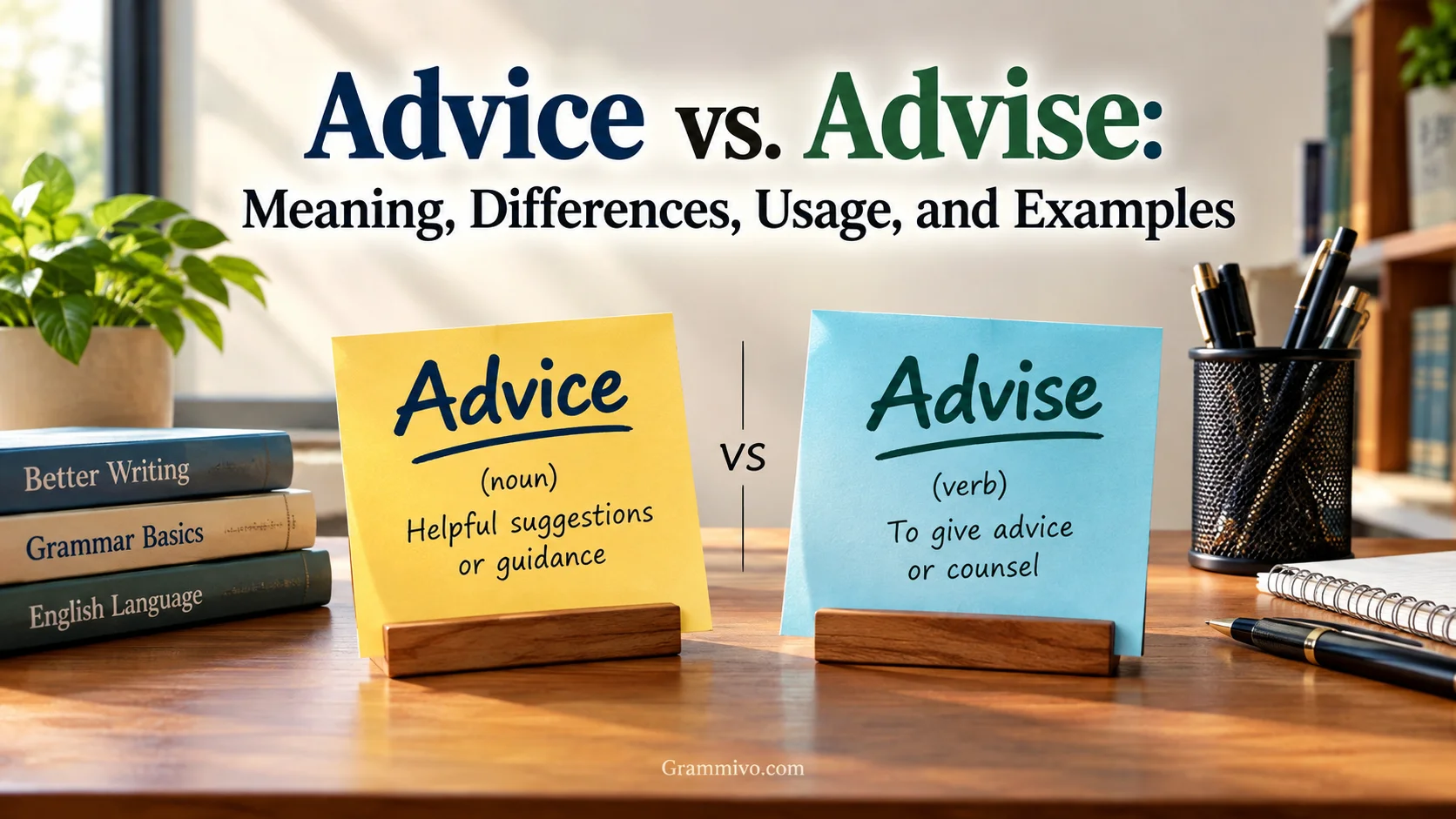
Advice vs. advise is one of those English word pairs that can trip up even confident writers. The two words look almost identical. They also relate to the same basic idea: giving someone guidance about what to do.
The important difference is grammatical. Advice is a noun, while advise is a verb. Once you understand that distinction, choosing the correct word becomes much easier.
For example, you can give advice, but you can’t “give advise.” Likewise, you can advise someone, but you can’t “advice someone.”
The pronunciation also differs. Advice ends with an /s/ sound, while advise ends with a /z/ sound. That small difference becomes useful when you want to remember which spelling belongs in a sentence.
Quick Answer
Advice is a noun that means a suggestion, recommendation, or guidance about what someone should do. Advise is a verb that means to give someone a recommendation or guidance.
Here are two simple examples:
- Advice: My father gave me some useful advice.
- Advise: My father advised me to save money.
A useful rule is:
Advice is something you give. Advise is something you do.
Think of advice as the information and advise as the action of giving that information.
| Word | Part of Speech | Meaning | Example |
| Advice | Noun | A recommendation or guidance | She gave me good advice. |
| Advise | Verb | To recommend or guide | She advised me to wait. |
Comparison Overview
| Feature | Advice | Advise |
| Part of speech | Noun | Verb |
| Basic meaning | Guidance or recommendation | The act of giving guidance |
| Pronunciation | /ədˈvaɪs/ | /ədˈvaɪz/ |
| Final sound | /s/ | /z/ |
| Common pattern | give/receive advice | advise someone |
| Countability | Usually uncountable | Verb |
| Example | I need your advice. | Please advise me. |
The easiest distinction is grammatical.
If the word refers to the guidance itself, use advice. If it describes the action of giving guidance, use advise.
Consider these sentences:
- I need your advice.
- Please advise me about what to do.
The first sentence needs a noun because advice is the thing the speaker needs. The second needs a verb because advise describes an action.
Main Differences Between Advice vs. Advise
The main difference between advice vs. advise comes down to their grammatical roles. Although they share the same basic idea, they don’t function in the same way.
Advice Is a Noun
Advice names guidance, an opinion, or a recommendation.
For example:
- Her advice helped me make a better decision.
- I asked my teacher for advice.
- He gave me excellent advice about the interview.
- We should follow the doctor’s advice.
In each sentence, advice refers to the guidance itself.
You can think of it as a form of information that someone offers to help another person choose an action.
Advise Is a Verb
Advise describes the action of giving guidance or making a recommendation.
For example:
- The doctor advised me to rest.
- My teacher advised me to practice every day.
- The lawyer advised us to read the agreement carefully.
- She advised him against taking unnecessary risks.
Here, advise tells us what someone did. The person gave guidance.
A Simple Comparison
Compare these two sentences:
The manager gave me useful advice.
The manager advised me to arrive early.
The meaning is closely related. The grammatical structure is different.
In the first sentence, advice is the thing the manager gave. In the second, advised is the action the manager performed.
What Does Advice Mean?
Advice means an opinion, recommendation, or suggestion intended to help someone decide what to do.
People give advice in countless situations. A friend might offer advice about a relationship. A teacher might give advice about studying. A financial professional might provide advice about managing money.
The word can describe both casual suggestions and serious professional guidance.
For example:
- Can you give me some advice?
- She offered valuable career advice.
- His advice saved me from making a serious mistake.
- I asked my parents for advice before accepting the job.
Advice Is Usually Uncountable
One of the most important grammar points about advice is that it is normally an uncountable noun.
That means you generally shouldn’t say:
- an advice
- two advices
- many advices
Instead, use expressions such as:
- some advice
- a piece of advice
- two pieces of advice
- some useful advice
- a bit of advice
For example:
Incorrect: She gave me an advice.
Correct: She gave me some advice.
Correct: She gave me a piece of advice.
When you want to count individual recommendations, piece provides the countable unit.
Examples of Advice in Sentences
Here are several examples showing how advice works naturally:
- I need some advice about my new job.
- She gave me a useful piece of advice.
- His financial advice was practical.
- They asked their coach for advice.
- Good advice can prevent expensive mistakes.
- I didn’t follow his advice at first.
- Her advice helped me prepare for the interview.
Notice that advice doesn’t describe the act of giving guidance. It names the guidance itself.
What Does Advise Mean?
Advise is a verb meaning to recommend something, guide someone, or tell someone what you think they should do.
It often appears when one person has knowledge or experience that may help another person make a decision.
For example:
- The doctor advised me to exercise regularly.
- The teacher advised the students to review their notes.
- My parents advised me to think carefully.
- The mechanic advised us to replace the tires.
The person doing the advising is performing an action. That’s why the verb advise is needed.
Common Grammar Patterns With Advise
Several structures appear frequently with advise.
Advise + Someone + To + Verb
This is one of the most common patterns.
Examples:
- The doctor advised him to rest.
- She advised me to apply early.
- The instructor advised us to arrive before noon.
- My manager advised me to check the figures again.
The structure is:
advise + person + to + base verb
So you might write:
The teacher advised John to study.
You wouldn’t normally write:
The teacher advised to study.
The person receiving the advice usually appears between advise and the infinitive.
Advise + Someone + Against + -ing
Use this structure when recommending that someone not do something.
Examples:
- The doctor advised him against eating too much sugar.
- The lawyer advised us against signing the document immediately.
- She advised me against driving in the storm.
This construction is especially useful because it expresses a warning or recommendation against an action.
Advise + Someone + On + Noun
You can also use advise when discussing a particular subject or issue.
Examples:
- The consultant advised us on financial planning.
- She advises clients on career development.
- The specialist advised him on the best treatment options.
Here, on introduces the topic about which guidance is given.
Advice vs. Advise Pronunciation
Spelling isn’t the only difference between these words. Their final sounds are different too.
Advice ends with an /s/ sound:
ad-VICE
Advise ends with a /z/ sound:
ad-VIZE
The difference may seem tiny. However, it provides a helpful memory clue.
| Word | Final Sound | Similar Sound |
| Advice | /s/ | like the sound in ice |
| Advise | /z/ | like the sound in eyes |
Try saying these pairs aloud:
- advice → advise
- device → devise
- practice → practise
The pronunciation pattern can help you remember that the noun advice has the /s/ sound while the verb advise has the /z/ sound.
Read More: Affect vs. Effect: Meaning, Examples, and Easy Ways to Choose
How to Use Advice Correctly
Because advice functions as a noun, it commonly appears after verbs such as give, offer, receive, seek, ask for, take, and follow.
Common Expressions With Advice
- give advice
- offer advice
- ask for advice
- seek advice
- receive advice
- take advice
- follow advice
- ignore advice
- need advice
- get advice
For example:
She asked her brother for advice.
The customer sought professional advice.
He ignored everyone’s advice.
We decided to follow her advice.
These combinations sound natural because advice represents the guidance being given, received, followed, or ignored.
A Piece of Advice
The phrase “a piece of advice” is especially common.
For example:
Here’s a piece of advice: always read the instructions before starting.
You can also say:
Let me give you one piece of advice.
If you’re referring to several individual recommendations, use pieces:
The counselor gave me three pieces of advice.
This is more natural than saying “three advices.”
How to Use Advise Correctly
Since advise is a verb, it needs to fit into a verb structure.
You can use it in several ways depending on what you want to express.
Advise Someone to Do Something
This is the most useful everyday pattern.
- I advised him to wait.
- She advised me to call first.
- The doctor advised her to get more sleep.
- The coach advised the players to stay focused.
Advise Someone Against Doing Something
Use this when you recommend avoiding an action.
- I advised him against buying the car.
- The guide advised tourists against traveling alone at night.
- The doctor advised her against lifting heavy objects.
Advise Someone on Something
Use on when the sentence focuses on the subject of the guidance.
- The accountant advised us on tax matters.
- She advises students on career choices.
- The consultant advised the company on its hiring strategy.
The correct structure depends on the meaning you want to communicate.
Common Mistakes With Advice and Advise
These two words cause several predictable mistakes. Once you know them, they’re easy to avoid.
“He Gave Me an Advice”
This mistake happens because many countable nouns can use a or an.
However, advice normally works differently.
Incorrect: He gave me an advice.
Correct: He gave me some advice.
Correct: He gave me a piece of advice.
“She Adviced Me”
The spelling adviced isn’t the standard form.
The past tense of advise is advised.
Incorrect: She adviced me to wait.
Correct: She advised me to wait.
The spelling changes from advise to advised because the verb takes the regular -ed ending.
“He Gave Me Good Advise”
Here, the problem is that the sentence needs the noun.
Incorrect: He gave me good advise.
Correct: He gave me good advice.
A quick test helps: if you can replace the word with guidance, you probably need advice.
He gave me good guidance.
Therefore:
He gave me good advice.
“The Teacher Advice Me”
This sentence needs a verb.
Incorrect: The teacher advice me to study.
Correct: The teacher advised me to study.
In the present tense, you could write:
The teacher advises me to study.
The correct form depends on the tense.
Advice vs. Advise in Different Contexts
The distinction becomes easier when you see these words in realistic situations.
Everyday Conversations
In casual conversations, people frequently ask for advice or give advice.
For example:
My friend asked me for advice about moving to another city.
If you describe the action of giving that guidance, use advise:
I advised my friend to compare the costs first.
The difference is subtle in meaning but clear in grammar.
Workplace English
Professional communication often uses both words.
For example:
The consultant gave the company valuable advice.
Or:
The consultant advised the company to reduce unnecessary expenses.
The first sentence emphasizes the guidance. The second emphasizes the action of recommending something.
You may also see formal phrases such as:
- Please advise.
- We advise customers to retain their receipts.
- Customers should seek professional advice when necessary.
Please advise is common in business communication. It generally means please provide information or tell me what action to take.
Academic English
Students encounter both forms in academic writing.
For example:
The professor gave students advice about their research projects.
Or:
The professor advised students to review their sources carefully.
The noun identifies the guidance. The verb describes the professor’s action.
FAQs:
Is Advice a Noun or a Verb?
Advice is a noun. It refers to guidance, suggestions, or recommendations.
Example:
She gave me excellent advice.
Is Advise a Noun or a Verb?
Advise is a verb. It means to recommend or guide someone.
Example:
She advised me to wait.
What Is the Difference Between Advice and Advise?
Advice is the guidance itself, while advise means to give or provide that guidance.
Example:
He gave me advice.
He advised me to leave early.
Is “A Piece of Advice” Correct?
Yes. “A piece of advice” is a standard and natural expressi
Conclusion:
Understanding advice vs. advise becomes much easier when you focus on their grammatical roles. Advice is a noun that refers to guidance, suggestions, or recommendations. Advise is a verb that means to give that guidance or recommend an action.
The simplest rule to remember is: you give advice, but you advise someone. For example, She gave me helpful advice uses the noun, while She advised me to wait uses the verb.
