
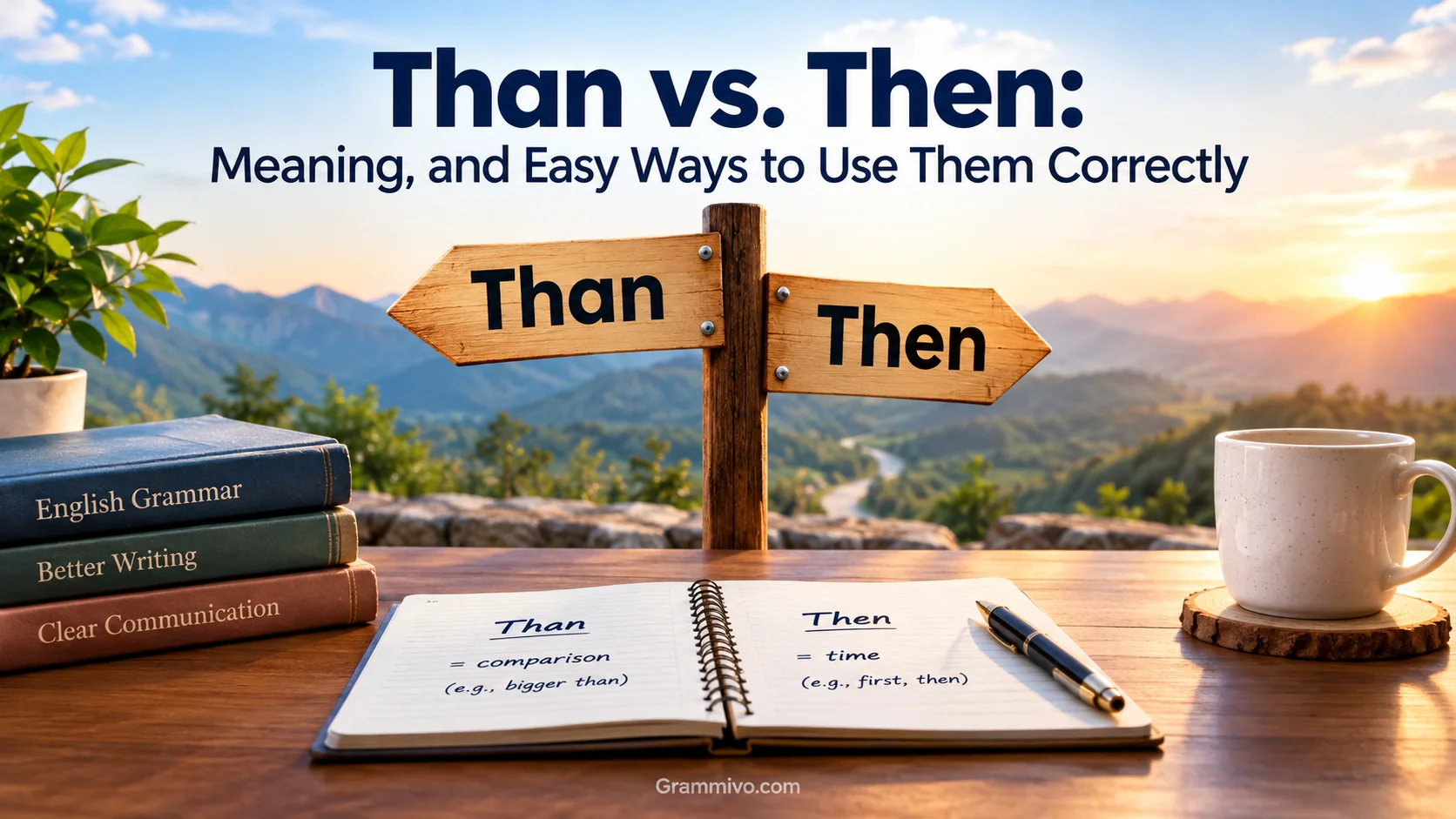
Than vs. then is one of those small English distinctions that can cause surprisingly big problems. The words look almost identical, sound somewhat similar in casual speech, and often appear in the same kinds of sentences. Yet they perform completely different jobs.
The simplest rule is this: than is mainly used for comparisons, while then is mainly used for time, sequence, or results.
For example, you would write:
- My car is faster than yours.
- Finish your homework, then watch television.
The first sentence compares two cars. The second describes what happens next.
Once you understand that basic difference, choosing between than and then becomes much easier. However, several grammar patterns can make the distinction confusing. Words such as more, less, rather, first, if, better, earlier, and later often appear around them.
This guide explains than vs. then in detail, including their meanings, grammar patterns, common mistakes, pronunciation, examples, memory tricks, and a practical quiz.
Quick Answer
Than is used mainly when comparing two or more people, things, actions, or ideas. Then is used mainly to talk about a time, the next event in a sequence, or a consequence.
| Word | Main meaning | Common use | Example |
| Than | Comparison | Comparing things | This book is better than that one. |
| Then | Time or sequence | Showing what happens next | We ate dinner and then went home. |
| Then | At that time | Referring to a particular time | I didn’t know her then. |
| Then | Result | Showing a consequence | If you’re ready, then let’s begin. |
The easiest rule to remember
Than = comparison.
Then = time, sequence, or result.
If you’re deciding between the two, ask yourself:
Am I comparing something? Use “than.” Am I talking about when or what happens next? Use “then.”
Comparison Overview
The words than and then differ in meaning, function, and grammatical use. Their similar spelling is the main reason writers sometimes interchange them.
Than commonly introduces the second element in a comparison. It appears after comparative adjectives and adverbs as well as expressions involving quantity or preference.
Then, on the other hand, usually relates to time or order. It can mean at that time, next, after that, or in that case depending on the sentence.
| Feature | Than | Then |
| Primary function | Comparison | Time, sequence, or result |
| Typical meaning | Compared with | At that time, next, or in that case |
| Common pattern | better than | first, then |
| Quantity | more than 10 | — |
| Preference | rather than | — |
| Sequence | — | eat, then leave |
| Conditional result | — | if so, then act |
| Example | She is taller than me. | She arrived then. |
Think of than as a comparison bridge. It connects one thing with another.
Think of then as a timeline marker. It tells you where something falls in time or what follows from something else.
Main Differences Between Than vs. Then
The most important difference between than vs. then comes down to their meaning.
Than Is Used for Comparisons
Than introduces the person, thing, or idea that serves as the second part of a comparison.
Consider:
The blue car is cheaper than the red car.
The sentence compares the prices of two cars. Than connects the two sides of that comparison.
More examples include:
- Winter is colder than autumn.
- Maria runs faster than James.
- This route is shorter than the other one.
- The new model costs more than the old model.
- He is more patient than his brother.
Whenever the sentence establishes a comparative relationship, than is usually the correct choice.
Then Is Used for Time
Then can refer to a particular point in time.
For example:
- I lived in New York then.
- She was only ten then.
- Things were different then.
- Back then, we didn’t have smartphones.
In these sentences, then means something close to at that time.
A useful substitution test works here. If you can replace then with at that time and the sentence still makes sense, then is probably correct.
Then Is Used for Sequence
Then can also tell the reader what happens next.
For example:
First, wash the vegetables. Then, cut them into small pieces.
Here, then doesn’t refer to a particular historical moment. Instead, it establishes an order of events.
Other examples include:
- Take a seat and then wait for your name to be called.
- She packed her bag and then left.
- First, open the document. Then check the figures.
- Mix the flour then add the milk.
This use makes then especially common in instructions, recipes, stories, and explanations.
Then Can Show a Result
In certain sentences, then introduces a consequence or conclusion.
For example:
If you don’t need the car, then I’ll take it.
The word then connects the condition with its result.
Another example:
If the store is closed, then we’ll come back tomorrow.
The word can often be omitted without making the sentence grammatically incorrect:
If the store is closed, we’ll come back tomorrow.
However, keeping then can make the relationship between the condition and result more explicit.
When to Use Than
Knowing the most common grammar patterns for than makes its correct use much easier.
Comparative Adjectives + Than
Comparative adjectives often take than when two things are compared.
Examples include:
- taller than
- shorter than
- older than
- younger than
- faster than
- slower than
- stronger than
- better than
- worse than
- easier than
- harder than
Examples:
- My sister is older than me.
- This exercise is easier than the last one.
- Today’s weather is colder than yesterday’s.
- The second movie was better than the first.
The comparison can involve people, objects, places, experiences, or abstract ideas.
More + Than
One of the most common patterns is more than.
Examples:
- The project took more than two weeks.
- She has more experience than I do.
- The company employs more than 500 people.
- He earns more than his previous salary.
A common spelling mistake is writing more then.
That form is incorrect when the intended meaning is comparison or quantity.
Correct: The bag costs more than $50.
Incorrect: The bag costs more then $50.
Less + Than
The same principle applies to less than.
Examples:
- The journey takes less than an hour.
- This phone weighs less than the previous model.
- The repair cost less than expected.
Here, than introduces the second part of a quantity comparison.
Fewer + Than
Use than after fewer when comparing countable quantities.
Examples:
- The second class has fewer students than the first.
- She made fewer mistakes than last time.
- There were fewer cars on the road than usual.
The word than remains correct because these sentences compare quantities.
Rather Than
The expression rather than indicates preference or an alternative.
Examples:
- I’d walk rather than take the bus.
- She chose tea rather than coffee.
- He decided to stay home rather than go out.
Writing rather then changes the phrase into an incorrect form.
Correct: I’d rather read than watch television.
Other Common Expressions With Than
Several familiar expressions contain than because they involve comparison.
Examples include:
- better than
- worse than
- more than
- less than
- fewer than
- greater than
- smaller than
- rather than
- other than
- more often than not
For example:
More often than not, preparation makes the difference.
Here, than forms part of a fixed expression.
When to Use Then
Unlike than, then has several closely related meanings. Most involve time, order, or consequence.
Then for Sequence
Use then when one action follows another.
For example:
Finish your breakfast and then brush your teeth.
The word tells you that brushing your teeth comes after breakfast.
More examples:
- First, choose a topic. Then, create an outline.
- She checked the address and then called the driver.
- Open the box and then remove the instructions.
- We went to dinner and then saw a movie.
Then for a Specific Time
Then can mean at that time.
Examples:
- I was working there then.
- She didn’t understand the problem then.
- Back then, people wrote more letters.
- He was much younger then.
The time may refer to the past or to another point established by context.
Then for “Next”
When explaining a process, then often means next.
For example:
Add the eggs, then stir the mixture.
The sequence is clear:
Add eggs → stir mixture
Another example:
Choose your seat, then wait for the presentation to begin.
Again, then signals the following action.
Then in Conditional Statements
Then can emphasize the result of a condition.
Examples:
- If you agree, then we’ll continue.
- If the weather improves, then we’ll go outside.
- If the answer is correct, then move to the next question.
In everyday English, speakers often leave then out:
If you agree, we’ll continue.
Both constructions can be grammatical. The version with then simply emphasizes the connection between the condition and its result.
Than vs. Then in Common Sentences
Seeing the words in context makes their distinction easier to recognize.
Comparison Examples
- This laptop is lighter than mine.
- The blue shirt looks better than the black one.
- He arrived earlier than expected.
- The new road is safer than the old road.
- She knows more about the subject than I do.
- This problem is harder than it looks.
Every example compares two things or establishes a difference in degree.
Sequence Examples
- First, read the question. Then, choose your answer.
- She finished work and then went home.
- We had lunch and then visited the museum.
- Turn left at the corner and then continue for two blocks.
- He opened the email and then replied.
These sentences establish an order of events.
Time Examples
- I didn’t know about the problem then.
- Things were simpler then.
- She lived in Chicago then.
- Back then, the building looked completely different.
In each case, then relates to a time.
Result Examples
- If you know the answer, then explain it.
- If the first plan fails, then we’ll try another.
- If you’re finished, then you can leave.
Here, then connects a condition with its consequence.
Read More: Advice vs. Advise: Meaning, Differences, Usage, and Examples
Common Mistakes With Than and Then
The confusion between these words usually comes from their similar spelling and pronunciation. Fortunately, most mistakes fall into a few predictable patterns.
Mistake: Using Then for a Comparison
Incorrect: My car is faster then yours.
Correct: My car is faster than yours.
The sentence compares two cars. Therefore, than is required.
Mistake: Using Than for Sequence
Incorrect: First, wash your hands. Than prepare the food.
Correct: First, wash your hands. Then prepare the food.
The sentence describes two actions in order. It doesn’t compare anything.
Mistake: Writing More Then
Incorrect: The package weighs more then five pounds.
Correct: The package weighs more than five pounds.
The phrase more than expresses quantity or comparison.
Mistake: Writing Rather Then
Incorrect: I’d stay home rather then drive in the rain.
Correct: I’d stay home rather than drive in the rain.
The fixed expression is rather than.
Mistake: Writing First Than
Incorrect: First than we need to check the data.
Correct: First, then we need to check the data.
When you describe what comes next, use then.
Easy Memory Tricks for Than vs. Then
A good memory trick should be simple enough to work when you’re writing quickly.
Remember: Than Means Comparison
Connect than with comparison.
Think:
Than → compare
Examples:
- bigger than
- smaller than
- better than
- more than
- less than
If you’re weighing one thing against another, than is your word.
Remember: Then Means Next or Time
Think:
Then → next
or
Then → at that time
Examples:
- First this, then that.
- Back then, things were different.
- Finish this, then start the next task.
The One-Second Test
Ask:
Can I replace the word with “next” or “at that time”?
If yes, use then.
For example:
Finish your work and then leave.
→ Finish your work and next leave.
The meaning is understandable, so then works.
Now ask:
This book is better than that one.
Can you replace than with “next”? No.
It’s a comparison. Therefore, than is correct.
Than vs. Then: Grammar Patterns to Remember
Certain patterns appear so frequently that learning them can almost eliminate the confusion.
Comparative + Than
comparative adjective/adverb + than
Examples:
- faster than
- higher than
- more carefully than
- less frequently than
Example:
She works more carefully than her colleague.
More, Less, or Fewer + Than
Examples:
- more than 100 people
- less than $20
- fewer than ten errors
These expressions all involve comparison or quantity.
First + Then
This is one of the easiest patterns to remember.
First → Then
Example:
First, gather the ingredients. Then, begin cooking.
If + Then
This pattern connects a condition with a result.
If X happens, then Y happens.
Example:
If the train is late, then we’ll take a taxi.
Rather + Than
This pattern expresses preference.
rather + than
Example:
She’d rather walk than wait for the bus.
FAQs:
Is “than” used for comparisons?
Yes. Than is primarily used to introduce the second part of a comparison.
For example:
This laptop is lighter than mine.
The sentence compares the weight of two laptops.
What does “then” mean?
Then commonly means at that time, next, or after that. It can also introduce or emphasize a result in conditional statements.
Examples include:
- Back then, I lived in Texas.
- Eat first and then leave.
- If that’s true, then we need another plan.
Is it “more than” or “more then”?
The correct expression is more than.
The building is more than 100 years old.
More then is incorrect when you’re expressing comparison or quantity.
Is it “rather than” or “rather then”?
The correct expression is rather than.
I’d rather read than watch television.
The phrase expresses preference or an alternative.
Is it “first than” or “first then”?
The correct expression is first, then when describing sequence.
First, save the document. Then, close the program.
Conclusion:
When you’re unsure, pause for a second and identify the sentence’s purpose. If you’re weighing two things against each other, choose than. If you’re moving from one event to another or referring to a time, choose then. Once that distinction becomes automatic, one of English’s most common spelling mix-ups becomes much easier to avoid.
