
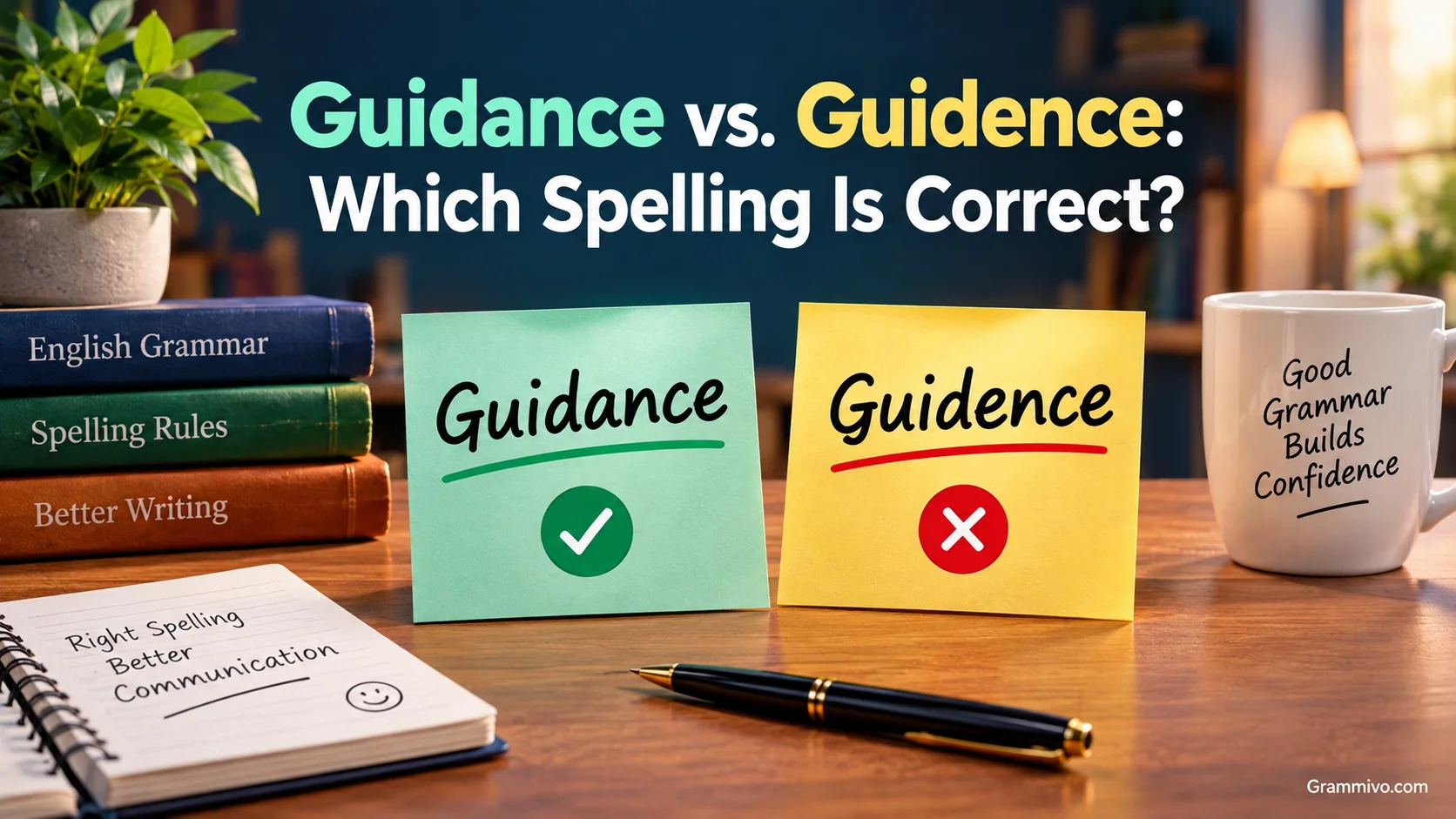
When you’re writing quickly, some words seem to invite spelling mistakes. Guidance is one of them. The word sounds as though it could end in -ence, which makes guidence look surprisingly believable. Yet only one of these spellings is correct in standard English.
The correct spelling is guidance. It means advice, direction, help, or support that helps someone make a decision or move forward. Guidence is a common misspelling and should not be used in standard American English.
This small spelling difference matters more than it might seem. You’ll often see guidance in professional emails, school documents, career advice, business communication, instructions, and formal writing. A single misplaced letter can make otherwise polished writing look careless.
Quick Answer
Guidance is the correct spelling. Guidence is incorrect.
Guidance is a noun meaning advice, direction, instruction, or support that helps someone decide what to do or how to proceed.
For example:
- Correct: The teacher gave the students valuable guidance.
- Incorrect: The teacher gave the students valuable guidence.
A simple way to remember the spelling is:
guide → guidance
The correct word keeps the “guid-” spelling and uses the ending “-ance”:
g-u-i-d-a-n-c-e
There is no standard English word spelled guidence with an -ence ending.
Comparison Overview
The difference between guidance and guidence is straightforward once you know which form English recognizes.
| Word | Correct Spelling? | Meaning | Standard Usage |
| Guidance | Yes | Advice, direction, help, or support | Standard English |
| Guidence | No | No standard meaning as this spelling | Misspelling |
The correct word, guidance, can appear in almost any situation where one person or organization helps another make a decision or take appropriate action.
For example:
The career counselor provided guidance about choosing a suitable profession.
In this sentence, guidance means helpful advice or direction.
By contrast, guidence doesn’t function as an accepted alternative spelling. If you see it in an email, article, assignment, or document, it should normally be corrected to guidance.
Main Differences Between Guidance and Guidence
The main difference is simple: guidance is correct, while guidence is incorrect.
However, understanding the reason behind the spelling makes it easier to avoid the mistake in the future.
Guidance Is the Correct Spelling
Guidance is the standard English noun formed from guide. It describes advice, direction, instruction, or assistance given to someone.
Examples include:
- A teacher gives guidance to students.
- A mentor provides guidance to a new employee.
- A counselor offers guidance about career choices.
- Parents often provide guidance to their children.
- A financial professional may offer guidance about managing money.
The word works in both everyday and formal writing.
Guidence Is a Misspelling
Guidence is not the standard spelling of the word.
People commonly make this mistake because the pronunciation doesn’t make the spelling completely obvious. English contains many nouns ending in -ence, such as difference, confidence, and existence. That pattern can make guidence look reasonable at first glance.
It isn’t.
When you mean advice, direction, or support, use guidance.
The Spelling Difference
The difference comes down to one letter:
Guidance → correct
Guidence → incorrect
The correct ending is -ance, not -ence.
This is one of those spelling details that becomes much easier when you connect the word to its base form:
guide → guidance
That connection provides a useful memory hook.
What Does Guidance Mean?
Guidance means help, advice, direction, or instruction intended to help someone make a decision or accomplish something.
The exact meaning depends on the situation.
A student might need guidance when choosing classes. An employee might need guidance when learning a new process. Someone making a major career decision might seek guidance from a counselor.
The common thread is help that points someone toward an appropriate choice or action.
Consider this example:
Maria sought guidance from her academic advisor before choosing her major.
Here, guidance refers to advice and direction that can help Maria make an informed decision.
The word doesn’t necessarily mean someone tells you exactly what to do. Often, guidance helps you understand your options so you can choose for yourself.
Guidance Can Mean Advice
In many situations, guidance is close in meaning to advice.
For example:
I asked my manager for guidance on handling the customer complaint.
The manager might explain the company’s policy, suggest an approach, or help the employee think through the situation.
Guidance Can Mean Direction
The word can also describe direction about how something should be done.
For example:
The organization issued guidance on workplace safety.
Here, guidance refers to recommendations or instructions intended to help people follow safe practices.
Guidance Can Mean Support
Sometimes guidance has a broader meaning. It can include encouragement, expertise, suggestions, and practical assistance.
A mentor, for example, might provide guidance throughout someone’s career without giving specific instructions for every decision.
That’s why guidance is a flexible word. It covers more ground than a single piece of advice.
Why Is Guidance the Correct Spelling?
The spelling guidance connects directly to the verb and noun guide.
The base word is:
guide
From this word, English forms related words such as:
- guide
- guided
- guiding
- guidance
The spelling of guidance preserves the recognizable guid- portion of guide.
The ending is -ance, giving us:
guid + ance = guidance
This doesn’t mean every English noun follows a perfectly predictable spelling pattern. English has absorbed vocabulary from many languages over centuries. As a result, spelling often requires familiarity with individual word forms.
Still, the relationship between guide and guidance provides a reliable memory aid.
Why Is “Guidence” Incorrect?
The incorrect spelling guidence usually results from a spelling assumption rather than a misunderstanding of the word’s meaning.
When people hear guidance, they may mentally associate the ending with words such as:
- confidence
- existence
- evidence
- difference
- experience
Many English words use -ence, so guidence can look plausible.
The problem is that English doesn’t allow writers to choose between -ance and -ence based only on how a word sounds.
In this case, the established spelling is guidance.
Think of it like a road sign. Several roads might look similar from a distance, but only one takes you to the right destination. The spelling guidance is the established route.
Guidance: Meaning, Grammar, and Word Forms
Understanding the grammar of guidance can help you use it naturally.
Guidance Is a Noun
Guidance functions as a noun.
For example:
Her guidance helped me make a better decision.
Here, guidance is the thing that helped the speaker.
Another example:
The students need additional guidance.
Again, guidance acts as a noun.
Is Guidance Countable or Uncountable?
In ordinary English, guidance is generally an uncountable noun.
That means you usually don’t say:
I received three guidances.
Instead, natural expressions include:
- some guidance
- helpful guidance
- professional guidance
- expert guidance
- a piece of guidance
- some useful guidance
For example:
The employee received some helpful guidance from her supervisor.
If you need to identify separate recommendations, pieces of guidance, suggestions, or recommendations may work better depending on the context.
Related Words
The word family around guidance includes several useful forms.
| Word | Part of Speech | Meaning |
| Guide | Noun/verb | A person who directs others or the act of directing |
| Guidance | Noun | Advice, direction, or support |
| Guided | Verb/adjective | Directed or led |
| Guiding | Verb/adjective | Directing or helping someone move forward |
For example:
The tour guide guided us through the museum.
The teacher provided guidance throughout the project.
Her guiding advice helped the team avoid a major mistake.
These words are related but don’t have identical grammatical roles.
How to Use Guidance Correctly
The word guidance appears in many settings. Its meaning becomes clearer when you look at the context.
Guidance for Making Decisions
People often seek guidance when a decision has several possible outcomes.
For example:
I need some guidance before deciding whether to accept the job.
The person isn’t necessarily asking someone else to make the decision. Instead, they want useful information or advice that can help them choose.
Guidance in Education
Schools and colleges frequently use the word guidance.
Examples include:
Students can seek guidance from their academic advisors.
The counselor provided guidance about college applications.
New students often need guidance when adjusting to campus life.
Educational guidance may involve academic choices, career planning, study habits, or personal development.
Guidance in the Workplace
Professional environments also rely heavily on guidance.
Consider:
The new employee asked her supervisor for guidance.
This could mean she wants help understanding a task, workplace procedure, or company expectation.
Managers also provide guidance when employees face unfamiliar problems.
Guidance in Professional Services
The word appears frequently in professional communication.
For example:
The company requested legal guidance before changing the contract.
Or:
Investors often seek professional guidance before making major financial decisions.
In these contexts, guidance can refer to informed recommendations from someone with relevant knowledge or expertise.
The word itself doesn’t guarantee that the person providing it has a particular professional qualification. The context determines that.
Common Phrases With Guidance
Some combinations occur so frequently that learning them can strengthen both vocabulary and usage.
Seek Guidance
Seek guidance means to ask for advice or direction.
If you’re unsure about the process, seek guidance from your supervisor.
Provide Guidance
Provide guidance means to give advice, direction, or assistance.
The mentor provides guidance to new professionals.
Offer Guidance
Offer guidance emphasizes making help available.
The counselor offered guidance to students who were struggling with their career choices.
Receive Guidance
Receive guidance means to get advice or direction from someone.
The team received guidance from an experienced project manager.
Follow Guidance
Follow guidance means to act according to advice or instructions.
Employees should follow the safety guidance provided by the company.
Under the Guidance of
This phrase means that someone works, learns, or develops with another person’s direction or support.
The young researcher worked under the guidance of an experienced scientist.
Professional Guidance
Professional guidance refers to advice or direction associated with professional expertise.
She sought professional guidance before making the decision.
These phrases are useful in both everyday communication and formal writing.
Read More: Than vs. Then: Meaning, and Easy Ways to Use Them Correctly
Guidance vs. Advice vs. Direction
Although guidance, advice, and direction overlap, they aren’t always interchangeable.
| Word | General Meaning | Typical Use |
| Guidance | Help or direction that assists someone | Broader support and decision-making |
| Advice | A recommendation about what someone should do | Personal or practical recommendations |
| Direction | Instructions or a particular course of action | Telling someone how or where to proceed |
Consider a student choosing a career.
A counselor might provide guidance by discussing the student’s interests, strengths, education options, and career paths.
The counselor might give advice by recommending that the student explore a particular field.
The counselor might provide direction by telling the student which application steps to complete.
The distinctions aren’t rigid. Native speakers often use these words in overlapping ways.
Guidance vs. Guidence: Common Mistakes
Spelling errors usually happen for understandable reasons. Recognizing the patterns behind them can make them easier to avoid.
Mistake: Writing “Guidence”
This is the most common problem.
Incorrect: The teacher gave us useful guidence.
Correct: The teacher gave us useful guidance.
Remember the -ance ending.
Mistake: Choosing the Ending by Sound
English pronunciation doesn’t always tell you exactly how to spell a word.
If you spell entirely by sound, you may produce guidence because the ending can sound similar to other words ending in -ence.
Instead, connect the word to its base form:
guide → guidance
Mistake: Writing “Guidances”
Because guidance refers to advice or help, writers sometimes treat it as a countable noun.
Usually, this isn’t natural:
The counselor gave me three guidances.
Better alternatives include:
The counselor gave me three pieces of guidance.
Or:
The counselor gave me three recommendations.
The best choice depends on what you’re trying to describe.
Guidance vs. Guidence Examples
Seeing the two forms side by side makes the difference easy to spot.
| Incorrect | Correct |
| She gave me helpful guidence. | She gave me helpful guidance. |
| We need professional guidence. | We need professional guidance. |
| His guidence helped the team. | His guidance helped the team. |
| The teacher offered career guidence. | The teacher offered career guidance. |
| I asked for some guidence. | I asked for some guidance. |
| The manager provided clear guidence. | The manager provided clear guidance. |
More Correct Examples
The mentor gave me valuable guidance during my first year at work.
Parents often provide guidance when children face difficult decisions.
The handbook offers guidance on workplace procedures.
She sought guidance before applying for the position.
The coach’s guidance helped the team improve its strategy.
Students can receive guidance from teachers and academic advisors.
Each example uses guidance as a noun referring to help, advice, or direction.
FAQs:
Is “guidance” or “guidence” correct?
Guidance is correct. Guidence is a misspelling.
Is “guidence” a word?
Guidence isn’t the standard English spelling of the noun meaning advice, direction, or support. Use guidance instead.
What does guidance mean?
Guidance means advice, direction, instruction, or support that helps someone make a decision or take action.
How do you spell guidance?
The correct spelling is:
G-U-I-D-A-N-C-E
Why do people spell guidance as guidence?
The mistake often comes from the pronunciation of the word and confusion between the endings -ance and -ence.
Words such as confidence and difference may make guidence look plausible. However, the established spelling is guidance.
Conclusion:
When it comes to guidance vs. guidence, the correct spelling is guidance. It refers to advice, direction, support, or instruction that helps someone make a decision or move forward. Guidence is a common spelling mistake and isn’t an accepted alternative.
The easiest way to remember the correct form is to connect it with guide: guide → guidance. The word uses the -ance ending, not -ence.
