
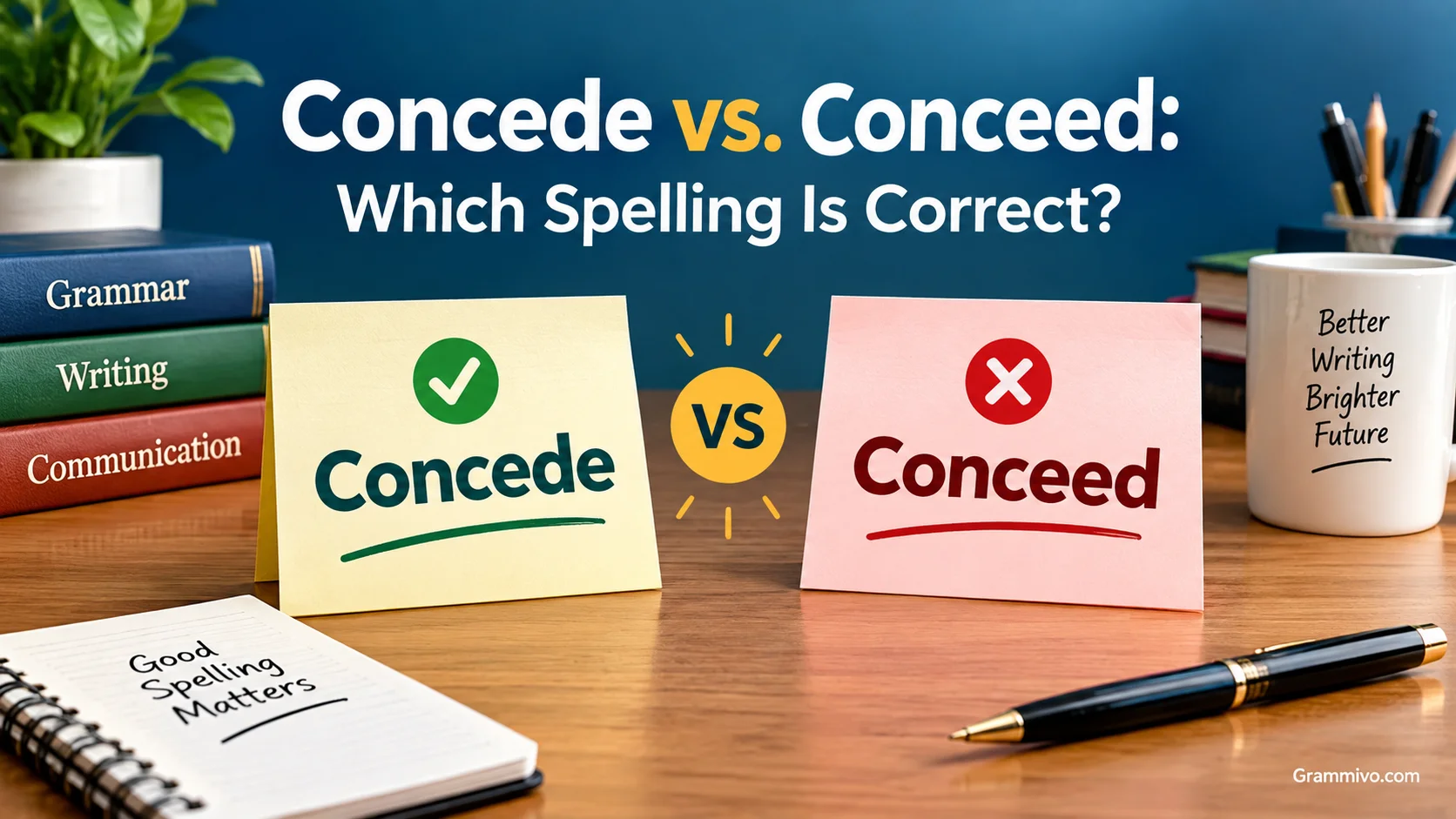
Concede vs. Conceed can confuse English learners because the letters and spelling look similar, but concede is the correct spelling and standard English verb, while Conceed is an incorrect misspelling. The meaning of concede is to admit something is true, accept that you have lost an argument or competition, or give something to someone after resisting.
Learners may also confuse its forms, especially when adding -ed to the base verb. The standard spelling has one e after the c and another e at the end, while its past-tense form is conceded.The common mix-up between conceded and conceited happens because these words look almost identical, although their pronunciation, English sounds, and completely different meanings set them apart.
Conceded means accepting defeat, admitting something, or giving in, whereas conceited describes a person who thinks too highly of themselves. Students can mix up these terms in writing, speaking, and conversation, causing the wrong word to change the entire meaning of a sentence and make it hard for native speakers to make sense of it.
Quick Answer
Concede is the correct spelling. Conceed is incorrect.
The word concede is a verb that commonly means to admit something is true, acknowledge another person’s point, accept defeat, or give something up.
For example:
After reviewing the evidence, he conceded that his original argument was wrong.
You might also see it in sports:
The team conceded two goals during the second half.
The incorrect form conceed should not be used in standard English.
A simple way to remember the spelling is:
Concede → cede
The word contains -cede, not -ceed.
Comparison Overview
| Word | Correct Spelling? | Meaning | Example |
| Concede | Yes | To admit, acknowledge, yield, or allow something | She conceded that he had a valid point. |
| Conceed | No | Misspelling of concede | He conceeded his mistake. |
| Conceded | Yes | Past tense of concede | They conceded defeat. |
| Conceding | Yes | Present participle of concede | The team is conceding too many goals. |
The important distinction is straightforward. Concede is an established English verb, while conceed is simply an incorrect spelling.
Main Differences Between Concede vs. Conceed
The biggest difference between concede vs. conceed is that only one of them is a standard English word.
Concede Is the Correct Word
Concede is spelled:
C-O-N-C-E-D-E
It has the ending -cede.
Examples include:
- I concede that you were right.
- The team conceded three goals.
- She refused to concede defeat.
- He conceded the point after hearing the evidence.
The word works naturally in both everyday and formal English.
Conceed Is a Misspelling
Conceed adds an unnecessary e after the c:
C-O-N-C-E-E-D
That spelling is incorrect in standard English.
For example:
- He conceeded that she was right.
- He conceded that she was right.
The same problem appears when people try to form the past tense.
- The candidate conceeded the election.
- The candidate conceded the election.
Why the Mistake Happens
English spelling doesn’t always behave like a tidy mathematical formula. That’s especially true with words ending in -cede and -ceed.
You have words such as:
- proceed
- exceed
- succeed
- recede
- concede
- precede
Because -ceed appears in several familiar words, writers sometimes assume that concede follows the same pattern.
It doesn’t.
The correct spelling is concede.
What Does “Concede” Mean?
Concede has several related meanings. At its heart, the word involves accepting, admitting, yielding, or allowing something.
The surrounding context tells you which meaning applies.
Concede Means to Admit Something
One common meaning is to admit that something is true, correct, or valid, especially when you initially disagreed.
For example:
After checking the figures, Maria conceded that her calculation was incorrect.
Maria doesn’t necessarily enjoy admitting the mistake. That’s part of the flavor of concede. The word often suggests that someone gives ground after resistance or consideration.
Another example:
He conceded that the proposal had several advantages.
Here, he acknowledges a positive point about the proposal.
Concede Means to Accept Someone Else’s Point
You can also concede a point during an argument or discussion.
For example:
I concede your point, but I still disagree with the overall conclusion.
This sentence is useful because it shows that conceding one point doesn’t require agreeing with everything.
You might acknowledge one valid argument while maintaining your broader position.
Concede Means to Accept Defeat
In competitions, elections, and disputes, concede can mean accepting that you’ve lost.
For example:
The candidate conceded the election after the final results were announced.
Similarly:
The boxer conceded defeat after the injury became too severe.
In this sense, conceding means recognizing the outcome rather than continuing to claim victory.
Concede Means to Give Something Up
The verb can also mean to yield or surrender something, such as territory, control, or an advantage.
For example:
The company refused to concede control of the project.
You could also say:
The government conceded several demands during the negotiations.
Here, the word describes giving ground in a negotiation.
Concede Means to Allow an Opponent to Score
Sports writers frequently use concede in a more specialized sense.
If a soccer team allows the opposing team to score, it concedes a goal.
For example:
The defense conceded two goals before halftime.
The same basic idea appears in other sports:
- A basketball team can concede points.
- A cricket team can concede runs.
- A soccer team can concede goals.
- A tennis player can concede points or games.
The meaning is essentially allowing the opposing side to gain something.
How to Use “Concede” Correctly
Knowing the definition is helpful. Knowing its common grammatical patterns is even better.
Concede + That-Clause
One of the most common structures is:
concede + that + statement
Examples:
- She conceded that the plan was expensive.
- He conceded that his opponent had a stronger argument.
- The manager conceded that the deadline was unrealistic.
- They conceded that the original estimate was too low.
This structure works particularly well when someone acknowledges an uncomfortable or opposing fact.
Concede + Noun
You can place a noun directly after concede.
Examples:
- The team conceded three goals.
- The company conceded the point.
- The politician conceded defeat.
- The player conceded the match.
The exact meaning depends on the noun that follows.
Concede defeat means accept that you’ve lost.
Concede a point means accept that another person’s argument or position has merit.
Concede a goal means allow the opposing team to score.
Concede to Someone
The structure concede to can describe yielding to another person or group.
For example:
After hours of negotiation, the company conceded to the workers’ demands.
Another example:
She eventually conceded to her opponent’s request.
In many situations, however, English speakers may choose a more specific verb such as agree, yield, or give in. The best choice depends on the context and intended tone.
Concede Something to Someone
Another useful construction is:
concede something to someone
For example:
The team conceded the advantage to its rival.
This structure emphasizes what was given up and who received it.
Concede in Sports and Competitions
Sports coverage uses concede constantly because competitions involve scoring, advantages, and defeat.
Consider this sentence:
The defense conceded a goal in the final minute.
It doesn’t mean the defenders verbally admitted something. Instead, it means they allowed the opposing team to score.
Here are some common sports combinations:
| Phrase | Meaning |
| Concede a goal | Allow an opposing team to score a goal |
| Concede a point | Allow an opponent to gain a point |
| Concede runs | Allow the opposing side to score runs |
| Concede defeat | Accept that you’ve lost |
| Concede the match | Accept or acknowledge the loss of a match |
Why Sports Writers Prefer “Concede”
The word is especially useful because it captures the idea of allowing an opponent to gain an advantage.
For example:
The defense played well but conceded three goals.
That sounds more precise than simply saying:
The defense gave the other team three goals.
The latter can sound as though the team deliberately handed them over. Concede doesn’t necessarily imply deliberate action.
Concede in Elections and Politics
You’ll also encounter concede frequently in election coverage.
When a candidate concedes an election, the candidate acknowledges that another candidate has won or that the race has effectively been decided.
For example:
The losing candidate conceded the race after the final results became clear.
This doesn’t necessarily mean every legal or administrative step has finished. Rather, it means the candidate accepts the political outcome and stops pursuing victory.
The word also appears in political debates:
The senator conceded that the proposal needed further changes.
Here, the senator acknowledges a weakness without necessarily abandoning the entire proposal.
Concede vs. Admit
Concede and admit overlap, but they aren’t always interchangeable.
Admit is broader and more common. You can admit a fact, mistake, secret, or wrongdoing.
Concede often carries the idea of giving ground, especially after disagreement.
Compare these sentences:
She admitted that she had made a mistake.
She conceded that her opponent had a stronger argument.
The first sentence simply reports an admission.
The second suggests that she had previously resisted the opposing position or had reason to challenge it.
A useful distinction is:
Admit = acknowledge something as true.
Concede = acknowledge or yield a point, often reluctantly or after resistance.
Read More: Humorous vs. Humerous: Which Spelling Is Correct?
Concede vs. Acknowledge
Acknowledge can also mean recognizing something as true or valid.
However, it often sounds more neutral.
For example:
The report acknowledged the project’s financial risks.
This doesn’t necessarily suggest reluctance.
Now compare:
The manager conceded that the project had serious financial risks.
The second sentence can suggest that the manager gave ground after initially minimizing or disputing those risks.
So while the words overlap, concede often has a stronger sense of yielding.
Concede vs. Surrender
These words are related but carry different shades of meaning.
Surrender usually suggests giving up completely or yielding to an opposing force.
Concede can be much less dramatic.
For example:
The army surrendered after the city was surrounded.
That’s a complete military defeat.
By contrast:
The negotiator conceded one point during the discussion.
The negotiator hasn’t necessarily lost everything. They simply gave ground on one issue.
Think of it this way:
Surrender can mean giving up the whole battle.
Concede can mean giving up one square on the chessboard.
Concede vs. Confess
These words shouldn’t be treated as synonyms.
Confess commonly involves admitting something secret, wrong, or blameworthy.
For example:
He confessed to stealing the money.
Concede, on the other hand, doesn’t require wrongdoing.
For example:
He conceded that his opponent had a better strategy.
There is no confession of misconduct here. He simply acknowledges the strength of another person’s position.
Concede Pronunciation
Concede is pronounced:
/kənˈsiːd/
A simple pronunciation guide is:
kuhn-SEED
The stress falls on the second syllable.
The ending sounds like the word seed.
For example:
concede → kuhn-SEED
Don’t let the pronunciation influence the spelling. Although the final sound resembles -ceed, the correct written form is -cede.
This is one reason the spelling can trip people up.
Concede: Past Tense and Other Forms
The verb concede follows regular verb patterns, but its spelling changes slightly when different endings are added.
| Verb Form | Correct Spelling | Example |
| Base form | concede | They concede the argument. |
| Third-person singular | concedes | She concedes the point. |
| Past tense | conceded | He conceded defeat. |
| Present participle | conceding | They are conceding too much. |
Conceded
The past tense is conceded, not conceeded.
Notice what happens:
concede → conceded
The final e remains part of the base spelling, while the spelling changes according to the normal -ed formation.
Examples:
- She conceded the point.
- He conceded defeat.
- The candidate conceded the race.
- The team conceded two goals.
Conceding
The present participle is conceding.
Examples:
- The team is conceding too many goals.
- He is conceding that the evidence is strong.
- They are conceding ground to their competitors.
The correct form is conceding, not conceeding.
Why Do People Spell Concede as Conceed?
The mistake usually comes from English spelling patterns.
Several familiar verbs contain -ceed:
- proceed
- exceed
- succeed
That creates a strong visual pattern in the reader’s mind.
Someone who knows these words might naturally think:
proceed → concede → conceed
Unfortunately, English doesn’t always reward pattern matching.
Other related-looking words use -cede:
- recede
- precede
- intercede
- secede
- concede
The important point isn’t memorizing a complicated linguistic rule. It’s recognizing the correct spelling of concede.
FAQs:
Is “concede” the correct spelling?
Yes. Concede is the correct spelling and a standard English verb. Conceed is a misspelling and should not be used in standard writing.
What does “concede” mean?
Concede can mean to admit that something is true, accept defeat, or give something up after resisting. For example, a team may concede defeat after losing a competition.
Is “conceed” a real English word?
No. Conceed is not the standard spelling of the English verb. If you want to express the idea of admitting something or accepting defeat, use concede.
What is the past tense of “concede”?
The past tense is conceded. For example: “The team conceded defeat after a difficult match.” The spelling changes by adding -d, not by writing “conceeded.”
What is the difference between “conceded” and “conceited”?
Conceded means admitted something, accepted defeat, or gave in. Conceited describes someone who has an overly high opinion of themselves. Although the words look similar, their meanings are completely different.
Conclusion:
Concede is the correct spelling, while conceed is incorrect. Remember that concede can mean to admit something, accept defeat, or give something up. Its past tense is conceded, which should not be confused with conceited. Keeping these meanings and spellings separate will help you write more clearly and avoid a common English spelling mistake.
