
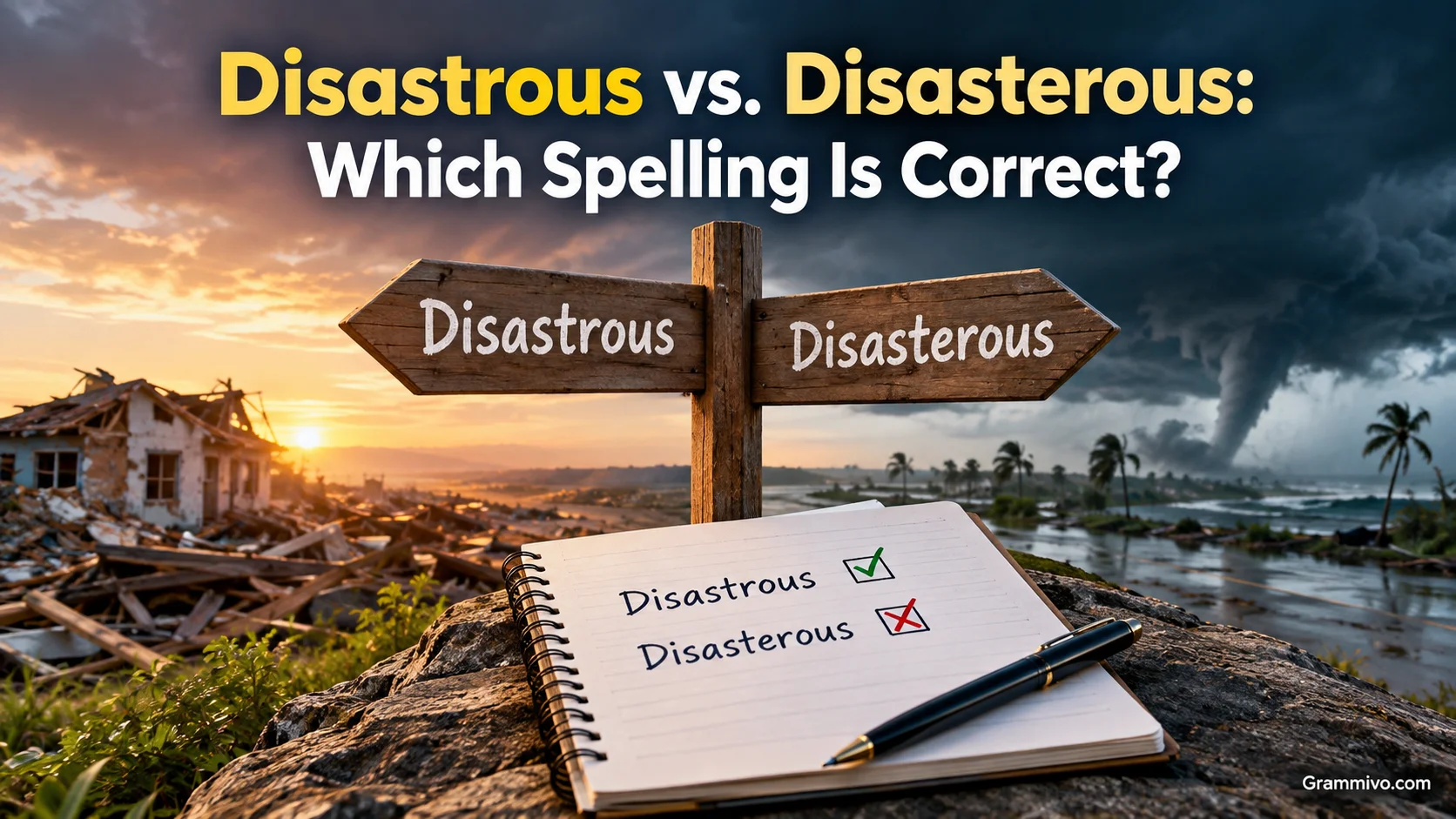
Disastrous vs. Disasterous: the correct spelling is disastrous, while disasterous is a common misspelling caused by the noun disaster and its “-ter” ending. The adjective takes the adjective ending “-ous,” creating a small word change when the suffix is added.
English spelling doesn’t always let you mirror the original noun, so disastrous is the correct form in standard English, including British English, American English, and standard American English. The extra “e” makes disasterous a common mistake and the wrong choice in formal English writing.
This spelling difference is easy to overlook, but noticing the change makes the word easier to use correctly.A simple guide is to remember that disastrous is used in school writing, business communication, professional documents, an email, a school assignment, an article, a report, and any polished sentence.
Quick Answer
Disastrous is the correct spelling.
Disasterous is incorrect in standard English and is generally a misspelling of disastrous.
The word disastrous is an adjective that describes something extremely harmful, damaging, unsuccessful, or likely to produce very bad results.
For example:
- Correct: The storm caused disastrous damage.
- Incorrect: The storm caused disasterous damage.
- Correct: The company made a disastrous decision.
- Incorrect: The company made a disasterous decision.
A simple way to remember it is:
A disaster can be disastrous.
Notice that disastrous drops the “e” found in disaster.
Comparison Overview
| Word | Correct Spelling? | Part of Speech | Meaning | Example |
| Disastrous | Yes | Adjective | Extremely harmful, damaging, or unsuccessful | The decision had disastrous consequences. |
| Disasterous | No | — | Common misspelling of disastrous | Avoid this spelling in formal writing. |
| Disaster | Yes | Noun | A major event or situation causing serious harm | The flood was a disaster. |
The key distinction is simple: disaster is a noun, while disastrous is an adjective.
You might say, “The earthquake was a disaster.” You could then describe its consequences as “disastrous.”
Main Differences Between Disastrous vs. Disasterous
The main difference isn’t one of meaning. It’s one of correct spelling.
Disastrous is the standard adjective. Disasterous is not the standard spelling of the word.
Disastrous Is the Correct Spelling
Disastrous describes something that causes or involves great harm, damage, failure, or negative consequences.
For example:
- The company experienced a disastrous financial year.
- The hurricane had disastrous effects on the coastline.
- Their first attempt at the project was disastrous.
- The policy produced disastrous results.
- Missing the deadline could have disastrous consequences.
The word can describe both physical destruction and figurative failure.
A storm can have disastrous effects, but so can a bad business decision. That’s one reason the word appears in many different types of writing.
Disasterous Is a Misspelling
Disasterous looks reasonable at first glance because it resembles the noun disaster.
That’s exactly where the trap lies.
A writer may think:
disaster + ous = disasterous
English spelling doesn’t always work that neatly. The accepted adjective is:
disastrous
The “e” disappears before the -ous ending.
So if you’re writing professionally, academically, or publicly, choose disastrous.
What Does Disastrous Mean?
Disastrous means extremely harmful, damaging, unsuccessful, or destructive.
It often describes something that produces serious negative consequences.
Consider these examples:
- A disastrous flood causes widespread damage.
- A disastrous investment results in major financial losses.
- A disastrous decision creates serious problems.
- A disastrous performance falls far below expectations.
- A disastrous mistake produces severe consequences.
The word doesn’t always describe a literal disaster. That’s an important point.
Disastrous Can Describe Physical Events
Natural events can be disastrous when they cause widespread destruction or suffering.
For example:
The hurricane had disastrous consequences for several coastal communities.
Here, disastrous refers to serious physical and social effects.
Other examples include:
- disastrous flooding
- disastrous wildfires
- disastrous earthquakes
- disastrous storms
- disastrous accidents
Disastrous Can Describe Failure
The word also works for situations that don’t involve physical destruction.
Imagine a company launches a product that nobody wants. Sales collapse, customers complain, and the company loses millions of dollars.
You could describe the launch as disastrous.
Likewise:
The team’s disastrous performance ended its championship hopes.
Nothing physically exploded. The word simply emphasizes how severe the failure was.
Disastrous Can Describe Consequences
One of the most common uses is the phrase disastrous consequences.
For example:
Ignoring the safety warnings could have disastrous consequences.
This construction works because the adjective describes the seriousness of the consequences.
Other natural combinations include:
- disastrous results
- disastrous effects
- disastrous consequences
- disastrous decision
- disastrous failure
- disastrous mistake
- disastrous outcome
- disastrous situation
- disastrous performance
Why Is “Disasterous” So Commonly Misspelled?
The mistake becomes easier to understand when you look at the noun disaster.
The noun is spelled:
D-I-S-A-S-T-E-R
When people want to form the adjective, they may instinctively preserve the entire spelling and add -ous:
disaster + ous → disasterous
That looks logical. Unfortunately, it’s not the accepted spelling.
The correct form is:
D-I-S-A-S-T-R-O-U-S
The e disappears.
The Spelling Pattern Behind Disastrous
The word disastrous comes from disaster, but its spelling doesn’t simply preserve every letter of the noun.
This is a useful reminder that English word formation can be less predictable than it appears.
You can’t always create a correct adjective by taking a noun and adding a suffix mechanically. Historical development, pronunciation, and established spelling patterns all influence modern English.
That’s why memorizing the standard form is useful here.
Disastrous vs. Disaster: Noun vs. Adjective
Understanding the grammatical difference between disaster and disastrous makes the spelling easier to remember.
| Word | Grammar | Meaning | Example |
| Disaster | Noun | A major harmful event or situation | The earthquake was a disaster. |
| Disastrous | Adjective | Extremely harmful or unsuccessful | The earthquake had disastrous effects. |
A noun names something.
An adjective describes something.
Compare these sentences:
The flood was a disaster.
The flood caused disastrous damage.
In the first sentence, disaster names the situation.
In the second, disastrous describes the damage.
How the Two Words Work Together
The relationship can be remembered with one sentence:
The disaster had disastrous consequences.
The first word identifies the event.
The second describes its effects.
That distinction is useful because it also reinforces the correct spelling. When you switch from disaster to disastrous, don’t carry the “e” into the adjective.
How to Spell Disastrous Correctly
The correct spelling is:
D-I-S-A-S-T-R-O-U-S
A useful visual breakdown is:
dis + astr + ous
The spelling ends with -trous, not -terous.
If you frequently write the word, pay particular attention to the middle:
disastrous
not:
disasterous
A Simple Spelling Trick
Use this sentence:
A disaster can be disastrous.
This works because it puts both forms together.
Disaster = noun.
Disastrous = adjective.
The phrase also makes the spelling difference visually obvious.
Another Way to Remember It
Think of the adjective as:
disastr + ous
rather than:
disaster + ous
That small mental adjustment can prevent the extra “e” from sneaking into your writing.
Disastrous Pronunciation
The pronunciation of disastrous can also help you recognize the word.
A common American English pronunciation is approximately:
dih-ZAS-trus
The middle syllable receives the main stress.
The pronunciation doesn’t sound like someone is clearly saying the full word disaster followed by -ous. That can help explain why the written form doesn’t preserve the “e.”
Remember, though, that pronunciation alone isn’t a reliable spelling guide in English. Words such as enough, though, and through prove that English spelling can be full of surprises.
Disastrous in a Sentence
Seeing the word in context is one of the fastest ways to understand how it works.
Everyday Examples
- The sudden storm caused disastrous damage to the town.
- His decision to ignore the warning proved disastrous.
- The trip started well but ended in a disastrous accident.
- Their attempt to repair the machine was disastrous.
- The mistake had disastrous consequences.
Business Examples
- The company made a disastrous investment.
- Poor planning led to disastrous financial losses.
- The product launch was disastrous for the brand.
- The merger became a disastrous business decision.
- A shortage of supplies could have disastrous effects on production.
Academic Examples
- Poor preparation resulted in a disastrous exam performance.
- The experiment produced disastrous results.
- Ignoring the research findings could have disastrous consequences.
- The student’s first approach proved disastrous, so she changed her strategy.
Sports Examples
- The team suffered a disastrous defeat.
- A slow start put the players in a disastrous position.
- Two defensive mistakes led to a disastrous second half.
- The injury had a disastrous effect on the team’s season.
Read More: Concede vs. Conceed: Which Spelling Is Correct?
Common Uses of Disastrous
Certain word combinations appear especially often with disastrous.
Disastrous Consequences
Disastrous consequences refers to extremely serious negative results.
Ignoring the safety regulations could have disastrous consequences.
This phrase works well in professional, academic, and general writing.
Disastrous Results
Use disastrous results when an action, experiment, strategy, or decision produces very poor outcomes.
The company changed its pricing strategy and experienced disastrous results.
Disastrous Effects
This phrase emphasizes the impact something has on people, systems, environments, or situations.
The chemical spill had disastrous effects on the local ecosystem.
Disastrous Decision
A disastrous decision is a choice that causes severe problems.
Selling the property without reviewing the contract was a disastrous decision.
Disastrous Failure
This phrase emphasizes a particularly severe or embarrassing failure.
The project ended in disastrous failure after months of poor planning.
Disastrous vs. Catastrophic
Disastrous and catastrophic overlap considerably, but they’re not always interchangeable.
Catastrophic often suggests an exceptionally severe event or outcome. Disastrous can describe serious failure or harm on a smaller scale.
Compare:
The earthquake had catastrophic consequences.
The company’s expansion strategy was disastrous.
The first sentence suggests enormous destruction.
The second describes severe business failure.
Both words communicate serious negative outcomes, but catastrophic often carries greater intensity.
Disastrous vs. Devastating
Devastating emphasizes the powerful impact something has on people, places, or situations.
For example:
The hurricane had a devastating impact on the community.
You could also say:
The hurricane had disastrous consequences.
The meanings overlap, but devastating often carries a stronger emotional sense of destruction or loss.
Synonyms for Disastrous
The best synonym depends on the context.
| Synonym | Typical Meaning |
| Catastrophic | Extremely severe or destructive |
| Devastating | Causing overwhelming damage or emotional impact |
| Destructive | Causing physical or figurative damage |
| Ruinous | Causing severe financial or practical damage |
| Calamitous | Involving serious disaster or misfortune |
| Terrible | Very bad, though less precise |
| Damaging | Causing harm or negative effects |
| Unsuccessful | Failing to achieve a desired result |
For instance, ruinous works especially well with financial situations:
The company faced ruinous losses.
Meanwhile, catastrophic suits large-scale events:
The region suffered catastrophic flooding.
Choosing the right synonym adds precision instead of simply making the sentence sound more dramatic.
Antonyms of Disastrous
The opposite of disastrous depends on what you’re describing.
Useful antonyms include:
- Successful
- Beneficial
- Favorable
- Advantageous
- Positive
- Fortunate
- Effective
- Promising
For example:
The new strategy produced disastrous results.
The opposite could be:
The new strategy produced successful results.
Or:
The new strategy produced positive results.
The best choice depends on the specific meaning you want to convey.
Common Mistakes With Disastrous
Mistake: Writing “Disasterous”
This is the most common error.
Incorrect:
The project had a disasterous outcome.
Correct:
The project had a disastrous outcome.
The solution is simple: remove the e.
Mistake: Treating Disaster and Disastrous as the Same Grammar
These words don’t perform the same grammatical job.
Incorrect:
The situation was a disastrous.
Correct:
The situation was a disaster.
Correct:
The situation was disastrous.
Use disaster as a noun and disastrous as an adjective.
Mistake: Assuming Every Related Word Keeps the Same Spelling
English contains many word families where spelling changes when forms develop.
That’s why you shouldn’t assume:
disaster + ous = disasterous
Instead, remember the established form:
disastrous
FAQs:
Is “disastrous” the correct spelling?
Yes. Disastrous is the correct spelling in standard English. Disasterous is a common misspelling and should be avoided in formal writing.
Is “disasterous” ever correct?
No. Disasterous is not the standard spelling. Although it may look logical because it comes from disaster, the accepted adjective is disastrous.
Why is “disastrous” spelled without the “e”?
English spelling sometimes changes a word when a suffix is added. In this case, disaster becomes disastrous, rather than disasterous. Remembering this change can help you avoid the common mistake.
What does “disastrous” mean?
Disastrous means extremely bad, harmful, or unsuccessful. For example, you might describe a failed project, severe accident, or terrible decision as disastrous.
What are some alternatives to “disastrous”?
Depending on the context, you can use words such as catastrophic, devastating, terrible, ruinous, or disastrous. However, each word can have a slightly different level of meaning, so choose the one that best fits your sentence.
Conclusion:
Disastrous is the correct spelling, while disasterous is a misspelling. The easiest way to remember it is to notice that the e in disaster disappears before the -ous ending. Whether you’re writing an email, school assignment, article, or professional document, using disastrous will keep your spelling accurate and polished.
