If you’ve ever paused while writing a sentence like “The company changed its policy”, you’re not alone. The difference between its and it’s looks tiny, but that little apostrophe completely changes the meaning and grammatical role of the word.
The confusion becomes even greater because its and it’s sound the same when spoken. You can’t rely on pronunciation to choose the correct form. You need to look at what the sentence actually means.
The good news is that the rule is surprisingly simple once you understand it. Its shows possession or association, while it’s is a contraction of it is or it has. Once you learn how to test the sentence, choosing the right form becomes almost automatic.
Whether you’re writing an email, school assignment, blog post, business report, or casual message, knowing the difference between its vs. it’s will make your writing cleaner and more professional.
Quick Answer
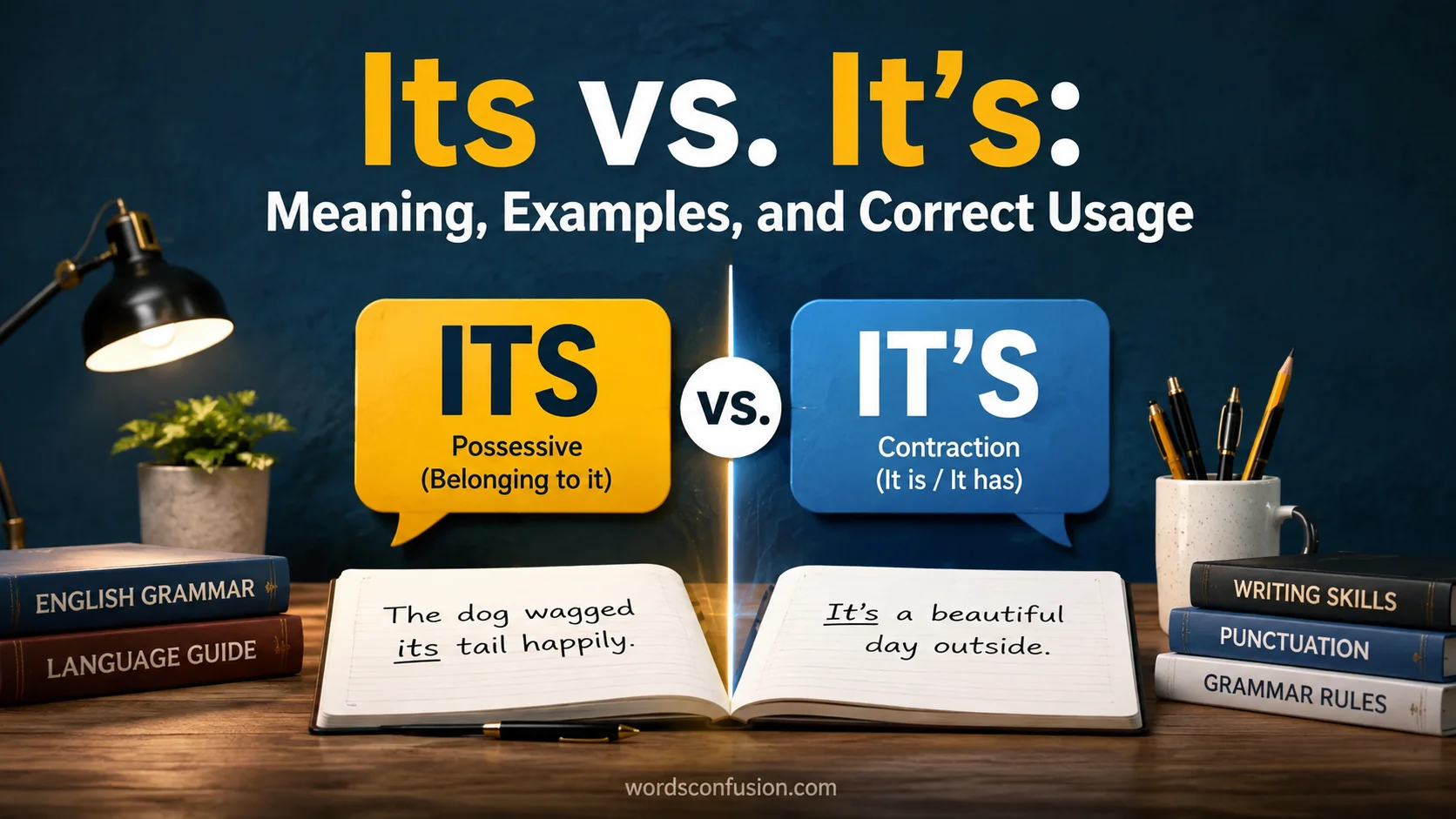
Its is the possessive form used to show that something belongs to or is associated with something previously mentioned.
- The dog wagged its tail.
- The company changed its logo.
- The phone lost its connection.
It’s is a contraction of it is or it has.
- It’s cold today. → It is cold today.
- It’s a beautiful house. → It is a beautiful house.
- It’s been a difficult week. → It has been a difficult week.
The easiest rule is this:
If you can replace “it’s” with “it is” or “it has,” use “it’s.” If you’re showing possession or association, use “its.”
Comparison Overview
The difference between its and it’s becomes much easier when you compare their grammatical jobs.
| Feature | Its | It’s |
| Main function | Shows possession or association | Forms a contraction |
| Meaning | Belonging to it | It is / It has |
| Apostrophe | No | Yes |
| Example | The cat licked its paw. | It’s sleeping. |
| Expanded form | Not applicable | It is / It has |
| Usually followed by | A noun | Adjective, noun phrase, verb, or other complement |
| Possessive? | Yes | No |
| Contraction? | No | Yes |
| Example with “has” | Not applicable | It’s been repaired. |
One detail deserves special attention: it’s can represent two different phrases.
It’s = it is
It’s getting dark.
It’s = it has
It’s already started.
Meanwhile, its remains the possessive form:
The machine has lost its power.
Main Differences Between Its vs. It’s
The biggest difference between its vs. it’s isn’t the apostrophe itself. The real difference lies in meaning and grammatical function.
Its Shows Possession or Association
Its tells you that something belongs to, comes from, or relates to a thing or entity.
For example:
The dog lifted its paw.
The paw belongs to the dog. Therefore, its is correct.
Consider another example:
The company updated its website.
The website belongs to or is associated with the company. Again, its is the correct form.
The relationship doesn’t always have to mean literal ownership. Its can describe a strong connection or association.
- The tree lost its leaves.
- The computer restarted its system.
- The country changed its laws.
- The restaurant updated its menu.
- The university revised its admission policy.
In each sentence, its connects the noun that follows it to something already identified by it.
It’s Means It Is
It’s commonly represents it is.
For example:
It’s cold outside.
Expand the contraction:
It is cold outside.
The sentence still makes perfect sense. That tells you it’s is correct.
Here are more examples:
- It’s important to practice.
- It’s a difficult question.
- It’s getting late.
- It’s surprisingly easy.
- It’s the best option.
- It’s unusual for this time of year.
Try expanding each one:
- It is important to practice.
- It is a difficult question.
- It is getting late.
- It is surprisingly easy.
- It is the best option.
- It is unusual for this time of year.
The meaning stays intact.
It’s Can Also Mean It Has
This is one of the most important details people often miss when learning its vs. it’s.
It’s can also be a contraction of it has.
For example:
It’s been a long day.
This means:
It has been a long day.
Another example:
It’s already started.
This means:
It has already started.
You’ll often see this construction when has acts as an auxiliary verb followed by a past participle.
Examples include:
- It’s been raining.
- It’s changed considerably.
- It’s already happened.
- It’s become more popular.
- It’s finally finished.
- It’s stopped working.
So the complete rule is:
It’s = it is or it has.
That small addition makes the rule much more accurate.
What Does “Its” Mean?
Its is a possessive determiner. It shows that something belongs to or is connected with it.
Think of it as the equivalent of possessive forms such as his, her, or their when the antecedent is it.
Compare these sentences:
- The boy lost his wallet.
- The girl lost her wallet.
- The company lost its customer.
- The students lost their notes.
The possessive forms don’t need apostrophes.
Examples of Its in Sentences
Here are several examples from different contexts:
The bird spread its wings.
The car lost its balance on the wet road.
The business changed its opening hours.
The phone has lost its signal.
The tree has shed its leaves.
The country announced its new policy.
The machine stopped because its engine overheated.
The website improved its loading speed.
The dog found its toy under the couch.
The company protected its intellectual property.
Notice the pattern. In every sentence, its comes before something associated with the thing being discussed.
Why Doesn’t “Its” Have an Apostrophe?
This question causes a lot of confusion because English commonly uses apostrophes to indicate possession.
For example:
- Sarah’s book
- The dog’s collar
- The company’s office
- The student’s notebook
So why don’t we write it’s when showing possession?
Because its belongs to a group of possessive forms that don’t use apostrophes.
Compare:
| Personal reference | Possessive form |
| he | his |
| she | her |
| they | their |
| you | your |
| it | its |
The apostrophe in it’s doesn’t indicate possession. It indicates that letters have been omitted from it is or it has.
That distinction is crucial.
Its → possessive
It’s → contraction
The apostrophe is actually telling you that something has been shortened.
What Does “It’s” Mean?
It’s has two standard meanings.
It’s = It Is
This is the most familiar use.
It’s difficult.
Means:
It is difficult.
Another example:
It’s a great opportunity.
Means:
It is a great opportunity.
You can use this test whenever you’re unsure.
Replace it’s with it is. If the sentence still works naturally, it’s is probably correct.
It’s = It Has
The second use involves it has.
It’s been raining all morning.
Means:
It has been raining all morning.
Here, replacing it’s with it is creates an incorrect sentence:
It is been raining all morning. ❌
But:
It has been raining all morning. ✓
Therefore, it’s means it has in this sentence.
The Easiest Way to Remember Its vs. It’s
When you’re stuck between its and it’s, don’t stare at the apostrophe. Use a replacement test.
Test One: Replace It’s With “It Is”
Take the sentence:
It’s a beautiful morning.
Replace it:
It is a beautiful morning.
It works. Therefore, it’s is correct.
Try another:
It’s getting colder.
→ It is getting colder.
Again, it works.
Test Two: Replace It’s With “It Has”
Now consider:
It’s been repaired.
Try both possibilities:
It is been repaired. ❌
It has been repaired. ✓
So the correct form is it’s.
Test Three: Look for Possession
Now take:
The company changed its name.
Try replacing its with it is:
The company changed it is name. ❌
Try it has:
The company changed it has name. ❌
Neither works. The sentence expresses association or possession.
Therefore:
The company changed its name. ✓
This three-step approach works remarkably well.
Its vs. It’s Examples
Understanding the rule is useful. Seeing it repeatedly in realistic sentences makes it stick.
Examples of Its
- The cat cleaned its fur.
- The school updated its website.
- The company increased its prices.
- The tree stretched its branches toward the sunlight.
- The phone lost its connection.
- The restaurant changed its menu.
- The car needs its tires replaced.
- The country announced its decision.
- The computer completed its update.
- The organization published its annual report.
Each sentence expresses a relationship between something and the thing identified as it.
Examples of It’s Meaning “It Is”
- It’s too late to call.
- It’s a beautiful painting.
- It’s difficult to explain.
- It’s getting warmer.
- It’s important to listen.
- It’s not the right answer.
- It’s almost midnight.
- It’s better than expected.
- It’s an interesting idea.
- It’s surprisingly affordable.
Examples of It’s Meaning “It Has”
- It’s been a busy week.
- It’s already started.
- It’s changed since yesterday.
- It’s become more common.
- It’s finally stopped.
- It’s happened before.
- It’s grown significantly.
- It’s improved over time.
- It’s been repaired.
- It’s disappeared completely.
Its vs. It’s in Different Sentence Patterns
Sentence structure can provide a useful clue.
Its + Noun
When its shows possession or association, it commonly comes directly before a noun.
- its color
- its size
- its purpose
- its owner
- its shape
- its name
- its website
- its price
- its location
- its history
Examples:
The company changed its name.
The animal protected its young.
The device reached its limit.
It’s + Adjective
When it’s means it is, an adjective can follow it.
It’s difficult.
It’s expensive.
It’s beautiful.
It’s unusual.
It’s dangerous.
The pattern makes the distinction easier to spot.
It’s + Noun Phrase
It’s can also mean it is before a noun phrase.
It’s a mistake.
It’s an old building.
It’s the correct answer.
It’s a useful tool.
Don’t confuse this with possession.
Compare:
It’s a company.
Here, it’s = it is.
But:
The company changed its policy.
Here, its = possession or association.
It’s + Verb Ending in -ing
This is another strong clue that it’s means it is.
It’s raining.
It’s snowing.
It’s moving.
It’s changing.
It’s working.
You can expand these sentences:
It is raining.
It is changing.
It is working.
It’s + Been
When you see it’s been, the contraction usually means it has been.
It’s been a long journey.
It’s been difficult.
It’s been repaired.
It’s been several years.
This construction is especially useful when distinguishing it’s from its.
FAQs:
What is the difference between its and it’s?
Its shows possession or association. It’s is a contraction meaning it is or it has.
Is “its” possessive?
Yes. Its is the possessive form associated with it.
For example:
The company changed its policy.
Is “it’s” possessive?
No. It’s isn’t the possessive form. It’s a contraction of it is or it has.
Can “it’s” mean “it has”?
Yes. For example:
It’s been a difficult year.
This means:
It has been a difficult year.
Why doesn’t “its” have an apostrophe?
Because its is a possessive form that doesn’t use an apostrophe. The apostrophe in it’s indicates omitted letters in it is or it has.
Conclusion:
Understanding its vs. it’s becomes much easier when you focus on what the word means rather than where the apostrophe appears. Its shows possession or association, as in “The dog wagged its tail,” while it’s is a contraction of it is or it has, as in “It’s raining” or “It’s been a long day.” When you’re unsure, replace it’s with “it is” or “it has.” If neither version works and the sentence shows possession, its is the right choice. Keep this simple rule in mind, and you’ll avoid one of the most common mistakes in English writing.
