
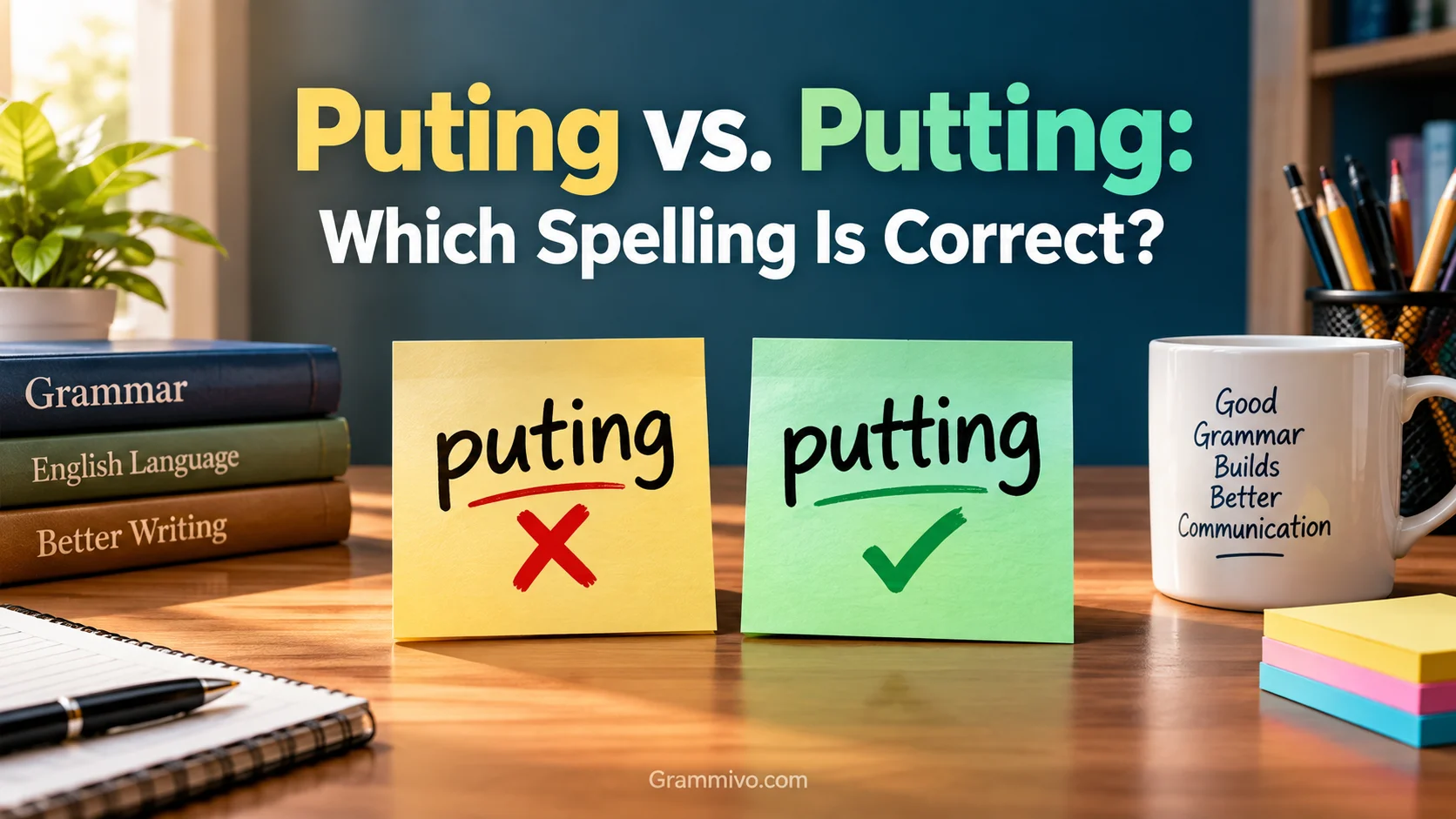
If you’ve ever typed puting instead of putting, you’re not alone. This small spelling mistake is easy to make because the base verb put looks so short and simple. Add -ing, and it might seem natural to write puting. However, standard American English uses putting with two Ts.
The difference is only one letter, but that extra t matters. Putting is the correct present participle and gerund form of put. The spelling puting is considered incorrect in standard English.
This distinction becomes especially useful when you’re writing emails, school assignments, professional documents, or everyday messages. Once you understand how putting is formed and why the spelling contains two Ts, the mistake becomes much easier to avoid.
Quick Answer
Putting is the correct spelling in standard US English. Puting is a misspelling.
The word putting is formed from the verb put plus the -ing suffix:
- put + ing = putting
- puting
- putting
For example:
She is putting the groceries away.
Here, putting describes an action happening at the moment of speaking.
The word can also function as a gerund:
Putting things off can cause problems later.
In this sentence, putting acts like a noun and refers to the activity of delaying something.
Comparison Overview
| Word | Correct Spelling? | Word Form | Meaning | Example |
| Putting | Yes | Present participle / gerund | The -ing form of put | He is putting the books away. |
| Puting | No | Misspelling | Intended to mean putting | Puting the books away |
The key point is simple: putting is the standard spelling. There is no standard English spelling puting with one t.
Main Differences Between Puting vs. Putting
The biggest difference between puting and putting is correctness. Putting follows standard English spelling conventions, while puting does not.
There is also an important grammatical point. Putting isn’t a separate verb from put. It’s an -ing form of the same verb.
Consider these examples:
- Put the keys on the desk.
- She is putting the keys on the desk.
- Putting the keys on the desk makes them easier to find.
The base form stays put, while the -ing form becomes putting.
Why “Putting” Has Two Ts
The spelling can look strange at first. After all, the base word contains only one t.
The reason becomes clearer when you look at the spelling pattern:
put + ing → putting
The final t is doubled before the -ing ending. This creates putting, not puting.
The same pattern appears in several familiar English verbs:
- sit → sitting
- run → running
- stop → stopping
- get → getting
- begin → beginning
English spelling rules can feel inconsistent at times. Still, putting follows a recognizable consonant-doubling pattern.
What Does “Putting” Mean?
Putting is the present participle and gerund form of put. Its exact meaning depends on the context because put has many different meanings.
At its most basic level, put means to move or place something somewhere.
For example:
She is putting the dishes in the cabinet.
However, English speakers use put in many broader ways. That means putting can describe physical placement, changes in condition, communication, preparation, effort, and several idiomatic expressions.
Putting Something Somewhere
This is one of the most common uses.
He is putting his phone on the table.
Here, putting describes moving the phone to a particular location.
More examples include:
- She is putting the groceries in the refrigerator.
- I’m putting the books back on the shelf.
- They are putting the chairs outside.
- He was putting his clothes into the suitcase.
Putting Something Into a Condition
Putting can also describe causing something to enter a particular state.
For example:
The company is putting the new system into operation.
The phrase doesn’t mean someone physically moved a system. Instead, the action causes the system to become operational.
Other examples include:
- The decision is putting everyone under pressure.
- The medication is putting him at ease.
- The storm put the town in danger.
Putting Something Into Words
The verb put also appears when someone expresses an idea.
She had trouble putting her feelings into words.
Here, putting means expressing or explaining something through language.
You might also hear:
- How should I put this?
- He put his concerns into writing.
- She is putting her argument clearly.
How to Use “Putting” in a Sentence
Understanding the spelling is only half the job. You also need to know how putting behaves grammatically.
Putting as a Present Participle
The present participle is the -ing form of a verb. It commonly appears with forms of be to create progressive verb constructions.
For example:
I am putting the dishes away.
The structure is:
subject + be + putting + complement
Other examples include:
- She is putting her shoes on.
- They are putting the equipment away.
- We were putting the plan together.
- He has been putting in extra hours.
In these sentences, putting forms part of the verb phrase.
Putting as a Gerund
An -ing form can also function as a noun. When it does, it’s called a gerund.
Consider:
Putting things off can create unnecessary stress.
The activity of delaying things serves as the subject of the sentence.
Another example:
I enjoy putting puzzles together.
Here, putting puzzles together functions as the object of enjoy.
More examples include:
- Putting safety first is essential.
- She enjoys putting her ideas on paper.
- Putting too much pressure on yourself can backfire.
- He dislikes putting things off until the last minute.
The spelling doesn’t change when putting functions as a gerund.
Common Phrases With “Putting”
English contains many expressions built around put and putting. Learning these phrases can make the spelling easier to remember because you’ll encounter putting repeatedly.
Putting Something Away
This means returning something to its proper storage place.
I’m putting the dishes away.
Putting Something On
This commonly means dressing yourself or placing something on a surface.
She is putting on her jacket.
It can also have other meanings depending on context.
Putting Something Off
This means delaying something.
He’s putting off his homework again.
The phrase is especially common when discussing procrastination.
Putting Something Down
This can mean placing something on a surface.
Put the box down carefully.
It can also mean criticizing someone or recording information.
She was putting down her thoughts in a notebook.
Putting Something Together
This can mean assembling something or combining ideas.
We’re putting the furniture together.
It can also refer to organizing information:
She is putting together a presentation.
Putting Something Aside
This means moving something away from immediate attention or saving it for later.
I’m putting some money aside for emergencies.
These expressions show why putting appears so often in everyday English.
Why “Puting” Is Incorrect
The spelling puting contains only one t, which makes it incorrect in standard English when you intend the -ing form of put.
Compare the two:
- puting
- putting
The incorrect version usually results from treating the word as though you can simply attach -ing without changing the final consonant.
However, English spelling sometimes requires a final consonant to be doubled before a suffix. Putting is one of the forms where that doubled consonant appears.
A Simple Spelling Check
When you need the -ing form of put, remember:
PUT has two Ts in PUTTING.
That small visual connection can prevent a surprisingly common typo.
Read More: Take Effect or Take Affect: Which One Is Correct?
Putting in Different Contexts
The word putting appears in everyday conversation, professional writing, academic contexts, and sports terminology.
Everyday English
You’ll frequently use putting when talking about ordinary actions.
Examples:
- I’m putting my keys on the counter.
- She’s putting the leftovers in the refrigerator.
- We’re putting the children to bed.
- He’s putting his shoes away.
These sentences describe familiar physical or routine actions.
Professional and Academic Writing
Putting also works naturally in formal contexts.
For example:
The organization is putting new safety measures in place.
Another example:
The researchers are putting greater emphasis on long-term outcomes.
Here, putting helps describe an ongoing process or change in emphasis.
Informal Conversation
In casual speech, putting appears in countless expressions.
I’m putting my phone away.
We’re putting together a quick dinner.
She’s putting off the decision.
These phrases sound natural because put is one of the most versatile verbs in English.
Putting in Golf
Putting has a specific meaning in golf.
In golf, putting refers to hitting the ball with a putter, usually on or around the green. A golfer uses a controlled stroke to send the ball toward the hole.
For example:
His putting improved during the final round.
Here, putting doesn’t mean placing something somewhere. It refers specifically to the golfer’s performance with the putter.
This is a useful reminder that context determines meaning.
Common Mistakes With “Putting”
Even though putting is a short word, several mistakes can appear around it.
Writing “Puting”
This is the most obvious error.
She is puting the groceries away.
She is putting the groceries away.
The second sentence uses the standard spelling.
Confusing “Put” and “Putting”
The words aren’t interchangeable in every sentence.
Compare:
I put the keys on the table every morning.
I am putting the keys on the table now.
The first sentence uses the base form put. The second uses putting as part of a progressive construction.
Adding an Unnecessary “T”
The opposite mistake can happen too.
putttting
puttinng
putting
The correct spelling has two Ts followed by i-n-g.
Break it into parts:
p-u-t-t-i-n-g
That gives you seven letters.
Putting vs. Other “-ing” Forms
The spelling of putting becomes easier to understand when you compare it with other verbs that double their final consonant.
| Base Verb | -ing Form |
| put | putting |
| sit | sitting |
| run | running |
| stop | stopping |
| get | getting |
| plan | planning |
| swim | swimming |
In many cases, English doubles a final consonant before -ing under specific spelling conditions.
A common pattern involves a short stressed vowel followed by a single consonant. For example:
- run → running
- sit → sitting
- stop → stopping
However, spelling rules have exceptions and variations. That’s why you shouldn’t blindly double every final consonant.
For put, the form to remember is simply:
put → putting
Putting vs. Put: What’s the Difference?
Put and putting are forms of the same verb. Their grammatical roles differ.
| Form | Function | Example |
| put | Base form / present form | I put the keys here every day. |
| putting | Present participle / gerund | I am putting the keys here now. |
The verb put is unusual because its past tense and past participle are also put.
For example:
- Present: I put the book on the desk.
- Past: Yesterday, I put the book on the desk.
- Past participle: I have put the book on the desk.
- Present participle: I am putting the book on the desk.
Notice the important distinction. The first three forms use put, while the -ing form uses putting.
That makes putting particularly useful to recognize as a separate grammatical form.
Putting in American English
In standard American English, putting is the accepted spelling.
Its pronunciation is commonly represented as /ˈpʊtɪŋ/. The first syllable sounds like the vowel in put, while the ending sounds like -ing.
The spelling remains the same across ordinary American English uses:
- putting
- putting
- putting
There isn’t a standard American spelling puting that can replace it.
If you see puting in a text, it will generally be understood as a spelling error rather than an alternative form.
Is “Puting” Ever Correct?
For ordinary English writing, puting isn’t the correct spelling of the -ing form of put.
If you’re writing an email, article, assignment, report, message, or professional document, use putting.
For example:
The team is puting together a new plan.
The team is putting together a new plan.
The second version follows standard English spelling.
Easy Trick to Remember “Putting”
Here’s a simple memory trick:
Put two Ts in “putting.”
Think of the word as:
PUT + TING = PUTTING
The repeated t is the part that people most often forget.
Another useful visual cue is:
put → putting
The t in put doesn’t disappear. Instead, it appears twice before -ing.
If you regularly type quickly, memorizing the whole word can help more than trying to reconstruct its spelling every time.
Examples: Putting vs. Puting
Seeing the two forms side by side makes the distinction straightforward.
Correct Examples
- She is putting the groceries away.
- We’re putting together a presentation.
- He is putting his phone on silent.
- Putting things off can create unnecessary problems.
- They are putting a new system in place.
- I was putting my clothes into the suitcase.
- The golfer’s putting improved significantly.
- She has been putting extra effort into the project.
Incorrect Examples
The following sentences contain the common spelling error:
- She is puting the groceries away.
- We’re puting together a presentation.
- He is puting his phone on silent.
- Puting things off can create unnecessary problems.
- They are puting a new system in place.
Each sentence should use putting instead.
FAQs:
Is “puting” a correct spelling?
No. Puting is a misspelling when you mean the -ing form of put. The correct spelling is putting, with two Ts.
Why does “putting” have two Ts?
The -ing form of put is spelled putting. The final t is doubled before the -ing ending. This creates the standard spelling p-u-t-t-i-n-g.
Is putting the present tense of put?
Putting is the present participle and gerund form of put. It commonly appears with forms of be, as in She is putting the book away. The simple present form is put, as in She puts the book away every day.
What is the difference between put and putting?
Put is the base form of the verb, while putting is its -ing form. For example, I put the keys here every morning uses put, while I am putting the keys here now uses putting.
How do you pronounce “putting”?
Putting is commonly pronounced /ˈpʊtɪŋ/ in American English. The first part sounds like put, followed by the -ing ending.
Conclusion:
The correct spelling is putting, not puting. When you add the -ing ending to put, the final t doubles. The word putting works as a present participle and a gerund. You’ll see it in everyday phrases such as putting away, putting on, putting off, and putting together. It also has specialized uses, such as putting in golf. If you’re ever unsure, remember the easiest rule: put two Ts in putting. That tiny spelling cue can save you from one of the most common mistakes with this short but versatile English verb.
