
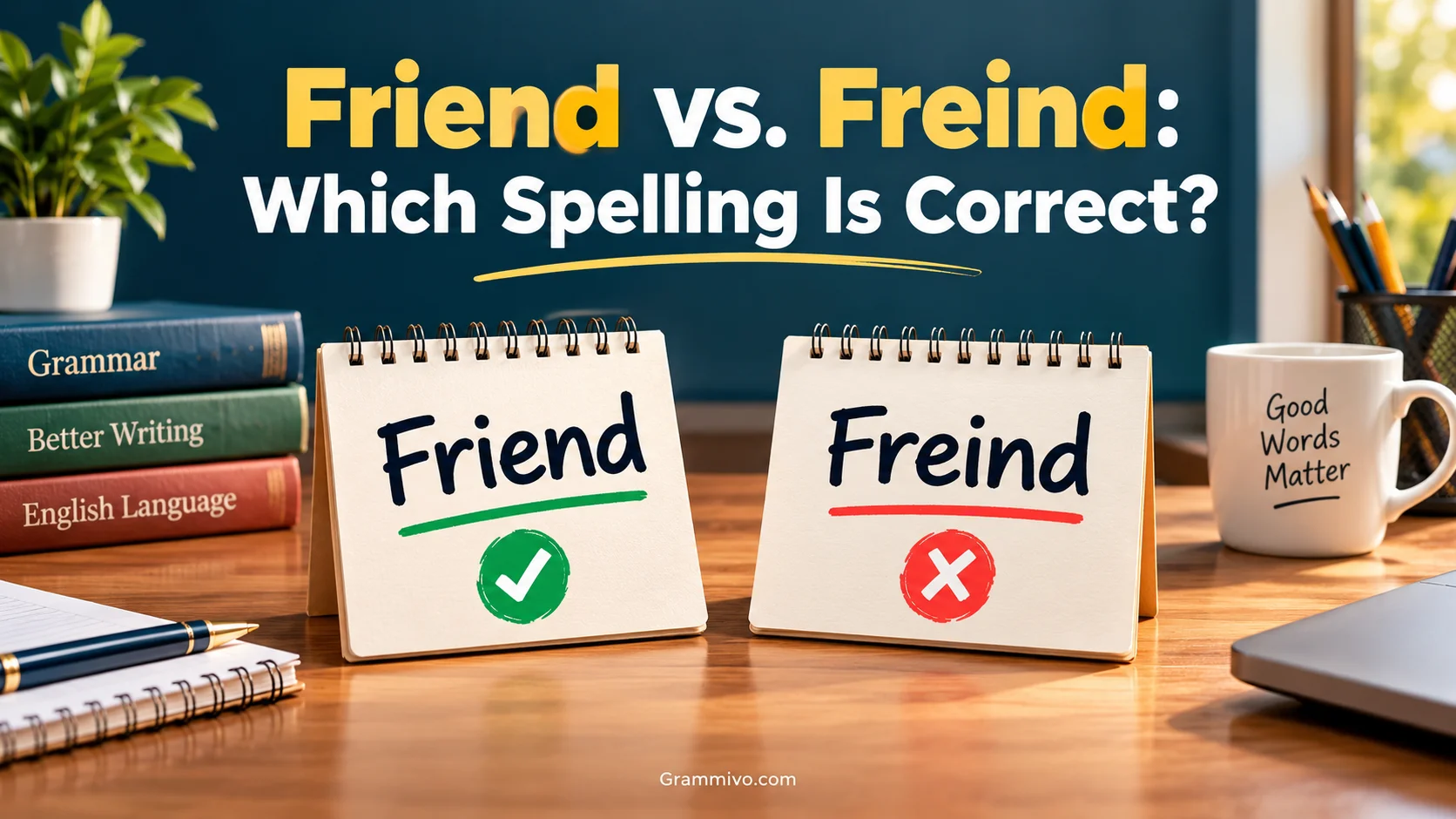
Have you ever typed “freind” and wondered whether it looked right? You’re not alone. Friend vs. freind is a common spelling confusion because the letters i and e appear in an order that many English learners find tricky.
The correct spelling is friend. The spelling freind is a misspelling and isn’t used as a standard English word. Although the two forms look almost identical, only one belongs in your emails, school assignments, messages, and professional writing.
The confusion often comes from the familiar spelling pattern “i before e.” English has many words that follow or appear to follow this pattern, yet friend has its own letter sequence that you need to remember. A small switch can turn an otherwise correct sentence into a spelling mistake.
In this guide, you’ll learn the difference between friend and freind, what friend means, how to pronounce it, why people misspell it, and how to remember the correct spelling. You’ll also see practical examples that make the distinction easy to recognize.
Quick Answer
Friend is the correct spelling. Freind is incorrect in standard English.
The word friend refers to a person you know, like, trust, or share a relationship with. It functions primarily as a noun, although it can also work as a verb in modern informal English, especially when discussing social media.
Correct:
My best friend lives across the street.
Incorrect:
My best freind lives across the street.
The easiest way to remember the spelling is to focus on the middle letters:
F-R-I-E-N-D
Not:
F-R-E-I-N-D
The correct word contains “ie”, not “ei.”
Comparison Overview
| Word | Correct Spelling? | Meaning | Part of Speech | Example |
| Friend | Yes | A person with whom you have a personal relationship | Noun; sometimes verb | Sarah is my closest friend. |
| Freind | No | No standard English meaning | — | Freind is a misspelling of friend. |
There isn’t a difference in meaning between friend and freind because freind isn’t a standard alternative spelling. If you intend to describe a person you know and like, friend is the word you want.
Main Differences Between Friend vs. Freind
The most important difference is simple: friend is correct, while freind is incorrect.
However, understanding why the mistake occurs can help you avoid it permanently. The two spellings contain exactly the same letters, but the i and e appear in a different order.
| Feature | Friend | Freind |
| Standard English spelling | Yes | No |
| Middle letter sequence | ie | ei |
| Standard dictionary word | Yes | No |
| Refers to a person you know and like | Yes | No |
| Appropriate in formal writing | Yes | No |
| Common spelling error | No | Yes |
So, if you’re writing about someone you trust, enjoy spending time with, or consider part of your social circle, use friend.
Remember: Your friend has “ie” in the middle.
What Does “Friend” Mean?
A friend is a person with whom you have a relationship based on qualities such as affection, trust, companionship, or mutual regard.
The relationship doesn’t have to look exactly the same in every situation. You might have a childhood friend you’ve known for decades. You might also have a friend from work whom you mainly see during the week.
For example:
- Maria is my oldest friend.
- I made a new friend at school.
- He invited several friends to dinner.
- My friend helped me prepare for the interview.
- She’s a close friend of the family.
The word can describe relationships with different levels of closeness. A best friend usually indicates a particularly close relationship, while a casual friend suggests a less intimate connection.
Common Types of Friends
English speakers frequently combine friend with other words to describe the relationship or context.
- Best friend — someone considered especially close
- Close friend — someone with whom you share a strong relationship
- Childhood friend — someone you became friends with as a child
- Family friend — someone who has a friendly relationship with a family
- School friend — someone you know through school
- Work friend — someone you know and socialize with through work
- Online friend — someone you know primarily through online interaction
- Old friend — someone you’ve known for a long time
These expressions all retain the same basic spelling: friend.
Why Is “Freind” Incorrect?
Freind is incorrect because it reverses the middle two vowels in the standard spelling of friend.
The correct sequence is:
f-r-i-e-n-d
The incorrect sequence is:
f-r-e-i-n-d
That one-letter-order change matters in English spelling. Unlike some words that have accepted regional variants, freind isn’t a standard US English spelling of friend.
This means you shouldn’t treat freind as another version of the word. It is simply a spelling error.
Friend vs. Freind Is Not a Meaning Difference
Some spelling comparisons involve two legitimate words with different meanings. Friend vs. freind doesn’t work that way.
For example, affect and effect are both standard words. Their meanings and grammatical functions differ.
With friend and freind, there is no equivalent distinction:
- Friend = standard English word
- Freind = misspelling
That distinction is worth remembering because it eliminates unnecessary confusion.
Why Do People Spell “Friend” as “Freind”?
The error usually comes from the unusual nature of English spelling rather than from a difference in pronunciation.
When you say friend, you hear a single syllable. The vowel sounds don’t clearly tell you whether the written form should contain ie or ei.
That creates a trap.
Many people also remember the common classroom rhyme:
“I before E, except after C.”
The problem is that English spelling has many exceptions and patterns that don’t fit neatly into a single rule. Friend is one of the words that can cause trouble when you rely too heavily on that general mnemonic.
Consider these words:
- believe
- piece
- field
- friend
They contain ie.
Now compare words such as:
- receive
- ceiling
- deceive
These contain ei.
The larger lesson is simple: English spelling patterns aren’t perfectly predictable. Memorizing the spelling of frequently used words can sometimes be more reliable than forcing every word into one rule.
Friend: Meaning, Pronunciation, and Word Forms
The word friend has a straightforward meaning, but its spelling and related forms are worth understanding.
How Do You Pronounce “Friend”?
Friend is pronounced approximately like “frend.”
Its standard pronunciation is represented as:
/frɛnd/
The word has one syllable.
The spelling contains ie, yet the vowel sound isn’t pronounced like the long ee sound in words such as piece or field. That’s another reason spelling the word from pronunciation alone can be difficult.
For example:
- friend → /frɛnd/
- end → /ɛnd/
The ending sounds provide a useful memory connection.
What Is the Plural of Friend?
The plural form is friends.
Simply add -s:
friend → friends
Examples:
- My friend is coming over.
- My friends are coming over.
Notice that the spelling of the base word doesn’t change.
Related Words From “Friend”
Several English words derive from or relate closely to friend.
| Word | Meaning | Example |
| Friend | A person with whom you have a friendly relationship | He is my friend. |
| Friends | More than one friend | My friends arrived early. |
| Friendship | The relationship between friends | Their friendship lasted for years. |
| Friendly | Kind, pleasant, or characteristic of a friend | The staff were friendly. |
| Friendliness | The quality of being friendly | Her friendliness put everyone at ease. |
| Befriend | To become a friend to someone | She befriended her new neighbor. |
Knowing these related forms can reinforce the correct spelling. Once friend becomes familiar, the shared spelling pattern becomes easier to recognize.
Read More: Bougie vs. Boujee: Meaning, Difference, and Correct Usage
Friend as a Noun
The most common grammatical role of friend is a noun.
A noun names a person, place, thing, or idea. In this case, friend names a person who has a friendly relationship with someone.
Examples include:
- My friend called me yesterday.
- John is a longtime friend.
- Her friend works at the library.
- We invited our friends to dinner.
The word can appear with determiners and possessives:
- a friend
- my friend
- your friend
- her friend
- their friend
- our friends
Singular and Plural Possessives
Possessive forms can also create confusion, especially in writing.
For one friend, use:
friend’s
Example:
My friend’s car is parked outside.
For multiple friends, use:
friends’
Example:
My friends’ cars are parked outside.
The apostrophe placement changes because the number of people changes.
Friend as a Verb
Although friend is most familiar as a noun, it can also function as a verb.
In modern informal English, especially in social-media contexts, to friend someone means to add that person to your online list of friends or contacts.
For example:
I friended him after meeting him at the conference.
You may also encounter:
She friended me on Facebook.
The past tense is commonly written friended.
This usage developed from the noun friend and became particularly familiar with the rise of social networking platforms.
Friend vs. Befriend
Don’t confuse friend as a verb with befriend.
Friend as a verb commonly refers to adding someone as a friend, particularly online.
Befriend generally means to become friendly with someone or act as a friend toward them.
Compare:
- I friended Alex on social media.
- Alex befriended the new student.
The first sentence has a distinctly modern, often digital sense. The second describes the development of a friendly relationship.
Common Mistakes With Friend
The most obvious error is freind, but several related mistakes can appear in writing.
Freind
Freind is the most common letter-order error.
Incorrect:
My freind is coming tomorrow.
Correct:
My friend is coming tomorrow.
Friand
Another possible misspelling is friand.
Incorrect:
She is a good friand.
Correct:
She is a good friend.
Freinds
Some writers carry the original error into the plural.
Incorrect:
My freinds live nearby.
Correct:
My friends live nearby.
The correct spelling remains friend before the plural -s.
Freindship
The same mistake can appear in related words.
Incorrect:
Their freindship lasted for years.
Correct:
Their friendship lasted for years.
The base spelling friend helps you build the related word correctly.
Friend vs. Freind in Sentences
Seeing the words in context makes the difference much easier to remember.
| Incorrect Sentence | Correct Sentence |
| She is my best freind. | She is my best friend. |
| I called my freind yesterday. | I called my friend yesterday. |
| My freinds are visiting tonight. | My friends are visiting tonight. |
| He has been a good freind for years. | He has been a good friend for years. |
| We became freinds at school. | We became friends at school. |
| Their freindship grew stronger. | Their friendship grew stronger. |
The pattern becomes obvious when you place the spellings side by side. Friend always keeps the ie sequence.
Examples in Everyday Conversation
You might say:
Can you ask your friend to call me?
Or:
I’ve known her since we were kids. She’s a close friend.
In casual messages, the word appears constantly:
Hey, friend! How’s your day going?
Even though the context changes, the spelling stays exactly the same.
Examples in School and Work
Formal and academic writing also require the standard spelling.
School:
My best friend helped me study for the exam.
Work:
A former friend recommended me for the position.
Professional communication:
Please send the information to my friend when you have a chance.
There’s no special formal spelling of the word. Friend works across casual and formal contexts.
A Simple Case Study: Catching the “Freind” Mistake
Imagine you’re writing a birthday card:
Happy birthday to my best freind!
At a glance, the sentence may seem perfectly understandable. The reader knows what you mean. Still, the spelling is wrong.
Now switch the middle letters:
Happy birthday to my best friend!
The meaning hasn’t changed. Only the spelling has been corrected.
This illustrates an important point about spelling errors: understanding and correctness aren’t always the same thing. People can understand a misspelled word from context, but standard writing still requires the accepted spelling.
That matters in schoolwork, applications, professional correspondence, published writing, and any situation where accuracy counts.
Easy Ways to Remember the Spelling of Friend
A good memory trick doesn’t need to be elaborate. You simply need something that sticks.
Remember “IE” in Friend
The quickest method is to memorize the middle:
FR + IE + ND
Think:
friend = fri + end
The ending “end” can act as an anchor.
fri + end → friend
By comparison:
fre + ind → freind
That second version doesn’t provide the same familiar visual pattern.
Connect Friend With “End”
Here’s a useful visual trick:
FRI + END = FRIEND
The word end appears at the end of friend:
FRI + END
You don’t need to rely on complicated spelling rules. Just remember that friend ends with “end.”
Use Familiar Phrases
Repeated exposure helps make correct spelling automatic.
Try remembering these common phrases:
- best friend
- good friend
- close friend
- old friend
- family friend
- new friend
- childhood friend
- dear friend
If you regularly read and write these expressions, friend becomes much easier to recognize.
FAQs:
Is “friend” or “freind” correct?
Friend is correct. Freind is a misspelling. Use friend in standard US English.
Why do people spell “friend” as “freind”?
People often reverse the i and e because English spelling patterns can be inconsistent. The pronunciation also doesn’t clearly reveal the written vowel order.
How do you spell friend correctly?
Spell it F-R-I-E-N-D. A useful memory aid is FRI + END.
What is the plural of friend?
The plural is friends. For example, I invited my friends to dinner.
What is an easy trick to remember the spelling of friend?
Remember that friend can be divided visually into FRI + END. The middle letters are IE, not EI.
Conclusion:
When you’re deciding between friend vs. freind, there’s only one standard spelling to choose: friend. Friend is a common English noun meaning a person with whom you share a friendly relationship. It can also function as a verb in modern informal usage, particularly in online contexts. Its plural form is friends, while related words include friendship, friendly, and befriend.
