
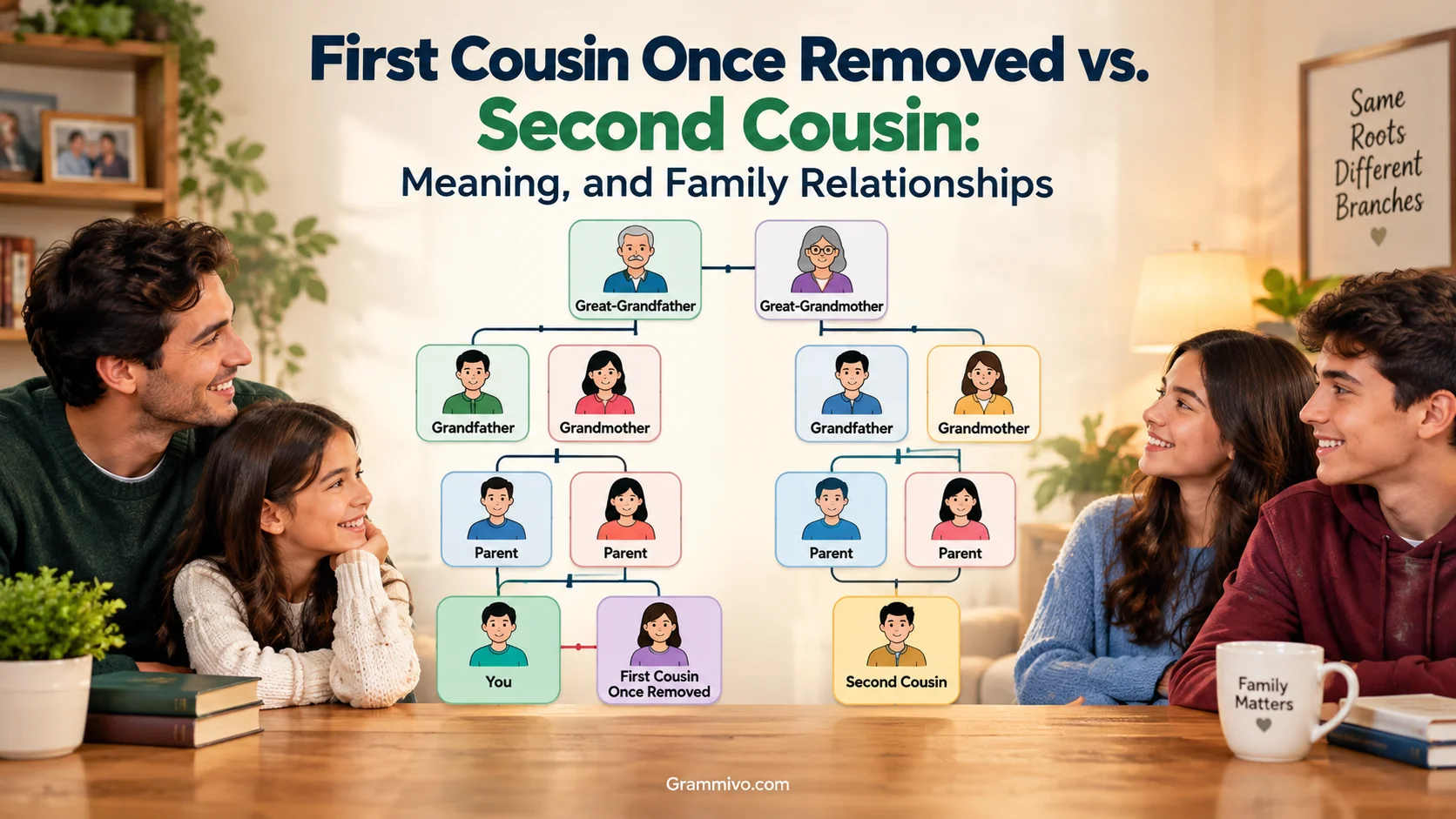
If you’ve ever tried to map a complicated family tree, terms like first cousin once removed and second cousin can make things surprisingly confusing. Both describe real family relationships, but they don’t mean the same thing.
The tricky part is that the word “cousin” tells you something about a shared ancestor, while “removed” tells you about a difference in generations. Once you understand that distinction, these relationships become much easier to identify.
For example, your first cousin’s child isn’t your second cousin. That person is your first cousin once removed. Meanwhile, the child of your parent’s cousin is generally your second cousin.
The easiest way to think about it is this: cousin numbers describe the family-tree distance from a shared ancestor, while “removed” describes a generational gap between two relatives.
Quick Answer
A first cousin once removed is someone who is one generation above or below your first cousin. Your first cousin’s child and your parent’s first cousin are both examples of first cousins once removed.
A second cousin is someone who shares your great-grandparents with you and is generally in the same generation. Your grandparent and their grandparent are siblings, making you and that person’s child second cousins.
| Relationship | Shared ancestral level | Generation difference | Common example |
| First cousin | Grandparents | 0 | Child of your parent’s sibling |
| First cousin once removed | Grandparents | 1 | Your first cousin’s child |
| Second cousin | Great-grandparents | 0 | Child of your parent’s first cousin |
| Second cousin once removed | Great-grandparents | 1 | Your second cousin’s child |
So, first cousin once removed and second cousin are different relationships. A first cousin once removed has a one-generation gap, while second cousins are normally in the same generation.
Comparison Overview
| Feature | First Cousin Once Removed | Second Cousin |
| Basic meaning | First cousin relationship separated by one generation | Cousin relationship based on shared great-grandparents |
| Shared ancestors | Grandparents | Great-grandparents |
| Generational difference | One generation | Usually none |
| Example | Your first cousin’s child | Your parent’s cousin’s child |
| Same generation? | No | Usually yes |
| “Removed” involved? | Yes | No |
| Common confusion | Mistaken for second cousin | Mistaken for a removed first cousin |
| Genealogical relationship | First cousin + one generation removed | Second cousin |
The distinction becomes much clearer when you stop thinking about the words as a single phrase. “First cousin” describes one part of the relationship. “Once removed” describes another.
Main Differences Between First Cousin Once Removed vs. Second Cousin
The biggest difference between first cousin once removed vs. second cousin is the combination of shared ancestry and generation level.
A first cousin once removed connects through the same ancestral line that creates first cousins. However, the two people sit one generation apart.
Second cousins connect through an older generation of ancestors. They usually sit in the same generation themselves.
First Cousin Once Removed Means One Generation Apart
Suppose your grandparents had two children: your parent and your parent’s sibling.
Your parent and your aunt or uncle are siblings. Their children are first cousins.
Now imagine your first cousin has a child.
That child is your first cousin once removed.
The relationship looks like this:
- Your grandparents are the common ancestors.
- Your parent and your aunt or uncle are siblings.
- You and your cousin are first cousins.
- Your cousin’s child is one generation below you.
- Therefore, that child is your first cousin once removed.
The word “once” indicates one generation of removal.
Second Cousins Share Great-Grandparents
Now move one generation farther back.
Imagine your grandparent and another person’s grandparent were siblings. Their parents were your shared great-grandparents.
The children of those siblings become first cousins.
When those first cousins have children, their children become second cousins to each other.
In other words:
Shared great-grandparents → their grandchildren → second cousins
Unlike a first cousin once removed, second cousins generally occupy the same generation.
The Shared Ancestor Is Different
This is one of the fastest ways to distinguish the two relationships.
For a typical first cousin relationship, the shared ancestors are grandparents.
For a typical second cousin relationship, the shared ancestors are great-grandparents.
That difference matters because genealogical cousin terminology follows the number of generations between people and their most recent common ancestors.
The Generational Gap Is Different
A first cousin once removed has a one-generation difference.
A second cousin generally has no generational difference.
Consider two people:
- Person A is the grandchild of a particular couple.
- Person B is the great-grandchild of that same couple.
If the relationship between their family lines makes them first cousins at the same generation, the one-generation difference makes them first cousins once removed.
Now consider two people who are both great-grandchildren of the same couple through different children. They are generally second cousins.
That’s the key distinction.
What Is a First Cousin Once Removed?
A first cousin once removed is a first cousin relationship with a one-generation difference.
That phrase can describe relatives in either direction. Someone can be one generation younger or one generation older than you.
This surprises many people because they assume “once removed” means the younger person is always the removed cousin. That’s not how genealogical terminology works.
Your First Cousin’s Child
This is the most familiar example.
Imagine you have a first cousin named Sarah.
Sarah has a daughter named Emma.
Sarah is your first cousin. Emma is your first cousin once removed.
You and Sarah belong to the same generation. Emma belongs to the next generation.
The relationship can be summarized as:
You → first cousin → Sarah → her child → Emma
Therefore:
Emma = your first cousin once removed.
Your Parent’s First Cousin
The relationship works in the opposite direction too.
Suppose your mother has a first cousin named David.
David is your mother’s first cousin. However, David is one generation above you.
Therefore, David is your first cousin once removed.
So both of these people can be your first cousin once removed:
- Your first cousin’s child
- Your parent’s first cousin
The direction changes, but the generational difference remains one.
Why “Removed” Doesn’t Mean Separated
The word “removed” has an everyday meaning that can cause confusion.
In normal conversation, “removed” might suggest distance, separation, or exclusion. In genealogy, it doesn’t mean any of those things.
It simply describes a difference in generations.
Once removed = one generation apart.
That’s all it means.
Someone can live next door to a first cousin once removed and still be “once removed.” Another relative could live thousands of miles away and have no removal at all.
Physical distance isn’t relevant.
What Is a Second Cousin?
A second cousin is a relative who shares your great-grandparents as common ancestors, assuming both people descend through different children of those shared ancestors.
Here’s the family progression:
- Shared great-grandparents
- Their children become siblings
- Their grandchildren become first cousins
- Their great-grandchildren become second cousins
This pattern helps explain why second cousins are generally one generation farther away genealogically than first cousins.
A Simple Second Cousin Example
Suppose your great-grandparents had two children, Alice and Robert.
Alice had a child named Mary.
Robert had a child named John.
Mary and John are first cousins.
Now Mary has a child, and John also has a child.
Those two children are second cousins.
You can therefore remember the relationship like this:
Great-grandparents → grandparents’ generation → parents’ generation → your generation
The exact family-tree structure can vary depending on which generation you’re starting from, but the defining feature remains the same: second cousins share great-grandparents and are normally in the same generation.
First Cousin Once Removed vs. Second Cousin: Family Tree Examples
A family tree makes these relationships much easier to visualize.
Example of a First Cousin Once Removed
Consider this simplified family:
Grandparents
├── Parent A
│ └── You
└── Parent B
└── Your First Cousin
└── Your Cousin’s Child
You and your first cousin share grandparents.
Your cousin’s child is one generation below both of you.
Therefore:
Your cousin’s child = your first cousin once removed.
Example of a Second Cousin
Now move another generation back:
Great-grandparents
├── Grandparent A
│ └── Parent A
│ └── You
└── Grandparent B
└── Parent B
└── Your Second Cousin
You and your second cousin share great-grandparents.
Neither person needs to be one generation above or below the other.
Therefore:
Your relative = your second cousin.
How to Calculate the Relationship
You don’t need to memorize every possible cousin relationship. A simple calculation method can help you work through complicated family trees.
Step 1: Find the Most Recent Common Ancestor
Start by identifying the closest ancestor shared by both people.
This could be:
- A grandparent
- A great-grandparent
- A great-great-grandparent
- Another earlier ancestor
The most recent common ancestor is especially important because more distant ancestors may also be shared.
Read More: Friend vs. Freind: Which Spelling Is Correct?
Step 2: Count Each Person’s Generations
Next, count how many generations separate each person from that ancestor.
For example:
You → parent → grandparent
That makes your grandparent two generations above you.
For another person, count the same way.
Step 3: Identify the Cousin Number
For standard cousin relationships, the smaller generation distance helps determine the cousin number.
A useful rule is:
Cousin number = smaller generation distance − 1
For example, if both people are three generations from their shared ancestor:
3 − 1 = 2
They are second cousins.
Step 4: Calculate the Removal
If the two people aren’t equally distant from the common ancestor, compare their generation counts.
For example:
- Person A is three generations from the common ancestor.
- Person B is four generations from the common ancestor.
The difference is one.
Therefore, the relationship is once removed.
This produces a second cousin once removed relationship when the smaller generation distance corresponds to second cousins.
A Simple Formula for Cousin Relationships
For many straightforward family trees, this formula makes cousin calculations easier:
Cousin number = smaller generation distance − 1
Then:
Removal = difference between the two generation distances
For example:
- Person A: 3 generations from the common ancestor
- Person B: 4 generations from the common ancestor
The smaller number is 3.
3 − 1 = 2nd cousin
The generation difference is:
4 − 3 = 1
So the relationship is:
Second cousin once removed
The same method works for more distant relationships.
First Cousin Once Removed vs. Second Cousin: Practical Cases
Case Study: Your Cousin Has a Baby
Imagine that you and your cousin Mark grew up together.
Your grandparents were siblings’ children, making you and Mark first cousins.
Mark has a daughter, Lily.
Lily doesn’t become your second cousin simply because she’s one generation younger.
Instead, she becomes your first cousin once removed.
Why?
Because your relationship with Mark is based on shared grandparents. Lily is one generation below Mark.
Case Study: Your Parent’s Cousin
Now imagine your father has a first cousin named James.
You might casually call James “my dad’s cousin.”
Genealogically, however, James is your first cousin once removed.
Your father and James belong to the same generation.
You’re one generation below them.
That’s what creates the “once removed” designation.
Case Study: Your Parent’s Cousin Has a Child
Now imagine James has a daughter named Olivia.
Your father and James are first cousins.
You and Olivia are one generation below them.
You and Olivia therefore share the relevant great-grandparents and are second cousins.
This is an excellent example because it shows how one generation can change the terminology.
First Cousin Once Removed vs. Second Cousin Chart
| Family situation | Your relationship |
| Your parent’s sibling’s child | First cousin |
| Your first cousin’s child | First cousin once removed |
| Your parent’s first cousin | First cousin once removed |
| Your parent’s first cousin’s child | Second cousin |
| Your second cousin’s child | Second cousin once removed |
| Your grandparent’s first cousin | First cousin twice removed |
The chart reveals an important pattern: the cousin number and the removal number answer different questions.
The cousin number tells you how far apart the family branches are. The removal number tells you how far apart the generations are.
Why “Once Removed” Means One Generation
The term removed becomes easier once you stop viewing it as a measure of closeness.
Think of generations as horizontal levels on a family tree.
If two relatives stand on the same level, they aren’t removed from each other.
If one stands one level above or below the other, they’re once removed.
If they’re two levels apart, they’re twice removed.
For example:
- Same generation → no removal
- One generation apart → once removed
- Two generations apart → twice removed
- Three generations apart → three times removed
This system works regardless of whether the older relative is male or female or whether the younger relative is male or female.
Common Misunderstandings About Cousin Relationships
“My First Cousin’s Child Is My Second Cousin”
This is one of the most common mistakes.
Your first cousin’s child is your first cousin once removed.
The child doesn’t become your second cousin because that child is one generation younger.
A second cousin relationship requires a different position in the family tree.
“Once Removed Means We Aren’t Close”
Not at all.
Removed is a technical genealogical term.
It doesn’t describe emotional closeness, physical distance, family conflict, or how frequently you communicate.
A first cousin once removed could be one of your closest family members.
“Second Cousins Are Always Distant Relatives”
The word “second” can make the relationship sound remote, but family circumstances vary.
Some second cousins may know each other well, especially in large extended families that remain closely connected.
Others may never meet.
Genealogical terminology describes the family-tree relationship, not the quality of the relationship.
“My Parent’s Cousin Is My Second Cousin”
Your parent’s first cousin is generally your first cousin once removed.
Your parent’s cousin and your parent occupy the same generation.
You’re one generation below them.
That one-generation difference creates the “once removed” designation.
“First Cousin Once Removed Only Refers to Younger Relatives”
It works in both directions.
Your first cousin’s child is your first cousin once removed.
Your parent’s first cousin is also your first cousin once removed.
The critical factor is the one-generation difference, not whether the person is older or younger.
FAQs:
Is a first cousin once removed the same as a second cousin?
No. A first cousin once removed and a second cousin describe different family relationships. A first cousin once removed involves a one-generation difference from a first-cousin relationship. Second cousins generally share great-grandparents and belong to the same generation.
Is my first cousin’s child my second cousin?
No. Your first cousin’s child is your first cousin once removed. Your first cousin is in your generation while their child is one generation below you.
Is my parent’s first cousin my first cousin once removed?
Yes. Your parent’s first cousin is generally your first cousin once removed because that person is one generation above you.
What does “once removed” mean in genealogy?
Once removed means one generation apart. It doesn’t mean the relatives are separated emotionally or physically. For example, your first cousin’s child and your parent’s first cousin are both first cousins once removed.
How do you calculate whether someone is a first cousin once removed or second cousin?
First, find the closest shared ancestor. Then count each person’s generations from that ancestor. The smaller generation count helps determine the cousin number, while the difference between the two generation counts determines the removal.
Do first cousins once removed and second cousins share the same amount of DNA?
Not necessarily. Genealogical relationships describe ancestry, while DNA inheritance varies from person to person. The expected genetic relationship can differ from the actual amount of DNA two relatives share.
Conclusion:
The difference between first cousin once removed vs. second cousin comes down to two simple ideas: shared ancestry and generation difference. A first cousin once removed is one generation above or below your first cousin relationship. Your first cousin’s child is a classic example. Your parent’s first cousin is another. A second cousin, on the other hand, generally shares your great-grandparents and belongs to the same generation as you.
