
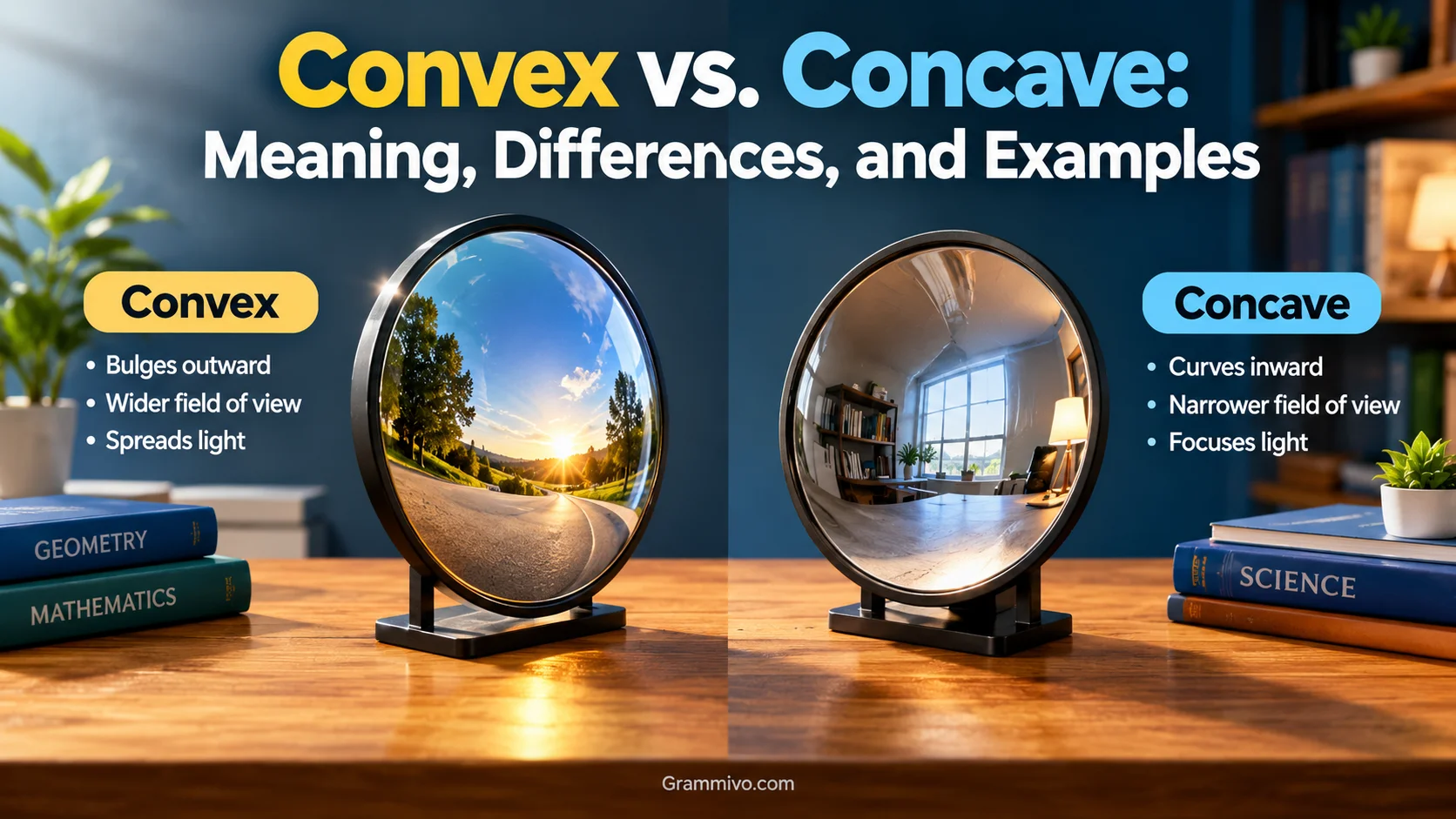
When you look at a ball, a spoon, a magnifying glass, or even a graph, you may notice something they have in common: curvature. Some surfaces bulge outward, while others curve inward. These two basic forms are described with the terms convex and concave.
The difference sounds simple, yet these words can become confusing because their meanings change slightly depending on the subject. Geometry uses one definition, while optics uses the terms for lenses and mirrors. Calculus uses them to describe how functions bend. Even an ordinary spoon can have both a convex and a concave surface.
The easiest starting point is visual. A convex shape generally bulges outward. A concave shape curves inward, creating a hollow or indentation. Think of a ball compared with the inside of a bowl.
However, there’s more to the distinction than appearance. In mathematics, a convex shape also follows a specific line-segment rule. In optics, convex and concave lenses affect light in opposite ways. Mirrors with these shapes also produce different images and fields of view.
Quick Answer
Convex means curved or bulging outward. Concave means curved or hollowing inward.
A quick memory trick is:
- Convex = bulges out
- Concave = caves in
For example, the outside of a ball is convex. The inside of a typical bowl is concave.
In geometry, a convex shape has no inward indentation, and a straight line connecting any two points inside the shape stays inside it. A concave shape has an indentation, so a line connecting certain points inside it can pass outside the shape.
In optics, the distinction matters even more:
- A convex lens generally converges parallel light rays.
- A concave lens generally diverges parallel light rays.
- A convex mirror spreads reflected rays outward and provides a wider field of view.
- A concave mirror can bring reflected rays together and can produce magnified images at certain distances.
So, while the basic visual rule remains useful, the exact behavior depends on what you’re studying.
Comparison Overview
| Feature | Convex | Concave |
| Basic meaning | Bulges outward | Curves inward |
| Visual appearance | Rounded outward surface | Hollow or indented surface |
| Inward indentation | Generally absent | Present |
| Polygon interior angles | All less than 180° | At least one greater than 180° |
| Diagonals in a polygon | Stay inside | At least one can leave the polygon |
| Line-segment test | Segment stays inside | Segment can pass outside |
| Typical lens | Converging | Diverging |
| Typical mirror effect | Wider field of view | Can converge reflected rays |
| Simple example | Ball | Inside of a bowl |
| Memory aid | Bulges out | Caves in |
One important detail deserves attention: convex and concave don’t describe only physical objects. They can also describe mathematical functions, curves, polygons, lenses, mirrors, and higher-dimensional shapes.
That broader meaning is why learning the underlying concept is more useful than memorizing isolated examples.
Main Differences Between Convex vs. Concave
The main difference between convex vs. concave is the direction of curvature. Convex forms extend outward, while concave forms curve inward. However, mathematics gives these terms more precise definitions than simple visual appearance.
A convex object or region generally has an outward-bulging boundary. A concave region contains some kind of inward indentation.
Consider a simple drawing:
- Convex: ( )
- Concave: ) (
These aren’t formal geometric diagrams, but they capture the basic idea.
The distinction becomes clearer when you examine shapes, angles, lines, lenses, mirrors, and functions separately.
What Does Convex Mean?
The word convex describes something that curves, bulges, or extends outward. In geometry, however, convexity has a precise mathematical meaning.
A region is convex if, whenever you select two points inside it, the entire straight line segment connecting those points also remains inside the region.
That’s known as the line-segment definition of convexity.
Imagine drawing a straight line between two points inside a solid circle. No matter which two points you choose, the line remains inside the circle. Therefore, a filled circle is convex.
The same principle applies to a rectangle, triangle, and many other shapes.
What Is a Convex Shape?
A convex shape doesn’t contain an inward dent that breaks the line-segment property.
For example, consider a triangle. Pick any two points inside it and connect them with a straight line. The entire segment remains inside the triangle.
A rectangle behaves the same way.
A circle does too.
This gives you a reliable mathematical test instead of relying solely on appearance.
Examples of Convex Shapes
Common convex shapes include:
- Circle
- Ellipse
- Triangle
- Square
- Rectangle
- Regular pentagon
- Regular hexagon
- Many irregular polygons without indentations
- Convex polyhedra
A useful fact is that every triangle is convex. There isn’t enough structure in a triangle to create the inward indentation required for concavity.
Likewise, every rectangle is convex.
Convex Objects in Everyday Life
You encounter convex surfaces constantly.
Examples include:
- The outside of a basketball
- The rounded exterior of an orange
- A dome
- The outer surface of a spoon
- Some rounded vehicle surfaces
- The outward-facing surface of a bubble
The surface doesn’t have to be perfectly spherical to qualify as convex. What matters is its geometric curvature and the relevant definition being used.
What Does Concave Mean?
Concave describes a shape or surface that curves inward or contains a hollowed region.
The word is easy to remember because concave sounds similar to “cave.” A cave goes inward. That mental connection makes the term much easier to recall.
In geometry, a concave region fails the convex line-segment test. You can find two points inside the region whose connecting segment passes partly outside it.
That inward indentation is the giveaway.
What Is a Concave Shape?
A concave shape contains at least one inward section.
Imagine an irregular polygon shaped somewhat like an arrowhead. If one part of the boundary points inward, the polygon can become concave.
For polygons, there is also a useful angle-based definition.
A concave polygon has at least one interior angle greater than 180 degrees.
That single angle creates the characteristic inward indentation.
Examples of Concave Shapes
Examples include:
- Crescent-shaped figures
- Arrowhead-shaped polygons
- Star-like regions
- Irregular polygons with inward dents
- Hollow or inward-curved surfaces
Not every star-shaped drawing is automatically described the same way in every context. The exact definition depends on whether you’re discussing the boundary, the enclosed region, or another mathematical object.
Concave Objects in Everyday Life
Concave surfaces are just as common.
Examples include:
- The inside of a spoon
- The inside of a bowl
- A cave
- A satellite dish
- A parabolic reflector
- The inner surface of certain mirrors
A bowl is a particularly useful example because its inner surface curves inward relative to the surrounding space.
Read More: Connotation vs. Denotation: Meaning, Differences, and Examples
Convex vs. Concave Shapes in Geometry
Geometry provides one of the clearest ways to understand the distinction.
A convex geometric shape allows every line segment between two points in the shape to remain inside the shape.
A concave shape doesn’t.
This difference sounds technical, but the idea is surprisingly visual.
Convex Polygons
A polygon is convex when all of its interior angles are less than 180 degrees.
Examples include:
- Triangle
- Square
- Rectangle
- Regular pentagon
- Regular hexagon
Every diagonal of a convex polygon also lies completely inside the polygon.
For example, draw both diagonals across a rectangle. Each diagonal stays inside the rectangle from one corner to the opposite corner.
That’s a hallmark of convexity.
Concave Polygons
A concave polygon has at least one interior angle greater than 180 degrees.
That angle corresponds to an inward indentation.
Unlike a convex polygon, a concave polygon can have a diagonal that extends outside the polygon.
Consider an arrow-shaped polygon with a notch. Connecting certain vertices can force the diagonal through the empty area outside the polygon.
This provides another practical identification method.
How to Identify a Convex or Concave Polygon
When you encounter an unfamiliar polygon, use these checks:
- Look for an inward dent.
- Check the interior angles.
- Look at the diagonals.
- Apply the line-segment test.
If every interior angle is below 180 degrees, the polygon is convex.
If at least one interior angle exceeds 180 degrees, it’s concave.
| Test | Convex Polygon | Concave Polygon |
| Inward indentation | No | Yes |
| Interior angles | All < 180° | At least one > 180° |
| Diagonals | Remain inside | Some may leave the polygon |
| Line-segment test | Always passes | Can fail |
Convex vs. Concave Curves and Functions
The terms become slightly more sophisticated when you move into calculus.
Here, convex and concave describe how a function bends rather than simply whether a physical object curves inward or outward.
For a twice-differentiable function, the second derivative provides an important test.
Generally:
- f”(x) > 0 indicates convexity or concavity upward under the convention commonly used in optimization.
- f”(x) < 0 indicates concavity downward.
Terminology can vary between mathematical texts. Some introductory calculus courses use “concave up” and “concave down” rather than calling the graph simply convex or concave.
Convex Functions
A function is convex when its graph lies below the straight line segment connecting two points on the graph.
A familiar example is:
f(x) = x²
Its graph forms a U-shaped parabola.
If you select two points on that parabola and connect them with a straight line, the line lies above the graph between those points.
This property is central to convex optimization.
Concave Functions
A concave function behaves in the opposite direction.
Its graph bends downward, resembling an upside-down U in a basic example.
Consider:
f(x) = -x²
The graph opens downward.
A straight line joining two points on the graph lies below the curve between those points.
Why Convexity Matters in Mathematics
Convexity isn’t just a vocabulary exercise. It plays a major role in optimization, economics, statistics, geometry, and computer science.
Convex optimization is especially important because a convex problem has mathematical properties that can make finding a global minimum more tractable.
That’s one reason the simple idea of “bulging outward” has such a large role in advanced mathematics.
Convex vs. Concave Lenses
Optics gives the words another practical meaning.
A lens changes the direction of light as light passes through it. The shape of the lens influences whether the rays tend to move toward one another or away from one another.
What Is a Convex Lens?
A convex lens is thicker near the center than near its edges in its common converging form.
It bends incoming parallel light rays toward one another.
The rays can meet at a point called the focal point.
Because of this behavior, a convex lens is often called a converging lens.
Common applications include:
- Magnifying glasses
- Camera lenses
- Microscopes
- Telescopes
- Projectors
- Corrective eyeglasses for certain forms of farsightedness
A magnifying glass provides an easy example. Hold the lens at an appropriate distance from an object and the object can appear enlarged.
What Is a Concave Lens?
A concave lens is thinner at the center and thicker toward its edges in its common form.
It causes parallel light rays to spread apart after passing through the lens.
Because it makes rays diverge, it’s called a diverging lens.
Common uses include:
- Corrective eyeglasses for nearsightedness
- Optical instruments
- Laser systems
- Some camera and telescope optical arrangements
A concave lens doesn’t make parallel rays physically meet at a real focal point on the far side. Instead, the diverging rays appear to originate from a virtual focal point on the incident side.
Convex vs. Concave Lenses
| Feature | Convex Lens | Concave Lens |
| Typical shape | Thicker at center | Thinner at center |
| Effect on parallel rays | Converges them | Diverges them |
| Common name | Converging lens | Diverging lens |
| Focal point | Real for parallel incident rays | Virtual |
| Common example | Magnifying glass | Certain eyeglasses |
The exact optical behavior depends on the lens geometry and surrounding medium. Still, the converging-versus-diverging distinction is the key idea for basic optics.
Convex vs. Concave Mirrors
Mirrors use the same curvature terms, but reflection replaces refraction.
Convex Mirrors
A convex mirror curves outward toward the object.
Reflected rays spread apart rather than converging to a real point.
One major advantage is the mirror’s wide field of view.
That’s why convex mirrors are useful for:
- Vehicle side mirrors
- Security mirrors
- Store surveillance
- Roadway visibility applications
Objects reflected in a convex mirror generally appear smaller and upright.
That smaller image allows more of the surrounding area to fit into the mirror.
Concave Mirrors
A concave mirror curves inward toward the object.
It can cause parallel incoming rays to reflect toward a focal point.
Depending on where the object sits relative to the mirror’s focal point and center of curvature, the mirror can produce different types of images.
For example, a concave mirror can produce:
- Real images
- Virtual images
- Magnified images
- Reduced images
- Inverted images
- Upright images
This makes concave mirrors more versatile than a simple “magnifying mirror” description suggests.
Common applications include:
- Shaving mirrors
- Makeup mirrors
- Reflecting telescopes
- Searchlights
- Certain optical instruments
Convex vs. Concave Mirrors
| Feature | Convex Mirror | Concave Mirror |
| Surface | Curves outward | Curves inward |
| Reflected rays | Diverge | Can converge |
| Field of view | Wider | Narrower |
| Typical image | Upright and reduced | Varies with object position |
| Common use | Vehicle side mirrors | Makeup and shaving mirrors |
| Focal point | Virtual | Can be real |
FAQs:
What is the difference between convex and concave?
Convex describes an outward-bulging form, while concave describes an inward-curving form. In geometry, convex regions satisfy the line-segment test. Concave regions don’t.
Is convex inward or outward?
Convex is outward. Think about the rounded outside of a ball. It bulges toward you rather than forming a hollow.
Is concave inward or outward?
Concave is inward. A cave provides a useful memory aid because it extends into the surrounding material.
Is a circle convex or concave?
A filled circle is convex. Any straight line segment joining two points inside the circle stays completely inside it.
Is a spoon convex or concave?
A spoon can be both. Its inner bowl is concave, while its back is generally convex.
Conclusion:
The difference between convex vs. concave becomes much easier once you focus on the direction of curvature. Convex shapes bulge outward. Concave shapes curve inward. That simple rule works as a starting point for geometry, everyday objects, lenses, and mirrors. Geometry adds the line-segment test and interior-angle rules. Optics adds another layer by showing how curvature changes the behavior of light.
