
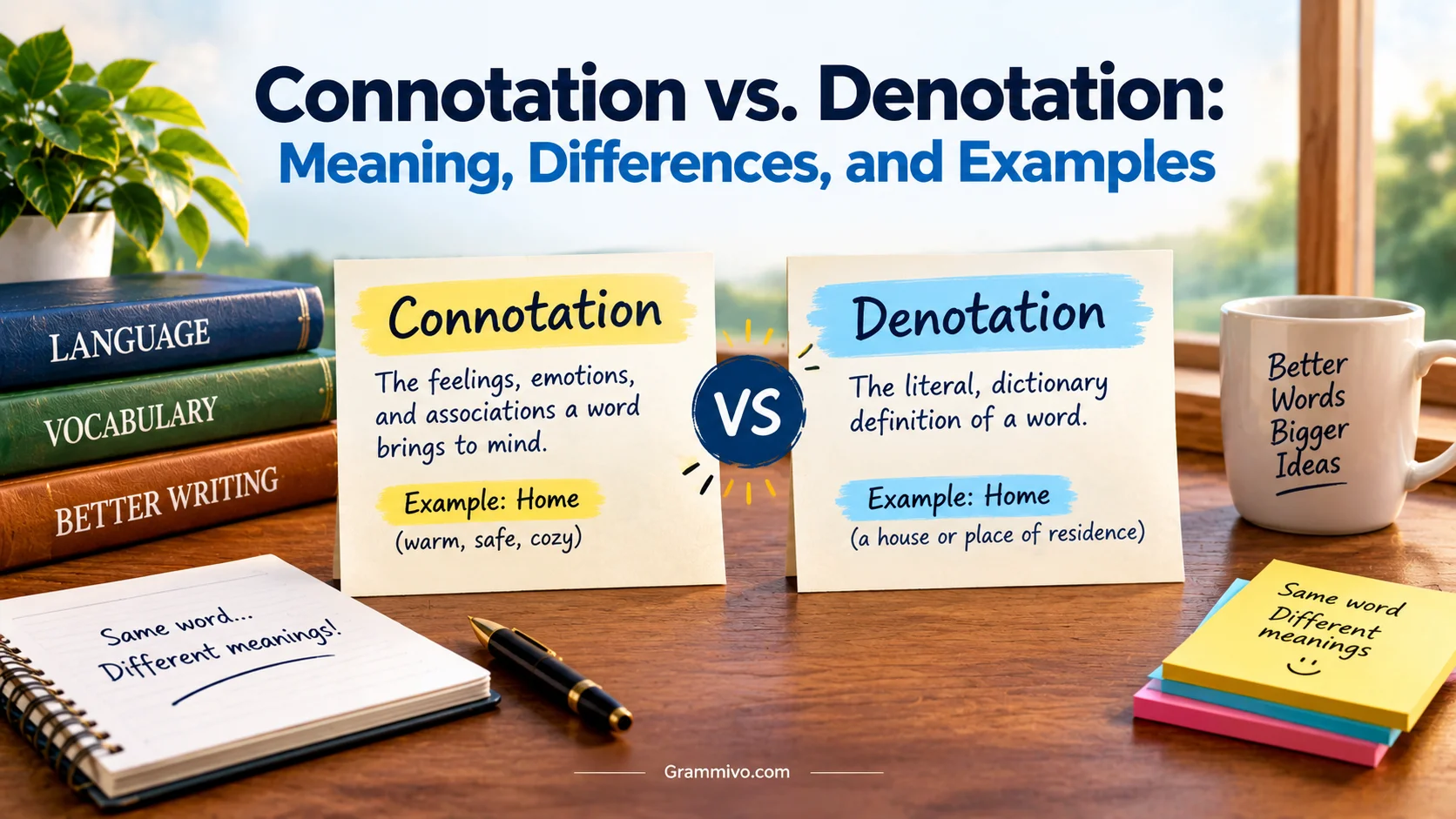
Words rarely stop at their dictionary definitions. A single word can describe something directly while also creating a feeling, image, judgment, or memory in your mind. That difference explains why connotation vs. denotation matters so much in everyday communication.
Consider the words house and home. Both can refer to a place where someone lives, but they don’t create exactly the same impression. A house is a physical structure. A home can suggest comfort, family, security, and belonging. Their basic meanings overlap, yet their emotional associations differ.
This distinction becomes especially important when you write, read literature, analyze advertisements, study vocabulary, or choose between similar words. The wrong word can make a sentence sound harsh, affectionate, formal, sarcastic, or even insulting.
Understanding denotation and connotation gives you better control over language. Once you know what a word literally means and what it suggests beyond that meaning, word choice becomes much easier.
Quick Answer
Denotation is the literal, direct, or dictionary meaning of a word. Connotation is the feeling, idea, judgment, or association that a word suggests beyond its literal meaning.
For example:
- Denotation of “snake”: A legless reptile.
- Connotation of “snake”: Deceit, danger, betrayal, or untrustworthiness.
A useful way to remember the distinction is simple:
Denotation tells you what a word means. Connotation tells you what a word suggests.
A dictionary usually helps you identify denotation. Context, culture, experience, and tone often help you understand connotation.
Comparison Overview
| Feature | Denotation | Connotation |
| Basic meaning | Literal or direct meaning | Associated or implied meaning |
| Main focus | What something is or refers to | What something suggests |
| Usually found in | Dictionaries and definitions | Context and interpretation |
| Emotional element | Usually limited | Often strong |
| Stability | Generally more consistent | Can vary considerably |
| Depends on context | Less dependent | Often highly dependent |
| Can be positive | Yes | Yes |
| Can be negative | Yes | Yes |
| Can be neutral | Usually | Yes |
| Example: “snake” | A type of reptile | Danger, deceit, betrayal |
The easiest distinction is literal meaning versus associated meaning. Denotation gives you the first layer. Connotation adds another layer.
Main Differences Between Connotation vs. Denotation
The difference between connotation and denotation becomes clearer when you examine what each one contributes to communication.
Denotation Gives the Literal Meaning
Denotation refers to what a word directly identifies. It describes the basic meaning you would generally expect to find in a dictionary.
For example, the denotation of “rose” is a type of flowering plant. The denotation of “child” refers to a young human being. The denotation of “car” refers to a road vehicle designed to transport people.
These meanings provide a shared starting point.
When someone says, “There is a rose in the garden,” the sentence gives you a fairly straightforward picture. You don’t need to interpret a hidden emotional message to understand what the speaker means.
Denotation therefore plays an important role in clarity. Technical writing, instructions, definitions, and factual communication often depend heavily on literal meanings.
Connotation Adds Associations
Connotation goes beyond the direct definition.
A rose can suggest love, romance, beauty, affection, or even secrecy depending on the context. Those ideas aren’t part of the plant’s basic dictionary definition. They come from cultural associations, personal experiences, literature, traditions, and common usage.
Likewise, calling someone stubborn and calling that person determined can describe a similar behavior while creating different impressions.
The difference is subtle but powerful.
Denotation identifies the subject. Connotation influences how the subject feels.
This is why two words with similar dictionary meanings can produce dramatically different reactions.
Denotation Is Usually More Stable
Denotative meanings tend to remain relatively consistent within a language.
A chair is generally understood as a piece of furniture designed for sitting. A mountain refers to a large natural elevation of the Earth’s surface. A teacher refers to someone who teaches.
The exact dictionary wording can vary between sources. However, the basic reference usually remains recognizable.
Connotations aren’t quite as stable.
A particular word may sound warm to one person and negative to another. Cultural background, age, personal experience, social setting, and historical context can all influence the associations attached to a word.
Connotation Depends More on Context
Context can dramatically change the effect of a word.
Consider “bold.” In one sentence, it may sound complimentary:
She made a bold decision and started her own business.
Here, bold suggests courage and confidence.
Change the context, and the impression can shift:
His bold comments offended everyone at the meeting.
Now the word may suggest excessive confidence or a lack of restraint.
The denotative idea remains related to confidence or willingness to take risks. The surrounding context changes the connotation.
What Is Denotation?
Denotation is the literal, explicit, or direct meaning of a word.
When you look up a word in a dictionary, the definition you find generally describes its denotation. It tells you what the word refers to without relying heavily on emotional interpretation.
For example:
- Bird denotes a type of warm-blooded, feathered animal.
- Ocean denotes a large body of salt water.
- Teacher denotes a person who teaches.
- Child denotes a young human being.
- Hospital denotes an institution where medical care is provided.
Denotation gives language its basic reference point. Without relatively stable literal meanings, communication would become much harder.
Examples of Denotation
Consider the word “home.”
Its denotation relates to the place where someone lives. That meaning provides the basic reference.
Now consider these sentences:
The house has three bedrooms.
The word house refers to a physical building.
Their home has always felt welcoming.
The sentence still refers to a place where people live. However, the word home can carry emotional associations that go beyond the physical structure.
The distinction isn’t always perfectly sharp. Words can overlap in denotation while differing substantially in connotation.
Denotation in Sentences
Here are several straightforward examples:
- The dog ran across the yard.
“Dog” directly refers to the animal. - She bought a new jacket.
“Jacket” refers to a piece of clothing. - The child opened the door.
“Child” refers to a young person. - They crossed the river by boat.
“River” refers to a natural flowing body of water.
In each case, the words primarily communicate direct information.
Read More: Long Term or Longterm: Which Spelling Is Correct?
What Is Connotation?
Connotation refers to the additional ideas, feelings, judgments, or associations connected with a word.
These associations aren’t necessarily included in the word’s literal definition. Instead, people develop them through culture, personal experience, media, literature, history, and everyday conversation.
For example, the denotation of “snake” refers to a reptile. Yet the word can also suggest:
- Danger
- Deception
- Betrayal
- Fear
- Untrustworthiness
Those associations explain why calling someone “a snake” sounds very different from simply saying that person owns a snake.
Positive Connotation
A word has a positive connotation when it creates a favorable or pleasant association.
Examples include:
- Confident — self-assured and capable
- Thrifty — careful and sensible with money
- Youthful — energetic or fresh
- Determined — persistent and committed
- Curious — interested and eager to learn
Notice how word choice can frame the same general behavior differently.
Someone who carefully manages money might be called thrifty. Calling the same person cheap can create a less favorable impression.
Negative Connotation
A word has a negative connotation when it creates an unfavorable association.
Examples include:
- Arrogant
- Nosy
- Childish
- Stingy
- Pushy
- Manipulative
These words don’t merely communicate information. They also encourage the reader or listener to interpret the subject in a particular way.
For example, “curious” generally suggests an interest in learning. “Nosy” suggests unwanted interest in someone else’s business.
Neutral Connotation
Some words carry relatively little emotional weight in a particular context.
For example:
- Table
- Window
- Notebook
- Vehicle
- Building
Their connotations can still change depending on context. However, these words often function primarily as straightforward references.
Connotation vs. Denotation Examples
The best way to understand this concept is to compare words that share similar basic meanings but produce different impressions.
House vs. Home
House generally denotes a physical building used as a residence.
Home can refer to a residence too, but it often carries associations of:
- Family
- Safety
- Comfort
- Belonging
- Memories
That’s why the sentence “There’s no place like home” feels more emotional than “There’s no place like a house.”
The difference isn’t about whether one word is correct. Both can be correct. The difference lies in what each word communicates beyond the literal reference.
Childish vs. Childlike
These words provide an especially useful example.
Childish can suggest immaturity, foolishness, or poor judgment.
Childlike can suggest innocence, curiosity, wonder, or openness.
Compare:
His childish behavior caused an argument.
with:
Her childlike curiosity made the museum visit exciting.
Both words relate to qualities associated with children. Their connotations point in very different directions.
Slim vs. Skinny
Both words can describe someone with a relatively thin body.
However, slim often has a favorable association with attractiveness or fitness.
Skinny can sometimes suggest excessive thinness or an unhealthy appearance.
The words overlap in reference, yet their emotional effects aren’t identical.
Inexpensive vs. Cheap
Both words can describe something that costs relatively little.
However:
- Inexpensive usually emphasizes price.
- Cheap can emphasize low quality as well as low cost.
Consider these two descriptions:
This restaurant serves inexpensive meals.
This restaurant serves cheap meals.
The first sentence focuses mainly on affordability. The second may make readers wonder whether the food or service lacks quality.
Confident vs. Arrogant
Someone who believes strongly in their abilities may be described as confident.
The word generally has a positive association.
Arrogant, however, suggests excessive self-importance or an inflated sense of superiority.
A writer who chooses between these words isn’t merely selecting two interchangeable synonyms. The writer is shaping the reader’s interpretation.
Curious vs. Nosy
Curious often suggests a desire to learn or understand.
Nosy usually suggests intrusive interest in another person’s private affairs.
For example:
Maya was curious about how the machine worked.
This sounds positive or neutral.
Maya was nosy about her neighbor’s personal life.
The second sentence carries a clear negative association.
Can a Word Have Both Denotation and Connotation?
Yes. In fact, many words have both.
A word can identify something literally while simultaneously creating additional associations.
Take “snake.”
Its denotation is a reptile. Its connotations may include danger or betrayal.
Take “rose.”
Its denotation is a flowering plant. Its connotations may include romance, love, beauty, or affection.
This relationship can be represented simply:
Word → Literal reference → Associated ideas and feelings
The literal reference doesn’t disappear when connotation appears. Instead, the word gains an additional layer of meaning through context and association.
How Context Changes Connotation
Context is one of the most important factors in understanding connotation.
A word can sound positive, negative, humorous, affectionate, formal, or insulting depending on how someone uses it.
Consider “old.”
In one context:
This is an old building with remarkable architecture.
The word may suggest history and character.
In another:
They replaced the old equipment because it no longer worked properly.
Here, old suggests age and possible obsolescence.
The denotation remains connected to age. The surrounding information influences the connotation.
Tone Also Matters
Tone can change how a word is received.
Imagine someone saying:
Well, aren’t you clever?
Depending on the situation and tone, clever might be sincere praise or sarcasm.
Written language has the same issue. Without vocal tone, readers rely on surrounding words, punctuation, context, and broader circumstances.
That’s why isolated words can sometimes be difficult to interpret accurately.
Connotation and Denotation in Writing
Writers use both forms of meaning constantly, whether they realize it or not.
Choosing Words for Tone
Suppose you want to describe someone who spends very little money.
You could write:
- She is thrifty.
- She is economical.
- She is frugal.
- She is cheap.
- She is stingy.
These words overlap in meaning. They don’t create identical impressions.
Thrifty can sound complimentary.
Frugal often suggests careful financial management.
Cheap may criticize someone’s willingness to spend.
Stingy usually carries a stronger negative judgment.
The denotations overlap. The connotations create the difference.
Persuasive Writing
Connotation plays a major role in persuasive language.
Consider the difference between:
- government spending
- government investment
- government waste
These expressions can refer to related financial activity while framing it differently.
A writer who chooses emotionally charged vocabulary can influence how readers perceive the subject.
That doesn’t mean every connotative word is manipulative. Writers naturally select words based on tone and purpose. However, recognizing connotation helps you notice how language frames an argument.
Creative Writing
Fiction writers depend heavily on connotation.
A novelist doesn’t need to explain every emotion directly. Carefully selected words can imply mood.
Compare:
The house stood at the end of the road.
with:
The abandoned house crouched at the end of the road.
The second sentence gives the building an almost living presence. Crouched can suggest something threatening, watchful, or unnatural.
The basic subject remains a house. The connotative language changes the atmosphere.
Academic and Professional Writing
Formal writing often benefits from precise and relatively neutral vocabulary.
For example, a researcher might describe participants as “older adults” rather than choosing language that carries unnecessary negative associations.
Similarly, professional communication often favors specific descriptions over emotionally loaded labels.
This doesn’t mean formal writing must eliminate all connotation. It means writers should understand the effect their vocabulary may have.
Connotation and Denotation in Literature
Literature provides some of the clearest examples of connotative meaning.
Authors frequently choose words for their emotional resonance rather than their dictionary meaning alone.
A storm, for example, can literally describe severe weather. In literature, it may also suggest:
- Conflict
- Fear
- Chaos
- Emotional turmoil
- Change
A dark road can simply describe a road without much light. Yet the same image may suggest uncertainty, danger, loneliness, or the unknown.
This is where connotation connects with symbolism, imagery, characterization, and tone.
A Simple Literary Example
Imagine a character entering a room.
Neutral:
She entered the room and sat beside the window.
More connotative:
She slipped into the dim room and settled beside the cold window.
The second version doesn’t simply report movement. Words such as dim, slipped, and cold create an atmosphere.
That is the power of connotation.
FAQs:
What is the difference between connotation and denotation?
Denotation is a word’s literal or direct meaning. Connotation refers to the feelings, ideas, judgments, or associations connected to that word.
For example, snake denotes a reptile. Its connotations may include danger or deceit.
Is connotation always emotional?
No. Connotation can involve emotions, cultural associations, social judgments, imagery, or broader ideas.
Some connotations are strongly emotional. Others are subtle.
Can a word have a positive and negative connotation?
Yes, depending on context and audience.
A word may sound complimentary in one situation and critical in another. Personal experience and cultural background can also affect how people interpret it.
Are connotation and denotation opposites?
Not exactly.
They describe different layers of meaning. A word can have a denotation and several connotations at the same time.
Why are connotation and denotation important?
They help you understand how language communicates both information and impression.
A writer who understands both can choose words more precisely and avoid unintended meanings.
Final Takeaway
The distinction between connotation vs. denotation becomes much easier once you separate a word’s direct meaning from its associations. Denotation tells you what a word refers to. Connotation tells you what the word suggests. A house can denote a residential building while home can suggest comfort and belonging. Childish and childlike can both relate to childhood yet create very different impressions. Cheap and inexpensive can both describe low prices while suggesting different things about quality.
