
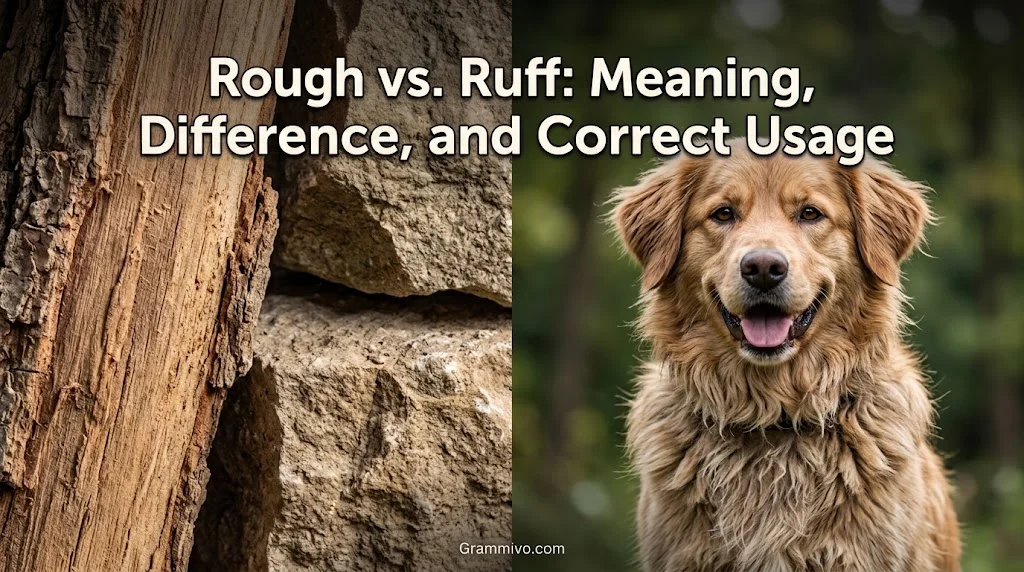
Have you ever heard someone say “rough” and wondered whether they meant “ruff”? The confusion makes sense. Both words are pronounced the same in standard English, yet their meanings are completely different. One is an everyday English word you’ll encounter constantly. The other has several specific meanings tied to clothing, birds, animals, and specialized vocabulary.
The difference becomes especially important in writing. If you’re describing a difficult day, an uneven surface, or harsh weather, rough is the word you need. If you’re talking about a historical collar, a ring of feathers, or a particular shorebird, ruff may be correct.
These words are homophones, meaning they sound alike but have different spellings and meanings. English has plenty of these linguistic traps. Think of pair and pear, right and write, or flower and flour. Rough and ruff belong to the same club.
Quick Answer
Rough and ruff are both correct English words, but they aren’t interchangeable.
- Rough usually describes something uneven, coarse, difficult, harsh, or unfinished.
- Ruff is a specialized noun that can describe a historical collar, a collar-like ring of feathers, an animal collar, or a particular shorebird.
- Both words are commonly pronounced /rʌf/.
- Rough is vastly more common in everyday English.
- Ruff isn’t a misspelling of rough. It has its own established meanings.
For example:
The road was rough after the storm.
Here, rough means uneven or difficult to travel over.
The actor wore an elaborate ruff around his neck.
Here, ruff refers to a historical type of collar.
The easiest rule is simple: use “rough” for everyday meanings such as uneven, difficult, harsh, or coarse. Use “ruff” when you’re referring to one of its specific meanings involving collars, feathers, animals, or the bird.
Comparison Overview
| Feature | Rough | Ruff |
| Pronunciation | /rʌf/ | /rʌf/ |
| Word type | Adjective, noun, verb, adverb | Primarily a noun |
| Common meaning | Uneven, coarse, difficult, harsh, unfinished | A collar, feather ruff, animal collar, or shorebird |
| Everyday frequency | Very common | Relatively uncommon |
| Homophone | Yes | Yes |
| Example | The road is rough. | She wore a lace ruff. |
| Can describe difficulty? | Yes | No |
| Can describe texture? | Yes | No |
| Can refer to a historical collar? | No | Yes |
| Can refer to a bird? | No | Yes |
Main Differences Between Rough vs. Ruff
The biggest difference between rough vs. ruff is meaning. Their pronunciation may be identical, but their written forms serve very different purposes.
Rough has a broad range of meanings. It can describe physical texture, difficult circumstances, harsh behavior, approximate amounts, unfinished work, and even certain actions.
Ruff, on the other hand, has a much narrower semantic range. It usually appears as a noun for something resembling a collar or ring around the neck. It can also refer to a particular migratory shorebird.
In other words, rough is an everyday workhorse while ruff is a specialized term.
Rough Describes Texture and Physical Surfaces
When something isn’t smooth, even, or soft, rough is often the correct word.
You might describe these things as rough:
- Sandpaper
- Unfinished wood
- Rocky ground
- A gravel road
- Coarse fabric
- Rough skin
- A jagged wall
- A weathered surface
For example:
The carpenter ran his hand across the rough wood.
The wood isn’t necessarily damaged. It simply has an uneven or coarse surface.
The word can describe physical sensations, too. A rough towel may feel scratchy against your skin. Rough stone may have an irregular texture. Rough fabric may feel coarse rather than smooth.
Rough Can Describe Difficult Experiences
Rough doesn’t only describe things you can touch.
English speakers commonly use it to describe difficult, unpleasant, or challenging experiences.
Consider these examples:
- I had a rough day at work.
- The team had a rough season.
- She went through a rough period.
- The family had a rough year.
- It was a rough journey through the mountains.
In these sentences, rough means difficult or unpleasant.
That’s why writing “I had a ruff day” is incorrect unless you’re deliberately making a joke about a dog.
Rough Can Describe Harsh Behavior
The word rough can also describe the way someone treats another person or handles something.
For example:
The player was penalized for rough treatment of the opponent.
Here, rough suggests behavior that was too forceful or aggressive.
You can also say:
- Don’t be rough with the puppy.
- The mechanic handled the equipment roughly.
- His rough manner made the conversation uncomfortable.
The meaning depends on context, but the central idea involves force, harshness, or lack of gentleness.
Rough Can Mean Approximate
One of the more useful meanings of rough is approximate or not exact.
This appears frequently in everyday and professional English.
For example:
Can you give me a rough estimate of the cost?
That doesn’t mean the estimate is careless. It means the number isn’t final or exact.
Common expressions include:
- rough estimate
- rough calculation
- rough figure
- rough idea
- rough approximation
You might tell a friend, “The trip will take roughly three hours.” Here, roughly means approximately.
Rough Can Mean Unfinished or Preliminary
The word also appears when something hasn’t reached its polished or final form.
A rough draft, for instance, is an early version of a piece of writing. It contains the main ideas but may still need substantial editing.
You might say:
I’ve finished a rough draft of the article, but I still need to revise it.
The same idea appears in design, planning, and creative work.
A rough sketch gives you the basic shape without all the final details. A rough plan establishes the general direction without locking down every decision.
This meaning connects naturally with the broader idea of something being unfinished or preliminary.
What Does “Rough” Mean?
Rough is a highly versatile English word. Its meanings change with context, but several major senses appear repeatedly in everyday communication.
Rough as an Adjective
The adjective rough is by far its most common grammatical use.
It can describe:
- A surface that isn’t smooth
- Weather that is severe
- Water that is turbulent
- A person who behaves harshly
- A difficult experience
- An unfinished version
- An approximate calculation
For example:
The ocean became rough as the wind increased.
Here, rough describes turbulent water.
Compare that with:
The table has a rough surface.
Now it describes texture.
The word stays the same while the context changes its precise meaning.
Rough as a Noun
Rough can also function as a noun.
One notable example comes from golf. In golf, the rough refers to the longer grass surrounding the more closely mowed fairway and green areas.
A golfer might say:
My ball landed in the rough.
Here, rough isn’t describing the ball. It’s naming a specific area of the golf course.
The noun also appears in expressions and specialized contexts, although these uses are less common than the adjective.
Rough as a Verb
Rough can function as a verb as well.
For example, to rough something out means to produce a preliminary version or basic form.
The designer roughed out the layout before creating the final version.
The phrasal verb rough up has a different meaning. It generally means to attack or handle someone roughly.
The suspect claimed that the officers roughed him up.
This expression is informal and should be understood from context.
Read More: Aging vs. Ageing: Meaning, Difference, and Correct Usage
What Does “Ruff” Mean?
Unlike rough, the word ruff doesn’t have a broad collection of everyday meanings.
Instead, it has several specific definitions.
Ruff as a Historical Clothing Collar
A ruff was a distinctive pleated collar that became fashionable in Europe during the 16th and early 17th centuries.
These collars could be elaborate, stiff, and surprisingly large. They surrounded the neck and sometimes extended outward like a decorative frame.
Historical portraits frequently show wealthy people wearing elaborate ruffs.
A ruff could communicate more than fashion. Clothing during this period often reflected social position, wealth, and status. Elaborate garments required time, material, and skilled craftsmanship.
So when you encounter the word ruff in a historical context, it may refer specifically to this type of collar.
The portrait shows the nobleman wearing a broad white ruff.
Ruff as a Ring of Feathers
Ruff can also describe a collar-like mass of feathers around the neck of certain birds.
The basic visual idea remains the same: the feathers create a structure resembling a collar or frill.
This use demonstrates how words often develop metaphorically. A physical object gets a name, and that name later applies to something with a similar shape or appearance.
Ruff as an Animal Collar
The word ruff can also refer to a collar-like covering around an animal’s neck.
For example, some descriptions of dogs or other animals may use ruff for a thick mane or decorative collar of fur.
You’ll encounter this use more often in descriptions of breeds, costumes, grooming, or animal appearance than in ordinary conversation.
Don’t confuse this with the sound “ruff” often used in playful writing to imitate a dog’s bark. That’s an informal representation of a sound rather than the standard meaning of the noun ruff.
Ruff as a Bird
Ruff is also the common name of a shorebird, Calidris pugnax.
This bird belongs to the sandpiper family. It is particularly notable for the males’ elaborate breeding plumage, which includes a striking neck ruff.
During breeding season, males can develop highly variable ornamental feathers around the neck. Their appearance differs considerably from one individual to another.
The bird’s name therefore fits neatly with one of the other meanings of ruff.
Rough vs. Ruff: Meaning, Spelling, and Pronunciation
The spelling difference is easy to see:
- Rough → R-O-U-G-H
- Ruff → R-U-F-F
The pronunciation is where things get tricky.
Both are generally pronounced /rʌf/ in standard English.
That means rough and ruff are homophones. They sound alike even though they have different spellings and meanings.
English contains many words like this. The spelling often preserves historical forms rather than giving you a simple letter-by-letter pronunciation guide.
The word rough is a particularly famous example because its spelling contains several letters that don’t correspond neatly to the modern pronunciation.
Why Are Rough and Ruff Pronounced the Same?
English pronunciation has changed dramatically over centuries. Spelling, however, often changed more slowly.
As a result, some English words retain spellings that reflect older stages of the language.
The -ough spelling in rough appears in several English words, yet those words don’t all share the same pronunciation.
Compare:
- rough → /rʌf/
- though → /ðoʊ/
- through → /θruː/
- thought → /θɔt/
- cough → /kɔf/ in many standard pronunciations
That little sequence of letters is almost a miniature lesson in English spelling history.
Rough vs. Ruff Examples
Seeing these words in complete sentences makes the distinction much clearer.
Examples With “Rough”
The trail was rough after several days of heavy rain.
Here, rough describes uneven physical conditions.
She had a rough morning after missing her flight.
Here, rough means difficult or unpleasant.
The fabric feels rough against my skin.
Here, it describes texture.
The manager gave us a rough estimate of the project’s cost.
Here, it means approximate.
He submitted a rough draft before completing the final version.
Here, it means preliminary or unfinished.
The players faced rough weather during the match.
Here, rough describes unpleasant or severe conditions.
Examples With “Ruff”
The portrait shows a woman wearing an elaborate ruff.
Here, ruff refers to historical clothing.
The bird displayed a large neck ruff during breeding season.
Here, it refers to feathers.
The dog wore a decorative ruff around its neck.
Here, it describes a collar-like feature.
A Ruff can show striking breeding plumage.
Here, Ruff is the name of a bird species.
Rough vs. Ruff in Common Phrases
Rough appears in dozens of familiar expressions because it has such a broad meaning range.
Common Expressions With Rough
- Rough draft — an unfinished first version
- Rough estimate — an approximate calculation
- Rough idea — a general understanding
- Rough road — an uneven road
- Rough seas — turbulent water
- Rough weather — severe or unpleasant weather
- Rough day — a difficult day
- Rough treatment — harsh treatment
- Rough around the edges — lacking polish or refinement
- Rough and ready — practical but not polished
Consider rough around the edges. It doesn’t necessarily mean physically rough. It can describe a person who has good qualities but lacks refinement or social polish.
For example:
He may be rough around the edges, but he’s generous and dependable.
That’s a figurative use of the word.
Uses of Ruff
The word ruff has fewer common combinations because its meanings are specialized.
You may encounter:
- Elizabethan ruff
- lace ruff
- neck ruff
- feather ruff
- ruff collar
- Ruff as a bird name
These expressions tend to appear in historical writing, fashion descriptions, birdwatching, zoology, or animal-related contexts.
Why Do People Confuse Rough and Ruff?
The answer is almost entirely pronunciation.
When someone says:
“The road was ruff.”
You immediately understand the intended meaning when you’re listening. The problem appears when that sentence moves from speech to writing.
English gives you no audible clue about whether the speaker means rough or ruff.
Context must do the work.
This is why homophones can cause spelling errors. Your brain recognizes the sound before it retrieves the correct written form.
A Simple Context Test
Ask yourself what you’re describing.
If the word means:
- difficult
- uneven
- coarse
- harsh
- approximate
- unfinished
then choose rough.
If you’re referring to:
- a historical collar
- a ring of feathers
- an animal’s collar-like neck feature
- the shorebird called a Ruff
then choose ruff.
That quick test solves most cases.
FAQs:
Is “rough” or “ruff” correct?
Both are correct words. The correct choice depends on what you mean. Use rough for meanings involving unevenness, difficulty, harshness, coarseness, or approximation. Use ruff for its specialized meanings involving collars, feathers, animals, or the bird.
Is “ruff” a real word?
Yes. Ruff is a legitimate English word. It can refer to a historical collar, a collar-like arrangement of feathers, an animal’s neck covering, or the shorebird known as the Ruff.
Are “rough” and “ruff” pronounced the same?
Yes. In standard English, rough and ruff are homophones. Both are generally pronounced /rʌf/.
What does “ruff” mean for a dog?
In animal-related descriptions, ruff can refer to a collar-like growth or covering around an animal’s neck. The exact usage depends on the context and the animal being described.
What does “rough” mean in a sentence?
Rough can mean several things. It may describe something physically uneven or coarse, a difficult experience, harsh treatment, turbulent conditions, or an approximate or unfinished version of something.
Conclusion:
The difference between rough vs. ruff becomes easy once you stop listening for the answer and start looking at the meaning. Rough is the everyday word. Use it for something uneven, coarse, difficult, harsh, turbulent, approximate, or unfinished. You might have a rough day, walk along a rough road, touch rough fabric, or prepare a rough draft. Ruff is a specialized word. It can describe a historical collar, a collar-like mass of feathers, an animal’s neck feature, or the shorebird called a Ruff.
