
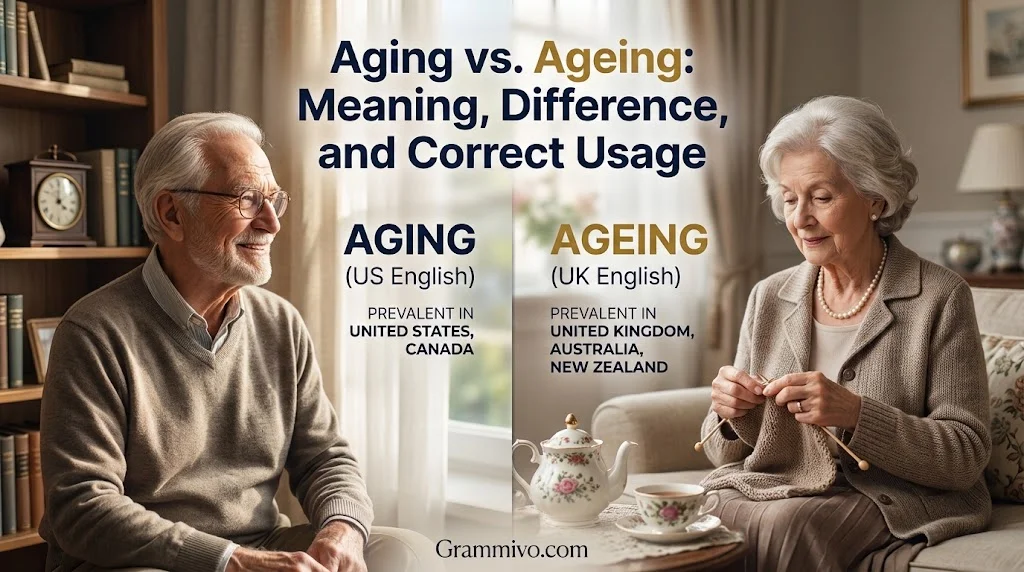
If you’ve ever paused over aging vs. ageing, you’re not alone. The two words look almost identical, sound the same, and carry the same basic meaning. So why does one version appear more often in American writing while the other shows up in British English?
The answer comes down mainly to regional spelling conventions. Aging is the standard spelling in American English, while ageing is the traditional and preferred spelling in British English and several other varieties of English.
Neither spelling represents a different process. Both describe growing older, developing age-related characteristics, or allowing something to mature over time. The choice depends largely on which variety of English you’re using and who will read your writing.
This distinction becomes especially important in academic writing, health articles, business documents, newspapers, and websites that target a particular country. A single spelling may look perfectly natural to one audience and slightly foreign to another.
Quick Answer
Aging and ageing are both correct spellings of the same word. Aging is the preferred spelling in American English, while ageing is generally preferred in British English. The two forms have the same meaning and pronunciation.
For example:
- US English: Aging is a natural part of life.
- British English: Ageing is a natural part of life.
If you’re writing for readers in the United States, choose aging. If you’re following British English conventions, choose ageing.
The important thing is consistency. Once you choose the spelling that matches your audience, use it throughout the article or document.
Comparison Overview
| Feature | Aging | Ageing |
| Basic meaning | Growing older or becoming older | Growing older or becoming older |
| American English | Preferred | Less common |
| British English | Less common | Preferred |
| Pronunciation | Same | Same |
| Part of speech | Gerund/present participle | Gerund/present participle |
| Verb | Age | Age |
| Meaning difference | None | None |
| Common phrase | Aging population | Ageing population |
| Common health term | Healthy aging | Healthy ageing |
| Regional distinction | Primarily US usage | Primarily UK usage |
The difference is therefore a spelling distinction rather than a meaning distinction.
You can think of it like color and colour. The object doesn’t change because the spelling does. The same principle applies to aging and ageing.
Main Differences Between Aging vs. Ageing
The biggest difference between aging vs. ageing is regional preference. Both forms come from the verb age, but English-speaking regions developed different spelling conventions for the word.
Aging Is Preferred in American English
American English generally drops the final e from age when adding the -ing ending:
age → aging
You’ll commonly see this spelling in American newspapers, medical publications, government material, academic writing, and everyday communication.
Examples include:
- Aging affects every part of the human body.
- The country has an aging population.
- Regular exercise can support healthy aging.
- The study examines brain changes associated with aging.
- The company is developing products for an aging population.
If your article targets American readers, aging is the natural choice.
Ageing Is Preferred in British English
British English commonly retains the e before -ing:
age → ageing
Examples include:
- Ageing is a natural biological process.
- The country has an ageing population.
- Healthy ageing can improve quality of life.
- The report examines the effects of ageing.
- The government is preparing for an ageing population.
For British readers, ageing usually looks more familiar and conventional.
The Meaning Doesn’t Change
This is the point that causes the most unnecessary confusion.
Aging doesn’t mean one kind of growing older while ageing means another. They aren’t two separate concepts.
Consider these sentences:
Aging is inevitable.
Ageing is inevitable.
The meaning is essentially identical. The only noticeable difference is the spelling convention.
The same applies when the word describes objects or substances:
The aging wine developed a richer flavor.
The ageing wine developed a richer flavor.
Again, the underlying idea remains the same.
What Does “Aging” Mean?
Aging refers to the process of becoming older or undergoing changes associated with the passage of time.
The word can describe people, animals, populations, materials, products, buildings, systems, and even wine.
For humans, aging includes the biological, psychological, and social changes that occur throughout life. In everyday language, however, the word can simply refer to getting older.
For example:
- Aging can bring physical and emotional changes.
- Her parents are concerned about healthy aging.
- The doctor discussed common changes associated with aging.
- The city has an aging transportation system.
The context determines exactly what kind of change the word describes.
Aging as a Biological Process
In health and science, aging can refer to the gradual accumulation of biological changes over time.
These changes can affect:
- Cells
- Tissues
- Muscles
- Bones
- Skin
- Vision
- Hearing
- Metabolism
- Immune function
- Cardiovascular health
- Cognitive function
Aging doesn’t mean that every person experiences the same changes at the same rate. Genetics, lifestyle, environment, medical history, nutrition, physical activity, and social factors can all influence how people age.
That makes aging a broad term rather than a description of one single biological event.
Aging Can Describe Things Other Than People
A common misconception is that aging only applies to humans.
It doesn’t.
You might talk about:
- Aging buildings
- Aging infrastructure
- Aging equipment
- Aging technology
- Aging wine
- Aging populations
- Aging materials
For example:
The city needs to replace its aging water pipes.
Here, aging doesn’t mean the pipes have become elderly. It means they have existed long enough to experience deterioration or age-related wear.
What Does “Ageing” Mean?
Ageing carries the same fundamental meaning as aging. It describes becoming older or changing as time passes.
The primary difference is spelling.
British English commonly uses ageing, particularly in formal writing.
For example:
The report examines how ageing affects the workforce.
A British publication might also write:
An ageing population creates new demands for healthcare and social services.
An American publication would normally use:
An aging population creates new demands for healthcare and social services.
The meaning remains unchanged.
Ageing in Health and Medicine
The term ageing appears frequently in British health-related writing.
You may encounter phrases such as:
- Healthy ageing
- Population ageing
- Ageing process
- Ageing population
- Age-related disease
- Successful ageing
- Healthy ageing initiatives
These expressions describe the same broad concepts that American writers discuss using aging.
Ageing in Everyday British English
British English speakers use ageing in ordinary contexts as well.
For example:
The ageing actor still performs on stage.
Or:
The house needs repairs because of years of ageing and exposure to weather.
Again, the spelling reflects the variety of English rather than a different definition.
Read More: Flyer or Flier: Which Spelling Is Correct?
Why Is “Aging” Spelled Without the E?
The spelling aging often catches learners’ attention because the base word is age.
At first glance, you might expect:
age + ing = ageing
That form does exist. It’s the preferred British spelling.
American English, however, generally uses aging.
This reflects a broader difference in spelling conventions between American and British English. American spelling often removes a final silent e before a suffix beginning with a vowel.
However, English spelling isn’t governed by one perfectly consistent rule. Historical usage, pronunciation, word formation, and regional conventions all play a role.
That’s why it isn’t useful to treat every spelling difference as a simple mathematical formula.
Aging and Similar American Spellings
American English uses several forms that differ from common British spellings.
| American English | British English |
| Aging | Ageing |
| Traveling | Travelling |
| Canceled | Cancelled |
| Labeling | Labelling |
| Signaling | Signalling |
These patterns aren’t identical in every circumstance. Still, they show why aging fits comfortably within broader American spelling conventions.
Why Does British English Use “Ageing”?
British English traditionally retains the e in ageing.
That gives the spelling:
age + ing = ageing
This form remains standard in many British publications and institutions.
The retained e also makes the connection to the base word age visually obvious. However, the reason isn’t that British English speakers pronounce the word differently.
They don’t.
Aging and Ageing Have the Same Pronunciation
In normal speech, aging and ageing are pronounced the same way.
The spelling difference doesn’t create a different vowel sound or stress pattern.
That makes this an especially clear example of a regional orthographic difference.
In other words, your reader hears essentially the same word regardless of which spelling you write.
Aging or Ageing: Which Is Correct in American English?
If you’re writing in US English, use aging.
This applies to formal and informal writing alike.
For example:
- Correct for US English: The aging population needs more healthcare resources.
- Preferred US spelling: Healthy aging begins with good lifestyle habits.
- Preferred US spelling: Scientists study the biological effects of aging.
You might still encounter ageing in an American context, especially when quoting a British source or discussing a publication that follows British conventions. That doesn’t make the spelling universally wrong.
It simply means the writer may be following another English variety.
Why Consistency Matters in American Writing
Imagine an American health article that begins with:
Healthy aging is an important part of modern healthcare.
Later, it says:
The article discusses healthy ageing and age-related conditions.
That switch isn’t a serious grammar error. Still, it creates an unnecessary inconsistency.
A polished article should normally choose one spelling system and stick with it.
Aging or Ageing: Which Is Correct in British English?
For British English, ageing is generally the preferred form.
Examples include:
- The ageing population is changing the country’s healthcare needs.
- Researchers are studying healthy ageing.
- Ageing can affect mobility and muscle strength.
- The government has introduced policies for an ageing workforce.
A British writer wouldn’t normally need to switch to aging simply because the word appears frequently.
What About British Publications Using “Aging”?
You may occasionally encounter aging in British contexts.
That can happen for several reasons:
- The publication follows an international style.
- The writer uses American English.
- The organization has its own style guide.
- The text was translated or edited.
- The term comes from an American source or title.
Therefore, ageing is the preferred British spelling, but real-world English contains variation.
Aging vs. Ageing in Other English Varieties
English doesn’t stop at American and British English. Other national varieties have their own conventions, and usage can overlap.
Canadian English
Canadian English often sits between American and British conventions.
Both aging and ageing can be encountered, although aging is common in Canadian usage.
The appropriate choice can depend on the publication, institution, or style guide.
If you’re writing specifically for Canadian readers, consistency matters more than pretending that only one form ever appears.
Australian English
Australian English generally favors ageing.
For example:
Australia is preparing for an ageing population.
The same sentence in American English would normally use:
The United States is preparing for an aging population.
New Zealand English
New Zealand English also commonly follows British spelling conventions, making ageing a familiar form.
As with Australian and British English, local style guides can influence specific editorial choices.
Aging vs. Ageing in Different Contexts
The word appears in many fields. Understanding those contexts makes the spelling distinction much easier to recognize.
Aging and Ageing in Medicine
Medical writing frequently discusses aging because age-related biological changes affect health across the lifespan.
Common American expressions include:
- Healthy aging
- Aging process
- Aging population
- Successful aging
- Aging-related changes
British writing generally changes these to:
- Healthy ageing
- Ageing process
- Ageing population
- Successful ageing
- Ageing-related changes
The underlying medical concepts don’t change.
Aging and Ageing in Demographics
Population studies often use the expression aging population or ageing population.
An aging population generally means that the proportion of older people within a population is increasing.
Several factors can contribute to this pattern, including:
- Longer life expectancy
- Lower birth rates
- Changes in migration
- Improved healthcare
- Changing family structures
This is a demographic concept rather than simply a statement that every individual in a country is getting older.
Aging and Ageing in Infrastructure
The word can also describe infrastructure that has existed for a long time.
For example:
The city is replacing its aging bridges.
A British publication might write:
The city is replacing its ageing bridges.
Here, the word can suggest that infrastructure is becoming older and may require maintenance, modernization, or replacement.
Aging and Ageing in Wine
The word aging also has a specialized meaning in food and beverage contexts.
Wine can undergo chemical changes during aging that influence its aroma, flavor, texture, and overall character.
For example:
The winemaker aged the wine in oak barrels.
You might also see:
The wine developed complexity during aging.
British writing can use ageing in the same context.
The process itself doesn’t become different because the spelling changes.
FAQs:
Is “aging” or “ageing” correct?
Both are correct. American English generally prefers aging, while British English generally prefers ageing.
Is “aging” correct in American English?
Yes. Aging is the standard American English spelling.
For example:
Healthy aging can support quality of life.
Is “ageing” correct in British English?
Yes. Ageing is the standard British English spelling.
For example:
Healthy ageing can support quality of life.
Is there a difference in meaning between aging and ageing?
No significant difference exists in meaning. Both refer to becoming older or changing with time.
Do aging and ageing sound different?
No. They generally have the same pronunciation.
The difference appears in writing rather than ordinary speech.
Conclusion:
The aging vs. ageing debate is much simpler than it first appears. Both spellings refer to the same process and generally share the same pronunciation. The main distinction is regional spelling. Use aging when you’re writing in American English. Use ageing when you’re following British English conventions.
The same distinction appears in many familiar English spelling pairs. What matters most isn’t choosing the spelling that seems universally “correct.” Instead, choose the form that matches your audience, publication, and overall style.
