
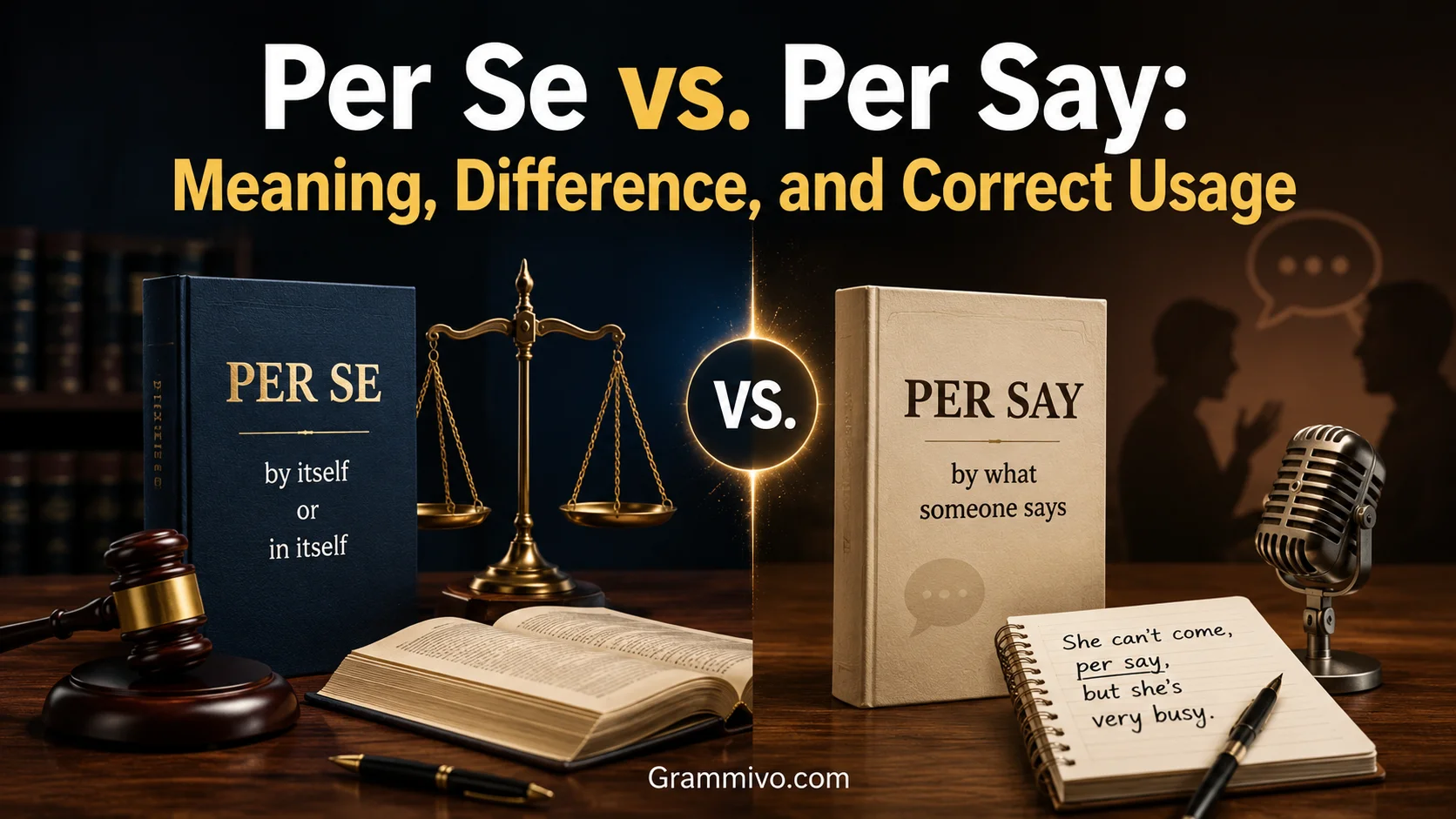
Have you ever written per say in a sentence and wondered whether it was correct? You’re not alone. Many English speakers confuse per se with per say because both expressions sound nearly identical when spoken aloud. However, only one is the standard spelling of the expression you’re probably trying to use.
The confusion usually comes from pronunciation. When people hear someone say per se, they may naturally assume the final sound represents the word say. Unfortunately, English spelling doesn’t always follow pronunciation, especially when Latin expressions enter everyday language.
The correct expression is per se, which means “by itself,” “in itself,” or “considered independently.” Writers use it to clarify that something isn’t necessarily good, bad, difficult, or important on its own, even if its surrounding circumstances create that impression.
For example, you might say, “Working from home isn’t difficult per se, but staying productive requires discipline.” Here, per se separates the act of working from home from the challenges that may accompany it.
Quick Answer
Per se is the correct spelling, while per say is a common misspelling when referring to the Latin expression. Per se means “by itself,” “in itself,” or “intrinsically.”
Here’s a quick comparison:
- Per se: Correct expression meaning “in itself” or “by itself.”
- Per say: Incorrect spelling when intended to represent per se.
- Pronunciation: Commonly pronounced pur SAY in English.
- Origin: Latin.
- Example: “The movie isn’t frightening per se, but its ending is unsettling.”
Remember this simple rule: Write per se, not per say. Although the expression sounds like “per say,” its final word is spelled se.
Comparison Overview
The table below highlights the main differences between per se and per say.
| Feature | Per Se | Per Say |
| Correctness | Standard, correct expression | Nonstandard spelling of the expression |
| Meaning | By itself; in itself | No established meaning as this expression |
| Origin | Latin | Phonetic misspelling |
| Pronunciation | Commonly pronounced “pur SAY” | Usually intended to sound the same |
| Grammatical role | Adverbial expression | Not standard in this usage |
| Formal writing | Accepted when appropriate | Incorrect when intended as per se |
| Everyday conversation | Commonly used | Sometimes appears through spelling confusion |
| Example | “The task isn’t difficult per se.” | “The task isn’t difficult per say.” |
The essential distinction is straightforward: per se is an established expression, whereas per say is usually a spelling mistake. Knowing its meaning and function will help you recognize when it belongs in a sentence.
What Does Per Se Mean?
Definition of Per Se
The expression per se means “by itself,” “in itself,” or “considered on its own.” It helps you discuss something independently of other factors that might influence how people perceive it.
For instance, consider this sentence:
“The restaurant isn’t expensive per se, but the extra service charges make the meal costly.”
The speaker isn’t necessarily saying the restaurant’s menu prices are high. Instead, the speaker distinguishes the restaurant itself from the additional expenses associated with dining there.
That’s the central purpose of per se. It allows you to make a distinction between something’s inherent characteristics and the circumstances surrounding it.
Here are a few more examples:
- “Criticism isn’t harmful per se.” Criticism can be useful or damaging depending on how someone delivers it.
- “The proposal isn’t unreasonable per se.” The proposal itself may make sense even if certain details need improvement.
- “Technology isn’t dangerous per se.” Its risks often depend on how people design, control, and use it.
- “Being quiet isn’t a weakness per se.” A quiet personality doesn’t automatically indicate insecurity or a lack of confidence.
In each example, per se narrows the statement. Rather than making an absolute judgment, the speaker focuses on the subject itself.
Origin and Etymology of Per Se
The expression per se comes from Latin, a language that has influenced English vocabulary for centuries. Its literal sense is closely related to “by itself” or “through itself.”
The two words contribute to its meaning:
- Per: A Latin preposition that can mean “through,” “by,” or “by means of,” depending on context.
- Se: A Latin reflexive pronoun meaning “itself,” “himself,” “herself,” or a corresponding reflexive form, depending on the context.
Together, the words form an expression that conveys the idea of something considered independently.
English has adopted many Latin expressions, particularly in academic, legal, scientific, and professional settings. Familiar examples include et cetera, vice versa, ad hoc, and bona fide.
Like these expressions, per se has retained its traditional spelling even though English speakers pronounce it according to English speech patterns.
This history explains why spelling it per say creates a problem. The expression didn’t originate as the English words per and say. Its spelling reflects its Latin origin.
How to Use Per Se in a Sentence
Using per se correctly requires more than remembering its spelling. You also need to understand what it contributes to a sentence.
Writers commonly place it after a noun, adjective, or phrase that they want to qualify.
For example:
- “The assignment isn’t complicated per se, but the instructions are confusing.”
- “I’m not opposed to change per se; I just prefer careful planning.”
- “The policy isn’t unfair per se, although its effects deserve further review.”
- “The software isn’t expensive per se, but the subscription fees add up.”
Notice the pattern. The speaker makes a statement, then uses per se to clarify that the statement applies to the subject considered independently.
You can use it in different settings.
In everyday conversation:
“I don’t dislike exercise per se. I just hate waking up early for it.”
In professional communication:
“The proposed schedule isn’t impractical per se, but it requires additional staffing.”
In academic writing:
“The findings do not establish that social media use is harmful per se; the effects may depend on usage patterns.”
However, don’t insert per se simply because you want your sentence to sound sophisticated. If “by itself” or “in itself” communicates your meaning more clearly, choose the simpler alternative.
Good writing depends on precision, not on how many Latin expressions you can fit into a paragraph.
What Does Per Say Mean?
Is Per Say a Correct Expression?
In standard English, per say is incorrect when used as a substitute for per se.
The mistake usually happens because the expression’s pronunciation resembles the English word say. Someone hears the phrase, remembers its sound, and writes the spelling that seems most natural.
Unfortunately, that spelling doesn’t match the established Latin expression.
Consider these examples:
Incorrect: “The idea isn’t bad per say.”
Correct: “The idea isn’t bad per se.”
The corrected sentence means that the idea itself isn’t necessarily bad. Other circumstances might still make it unsuitable.
Here’s another example:
Incorrect: “Money isn’t the problem per say.”
Correct: “Money isn’t the problem per se.”
In the correct version, the writer distinguishes money itself from the circumstances contributing to the problem.
There is one important qualification. The words per say can appear together in unusual contexts, such as a quotation, a person’s name, or text discussing the misspelling itself. The problem arises when someone intends to use the established expression but writes it incorrectly.
For ordinary writing, remember that the standard expression is always per se.
Why Do People Confuse Per Se and Per Say?
The confusion between per se and per say is easy to understand. Several factors contribute to the mistake.
Pronunciation creates the first problem. In common English speech, per se sounds like “pur SAY.” Because say is a familiar English word, people may assume it supplies the correct spelling.
The expression has a foreign origin. Readers who haven’t encountered Latin expressions before may not recognize that se belongs to the original phrase. They may interpret the expression as two ordinary English words.
People often learn expressions by hearing them. Someone might hear per se repeatedly in meetings, podcasts, interviews, or conversations without ever seeing it written. When that person finally uses the phrase in an email, the spelling may become a guessing game.
Autocorrect doesn’t solve every spelling problem. Depending on the software and sentence, a spellchecker might overlook the error or suggest a replacement that doesn’t fit the intended meaning.
For example, a person who frequently hears “not difficult per se” might type “not difficult per say” because the latter looks familiar.
The best solution is to connect the spelling with the expression’s meaning and Latin origin. Once you understand that per se means “in itself,” the correct spelling becomes easier to remember.
Read More: OTP Meaning in Text: What Does OTP Mean in Texting?
Main Differences Between Per Se and Per Say
Spelling and Grammatical Correctness
The most important difference concerns spelling. Per se is the accepted expression in standard English, while per say is generally an error when used with the same intended meaning.
The distinction matters in several kinds of writing:
- Academic papers: Correct spelling supports clarity and credibility.
- Business emails: Accurate language helps maintain a professional tone.
- Blog posts: Proper usage prevents avoidable editing mistakes.
- Reports and presentations: Consistent spelling makes your work look polished.
- Personal messages: Correct usage helps you communicate precisely.
Although readers can often understand per say from context, that doesn’t make it correct.
Imagine sending a report that includes the sentence, “The strategy isn’t ineffective per say.” Your reader will probably understand your point. However, the misspelling can distract from your argument and make the document appear less carefully edited.
The solution is simple: write per se whenever you mean “in itself” or “by itself.”
Meaning and Usage
Per se has an established meaning. It helps you distinguish a subject from the circumstances, consequences, or related factors surrounding it.
By contrast, per say has no standard meaning as a replacement for that expression.
Compare the following sentences:
| Sentence | Explanation |
| “The deadline isn’t unreasonable per se.” | Correct; the deadline itself may be reasonable. |
| “The deadline isn’t unreasonable per say.” | Incorrect spelling of the intended expression. |
| “The deadline isn’t unreasonable by itself.” | Correct alternative with a similar meaning. |
| “The deadline isn’t unreasonable in itself.” | Another acceptable alternative. |
The first sentence uses the Latin expression correctly. The third and fourth convey a similar idea without using Latin.
You can also use per se to avoid making an overly broad judgment.
For example, saying “Competition isn’t harmful per se” doesn’t mean competition can never cause harm. It means competition, considered on its own, isn’t automatically harmful.
The surrounding circumstances still matter.
Pronunciation
In common English usage, per se is pronounced approximately “pur SAY.” The first word sounds similar to “purr,” while the second rhymes with “day.”
A simple pronunciation guide is:
- Per: Pur
- Se: Say
- Together: Pur SAY
Pronunciation can vary slightly among speakers and accents. However, the final word remains spelled se, regardless of how it sounds.
This is where many spelling mistakes begin. People often rely on phonetic memory when writing unfamiliar expressions.
English contains plenty of examples where spelling and pronunciation don’t align neatly. Words such as colonel, island, and choir demonstrate that familiar sounds don’t always reveal a word’s spelling.
The same principle applies here. Knowing how to pronounce per se doesn’t automatically tell you how to spell it.
When writing the expression, remember its established Latin form rather than trying to reproduce its sound.
Formal and Informal Contexts
You can use per se in both formal and informal communication. Its suitability depends on the sentence, audience, and tone.
In everyday conversation, it can make a distinction quickly:
“I’m not against online shopping per se; I just prefer seeing products in person.”
In professional writing, it can help qualify a claim:
“The proposed change isn’t problematic per se, but its implementation requires careful planning.”
In academic writing, it can help distinguish a concept from its possible effects:
“The analysis does not suggest that the practice is harmful per se.”
However, the expression isn’t always the clearest choice.
For a general audience, “in itself” may feel more natural than per se. Compare these versions:
- More formal: “The procedure isn’t complicated per se.”
- More conversational: “The procedure isn’t complicated in itself.”
Both sentences communicate a similar idea. The second may sound more accessible to readers unfamiliar with Latin expressions.
Choose the version that best fits your audience. Formality should support your message rather than make it harder to understand.
Per Se Examples in Sentences
Examples make it easier to understand how per se works in real communication. The following sentences demonstrate its meaning across different situations.
Examples of Per Se in Everyday English
These examples show how people use per se in casual conversation.
Example 1: “I’m not upset about the decision per se; I’m upset that nobody consulted me.”
The speaker doesn’t necessarily object to the decision itself. The lack of consultation is the real concern.
Example 2: “The neighborhood isn’t dangerous per se, but some streets become poorly lit at night.”
The neighborhood isn’t being described as inherently dangerous. The speaker identifies a specific circumstance that may create concern.
Example 3: “I don’t dislike cooking per se, but I don’t enjoy washing all the dishes afterward.”
The speaker distinguishes cooking from the cleanup that follows.
Example 4: “The book isn’t boring per se; it just takes a while to get going.”
The book may become interesting later, even if its opening feels slow.
Example 5: “There’s nothing wrong with spending money per se, as long as you stay within your budget.”
Spending money isn’t automatically a problem. Financial trouble may arise when spending exceeds available resources.
Example 6: “I’m not against meetings per se, but this project probably needs an email instead.”
The speaker doesn’t reject meetings altogether. The concern relates to whether a meeting suits the situation.
These examples share one useful feature: per se separates the subject itself from a related concern.
FAQs:
Is It Per Se or Per Say?
Per se is correct when you mean “by itself” or “in itself.” Per say is a common misspelling caused by the expression’s pronunciation.
For example, write “The idea isn’t bad per se,” not “The idea isn’t bad per say.”
What Does Per Se Mean in Simple Terms?
Per se means “by itself” or “in itself.” It helps you describe something independently of other factors.
For example, “The job isn’t difficult per se” means that the job itself isn’t necessarily difficult, although certain circumstances may make it challenging.
How Do You Pronounce Per Se?
In common English usage, per se is pronounced approximately “pur SAY.” The pronunciation explains why some people mistakenly write per say.
Regardless of the pronunciation, the standard spelling remains per se.
Is Per Se Latin?
Yes. Per se is a Latin expression that entered English with the meaning “by itself” or “in itself.”
English uses many Latin expressions, particularly in academic, legal, scientific, and professional contexts.
Can I Use Per Se in Formal Writing?
Yes. You can use per se in formal writing when it accurately expresses your meaning.
It’s common in analytical discussions, academic prose, and professional communication. However, “in itself” may be a clearer choice for readers who aren’t familiar with Latin expressions.
Conclusion:
When deciding between per se and per say, remember that per se is the correct expression. It comes from Latin and means “by itself,” “in itself,” or “considered on its own.” The confusion usually stems from pronunciation. Because per se sounds like “per say” in common English speech, writers sometimes spell it phonetically. However, the standard expression retains its original spelling.
