
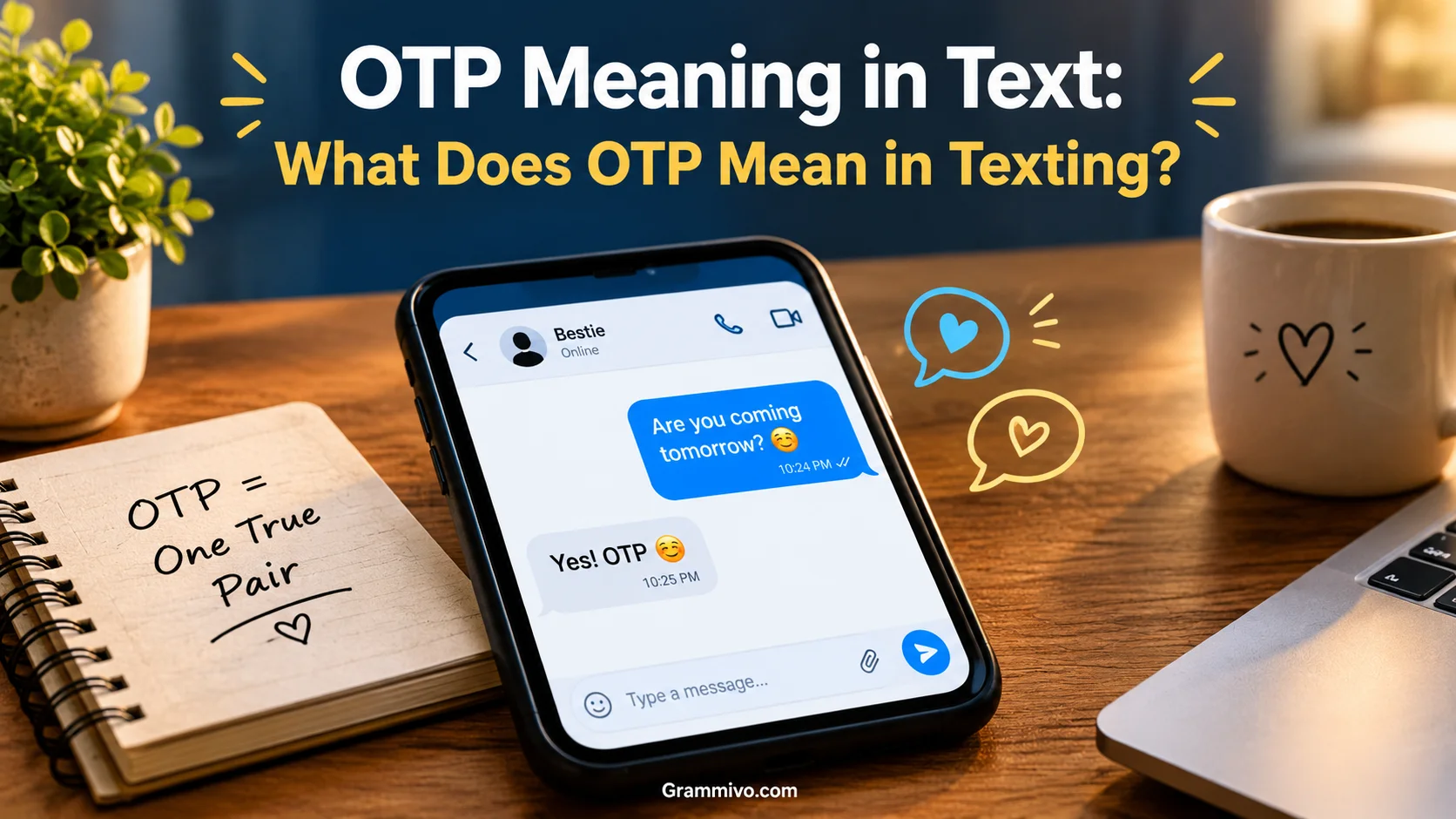
Have you ever received a message containing “OTP” and wondered what the sender meant? You’re not alone. This three-letter abbreviation appears in text messages, social media comments, fandom discussions, and online security notifications. However, its meaning can change depending on the situation.
The OTP meaning in text most commonly refers to “On the Phone” in casual messaging or “One True Pairing” in fandom communities. In other situations, OTP stands for “One-Time Password,” a temporary security code used to verify your identity online.
So, how can you tell which meaning someone intends? The answer lies in the surrounding conversation. If a friend asks why you’re not responding, OTP might mean you’re on a call. If someone discusses their favorite fictional couple, the same abbreviation probably refers to a beloved pairing. A banking notification, meanwhile, usually points to a security code.
Understanding these differences helps you interpret messages correctly and avoid awkward misunderstandings. Let’s explore the meanings of OTP, how people use it, and how you can respond naturally.
Quick Answer
OTP in text can have three common meanings:
- On the Phone: A casual way to say you’re currently talking on a phone call.
- One True Pairing: A fandom term for a person’s favorite romantic couple, usually involving fictional characters.
- One-Time Password: A temporary security code used to verify your identity when logging in or completing an online transaction.
Example: “Can’t talk rn, OTP” may mean “I’m on the phone right now.” In a conversation about a TV show, “They’re my OTP!” means the speaker loves that couple. If a banking app asks you to enter an OTP, it means a verification code.
The context, not the abbreviation alone, tells you which definition fits.
Comparison Overview
OTP has several meanings, but each belongs to a different communication setting. Comparing them makes the abbreviation easier to understand.
| OTP Meaning | Where It’s Commonly Used | Example |
| On the Phone | Text messages and casual chats | “I’ll call you later. OTP rn.” |
| One True Pairing | Fandoms, entertainment discussions, and social media | “Those two are my OTP!” |
| One-Time Password | Banking, account logins, and online transactions | “Enter the OTP sent to your phone.” |
The biggest difference is the purpose behind each use. “On the Phone” describes someone’s current activity, while “One True Pairing expresses a favorite relationship.” A “One-Time Password” protects access to an account or service.
These meanings aren’t interchangeable. If your friend texts “OTP” during a conversation about a movie couple, replying with a question about a banking code will probably confuse them. Likewise, treating a security notification as casual slang could cause you to overlook an important account-verification step.
Main Differences Between OTP Meaning in Text
OTP Meaning: On the Phone
In casual texting, OTP can stand for “On the Phone.” People may use it to explain why they can’t reply, why they’re temporarily unavailable, or why they need to continue a conversation later.
Imagine messaging your friend while they’re talking to someone else. They might reply, “OTP, give me five minutes.” This tells you they’re on a call and will get back to you when they finish.
This meaning is practical because it communicates a simple situation without requiring a complete sentence. However, not everyone uses OTP this way, so you should consider the context before assuming its meaning.
Examples of OTP meaning “On the Phone”:
- “Can’t talk rn, OTP.” — I’m on the phone right now.
- “I’ll text you after this. OTP.” — I’m currently on a call.
- “Why aren’t you answering?” “OTP with Mom.” — I’m talking to Mom on the phone.
- “Wait a sec, OTP!” — Give me a moment because I’m on a call.
Here are a few common texting abbreviations that may appear alongside OTP:
| Abbreviation | Meaning | Example |
| RN | Right Now | “I’m busy RN.” |
| BRB | Be Right Back | “BRB, taking a call.” |
| IDK | I Don’t Know | “IDK when she’ll finish.” |
| TTYL | Talk to You Later | “I’m OTP, TTYL.” |
One important detail: “On the Phone” is a context-dependent interpretation, not a universal definition of OTP. Some people may write “on a call” instead because it’s clearer. If the meaning isn’t obvious, ask a quick question rather than guessing.
OTP Meaning: One True Pairing
In fandom culture, OTP stands for “One True Pairing.” It describes the romantic couple a fan loves most in a fictional story or, sometimes, among public figures.
The term is especially common in discussions about television shows, movies, books, anime, video games, and other entertainment. Fans use it to express strong support for a particular relationship between two characters.
For example, someone watching a romantic television series might say, “They’re my OTP!” That means the person considers the couple their favorite pairing. They might enjoy the characters’ chemistry, emotional connection, shared history, or romantic storyline.
An OTP doesn’t have to be an official couple in the story. Fans may support a relationship even when the characters never become romantically involved in the original work.
Examples of OTP meaning “One True Pairing”:
- “Harry and Ginny are my OTP.” — The speaker loves that fictional couple.
- “I’ve shipped these two since season one. They’re my OTP!” — The speaker has supported the pairing for a long time.
- “This anime gave my OTP the happiest ending.” — The speaker is excited that their favorite couple ended up together.
- “Who’s your OTP in this series?” — Which couple do you like most?
The term also connects to the word “ship,” which means to support or want a romantic relationship between two people or characters.
For instance, if you say, “I ship those characters,” you’re expressing support for their relationship. If you call them your OTP, you’re identifying them as a particularly meaningful or favorite pairing.
OTP Meaning: One-Time Password
In banking, cybersecurity, and account verification, OTP means “One-Time Password.” Unlike casual slang, this definition has a specific technical purpose.
A one-time password is a temporary code that helps a service verify your identity. A bank, email provider, shopping platform, or other service may ask you to enter it when you sign in, reset a password, or approve a transaction.
Depending on the service, the code may arrive through a text message, an authenticator app, email, or another supported method. Some systems generate codes that expire quickly, while others use codes tied to a particular login attempt or transaction.
For example, you might receive a message saying, “Your OTP is 482731. Do not share this code.” If you recently tried to sign in, the code may be part of the verification process.
The key point is that a one-time password is a security credential, not a texting expression.
Common uses include:
- Verifying a new account.
- Confirming a login from an unfamiliar device.
- Resetting an account password.
- Approving certain banking or payment transactions.
- Confirming that you control a registered phone number or another verification method.
However, receiving a code doesn’t automatically mean someone has successfully accessed your account. It may simply mean that someone entered your phone number or started a verification process. If you didn’t request the code, don’t share it. Check the account through its official app or website and follow its security guidance.
Read More: RS Meaning in Text: What Does RS Mean in Texting?
How to Know What OTP Means in a Text
When you see OTP in a message, don’t jump to the first definition you recognize. Instead, look at what the sender is discussing and what happened just before the message.
The same three letters can communicate a casual update, a fandom opinion, or a security instruction. A little context usually makes the intended meaning clear.
Look at the Conversation Topic
The topic is often your strongest clue. If someone is explaining why they can’t answer your messages, “On the Phone” may fit. If you’re discussing a romantic storyline, “One True Pairing” makes more sense.
For example, consider these messages:
- “Can’t reply, OTP.” The sender may mean they’re on a phone call.
- “They’ll always be my OTP.” The sender is probably talking about a favorite couple.
- “Enter the OTP to continue.” The service is asking for a verification code.
Notice how the words around OTP help you interpret it. You rarely need to memorize every possible definition when the conversation already provides a useful clue.
Check Who Sent the Message
The sender’s identity and the platform can also help you understand the abbreviation.
A friend who regularly uses texting slang might write OTP to explain why they’re unavailable. A fan discussing an anime series might use it to describe two characters. A bank or digital service may use OTP when verifying an account.
However, don’t rely on the sender alone. Friends can forward security messages, and fandom discussions can happen in ordinary group chats. Consider both the person and the subject.
Pay Attention to Words Around OTP
Certain words make one interpretation more likely than others.
| Words or Phrases | Likely Meaning |
| “Can’t talk,” “call,” or “busy” | On the Phone |
| “Ship,” “couple,” or “favorite characters” | One True Pairing |
| “Enter code,” “verify,” or “login” | One-Time Password |
| “Transaction” or “authentication” | One-Time Password |
These clues aren’t absolute rules. They’re practical ways to narrow down the possibilities.
When you’re still unsure, ask: “Do you mean you’re on a call or something else?” A quick clarification beats a confident but incorrect assumption.
Examples of OTP in Text Messages
Realistic examples make it easier to recognize how OTP works in different conversations. Here are several situations you might encounter.
Everyday Texting Examples
Example 1
- Alex: “Are you free to talk?”
- Sam: “Not yet, OTP with Dad.”
- Meaning: Sam is probably on the phone with Dad.
Example 2
- Mia: “Why did you stop replying?”
- Noah: “Sorry, OTP. I’ll text you in a bit.”
- Meaning: Noah is explaining that he’s currently on a call.
In both examples, OTP functions as a quick status update. The sender doesn’t need to explain the entire situation.
Fandom and Entertainment Examples
Example 3
- Jamie: “Which couple do you like most in the show?”
- Taylor: “Those two are my OTP!”
- Meaning: Taylor considers the characters their favorite romantic pairing.
Example 4
- Chris: “I can’t believe they finally got together.”
- Riley: “My OTP is officially canon!”
- Meaning: Riley’s favorite pairing has become an official relationship in the story.
In fandom language, “canon” refers to something established in the original story or officially recognized by its creators. Fans may support a pairing long before it becomes canon.
Online Security Examples
Example 5
- Service: “Your verification code is 583204.”
- User: “The app is asking me for an OTP.”
- Meaning: The user needs a temporary code to complete a verification step.
Example 6
- User: “I received an OTP even though I didn’t try to log in.”
- Friend: “Don’t share it. Check your account security.”
- Meaning: The user received an unexpected verification code and should investigate carefully.
These examples illustrate an important distinction. Casual slang helps people communicate quickly, but a security code deserves careful handling.
How to Reply When Someone Says OTP
Your response should match the meaning of OTP in the conversation. You don’t need a complicated reply. A short, natural message usually works best.
If OTP Means “On the Phone”
If someone tells you they’re on a call, acknowledge their message and let them finish.
You could reply:
- “No worries. Text me when you’re free.”
- “Okay, talk later!”
- “All good. I’ll wait.”
- “Sure, call me back when you can.”
For example, if your friend says, “OTP with my sister,” you could respond, “Okay, message me afterward.” There’s no need to keep asking questions while they’re busy.
FAQs:
What does OTP mean from a girl?
When a girl sends OTP, she may mean “On the Phone,” “One True Pairing,” or “One-Time Password.” Her intended meaning depends on the conversation. For example, she might use OTP to explain why she’s unavailable or to describe her favorite fictional couple. The abbreviation doesn’t have a special meaning based on the sender’s gender.
What does OTP mean from a guy?
A guy may use OTP in the same ways as anyone else. In a casual conversation, he might mean “On the Phone.” While discussing a movie or TV show, he could mean “One True Pairing.” If he’s talking about account verification, OTP likely means “One-Time Password.”
Does OTP mean One True Pairing?
Yes. In fandom culture, OTP stands for “One True Pairing.” It describes a person’s favorite romantic couple, often involving fictional characters from books, movies, television shows, anime, or video games. The pairing doesn’t necessarily have to become an official relationship in the original story.
Does OTP mean On the Phone?
Yes, OTP can mean “On the Phone” in informal messaging. Someone might write, “OTP rn,” to explain that they’re currently on a call. However, this interpretation isn’t universal, so check the surrounding conversation if you’re unsure.
What does OTP mean on TikTok?
On TikTok, OTP often means “One True Pairing” in fandom videos, romantic edits, and discussions about favorite couples. In other contexts, it may refer to a one-time password or another intended meaning. The video’s subject and caption usually provide useful clues.
Conclusion:
The OTP meaning in text depends on the conversation. It can stand for “On the Phone” in casual messages, “One True Pairing” in fandom communities, or “One-Time Password” in digital security. If someone says they’re OTP while explaining why they can’t respond, they may be on a call. If they call two characters their OTP, they’re talking about a favorite couple. And if an app asks you to enter an OTP, it wants a verification code.
