
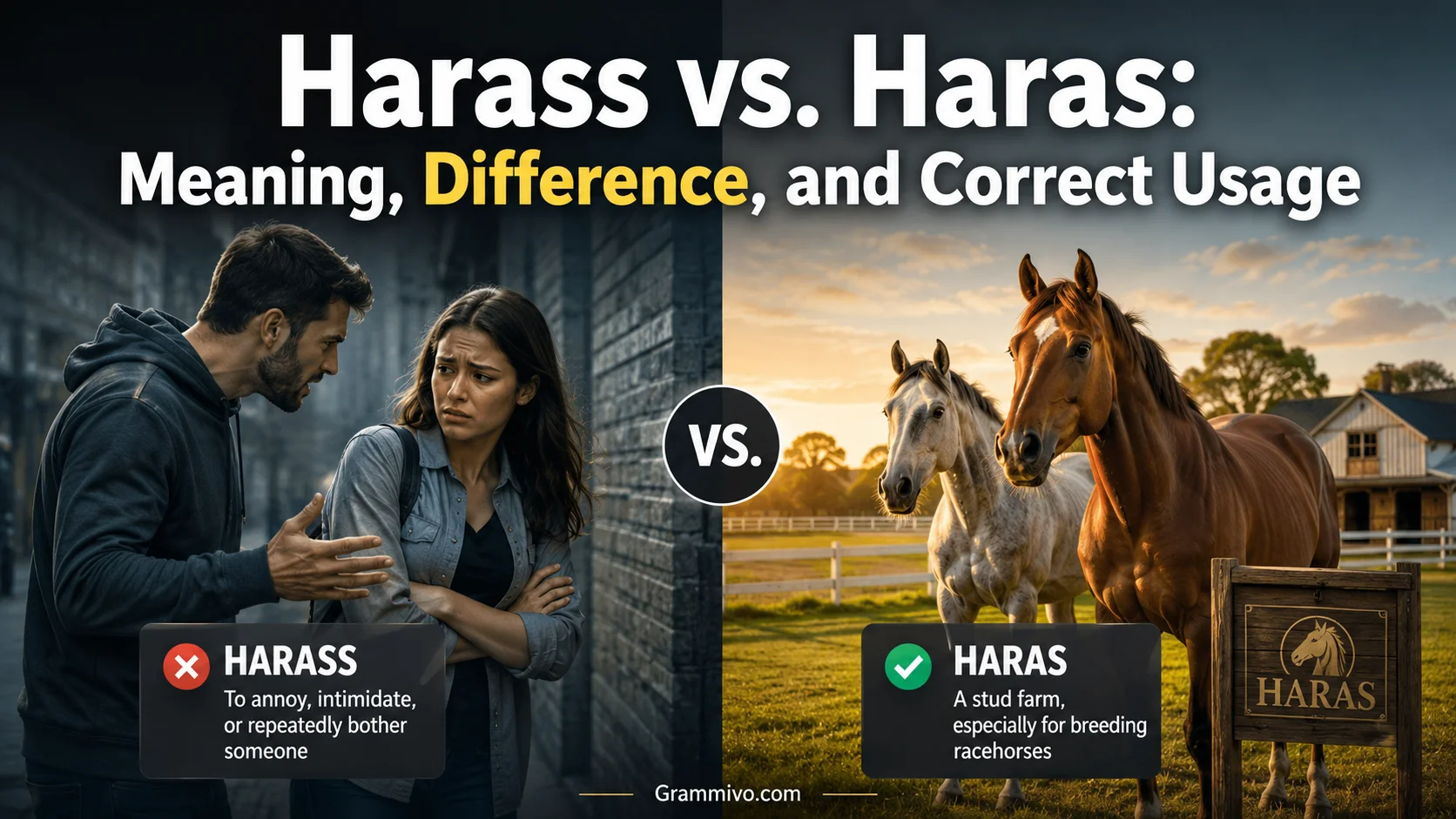
Choosing between harass and haras might seem like a small spelling decision, but only one is the standard English spelling for the verb meaning to bother, intimidate, or trouble someone repeatedly. The confusion often comes from typing quickly, forgetting a final letter, or being unsure how to spell words that end in double consonants.
If you’ve ever wondered whether to write harass or haras in an email, school assignment, workplace complaint, or social media post, you’re not alone. These spellings look almost identical, yet using the wrong one can make your writing appear careless.
The good news? Learning the correct spelling is straightforward once you understand the word’s meaning, pronunciation, and grammatical forms. You’ll also learn how to use harass naturally in sentences and distinguish it from related words such as harassment.
Quick Answer
Harass is the correct standard English spelling when you mean to repeatedly bother, intimidate, threaten, or distress someone. Haras is generally a misspelling of harass when used with this meaning.
- Correct: The school warned students not to harass their classmates.
- Incorrect: The school warned students not to haras their classmates.
- Meaning: To subject someone to persistent unwanted behavior, pressure, intimidation, or disturbance.
- Part of speech: Verb.
- Related noun: Harassment.
Remember that harass ends with two s letters. Whenever you describe someone repeatedly bothering or intimidating another person, use harass.
Comparison Overview
The easiest way to understand harass vs. haras is to compare their spelling, meaning, and grammatical use.
| Feature | Harass | Haras |
| Standard English spelling for the intended verb | Correct | Incorrect |
| Part of speech | Verb | Not the standard form of this verb |
| Meaning | To bother, intimidate, or trouble someone persistently | No equivalent standard English verb meaning |
| Final letters | Double ss | Single s |
| Example | They must not harass other students. | They must not haras other students. |
| Appropriate in formal writing | Yes | No, when harass is intended |
The distinction is simple: harass is the correct spelling for the intended meaning. Although haras can appear in other linguistic contexts, it isn’t the standard English spelling of this verb.
For example, if you’re writing a workplace complaint, you might say, “My coworker continued to harass me after I asked him to stop.” Writing haras instead would introduce a spelling error.
What Does Harass Mean?
Definition of Harass
The verb harass means to repeatedly bother, intimidate, pressure, threaten, or distress someone through unwanted behavior. It often describes actions that make another person feel uncomfortable, unsafe, frightened, or overwhelmed.
Harassment can happen in many settings. Someone might repeatedly send unwanted messages, insult a colleague, intimidate a classmate, or persistently contact a person who has asked for space.
The word doesn’t always refer to physical behavior. Verbal comments, threatening messages, and other forms of unwanted conduct can also amount to harassment, depending on the circumstances.
Consider these examples:
- A student repeatedly mocks a classmate and refuses to stop.
- A person sends threatening messages to someone every night.
- A coworker repeatedly intimidates another employee.
- A stranger continues contacting someone after being asked to stop.
In each situation, the word harass may describe the behavior, depending on the details.
However, not every unpleasant interaction qualifies as harassment. A disagreement, an isolated rude comment, or reasonable criticism doesn’t automatically constitute harassment. The context, frequency, nature of the conduct, and applicable rules all matter.
Examples of Harass in Sentences
Seeing the word in context makes its meaning easier to understand. Here are examples from everyday situations.
- School: Teachers should intervene when students harass their classmates.
- Workplace: The company investigated allegations that a supervisor had harassed an employee.
- Online: Anonymous users sometimes harass people through repeated abusive messages.
- Personal relationships: He asked his former partner not to harass him with unwanted calls.
- Public spaces: Security staff intervened when a visitor began to harass other guests.
- Customer service: Customers shouldn’t harass employees over a disagreement about a refund.
- Sports: The coach warned spectators not to harass the players.
Notice that harass describes an action directed toward someone. It can appear in many different sentence structures while keeping its central meaning.
Common Forms of Harassment
Harassment can take several forms, and understanding these differences helps you use the word more precisely.
Verbal harassment involves unwanted words or comments that may intimidate, humiliate, threaten, or target someone. Repeated insults and abusive remarks are common examples.
Workplace harassment refers to inappropriate conduct in a work environment. Depending on the circumstances and applicable law, it may involve intimidation, discriminatory behavior, threats, or unwelcome conduct that affects an employee’s working conditions.
Online harassment occurs through digital channels, including social media, email, messaging apps, and online forums. Examples include repeated abusive messages, targeted humiliation, and threatening communications.
Physical harassment may involve unwanted physical conduct or intimidating behavior. The precise meaning depends on the circumstances and the context in which the term appears.
Repeated unwanted contact can also be described as harassment. For example, someone who repeatedly contacts another person after being clearly asked to stop may be engaging in harassing behavior.
These categories can overlap. Someone might experience verbal harassment at work and then receive abusive messages online from the same person.
It’s also important to distinguish everyday usage from legal definitions. Whether specific conduct meets a legal standard depends on the jurisdiction, circumstances, and applicable law.
What Does Haras Mean?
Is Haras a Correct English Word?
When comparing harass vs. haras, the important question is whether haras is an accepted spelling of the intended English verb.
In standard English, haras is not the correct spelling of the verb harass. If you want to describe repeatedly bothering, intimidating, or distressing someone, write harass.
For example:
- Incorrect: The manager told employees not to haras their colleagues.
- Correct: The manager told employees not to harass their colleagues.
The second sentence uses the established spelling and communicates the intended meaning clearly.
However, it’s worth making a distinction. A letter sequence that looks like a misspelling in one context may appear in a proper name, a foreign-language expression, or a specialized context. Therefore, it’s too broad to claim that haras can never appear anywhere.
For ordinary English writing, though, the choice is clear: use harass when you mean to bother or intimidate someone persistently.
Read More: Anise vs. Aniseed: Meaning, Difference, and Correct Usage
Why Do People Write Haras Instead of Harass?
Several common mistakes explain why people type haras instead of harass.
Forgetting the final letter: The most direct cause is leaving out one of the two final s’s. Because the words differ by only one letter, the mistake can easily go unnoticed.
Typing too quickly: When writing messages, comments, or emails in a hurry, people sometimes omit letters. This happens especially when they don’t reread their work.
Uncertainty about spelling: English spelling includes many patterns that don’t follow a single predictable rule. Writers who aren’t familiar with harass may assume one final s is enough.
Relying entirely on autocorrect: Spell-checking tools can catch many errors, but they don’t replace careful proofreading. Some tools may miss an error depending on the application, language settings, and surrounding text.
Confusing spelling with pronunciation: The word’s pronunciation may not make the double s immediately obvious. Hearing a word and spelling it correctly are two different skills.
A simple proofreading habit can prevent most of these errors. When you use harass, check that the word ends with ss before submitting your writing.
Examples of Incorrect Usage
The following examples show how to correct haras in different situations.
| Incorrect sentence | Correct sentence |
| Don’t haras people online. | Don’t harass people online. |
| The teacher warned him not to haras his classmates. | The teacher warned him not to harass his classmates. |
| She reported that a stranger continued to haras her. | She reported that a stranger continued to harass her. |
| Employees should never haras their coworkers. | Employees should never harass their coworkers. |
| The school has rules against students who haras others. | The school has rules against students who harass others. |
In every example, correcting the spelling makes the sentence conform to standard English usage. The sentence’s meaning stays the same.
Main Differences Between Harass vs. Haras
Although harass and haras look nearly identical, they differ in spelling validity and grammatical use.
Spelling Difference Between Harass and Haras
The main difference is the final consonant.
- Harass: H-A-R-A-S-S
- Haras: H-A-R-A-S
The standard English verb contains two s’s at the end. The misspelled form contains only one.
This small difference matters because spelling helps readers recognize words quickly. In professional writing, academic assignments, and formal complaints, correct spelling also supports clarity and credibility.
A useful reminder is to focus on the final two letters whenever you type the word. If you’re describing persistent unwanted behavior, finish with ss.
Meaning Difference Between Harass and Haras
Harass has an established meaning in English. It describes persistent unwanted behavior intended to trouble, intimidate, pressure, or distress someone, or behavior that has that effect in context.
By contrast, haras doesn’t serve as the standard English spelling of that verb. A reader will usually interpret it as a spelling mistake when it appears in a sentence about harassment.
Compare these examples:
- The supervisor must not harass employees. This sentence uses the correct spelling.
- The supervisor must not haras employees. This sentence contains a spelling error.
The intended meaning is easy to infer in the second example, but the spelling still needs correction.
Pronunciation Difference Between Harass and Haras
The standard pronunciation of harass includes the sounds represented by both final s letters. In ordinary speech, however, the double s doesn’t mean you pronounce two separate s sounds.
The word is commonly pronounced with either first-syllable or second-syllable stress, depending on regional and individual usage. You may hear pronunciations resembling HARR-ass or huh-RASS.
Because both spellings look similar, pronunciation alone won’t reliably help you identify the missing letter. The best approach is to remember the written form: harass.
Grammatical Usage of Harass
The word harass functions as a verb. You can change its form to match the tense or grammatical structure of a sentence.
| Word form | Grammatical use | Example |
| Harass | Base form | Don’t harass other people. |
| Harasses | Third-person singular present | He harasses his coworkers. |
| Harassed | Past tense | The customer harassed the employee. |
| Harassed | Past participle | She has been harassed online. |
| Harassing | Present participle | They are harassing another student. |
| Harassment | Related noun | The school investigated the harassment. |
These forms follow standard English grammar. Notice that harassed contains a double s followed by -ed, while harassing contains a double s followed by -ing.
Learning the full word family helps you avoid related mistakes instead of memorizing just one spelling.
How to Use Harass Correctly in a Sentence
Harass in Everyday Conversations
In everyday English, harass can describe repeated unwanted behavior in personal, social, or public situations.
For example, imagine that someone keeps calling a friend late at night after the friend has asked them to stop. You could say, “He keeps harassing her with unwanted phone calls.”
Here are more examples:
- Please don’t harass your neighbors over a minor disagreement.
- The group asked its members not to harass visitors.
- She blocked the account because its owner continued to harass her.
- The fans were told not to harass the performers after the show.
The word communicates more than ordinary annoyance in many contexts. It often suggests persistent, intrusive, intimidating, or distressing behavior.
Still, choose your words carefully. If someone makes one mildly irritating comment, bother or annoy may describe the situation more accurately.
Harass in Professional and Workplace Writing
In professional settings, harass often appears in policies, complaints, employee reports, and discussions about workplace conduct.
For example:
- The company prohibits employees from harassing coworkers.
- Human resources reviewed the complaint about alleged harassment.
- Managers must address reports of threatening or harassing behavior.
- Employees can report conduct that violates workplace policies.
When writing a formal complaint, describe specific actions rather than relying only on a broad label. Include relevant dates, messages, incidents, and witnesses when appropriate.
For instance, “My coworker harassed me” identifies the concern. A more detailed account might explain that the coworker repeatedly sent unwanted messages after being asked to stop.
That additional context helps the reader understand what happened. It also avoids making an unsupported legal conclusion before the facts have been assessed.
Harass in Online Communication
Online harassment can occur on social media platforms, gaming services, discussion boards, and messaging apps.
Someone might repeatedly send abusive direct messages, target another person with humiliating comments, or make threats through an online account.
Examples include:
- Several users began to harass the creator after the video went viral.
- The platform removed accounts that repeatedly harassed other members.
- He saved the threatening messages as evidence of online harassment.
- The moderator warned users not to harass anyone in the discussion.
A single critical comment isn’t necessarily harassment. Repeated targeting, threats, intimidation, and other unwanted conduct may make the situation more serious.
If you describe online behavior in a report, be specific about what occurred. Terms such as insulted, threatened, contacted repeatedly, and harassed communicate different details.
FAQs:
Is Haras or Harass the Correct Spelling?
Harass is the correct standard English spelling when you mean to repeatedly bother, intimidate, threaten, or distress someone. Haras is generally a misspelling in this context.
Is Haras a Real Word?
Haras isn’t the standard English spelling of the verb harass. It may appear in other linguistic contexts or proper names, but you shouldn’t use it as a substitute for harass in ordinary English writing.
How Do You Spell Harass Correctly?
The correct spelling is H-A-R-A-S-S. Remember the double s at the end. This spelling remains consistent in forms such as harassed and harassing.
What Is the Past Tense of Harass?
The simple past tense is harassed. For example, “The customer harassed the employee.” The past participle is also harassed, as in “The employee has been harassed.”
What Is the Difference Between Harass and Harassment?
Harass is a verb that describes an action, while harassment is a noun that names the behavior. You might say, “They harass employees” or “The company investigates harassment complaints.”
Conclusion:
When comparing harass vs. haras, the correct choice is straightforward. Harass is the standard English verb for repeatedly bothering, intimidating, threatening, or distressing someone. Haras is generally a spelling mistake when used with that meaning. Remember the double s at the end of harass. Its other common forms include harasses, harassed, and harassing, while harassment is the related noun.
