
Have you ever paused while typing the word moment because you weren’t sure whether it needed one “m” or two? You’re not alone. Many English learners and native speakers occasionally write moment as momment, especially when typing quickly or relying on how a word sounds.Although these spellings look almost identical, only one is correct in standard English.
The difference comes down to a single extra letter, but that small mistake can affect the accuracy of your writing. Understanding the difference between moment and momment will help you avoid spelling errors in text messages, emails, school assignments, and professional documents. More importantly, learning the correct spelling and meaning will make it easier to recognize and use the word confidently.
Quick Answer:
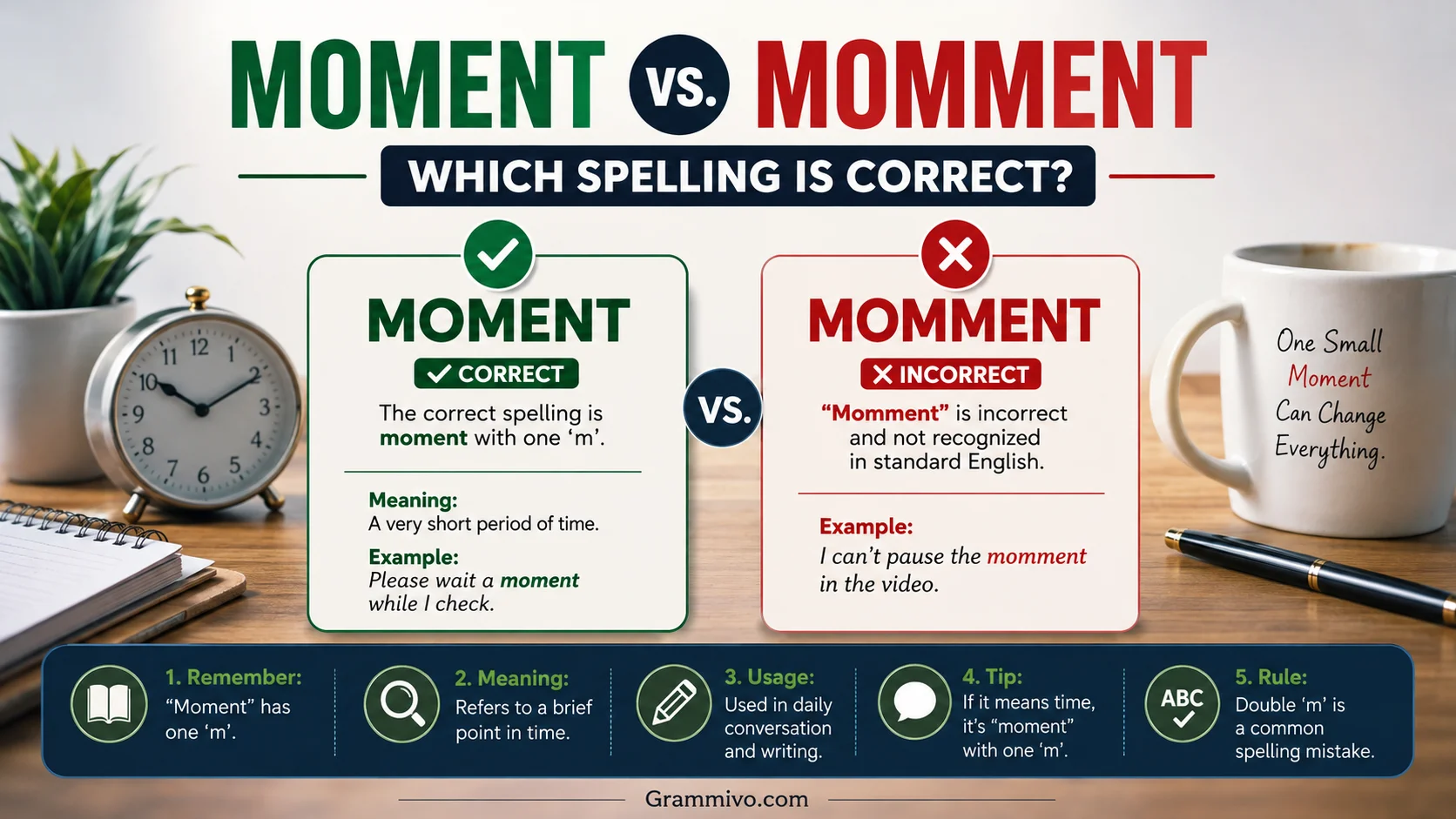
Moment is the correct spelling, while momment is a misspelling. The standard English word moment contains only one “m” after its first letter. It refers to a short period of time, a particular point in time, or an important experience.
For example:
- Correct: Please give me a moment to check the information.
- Incorrect: Please give me a momment to check the information.
Remember that the correct spelling is M-O-M-E-N-T, not M-O-M-M-E-N-T.
Comparison Overview
The easiest way to understand moment vs. momment is to compare their spelling, meaning, pronunciation, and grammatical use.
| Feature | Moment | Momment |
| Correct spelling | Yes | No |
| Standard English word | Yes | No |
| Part of speech | Noun | Not recognized as a standard word |
| Meaning | A short period or particular point in time | No established standard meaning |
| Number of letters | 6 | 7 |
| First two letters | Mo | Mo |
| Double consonant | No | Incorrect extra “m” |
| Pronunciation | MOH-mənt | Intended pronunciation usually matches moment |
| Standard usage | Everyday and formal writing | Spelling mistake |
The main difference is the extra letter “m” in momment. English dictionaries recognize moment as the correct spelling.
You can use moment in conversations, professional emails, academic assignments, and creative writing. However, you should avoid momment because it isn’t an accepted alternative spelling.
Main Differences Between Moment vs. Momment
Although moment and momment look similar, they don’t have the same spelling status. One is a recognized English noun, while the other is simply an incorrect spelling.
Here are the main differences worth understanding.
Moment Is the Correct English Spelling
The word moment follows the standard English spelling. It contains six letters and has one “m” after the initial letter.
Writers use it to describe short periods, specific points in time, and meaningful experiences. It also appears in many common expressions.
For example:
- Wait a moment while I finish this task.
- That was the happiest moment of my life.
- I’ll call you in a moment.
- We enjoyed every moment of our vacation.
In each sentence, moment refers to a particular period or experience.
Momment Is an Incorrect Spelling
The spelling momment adds an unnecessary second “m.” Standard English dictionaries don’t recognize it as a correct spelling of the intended word.
People may accidentally type it because they confuse its letter pattern with other English words that contain double consonants.
For example, consider these sentences:
- Incorrect: I need a momment to think.
- Correct: I need a moment to think.
The correction is simple. Remove the extra “m” to produce the standard spelling.
Moment and Momment Have Different Letter Counts
Another easy way to distinguish these spellings is to count their letters.
- Moment: M-O-M-E-N-T (6 letters)
- Momment: M-O-M-M-E-N-T (7 letters)
The correct spelling contains two “m” letters in total, separated by the letter “o.” It doesn’t contain two consecutive “m” letters.
This small detail can help you catch the mistake when proofreading.
What Does Moment Mean?
The word moment is a noun that describes a short period of time or a particular point in time. It can also refer to an experience that holds special importance.
People use this word in everyday conversations because it expresses time and experiences naturally.
For example, when someone says, “Give me a moment,” they’re asking for a little time. When someone describes a wedding as “a beautiful moment,” they’re referring to a meaningful experience.
Let’s explore its main meanings.
Moment Means a Short Period of Time
One common meaning of moment is a brief period. It usually describes a short amount of time without specifying an exact number of seconds or minutes.
For example:
- Give me a moment to organize these papers.
- She stepped outside for a moment.
- I’ll be ready in a moment.
- He stopped talking for a moment.
In these examples, the word describes a short pause or interval.
The exact duration depends on the situation. A moment might last several seconds or a little longer.
Moment Means a Particular Point in Time
Moment can also describe a specific point or stage in time. This meaning often appears when discussing past events, present situations, or future occasions.
For example:
- At that moment, everyone became silent.
- This is the moment we’ve been waiting for.
- I remember the exact moment we first met.
- The moment arrived sooner than expected.
Here, moment identifies a particular point associated with an event.
Moment Means an Important Experience
Sometimes, moment describes an experience that carries emotional, personal, or historical importance.
People often use it when talking about achievements, celebrations, relationships, and unforgettable events.
Examples include:
- Graduating from college was a proud moment.
- Their first meeting became a memorable moment.
- Winning the championship was the greatest moment of his career.
- Holding her newborn baby was an emotional moment.
These experiences might last longer than a few seconds. However, the word highlights their importance rather than their duration.
Moment Can Refer to a Suitable Time
The word can also describe an appropriate or convenient time for something.
For instance:
- This isn’t the right moment to discuss money.
- Wait for the perfect moment before making your announcement.
- She chose a quiet moment to ask an important question.
In these sentences, moment refers to timing rather than a specific length of time.
What Does Momment Mean?
Unlike moment, momment has no established meaning as a standard English word. It’s generally a misspelling created by adding an unnecessary “m.”
If you encounter this spelling in a message, article, social media post, or email, the writer most likely intended to write moment.
For example:
- Incorrect: Give me a momment to respond.
- Correct: Give me a moment to respond.
The intended meaning remains clear because readers can usually recognize the mistake. However, that doesn’t make the incorrect spelling acceptable in standard writing.
Why Do People Write Momment Instead of Moment?
Several factors can explain why people accidentally use momment.
Typing too quickly: When people type without checking their spelling, they may accidentally repeat a letter.
Confusion with double consonants: English contains many words with repeated consonants. Writers sometimes apply that pattern incorrectly to moment.
Unfamiliarity with the word: People who don’t regularly use the word may struggle to remember its exact letter arrangement.
Autocorrect limitations: Spell-checking tools don’t always catch every error. Depending on the application, a typing mistake may remain unnoticed.
Visual confusion: Because the two spellings look almost identical, readers may overlook the extra letter.
The best solution is to learn the correct spelling rather than rely entirely on automatic corrections.
Why Is It Moment Instead of Momment?
The correct spelling is moment because that’s the established spelling of the English word. The extra “m” in momment doesn’t belong to its standard written form.
Understanding the word’s spelling pattern makes the difference easier to remember.
The Correct Letter Arrangement
The word moment contains six letters arranged in this order:
- M
- O
- M
- E
- N
- T
Notice that the two “m” letters don’t appear next to each other. The first “m” begins the word, while the second follows the letter “o.”
The incorrect spelling adds another “m” between the second “m” and the letter “e.”
| Correct arrangement | Incorrect arrangement |
| M-O-M-E-N-T | M-O-M-M-E-N-T |
| Six letters | Seven letters |
| Standard spelling | Misspelling |
Remembering this arrangement will help you avoid the most common mistake.
The Pronunciation Doesn’t Require a Double M
Another reason people confuse these spellings is pronunciation.
In standard American English, moment is commonly pronounced MOH-mənt. It has two syllables, with the first syllable receiving the main stress.
The pronunciation doesn’t require an additional consonant. Adding another “m” doesn’t create a different standard English word or change the intended meaning.
Therefore, remember that spelling and pronunciation don’t always follow the same patterns. You should learn the accepted written form instead of guessing how many letters a sound needs.
How to Use Moment in a Sentence
Once you understand the correct spelling, using moment becomes straightforward. It’s a versatile noun that fits naturally into everyday conversations, professional communication, and descriptive writing.
Here are several practical ways to use it.
Using Moment for a Short Period
Use moment when you want someone to wait briefly or when describing a short pause.
Examples:
- Could you wait a moment while I find your file?
- She closed her eyes for a moment.
- The teacher paused for a moment before continuing.
- I’ll be back in a moment.
This usage is especially common in everyday conversations.
Using Moment for a Memorable Experience
When describing an important event, moment helps emphasize its emotional significance.
Examples:
- Seeing my family after years apart was a special moment.
- Their wedding day created beautiful memories and unforgettable moments.
- Receiving my first paycheck was an exciting moment.
- The team celebrated a historic moment after winning the final.
You can use this meaning in personal stories, speeches, social media captions, and articles.
Using Moment for a Specific Time
When referring to a particular point in time, the word helps readers understand when something happened.
Examples:
- At that moment, I realized my mistake.
- The audience became quiet at the moment the performance began.
- I’ll never forget the moment she accepted the proposal.
- This is the moment when everything changes.
This construction works particularly well when narrating events.
Using Moment in Professional Communication
The word also appears frequently in workplace conversations and business emails.
Examples:
- Please give me a moment to review your request.
- I’ll share the updated document in a moment.
- Do you have a moment to discuss the project?
- Let me take a moment to explain the next steps.
These expressions sound polite and natural. They’re useful when you need someone’s attention without sounding demanding.
Common Expressions and Phrases With Moment
English speakers use moment in many familiar expressions. Learning these phrases will help you understand the word in different contexts.
At the Moment
The expression at the moment refers to the present time or current situation.
Examples:
- I’m working on another project at the moment.
- She isn’t available at the moment.
- We’re experiencing some technical difficulties at the moment.
- I don’t have enough information at the moment.
This phrase is particularly useful when describing something happening right now.
In a Moment
In a moment means something will happen very soon.
Examples:
- I’ll send you the details in a moment.
- Dinner will be ready in a moment.
- The meeting will begin in a moment.
- Please wait here. Someone will assist you in a moment.
The phrase generally communicates a short wait.
Just a Moment
Just a moment is a polite way to ask someone to wait briefly.
Examples:
- Just a moment, please. I’ll check your reservation.
- Just a moment while I open the document.
- Could you give me just a moment to finish?
- Just a moment! I haven’t explained everything yet.
You can use this expression in personal conversations and customer service situations.
A Moment Ago
A moment ago refers to something that happened very recently.
Examples:
- I saw him a moment ago.
- She called me a moment ago.
- The delivery driver was here a moment ago.
- We were discussing that issue a moment ago.
It helps establish a recent point in the past.
For a Moment
For a moment describes something that happens or continues briefly.
Examples:
- I thought about leaving for a moment.
- She looked surprised for a moment.
- Let’s sit down for a moment.
- He remained silent for a moment.
This phrase often describes temporary actions, feelings, or reactions.
Moment of Truth
A moment of truth is a critical point when the real outcome of a situation becomes clear.
Examples:
- The final examination was his moment of truth.
- It was the moment of truth for the entire team.
- After months of preparation, the presentation became her moment of truth.
People commonly use this expression when discussing challenges, decisions, and important outcomes.
A Moment to Remember
A moment to remember describes an experience worth keeping in your memory.
Examples:
- Watching the sunset together was a moment to remember.
- Their championship victory created a moment to remember.
- Meeting my favorite author was truly a moment to remember.
This expression frequently appears in celebration messages, photographs, and personal stories.
Frequently Asked Questions
Is Moment or Momment Correct?
Moment is correct. It’s the standard English spelling of the word. Momment is an incorrect variation with an unnecessary extra “m.”
For example: “Please give me a moment to finish my work.”
How Do You Spell Moment Correctly?
The correct spelling is M-O-M-E-N-T. It contains six letters, including two “m” letters that aren’t next to each other.
Remember the arrangement: one “m,” followed by “o,” another “m,” and then “ent.”
Why Do People Spell Moment With Two M’s?
People may accidentally write momment because they type quickly, confuse consonant patterns, or misunderstand the word’s spelling.
However, standard English uses only moment. The additional “m” is unnecessary.
Is Momment a Real English Word?
Momment isn’t recognized as a standard English word or an accepted alternative spelling of moment.
You’ll sometimes encounter it in informal online writing or typing mistakes. In standard communication, use moment instead.
What Is the Plural of Moment?
The plural of moment is moments.
Simply add “s” to the singular form.
Examples:
- We shared many beautiful moments together.
- Those were unforgettable moments in my life.
- Every moment of the journey felt exciting.
Remember that the plural form is moments, not momments.
Conclusion:
When comparing moment vs. momment, the answer is straightforward: moment is the correct spelling, while momment is a misspelling. The standard word contains six letters and refers to a brief period, a particular point in time, or an important experience. You can use it in everyday conversations, professional emails, academic writing, and memorable expressions.
