
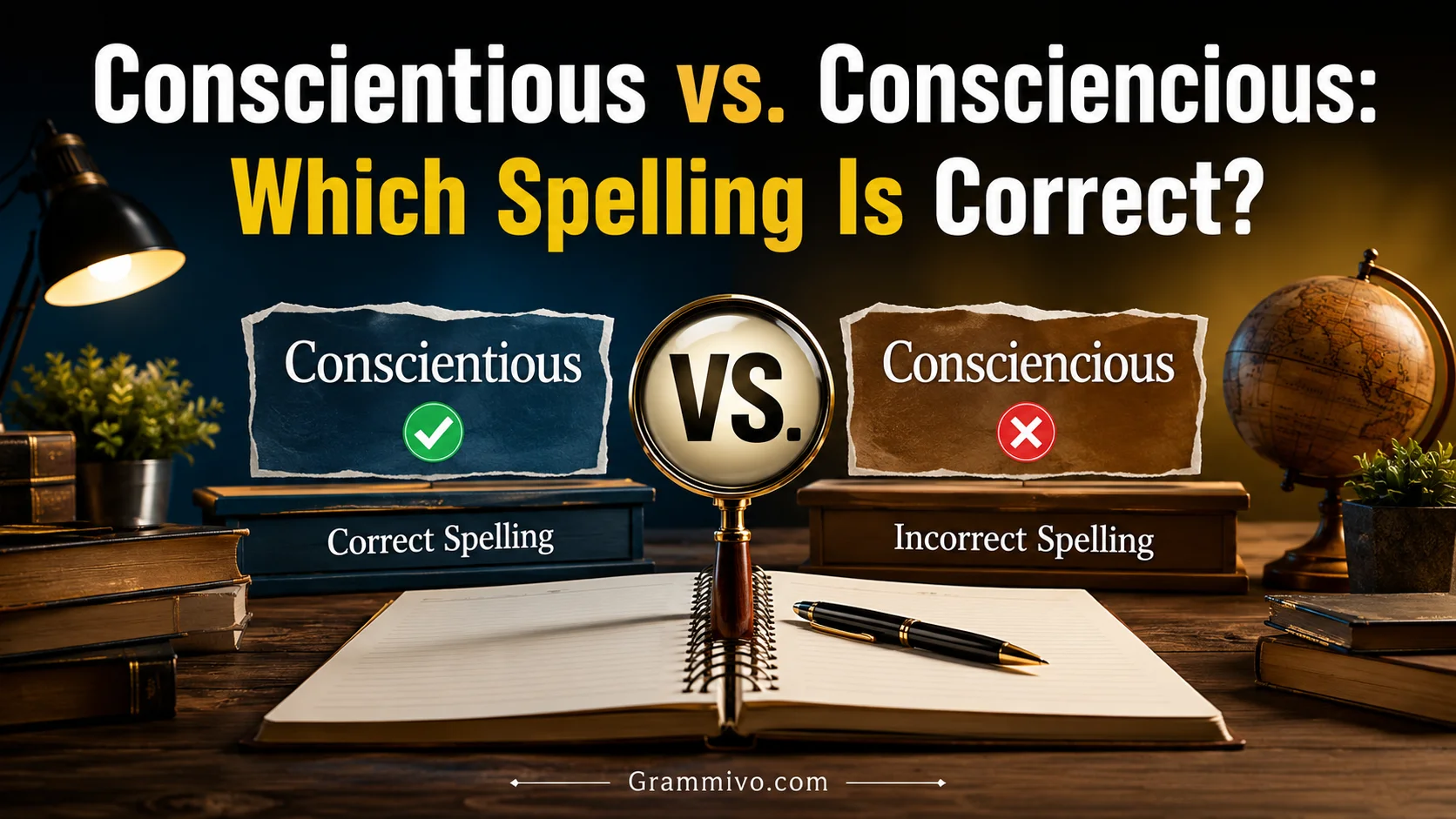
If you’ve ever hesitated over conscientious vs. consciencious, you’re not alone. The word looks deceptively complicated, and the connection to conscience can make the spelling even harder to remember. One extra c is enough to turn the correct word into a misspelling.
The correct spelling is conscientious. Consciencious is incorrect.
The difference matters because conscientious is a useful adjective in everyday, academic, and professional English. It describes someone who takes responsibilities seriously, pays close attention to what they do, and makes a genuine effort to do things properly.
This guide explains the spelling, meaning, pronunciation, origin, related words, common mistakes, and practical usage of conscientious. By the end, you’ll know exactly when to use it and why consciencious doesn’t belong in standard English.
Quick Answer: Conscientious or Consciencious?
Conscientious is the correct spelling. Consciencious is a misspelling.
| Spelling | Correct? | Meaning |
| conscientious | Yes | Careful, responsible, and guided by a strong sense of duty |
| consciencious | No | Incorrect spelling |
For example:
Maya is a conscientious employee who checks every report before submitting it.
Here, conscientious tells you more than simply saying Maya is “careful.” It suggests that she takes her responsibility seriously and makes a deliberate effort to do the job properly.
So if you’re writing an email, school assignment, résumé, report, or article, use conscientious.
What Does Conscientious Mean?
Conscientious is an adjective that describes someone who is careful, responsible, thorough, and serious about fulfilling duties.
The word often carries two ideas at once. First, the person pays attention to what they’re doing. Second, they feel a responsibility to do it correctly.
For example:
- A conscientious student completes assignments carefully.
- A conscientious employee takes workplace responsibilities seriously.
- A conscientious driver follows traffic rules and considers other road users.
- A conscientious researcher checks information carefully.
- A conscientious effort shows deliberate care and responsibility.
That combination makes conscientious stronger and more specific than simply saying careful.
Consider these two sentences:
He is careful with company records.
He is conscientious about maintaining company records.
Both sentences suggest attention to detail. However, the second sentence also suggests a sense of responsibility and duty.
Cambridge Dictionary defines conscientious in terms of giving serious attention to what you do so that you do it carefully and correctly. Merriam-Webster similarly connects the word with careful attention and a sense of responsibility.
What Does Conscientious Mean in Simple English?
In simple terms, conscientious means you care about doing things properly and responsibly.
Imagine two employees receive the same task. One completes it quickly and moves on. The other checks the details, follows the instructions, notices a potential problem, and fixes it before submitting the work.
The second employee is behaving conscientiously.
The word doesn’t necessarily mean that someone works slowly. A conscientious person can work quickly. The important point is that they don’t casually ignore their responsibilities.
Why Is “Consciencious” Incorrect?
The problem with consciencious is that it looks believable.
English spelling often creates traps where a wrong form resembles a familiar word. In this case, the relationship between conscientious and conscience can encourage writers to insert an extra c.
The incorrect version is:
consciencious
The correct version is:
conscientious
Notice the troublesome middle section:
con-sci-en-tious
There is no extra c after conscience-like spelling.
A useful way to see the difference is:
| Incorrect | Correct |
| consciencious | conscientious |
| consciencious person | conscientious person |
| consciencious worker | conscientious worker |
| consciencious effort | conscientious effort |
The incorrect spelling doesn’t represent a separate meaning. It is simply a misspelling of conscientious.
How Do You Spell Conscientious?
The correct spelling is:
C-O-N-S-C-I-E-N-T-I-O-U-S
That gives you:
conscientious
The difficult part is the middle and ending:
con-sci-en-tious
Many people see science hiding inside the word and instinctively add letters associated with it. Don’t.
The word contains sci, but it isn’t spelled like science.
A Simple Spelling Trick
Try remembering:
conSCIentious
The sci is followed by entious, not encious.
Another useful comparison is:
- conscience
- conscientious
These words are related, but their spellings aren’t identical.
If you memorize the complete word rather than trying to spell it from pronunciation, you’ll avoid most errors.
How Do You Pronounce Conscientious?
In American English, conscientious is commonly pronounced approximately:
kon-shee-EN-shus
Cambridge gives the US pronunciation as /ˌkɑːn.ʃiˈen.ʃəs/.
The strongest stress falls on the EN sound:
con-shee-EN-shus
This pronunciation explains another reason people sometimes struggle with the spelling. The spoken form doesn’t clearly reveal every letter.
You hear something close to:
kon-shee-en-shus
But you write:
conscientious
That’s a classic English spelling problem: pronunciation and spelling don’t always line up neatly.
Conscientious vs. Conscience
Conscientious and conscience are closely related, but they aren’t interchangeable.
Conscience
A conscience is a person’s inner sense of right and wrong.
His conscience bothered him after he lied.
The noun refers to an internal moral awareness.
Conscientious
Conscientious is an adjective describing someone who behaves carefully and responsibly, often because they take their duties or moral responsibilities seriously.
She is conscientious about following the company’s safety procedures.
A simple way to remember the distinction is:
| Word | Part of Speech | Meaning | Example |
| conscience | Noun | Inner sense of right and wrong | My conscience wouldn’t let me ignore it. |
| conscientious | Adjective | Careful, responsible, and dutiful | He is a conscientious worker. |
| conscientiously | Adverb | In a careful and responsible way | She completed the task conscientiously. |
| conscientiousness | Noun | The quality of being conscientious | His conscientiousness impressed the manager. |
Understanding this word family can make the spelling easier because you can see how the forms connect.
Conscientious vs. Consciencious: Is There a Meaning Difference?
No.
There is no legitimate meaning distinction between conscientious and consciencious because consciencious is not the standard spelling of a separate English word.
This means you shouldn’t write:
“Conscientious means one thing, while consciencious means another.”
That would create a distinction that standard English doesn’t recognize.
The practical rule is simple:
Use conscientious. Avoid consciencious.
| Form | Status |
| conscientious | Standard English |
| consciencious | Misspelling |
This is different from pairs such as affect/effect or advice/advise, where both forms are legitimate words with different meanings.
With conscientious, there isn’t a two-word vocabulary distinction to learn.
Examples of Conscientious in Sentences
Seeing the word in context makes its meaning much easier to understand.
Sarah is a conscientious student who checks her work before turning it in.
Here, conscientious highlights Sarah’s careful and responsible approach to schoolwork.
The accountant was conscientious about reviewing every figure in the report.
The word suggests that the accountant takes accuracy seriously.
James is a conscientious employee who always follows safety procedures.
This emphasizes both care and responsibility.
She made a conscientious effort to treat everyone fairly.
Here, conscientious describes a deliberate effort guided by a sense of responsibility.
A conscientious researcher verifies important information before publishing it.
The adjective fits because accuracy and responsibility matter in research.
He is conscientious about meeting deadlines.
This construction is especially natural in professional English.
The nurse took a conscientious approach to every patient’s needs.
The word emphasizes careful attention and professional responsibility.
More Everyday Examples
- She is conscientious about keeping her promises.
- He became known as a conscientious worker.
- The teacher praised her conscientious approach to studying.
- We need someone conscientious enough to notice small errors.
- His conscientious effort improved the final result.
- The technician performed a conscientious inspection before approving the equipment.
How to Use “Conscientious” Correctly
The most common use places conscientious before a noun.
For example:
- conscientious employee
- conscientious student
- conscientious worker
- conscientious researcher
- conscientious approach
- conscientious effort
- conscientious decision
You can also use it after a linking verb:
She is conscientious.
He became more conscientious about his responsibilities.
Another useful construction is:
conscientious about + noun/gerund
Examples include:
- conscientious about his work
- conscientious about following instructions
- conscientious about keeping records
- conscientious about meeting deadlines
This pattern is particularly common when you want to explain exactly where someone’s care or sense of responsibility appears.
Conscientious vs. Careful
At first glance, conscientious and careful look almost interchangeable. They’re related, but the emphasis differs.
Careful generally means paying attention to avoid mistakes, danger, or damage.
Conscientious goes further by suggesting responsibility, duty, or a strong desire to do something properly.
Compare:
Be careful with that glass.
This means avoid dropping or breaking it.
She is conscientious about her work.
This means she takes her work seriously and consistently tries to perform it properly.
A person can be careful in one situation without being generally conscientious.
For example, someone might drive carefully on a rainy day. That doesn’t necessarily tell you anything about how responsibly they approach their other duties.
Conscientious vs. Diligent
Diligent focuses strongly on steady and persistent effort.
Conscientious focuses more on responsibility, care, and doing something properly.
| Word | Main Idea | Example |
| conscientious | Responsible and careful | She is conscientious about her duties. |
| diligent | Persistent and hardworking | He was diligent in completing the research. |
The words often overlap.
A conscientious employee may also be diligent. However, the two adjectives aren’t exact substitutes in every sentence.
If you want to emphasize steady hard work, diligent may be better.
If you want to emphasize responsibility and careful performance, conscientious usually fits better.
Read More: Buoyant vs. Bouyant: Which Spelling Is Correct and Why?
Conscientious vs. Meticulous
Meticulous describes extremely careful attention to small details.
Someone who checks every comma in a document might be meticulous. Someone who takes their responsibilities seriously and makes sure the work gets done properly might be conscientious.
Consider this distinction:
The editor was meticulous about punctuation.
The emphasis falls on tiny details.
The editor was conscientious about meeting the publication’s standards.
The emphasis falls on responsibility and proper performance.
A person can certainly be both.
In fact, the qualities often work together:
A conscientious employee may use meticulous methods when the task demands them.
Conscientious vs. Conscious
Another common source of confusion is conscious.
These words look related because they share historical roots, but they have different modern meanings.
Conscious
Conscious usually means awake, aware, or aware of something.
She was conscious of the noise outside.
Conscience
Conscience means an inner sense of right and wrong.
His conscience wouldn’t let him take the money.
Conscientious
Conscientious means careful, responsible, and serious about duties.
He is conscientious about following the rules.
A quick comparison helps:
| Word | Meaning |
| conscious | Aware or awake |
| conscience | Inner moral sense |
| conscientious | Careful, responsible, and dutiful |
Mixing these words can create both spelling and meaning problems.
Conscientious in Professional and Workplace English
Few contexts showcase conscientious better than the workplace.
Managers may describe an employee as conscientious when that person consistently handles responsibilities carefully. The compliment suggests more than productivity. It speaks to reliability.
For example:
We’re looking for a conscientious team member who pays attention to details and follows procedures.
The employer isn’t necessarily asking for someone who works slowly or obsessively. Instead, the description signals trustworthiness and responsible performance.
You might also see the word in:
- performance reviews
- job descriptions
- recommendation letters
- academic evaluations
- professional references
- résumés
- workplace conversations
Why “Conscientious” Can Be Strong Praise
Calling someone conscientious often means you trust them with important responsibilities.
Suppose a manager says:
“She’s a conscientious employee.”
That can imply several positive qualities:
- She takes deadlines seriously.
- She pays attention to details.
- She follows instructions.
- She notices potential problems.
- She takes ownership of her work.
- She tries to correct mistakes.
- She doesn’t treat responsibilities casually.
It’s a compact word with a surprisingly rich meaning.
Conscientious in Academic Writing
Students can also be described as conscientious.
A conscientious student doesn’t necessarily earn the highest grades. Instead, the adjective describes the student’s approach to learning.
For example:
A conscientious student reviews feedback and applies it to future assignments.
The important quality is the student’s responsible approach.
Teachers might use the word when describing students who:
- complete assignments carefully
- follow instructions
- prepare consistently
- revise their work
- take feedback seriously
- meet academic responsibilities
It can therefore describe effort and conduct, not merely achievement.
FAQs:
Is “consciencious” a word?
Consciencious is not the standard spelling of an English word. It is a misspelling of conscientious.
Is it conscientious or consciencious?
The correct spelling is conscientious.
She is a conscientious worker.
Not:
She is a consciencious worker.
What does conscientious mean?
Conscientious means careful, responsible, thorough, and serious about fulfilling duties.
It often suggests that someone makes a deliberate effort to do things properly.
How do you spell conscientious?
The correct spelling is:
C-O-N-S-C-I-E-N-T-I-O-U-S
conscientious
How do you pronounce conscientious?
In American English, it is approximately pronounced:
kon-shee-EN-shus
The Cambridge pronunciation is /ˌkɑːn.ʃiˈen.ʃəs/.
Conclusion:
When choosing between conscientious vs. consciencious, choose conscientious every time. The correct word describes someone who takes responsibilities seriously, pays attention to their work, and makes a genuine effort to do things properly. It can describe a conscientious student, a conscientious employee, a conscientious researcher, or a conscientious effort. The spelling looks challenging because the word’s connection to conscience can tempt you to add an extra c. Don’t let that visual trap fool you.
