
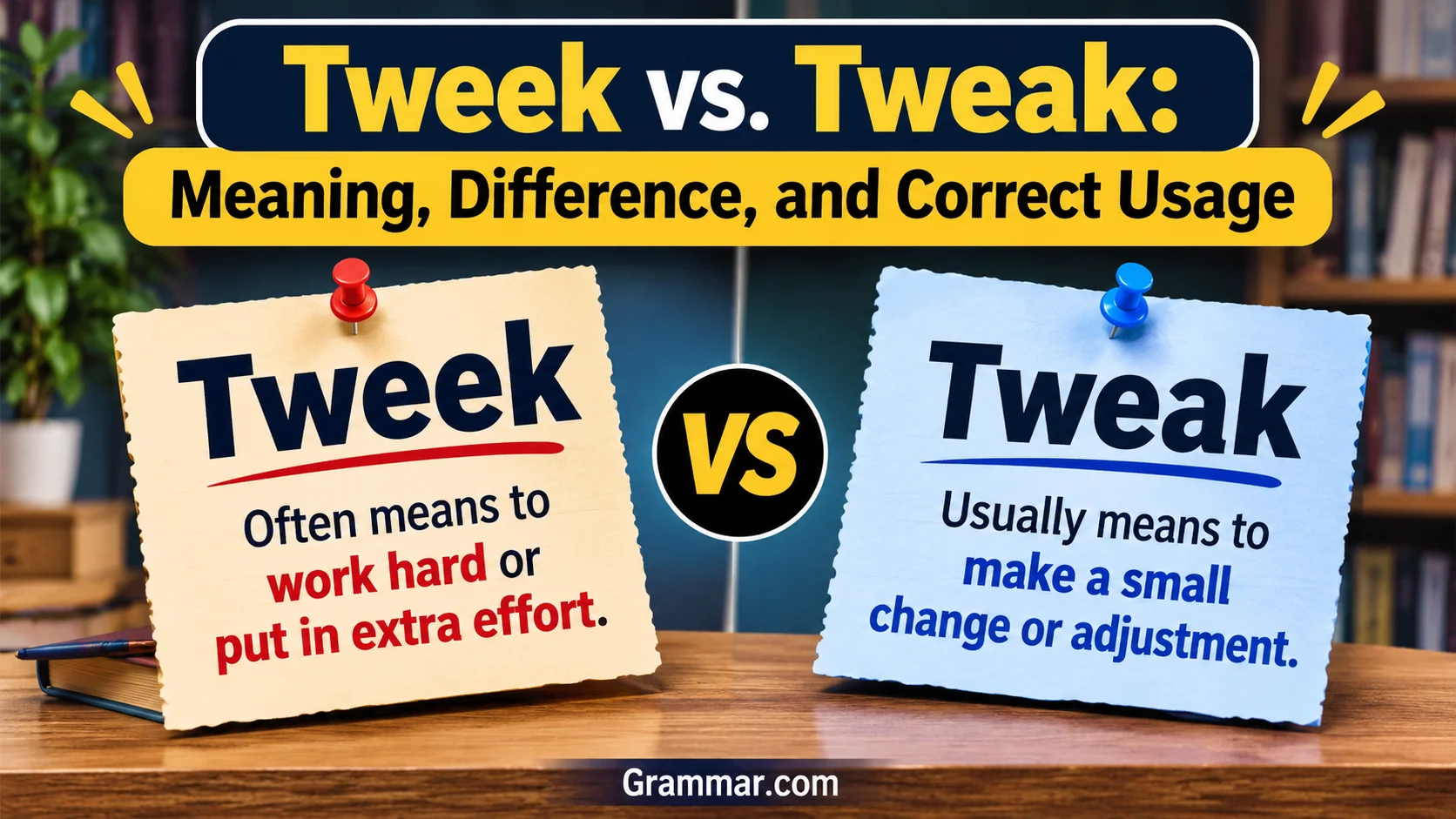
Have you ever written tweek when you actually meant tweak? These two spellings look almost identical and sound exactly the same. However, only one represents the standard English word for making a small adjustment or improvement.
The confusion usually comes from the long E sound in tweak. When people hear the word, they may naturally assume it needs two E’s. Unfortunately, pronunciation doesn’t always make English spelling predictable.
Whether you’re editing a document, adjusting software settings, improving a design, or discussing a small change at work, knowing the correct spelling matters. A single letter can make the difference between polished writing and an avoidable spelling mistake.
Quick Answer
Tweak is the correct standard English spelling when you mean to make a small adjustment or improvement to something. Tweek is generally a misspelling of tweak when used with this meaning.
For example:
- Correct: I need to tweak the presentation before the meeting.
- Incorrect: I need to tweek the presentation before the meeting.
The word tweak works as both a verb and a noun. As a verb, it means to make a small change. As a noun, it describes the adjustment itself.
If you’re writing about modifying settings, refining a design, adjusting a plan, or improving a document, always use tweak.
Comparison Overview
Although tweek and tweak differ by only one letter, their spelling and standard usage aren’t interchangeable. Understanding their basic differences makes the correct choice much easier.
| Feature | Tweek | Tweak |
| Standard spelling | No, not for the intended meaning | Yes |
| Pronunciation | Usually intended to sound like tweak | /twiːk/ |
| Meaning | Generally a misspelling of tweak | A small adjustment or modification |
| Part of speech | Not standard for this meaning | Verb and noun |
| Correct usage | Avoid when meaning an adjustment | Use in standard English |
| Example | Incorrect: Tweek the settings | Correct: Tweak the settings |
The most important distinction is that tweak has an established meaning in standard English. It describes a minor change that improves, adjusts, or refines something.
For example, a designer might tweak a logo by changing its color slightly. Similarly, a writer might tweak a sentence to make it clearer without rewriting the entire paragraph.
On the other hand, writing tweek in these situations introduces a spelling error.
Main Differences Between Tweek and Tweak
The difference between these spellings becomes clearer when you examine their meanings, grammatical roles, and everyday applications.
Tweak: Meaning and Definition
The word tweak means to make a small adjustment, modification, or improvement to something. It usually describes a relatively minor change rather than a complete transformation.
People use this word when something already works but needs a little refinement.
For example, imagine you’ve created a presentation for an important meeting. The slides look good, but a few headings need clearer wording. You can tweak those headings without rebuilding the entire presentation.
Similarly, a photographer might tweak an image’s brightness or contrast to achieve a better result.
The word tweak can function as both a verb and a noun.
As a verb:
It describes the action of making a small change.
- I need to tweak the wording of this email.
- She tweaked the recipe to make it less sweet.
- The developer tweaked the application settings.
- We should tweak the schedule before sharing it.
As a noun:
It describes the small adjustment itself.
- The design needs one final tweak.
- A few minor tweaks improved the presentation.
- The software received a performance tweak.
- That small tweak made the instructions easier to understand.
In both forms, the central idea remains the same: a relatively small change that makes something more suitable or effective.
What Does Tweak Imply?
Interestingly, tweak often suggests that the original version is already acceptable.
You aren’t necessarily fixing something broken. Instead, you’re making a targeted adjustment to improve its quality, appearance, performance, or usefulness.
Consider these examples:
- Editing: Changing a few words to make a paragraph more readable.
- Technology: Adjusting application settings for better performance.
- Cooking: Adding extra seasoning to improve a dish’s flavor.
- Business: Modifying a proposal to better match a client’s expectations.
- Design: Changing spacing or colors to improve visual balance.
This subtle meaning makes tweak especially useful when describing small improvements.
Tweek: Meaning and Definition
Tweek is generally an incorrect spelling of tweak when someone intends to describe a small adjustment or modification.
For example:
- Incorrect: Can you tweek the background color?
- Correct: Can you tweak the background color?
The mistake often happens because English spelling doesn’t always follow pronunciation patterns.
When people hear tweak, they recognize a long E sound. Since English contains many words with the double-E spelling, such as week, sleep, and green, they may mistakenly apply the same pattern.
However, the correct spelling uses EA, not EE.
It’s also worth distinguishing a spelling mistake from a name or creative spelling. Tweek may appear as a proper name, username, brand, or fictional character name. Those uses don’t make it a standard spelling of the verb tweak.
Therefore, context matters. If you’re discussing a small adjustment, use tweak.
Tweak vs. Tweek: Which Spelling Is Correct?
The correct spelling is tweak.
Standard English dictionaries recognize tweak as a verb and noun. Its meaning involves making a small adjustment or describing that adjustment.
By contrast, tweek isn’t the accepted spelling for this meaning.
Here are some examples showing the difference:
| Incorrect Sentence | Correct Sentence |
| I need to tweek my resume. | I need to tweak my resume. |
| She made a small tweek to the design. | She made a small tweak to the design. |
| Can you tweek the volume? | Can you tweak the volume? |
| We should tweek the schedule. | We should tweak the schedule. |
| He tweeked the settings yesterday. | He tweaked the settings yesterday. |
A useful way to remember the correct spelling is to associate tweak with break or speak. These words share the same EA spelling pattern.
Remember: when you mean a small adjustment, write tweak.
How to Use Tweak in a Sentence
Knowing the correct spelling is only the beginning. You should also understand how tweak works in different sentence structures.
The word is flexible because it functions as both a verb and a noun. Its meaning changes slightly depending on how you use it.
Tweak as a Verb
As a verb, tweak describes the action of adjusting or modifying something slightly.
You can use it when discussing practical changes to objects, plans, settings, documents, and creative work.
Examples:
- I want to tweak my daily routine to make it more productive.
- The chef tweaked the recipe after receiving customer feedback.
- She needs to tweak her presentation before submitting it.
- We tweaked the website layout to improve navigation.
- The technician tweaked the machine until it worked properly.
- He tweaked his workout schedule to allow more recovery time.
Notice how each example describes an action. Someone changes an existing thing without necessarily replacing it.
Common Verb Forms of Tweak
Like other regular English verbs, tweak follows a predictable pattern.
| Verb Form | Spelling | Example |
| Base form | Tweak | I want to tweak the design. |
| Third-person singular | Tweaks | She tweaks the settings regularly. |
| Present participle | Tweaking | He is tweaking the document. |
| Simple past | Tweaked | They tweaked the original plan. |
| Past participle | Tweaked | The settings have been tweaked. |
One spelling detail deserves attention: when you add endings, the final K remains.
For example:
- Tweak → Tweaked
- Tweak → Tweaking
- Tweak → Tweaks
You don’t write tweeked or tweeking when describing adjustments.
Tweak as a Noun
As a noun, tweak refers to the small change itself rather than the action of making it.
You can use it with words such as small, minor, final, and slight.
Examples:
- The website needs a small tweak before launch.
- One final tweak will make the design look better.
- The manager suggested a minor tweak to the proposal.
- A simple tweak improved the app’s overall performance.
- These small tweaks made the document easier to read.
The noun form often appears with verbs such as make, suggest, require, and need.
For instance:
- Make a tweak.
- Suggest a tweak.
- Need a tweak.
- Require a few tweaks.
These expressions are common in everyday conversations and professional communication.
Common Expressions and Phrases With Tweak
Certain expressions appear frequently in writing and conversation. Learning them helps you use the word naturally.
| Expression | Meaning | Example |
| Tweak the settings | Adjust configuration options | I tweaked the settings to improve the display. |
| Make a few tweaks | Make several small changes | We made a few tweaks to the report. |
| Tweak the design | Adjust visual elements | The designer tweaked the logo. |
| Tweak the wording | Improve the language | Please tweak the wording of this paragraph. |
| Tweak the system | Adjust how a system operates | The engineer tweaked the system for better efficiency. |
| Tweak the formula | Modify a formula slightly | She tweaked the formula to improve accuracy. |
| Tweak the schedule | Make small scheduling changes | We need to tweak the schedule for Friday. |
| Tweak the recipe | Adjust ingredients or quantities | I tweaked the recipe by adding more garlic. |
These expressions work because tweak communicates a specific kind of change. It suggests refinement rather than starting from scratch.
Tweak Pronunciation: How Do You Say It?
The word tweak is pronounced tweek, with one syllable and a long E sound.
Its International Phonetic Alphabet (IPA) pronunciation is:
/twiːk/
You can break the pronunciation into three parts:
- /t/ – The initial T sound.
- /w/ – The W sound that follows.
- /iːk/ – The long E sound followed by K.
The entire word sounds like tweek when spoken aloud.
This pronunciation explains why people sometimes confuse its spelling. They hear the long E sound and assume the word should contain two E’s.
However, English pronunciation and spelling don’t always match perfectly.
Consider these words:
| Word | Pronunciation Pattern | Spelling |
| Tweak | Long E sound | EA |
| Week | Long E sound | EE |
| Speak | Long E sound | EA |
| Sleep | Long E sound | EE |
| Break | Different vowel sound | EA |
Notice that different spelling combinations can represent similar sounds. That’s why listening carefully isn’t always enough to identify the correct spelling.
The best approach is to remember the established spelling: tweak.
Tweak: Synonyms and Related Words
Although tweak is useful in many situations, other words may communicate your intended meaning more precisely.
Some alternatives emphasize small adjustments while others suggest broader changes.
Here are several useful synonyms and their differences.
Adjust
Adjust means to change something slightly to make it more suitable, accurate, or comfortable.
Examples:
- Adjust the chair to improve your posture.
- I need to adjust the brightness on my screen.
- We adjusted the meeting time to accommodate everyone.
Use adjust when you want a straightforward and neutral alternative.
Modify
Modify means to change or alter something, often to make it more suitable for a particular purpose.
Examples:
- The company modified its original policy.
- We need to modify the design before production.
- She modified the document to include new information.
Unlike tweak, modify doesn’t necessarily suggest a very small change.
Fine-Tune
Fine-tune means to make small, careful adjustments to improve performance, accuracy, or quality.
Examples:
- The engineer fine-tuned the machine.
- We need to fine-tune our marketing strategy.
- She fine-tuned the presentation before the conference.
This expression is particularly useful when discussing detailed improvements.
Alter
Alter means to change something from its original condition or form.
Examples:
- The tailor altered my jacket.
- We altered the original design.
- The company altered its business strategy.
Alter can describe small or substantial changes depending on context.
Refine
Refine means to improve something by making careful changes that increase its quality or effectiveness.
Examples:
- She refined her writing style.
- The team refined the proposal after reviewing feedback.
- We refined the design to create a cleaner appearance.
Use refine when the goal involves improving quality rather than simply changing something.
Tweak vs. Its Synonyms: What’s the Difference?
The following table explains when each word works best.
| Word | Main Meaning | Best Used When |
| Tweak | Make a small adjustment | A minor change is needed |
| Adjust | Change something to improve suitability | Position, settings, or conditions need changing |
| Modify | Change something | A broader alteration is necessary |
| Fine-tune | Make precise improvements | Performance or accuracy needs refinement |
| Alter | Change the original form | Something needs a noticeable change |
| Refine | Improve through careful changes | Quality, clarity, or effectiveness needs improvement |
For example, you might tweak a paragraph by changing two words. However, you might revise the entire document if its structure needs significant improvement.
Choosing the right synonym helps you communicate the size and purpose of a change more accurately.
Common Mistakes to Avoid When Using Tweak
Even though tweak is a relatively simple word, several mistakes can affect its spelling and usage.
Understanding these errors will help you write more confidently.
Spelling Tweak as Tweek
This is the most common mistake associated with the topic.
Because both spellings can represent the same pronunciation, writers sometimes choose the wrong vowel combination.
- Incorrect: I need to tweek the settings.
- Correct: I need to tweak the settings.
Remember: The standard spelling contains EA.
Frequently Asked Questions
Is Tweek a Correct English Word?
Tweek isn’t the standard spelling of the English word meaning a small adjustment. In ordinary writing, it should be considered a misspelling of tweak when used with that meaning.
However, Tweek can appear as a proper name, username, or creative spelling. Its acceptability depends on the context.
Is Tweak or Tweek the Correct Spelling?
Tweak is the correct spelling when referring to a small change or adjustment.
For example, you should write, “I need to tweak my presentation,” rather than “I need to tweek my presentation.”
What Does Tweak Mean in Simple Words?
Tweak means to make a small change to improve or adjust something.
For example, changing a few words in an email to make it clearer is a tweak.
It can also describe the small change itself, as in “I made a small tweak to the design.”
Is Tweak a Verb or a Noun?
Tweak works as both a verb and a noun.
As a verb, it describes making a small adjustment: “She tweaked the settings.”
As a noun, it describes the adjustment: “The settings needed a small tweak.”
How Do You Pronounce Tweak?
Tweak is pronounced /twiːk/. It has one syllable and sounds like “tweek.”
The long E sound can cause spelling confusion. However, the correct spelling uses EA.
Conclusion:
When comparing tweek vs. tweak, the correct choice is straightforward. Tweak is the standard English spelling for making a small adjustment or improvement. You can use it as a verb when describing an action or as a noun when referring to the adjustment itself. It works naturally in everyday conversations, professional communication, writing, design, and technology. Although tweek may appear as a creative name or informal spelling, it isn’t the standard form for this meaning.
