
Have you ever wondered whether the correct spelling is Arial or Ariel? These two words look almost identical, and their pronunciation can make the confusion even worse. However, they refer to entirely different things.
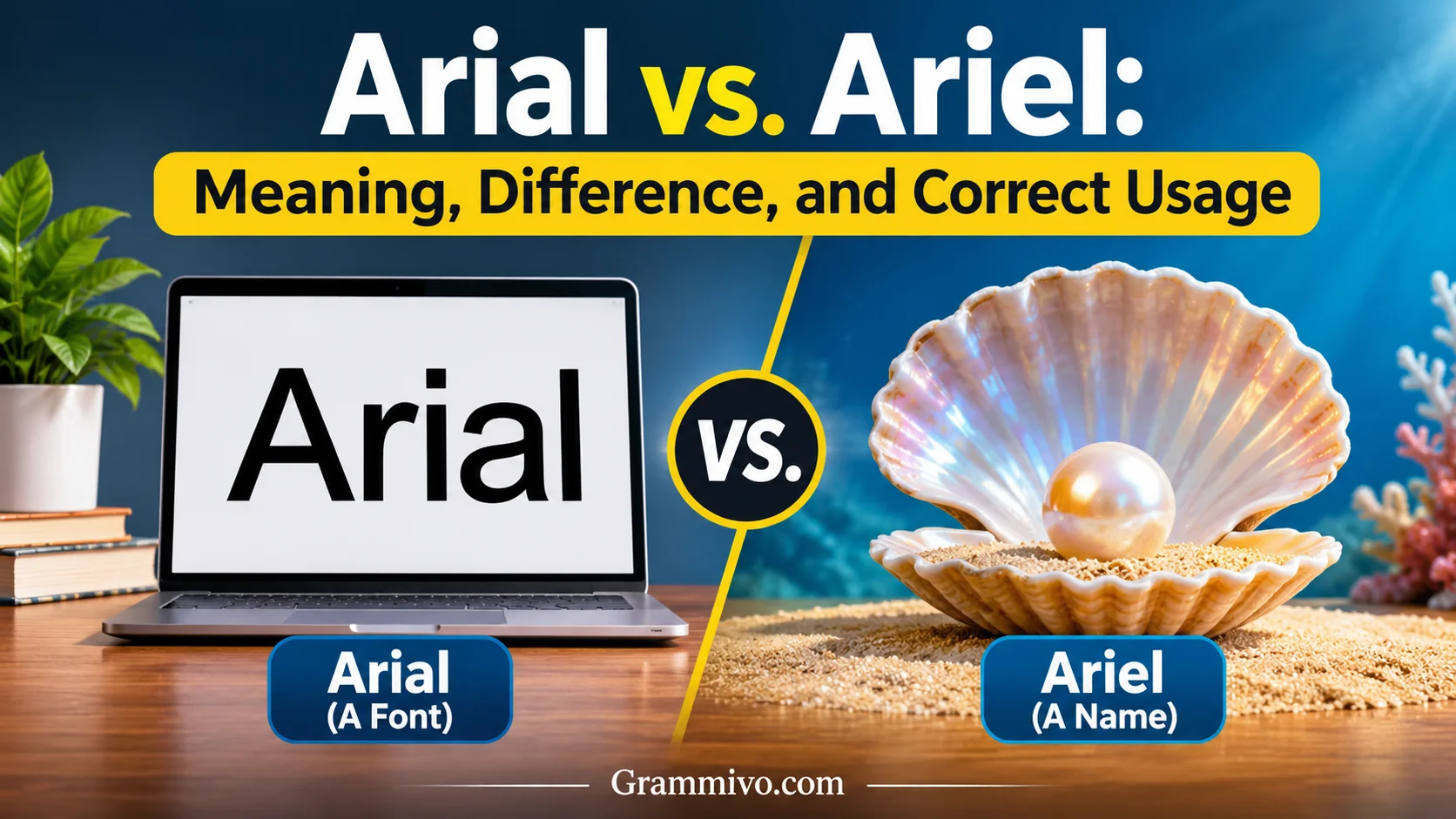
Arial is a popular sans-serif typeface used in documents, websites, presentations, and digital designs. Ariel, on the other hand, is a personal name with Hebrew origins. It’s also recognized as the name of famous fictional characters in literature and entertainment.
Although both words contain the same letters, their meanings, backgrounds, and everyday uses differ. Choosing the wrong spelling can create confusion, especially when discussing typography or referring to someone by name.
Quick Answer
Arial is the correct spelling when referring to the popular computer font used in documents, websites, and other digital content. Ariel is the correct spelling when referring to a person’s name or a fictional character.
Here is the easiest way to remember the difference:
- Arial: A sans-serif font used for writing and designing text.
- Ariel: A personal name of Hebrew origin, commonly interpreted as “lion of God.”
Example sentences:
- Please change the document’s font to Arial before printing.
- Ariel is joining us for dinner tonight.
Remember, both spellings are correct. The right choice depends entirely on what you’re discussing.
Comparison Overview
Arial and Ariel may look like spelling variations of the same word, but they have separate meanings and origins. One belongs to typography, while the other primarily identifies people.
The following table highlights their main differences.
| Feature | Arial | Ariel |
| Meaning | A sans-serif typeface | A personal name |
| Word category | Proper noun | Proper noun |
| Origin | Developed as a typeface in 1982 | Hebrew origin |
| Common association | Fonts and typography | People and fictional characters |
| Pronunciation | AIR-ee-ul | AIR-ee-ul |
| Primary use | Documents, websites, and designs | Names and personal references |
| Example | This document uses Arial. | Ariel is my friend. |
| Related field | Graphic design and typography | Names, culture, and literature |
The biggest difference is their purpose. Arial identifies a font, whereas Ariel identifies a name.
Both words usually begin with capital letters because they function as proper nouns. However, their meanings become clear when you examine the surrounding sentence.
Main Differences Between Arial and Ariel
The difference between Arial and Ariel goes beyond one letter’s position. Their origins, meanings, and practical applications make them separate terms.
Let’s examine each distinction to understand when you should use them.
Meaning and Definition of Arial vs. Ariel
The most important distinction involves what each word represents.
Arial refers to a typeface designed for displaying written characters. It belongs to the sans-serif family, which means its letters generally lack the small decorative strokes called serifs.
You’ll often see Arial in word-processing applications, business documents, websites, and presentations. Its straightforward appearance makes it a familiar choice for everyday communication.
Ariel is primarily a personal name with Hebrew roots. Its commonly accepted meaning is “lion of God.” People use it as a given name, and it appears in religious traditions, literature, and popular entertainment.
For example:
- “The designer selected Arial for the company brochure.” Here, Arial identifies a font.
- “Ariel received an invitation to the wedding.” Here, Ariel identifies a person.
These examples demonstrate why the two spellings aren’t interchangeable.
Part of Speech and Usage
Arial and Ariel both function as proper nouns, but they belong to different naming categories.
Arial names a specific typeface. In a sentence, it commonly appears when someone discusses typography, formatting, or visual design.
For example:
- Arial is one of the fonts available in Microsoft Word.
- The website uses Arial for its body text.
- I prefer Arial because its letters look clean and simple.
Ariel usually functions as a personal name. It can identify a friend, family member, public figure, or fictional character.
For example:
- Ariel is studying at the university.
- My sister named her daughter Ariel.
- Ariel appears in Shakespeare’s play The Tempest.
Important distinction: Neither word is an ordinary common noun. Both identify specific things, but they refer to different subjects.
Origin and Background of Arial vs. Ariel
Their histories provide another useful way to distinguish these terms.
Arial’s background
Arial is a modern typeface developed by Monotype designers Robin Nicholas and Patricia Saunders. It was released in 1982 and became widely recognized through its inclusion in Microsoft software.
The font gained popularity because it offered a practical, familiar appearance for everyday printing and digital communication.
Its design has similarities to Helvetica, another influential sans-serif typeface. However, Arial and Helvetica have distinct letterforms and design histories.
Ariel’s background
Ariel comes from Hebrew and is commonly interpreted as “lion of God.” The name has historical and religious associations.
In biblical Hebrew, Ariel appears as a name or designation associated with Jerusalem in certain passages. Its use as a personal name has continued across different cultures and generations.
Today, people use Ariel as both a masculine and feminine given name. Its popularity and pronunciation can vary depending on the country and language.
Pronunciation Differences Between Arial and Ariel
One reason people confuse Arial and Ariel is their similar pronunciation.
In many American English contexts, both words sound approximately like AIR-ee-ul.
However, pronunciation can vary slightly depending on the speaker’s accent and personal naming preferences. Some people pronounce Ariel differently because it’s a personal name.
| Word | Common American Pronunciation | Meaning |
| Arial | AIR-ee-ul | A typeface |
| Ariel | AIR-ee-ul | A personal name |
Because their sounds are so similar, pronunciation isn’t always a reliable way to identify the intended word.
Instead, pay attention to the sentence.
If someone discusses changing a document’s font, they almost certainly mean Arial. If they’re introducing a person, Ariel is the appropriate spelling.
Context and Purpose
Context provides the clearest distinction between these two words.
Use Arial when discussing:
- Font selection.
- Document formatting.
- Website typography.
- Graphic design.
- Digital presentations.
- Printed materials.
Use Ariel when discussing:
- A person’s name.
- A family member or friend.
- A fictional character.
- A literary figure.
- A character in a movie or television show.
Consider these examples:
Correct use of Arial:
“The marketing team chose Arial for its presentation because the font looked clean and familiar.”
Correct use of Ariel:
“Ariel invited her classmates to celebrate her birthday.”
The surrounding information makes the intended meaning obvious.
Capitalization and Spelling Differences
Both Arial and Ariel begin with capital letters because they are proper nouns.
However, their internal letter arrangement differs.
- Arial: A-r-i-a-l
- Ariel: A-r-i-e-l
The difference appears near the end of each word.
Arial contains the letter sequence “ial,” while Ariel contains “iel.” This small spelling change creates two completely different meanings.
When writing about fonts, use the official spelling Arial. When referring to someone whose name is Ariel, preserve that person’s preferred spelling.
Read More: Sentence vs. Sentance: Meaning, Difference, and Correct Usage
What Does Arial Mean?
Arial is one of the most recognizable sans-serif typefaces in modern computing. You’ve probably encountered it in documents, spreadsheets, websites, advertisements, and presentations.
Its simple appearance makes it useful across many everyday design situations.
Definition of Arial
Arial is a sans-serif typeface created for clear and practical text display. Unlike serif fonts, which contain small finishing strokes at the ends of many letters, Arial uses relatively straightforward letterforms.
For example, compare Arial with Times New Roman.
Times New Roman has distinctive serifs that give its letters a more traditional appearance. Arial removes those decorative strokes and creates a cleaner visual style.
This doesn’t mean Arial is automatically better or more readable in every situation. Font readability depends on several factors, including size, spacing, screen quality, and the length of the text.
However, Arial remains a familiar choice for general-purpose writing.
History and Origin of the Arial Font
Arial entered the typography world in 1982. Monotype commissioned the typeface, and designers Robin Nicholas and Patricia Saunders developed its original design.
Its widespread adoption came later, particularly through Microsoft products.
Microsoft included Arial in Windows and other software distributions. This exposure helped make the font familiar to millions of computer users.
Arial also became a common alternative to Helvetica in digital environments.
Although the two typefaces share broad design similarities, they aren’t identical. Their letter proportions, curves, and individual character shapes contain noticeable differences.
A useful fact: Arial’s popularity grew largely because people could access it through widely used computer software without needing specialized design tools.
Characteristics of the Arial Font
Arial has several recognizable design features that make it suitable for everyday typography.
Sans-serif letterforms: Arial doesn’t use the traditional finishing strokes associated with serif typefaces.
Straightforward appearance: Its letter shapes create a familiar and practical visual style.
Multiple styles and weights: Arial comes in different styles, including regular, italic, bold, and bold italic. Other available variants depend on the font package and software.
Versatile formatting: Designers and writers can use Arial for headings, paragraphs, labels, captions, and other text elements.
Broad software support: Arial has appeared in many popular operating systems and applications, making it familiar across different digital environments.
These characteristics explain why Arial remains a common choice for general documents and everyday design projects.
Where Is Arial Commonly Used?
Arial appears in many situations because it offers a familiar and uncomplicated appearance.
Here are some common examples.
- Microsoft Word: People use Arial for letters, assignments, reports, and other documents.
- Business reports: Companies often choose Arial for presentations, internal documents, and professional communication.
- Websites: Designers may use Arial as a body font or part of a broader font stack.
- Educational materials: Students and teachers use Arial for worksheets, classroom handouts, and assignments.
- Presentations: Its straightforward appearance works well for slides and informational content.
- Graphic design: Designers sometimes select Arial for advertisements, labels, posters, and promotional materials.
However, Arial isn’t the only suitable font for these purposes. Alternatives such as Helvetica, Calibri, and other sans-serif typefaces may work better depending on the project’s visual goals.
Examples of Arial in Sentences
Understanding Arial becomes easier when you see it in everyday writing.
Here are several correct examples:
- I changed the document to Arial before sending it to my manager.
- The website uses Arial for its main body text.
- Please select Arial, size 12, for your assignment.
- Our designer recommended Arial for the presentation.
- The company uses Arial in several internal documents.
- Arial looks simple and familiar on my computer.
- She prefers Arial over decorative fonts for professional reports.
In every example, Arial refers to a typeface rather than a person.
What Does Ariel Mean?
Ariel is a personal name with Hebrew origins. It has historical, cultural, and literary associations that make it recognizable in different parts of the world.
Unlike Arial, it doesn’t identify a font or typography style.
Definition of Ariel
Ariel is a given name commonly interpreted as “lion of God.”
The name has Hebrew roots and appears in religious and literary contexts. Depending on the culture, parents may choose Ariel for a boy or a girl.
It’s also associated with well-known fictional characters, including Shakespeare’s spirit in The Tempest and Disney’s mermaid princess in The Little Mermaid.
Because Ariel functions as a personal name, its spelling should remain consistent when referring to a particular individual.
For example:
“Ariel is attending the conference next week.”
Here, Ariel identifies a person rather than a design element or font.
Origin and Meaning of the Name Ariel
The name Ariel comes from Hebrew. It’s commonly connected to two Hebrew elements associated with a lion and God.
Its traditional interpretation is “lion of God.”
The lion often represents strength, courage, and power in symbolic traditions. Consequently, the name can carry strong and meaningful associations.
Ariel also appears in biblical language. In Isaiah 29, Ariel is used in connection with Jerusalem. The term has also appeared in other historical and religious interpretations.
Over time, the name developed a broader presence as a personal name across different cultures.
Its use isn’t limited to one gender. Some families choose Ariel for boys, while others prefer it for girls.
Arial vs. Ariel: Side-by-Side Examples
Sometimes, the easiest way to understand a spelling difference is to compare both words in similar situations.
The following examples demonstrate how one letter arrangement changes the meaning.
| Sentence | Correct Word | Explanation |
| Please change the font to Arial. | Arial | Refers to a typeface. |
| Ariel is waiting outside. | Ariel | Refers to a person. |
| The designer selected Arial for the brochure. | Arial | Refers to typography. |
| Ariel is learning to play the piano. | Ariel | Refers to someone’s name. |
| This website uses Arial for its paragraphs. | Arial | Identifies a font. |
| I watched Ariel in The Little Mermaid. | Ariel | Identifies a fictional character. |
| The report looks better in Arial. | Arial | Refers to formatting. |
| Ariel sent me a birthday invitation. | Ariel | Identifies a person. |
Frequently Asked Questions
Is It Arial or Ariel?
Both spellings are correct, but they have different meanings. Arial refers to a sans-serif typeface used in documents and digital designs. Ariel is a personal name with Hebrew origins, commonly interpreted as “lion of God.” Choose the spelling that matches your intended meaning.
What Is the Difference Between Arial and Ariel?
The primary difference is their meaning and purpose. Arial is a font used to display written text, while Ariel is a given name used for people and fictional characters. Their similar spelling and pronunciation often cause confusion.
Is Arial a Font or a Name?
Arial is primarily known as a typeface. It belongs to the sans-serif font family and is widely used in documents, presentations, websites, and other digital materials. Its simple appearance makes it a familiar option for everyday typography.
Is Ariel a Real Name?
Yes, Ariel is a real personal name with Hebrew origins. It can be used for both boys and girls. The name is commonly interpreted as “lion of God” and has historical, religious, and cultural associations.
How Do You Pronounce Arial and Ariel?
In many American English accents, Arial and Ariel are pronounced similarly as AIR-ee-ul. However, individual pronunciation may vary, particularly when Ariel is someone’s personal name. Context usually helps identify the intended word.
Conclusion:
Understanding the difference between Arial vs. Ariel is simple once you recognize what each word represents. Arial refers to a widely used sans-serif typeface found in documents, websites, presentations, and digital designs. Ariel is a personal name with Hebrew origins and the commonly accepted meaning “lion of God.” Although their spellings and pronunciations are similar, their meanings aren’t interchangeable.
