
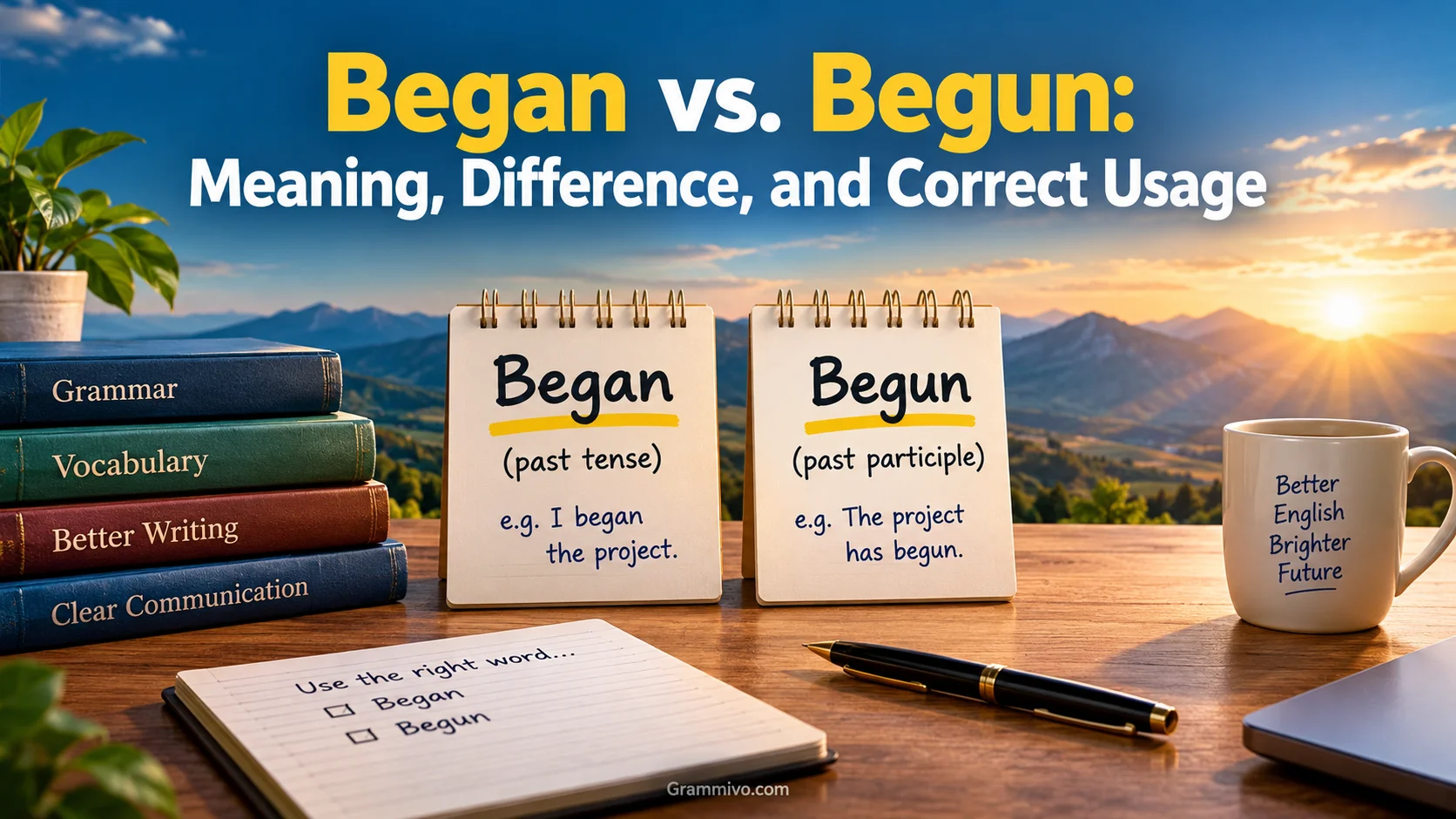
Have you ever wondered whether to write “The meeting began” or “The meeting begun”? You’re not alone. These two words often confuse English learners and even native speakers because they come from the same verb and describe the same basic action.
The difference comes down to grammar. Began is the simple past tense of begin, while begun is its past participle. Although both refer to something starting, you can’t freely swap them in a sentence.
For example, you would say, “The movie began at seven,” but “The movie has begun.” Both sentences are correct because each word follows a different grammatical pattern.
Once you understand how these verb forms work, choosing between began and begun becomes much easier. Let’s explore their meanings, sentence structures, common mistakes, and practical examples so you can use them confidently in everyday writing.
Quick Answer
Began vs. begun: Began is the simple past tense of begin, while begun is the past participle. Use began for a past action without a perfect-tense helping verb. Use begun with has, have, or had to form perfect tenses.
- Began: The class began at 9 a.m.
- Begun: The class has begun.
- Begin: The class will begin soon.
Easy rule to remember: Begin, began, begun. If you’re describing a past event directly, began is usually the right choice. If you’re using a perfect tense, choose begun.
Comparison Overview
The words begin, began, and begun are three forms of the same irregular verb. Each has a specific grammatical role, and understanding those roles helps you build correct sentences.
| Feature | Begin | Began | Begun |
| Verb form | Base form | Simple past tense | Past participle |
| Main purpose | Describes an action in its base form | Describes an action in the past | Forms perfect tenses and passive constructions |
| Common pattern | Begin, begins, or to begin | Subject + began | Has/have/had + begun |
| Example | We begin work at eight. | We began work yesterday. | We have begun work. |
| Common time reference | Present, future, or after certain verbs | A past event | Past action viewed in relation to another time |
Consider these three sentences:
- Begin: “I want to begin my presentation.” The base form follows want to.
- Began: “I began my presentation yesterday.” The sentence describes a past action.
- Begun: “I have begun my presentation.” The helping verb have combines with the past participle.
The key isn’t simply when an action happens. You must also consider the verb structure surrounding it.
What Does Began Mean?
Began is the simple past tense of the verb begin. It describes the point when an action, event, process, or activity started in the past.
You use began when you want to report that something started at an earlier time. The sentence doesn’t need has, have, or had to express the simple past.
For example, “The concert began at eight” tells readers when the concert started. Likewise, “She began learning Spanish last year” describes when her learning process started.
The word doesn’t necessarily mean that the entire activity has finished. It only identifies its starting point.
For instance, “He began writing his novel in 2024” doesn’t tell you whether he has finished the novel. It simply establishes when he started writing.
Examples of Began in Sentences
Here are practical examples showing how began works in different situations.
- Daily activities: I began cooking dinner after work.
- Education: The semester began in August.
- Business: The company began operations in a small office.
- Entertainment: The movie began ten minutes late.
- Personal development: She began exercising every morning.
- Weather: Heavy rain began before sunrise.
- Relationships: Their friendship began during college.
- Historical events: The industrial revolution began in Britain during the eighteenth century.
Each example describes a starting point in the past.
Notice that began can take a direct object, as in “She began the assignment,” or appear before an -ing form, as in “She began studying.” Both constructions are grammatical.
When to Use Began
Use began when the sentence calls for the simple past tense.
For completed past events: “The ceremony began at noon.” The sentence reports a past occurrence.
For events with a specific past-time reference: “We began the project last Monday.” The phrase last Monday establishes when the action started.
For storytelling: “The lights went out, and the audience began shouting.” The verb helps move a narrative forward.
For actions that started in the past but may continue: “She began working here five years ago.” This tells you when she started, not whether she still works there.
However, pay attention to helping verbs in questions and negative statements. English often uses the base form begin after did.
- Correct: Did the meeting begin on time?
- Incorrect: Did the meeting began on time?
- Correct: The meeting did not begin on time.
- Incorrect: The meeting did not began on time.
Why? The auxiliary verb did already carries the past-tense marking. The main verb therefore stays in its base form.
What Does Begun Mean?
Begun is the past participle of the verb begin. Unlike began, it usually needs a helping verb when it appears in a complete verb phrase.
You’ll most often see begun with has, have, or had. These combinations form perfect tenses, which connect an action to a particular point in time.
For example, “They have begun construction” indicates that construction has started and presents that development as relevant to the present. Meanwhile, “They had begun construction before winter” places the start before another past event.
The past participle also appears in passive constructions, such as “The investigation was begun last week.” Although grammatically possible, this passive sentence often sounds less natural than “Investigators began the investigation last week.”
Examples of Begun in Sentences
Here are examples of begun in common grammatical constructions.
- Present perfect: I have begun reading the new book.
- Present perfect: She has begun her training.
- Past perfect: They had begun dinner before we arrived.
- Future perfect: By noon, the team will have begun the next phase.
- Passive voice: The restoration has been begun, although much work remains.
- Workplace communication: We have begun reviewing the applications.
- Education: The students have begun preparing for their exams.
- Personal goals: He has begun making healthier choices.
In each example, begun follows a helping verb or forms part of a larger verb phrase.
When to Use Begun
Choose begun when the sentence requires a past participle.
With has or have: Use these helping verbs to form the present perfect tense.
- Correct: The meeting has begun.
- Correct: We have begun our research.
- Incorrect: The meeting has began.
- Incorrect: We have began our research.
With had: Use had begun when one past action started before another past event.
- Correct: The movie had begun before we found our seats.
- Incorrect: The movie had began before we found our seats.
With future perfect constructions: Use will have begun to describe an action expected to have started by a future point.
- Correct: The ceremony will have begun by the time we arrive.
- Incorrect: The ceremony will have began by the time we arrive.
In passive constructions: Use begun after the appropriate form of be when the sentence requires the past participle.
- Correct: Work was begun on the new building last month.
- More natural in many contexts: Workers began building the new structure last month.
Remember that begun doesn’t automatically mean an action continues. The surrounding tense and context determine how the sentence relates the action to time.
Main Differences Between Began and Begun
Although began and begun share the same meaning at their core, they serve different grammatical functions. Understanding those differences helps you avoid errors in emails, essays, reports, and everyday conversations.
Verb Form and Grammatical Function
The clearest difference is their grammatical form.
- Began is the simple past tense.
- Begun is the past participle.
- Begin is the base form.
These forms belong to an irregular verb pattern. Unlike regular verbs, which usually form their past tense and past participle by adding -ed, begin changes its spelling.
Compare these examples:
| Sentence | Correct form | Why it works |
| The class began at nine. | Began | Simple past tense |
| The class has begun. | Begun | Present perfect tense |
| The class had begun before I arrived. | Begun | Past perfect tense |
| The class will begin tomorrow. | Begin | Base form after will |
| Did the class begin already? | Begin | Base form after did |
The final two examples matter because not every reference to the past uses began or begun. Auxiliary verbs can change the form you need.
Read More: Absence vs. Abscence: Meaning, Difference, and Correct Usage
Auxiliary Verbs and Sentence Structure
An auxiliary verb, also called a helping verb, works with a main verb to express tense, voice, or another grammatical feature.
In perfect-tense constructions, the auxiliary verb determines the grammatical structure. The main verb appears as a past participle.
Consider the difference:
- “She began the project.” The simple past describes when she started.
- “She has begun the project.” The present perfect connects the start to the present.
- “She had begun the project before the deadline changed.” The past perfect places the start before another past event.
The words has, have, and had don’t simply decorate the sentence. They establish the perfect-tense construction, which requires begun rather than began.
Other helping verbs create different patterns. For example, did takes the base form:
- Correct: Did she begin the project?
- Incorrect: Did she began the project?
Similarly, modal verbs such as will, can, and should generally take the base form:
- We will begin shortly.
- You can begin whenever you’re ready.
- They should begin preparing now.
Time and Context
Time expressions can help you choose the right tense, but they don’t tell the whole story. The grammatical structure matters just as much.
Look at these sentences:
“The store began offering delivery last year.”
This sentence uses the simple past to report when the store started offering delivery. The phrase last year points to a past time.
“The store has begun offering delivery.”
Here, the present perfect presents the new service as a development relevant to the present. The sentence doesn’t specify exactly when the service started.
“The store had begun offering delivery before its competitor opened.”
The past perfect establishes that one event started before another past event.
A common misconception is that begun always describes something unfinished. That isn’t true. The perfect tense can describe an action that has already ended, depending on context.
For example, “The concert had begun and ended before we arrived” uses begun correctly even though the concert was over.
Began vs. Begun in Questions and Negative Sentences
Questions and negative statements often cause confusion because English uses helping verbs to form them.
When you use did, choose begin, not began or begun.
| Sentence type | Correct example |
| Statement | The presentation began at ten. |
| Question | Did the presentation begin at ten? |
| Negative | The presentation did not begin at ten. |
| Present perfect question | Has the presentation begun? |
| Present perfect negative | The presentation has not begun. |
| Past perfect question | Had the presentation begun before you arrived? |
The rule is straightforward: After did, use the base form begin. After has, have, or had in perfect tenses, use begun.
One more detail is worth remembering. In questions such as “When did the class begin?” the word did already indicates the past. The main verb remains begin even though the sentence asks about a past event.
Began vs. Begun in Different Verb Tenses
Verb tenses show how an action relates to time. Learning the patterns below will help you recognize which form belongs in each sentence.
Simple Past Tense
The simple past describes an action or event that occurred in the past.
Structure: Subject + began + remaining sentence.
Examples:
- The conference began on Tuesday.
- My brother began learning guitar last summer.
- The storm began without warning.
- We began discussing the proposal after lunch.
You don’t need a helping verb in an ordinary affirmative statement using the simple past. However, questions and negative statements usually use did plus begin.
Present Perfect Tense
The present perfect connects a past action to the present or describes an experience or development without specifying a finished past-time reference.
Structure: Subject + has/have + begun.
Examples:
- The company has begun hiring new employees.
- We have begun planning our vacation.
- She has begun studying for the examination.
- The first stage has begun.
Use has with third-person singular subjects such as he, she, and it. Use have with I, you, we, and they.
For example, “He has begun” is correct, while “He have begun” is not.
Past Perfect Tense
The past perfect shows that an action occurred before another point or event in the past.
Structure: Subject + had + begun.
Examples:
- The train had begun moving before we reached the platform.
- She had begun cooking when the electricity went out.
- The company had begun expansion before the market slowed.
- I had begun reading the report when my manager called.
The word had works with every subject. You don’t change it for singular or plural nouns.
Use the past perfect when the relationship between two past events matters. If you’re simply reporting one past event, the simple past may be more natural.
FAQs:
Is It Began or Begun?
Both words are correct, but they fit different grammatical structures. Use began for the simple past and begun as the past participle.
- Correct: The meeting began at noon.
- Correct: The meeting has begun.
Is It Has Began or Has Begun?
Has begun is correct in standard English. The present perfect requires has followed by the past participle begun.
For example: “She has begun working on the proposal.”
Is It Had Began or Had Begun?
Had begun is correct. The past perfect follows the pattern had plus the past participle.
For example: “The team had begun the project before the deadline changed.”
Can You Say The Meeting Begun?
Not as a standard, complete simple past statement. Say “The meeting began” instead.
However, begun can appear in a larger construction, such as “The meeting had begun before we arrived.”
Is Began a Past Participle?
No. Began is the simple past tense of begin. The past participle is begun.
Conclusion:
The difference between began and begun becomes simple once you understand their grammatical roles. Began is the simple past tense of begin, while begun is the past participle used in perfect tenses and certain other constructions. Remember the pattern: begin, began, begun. Use began to report a past event, and choose begun when the sentence calls for a past participle. After did, use begin.
