
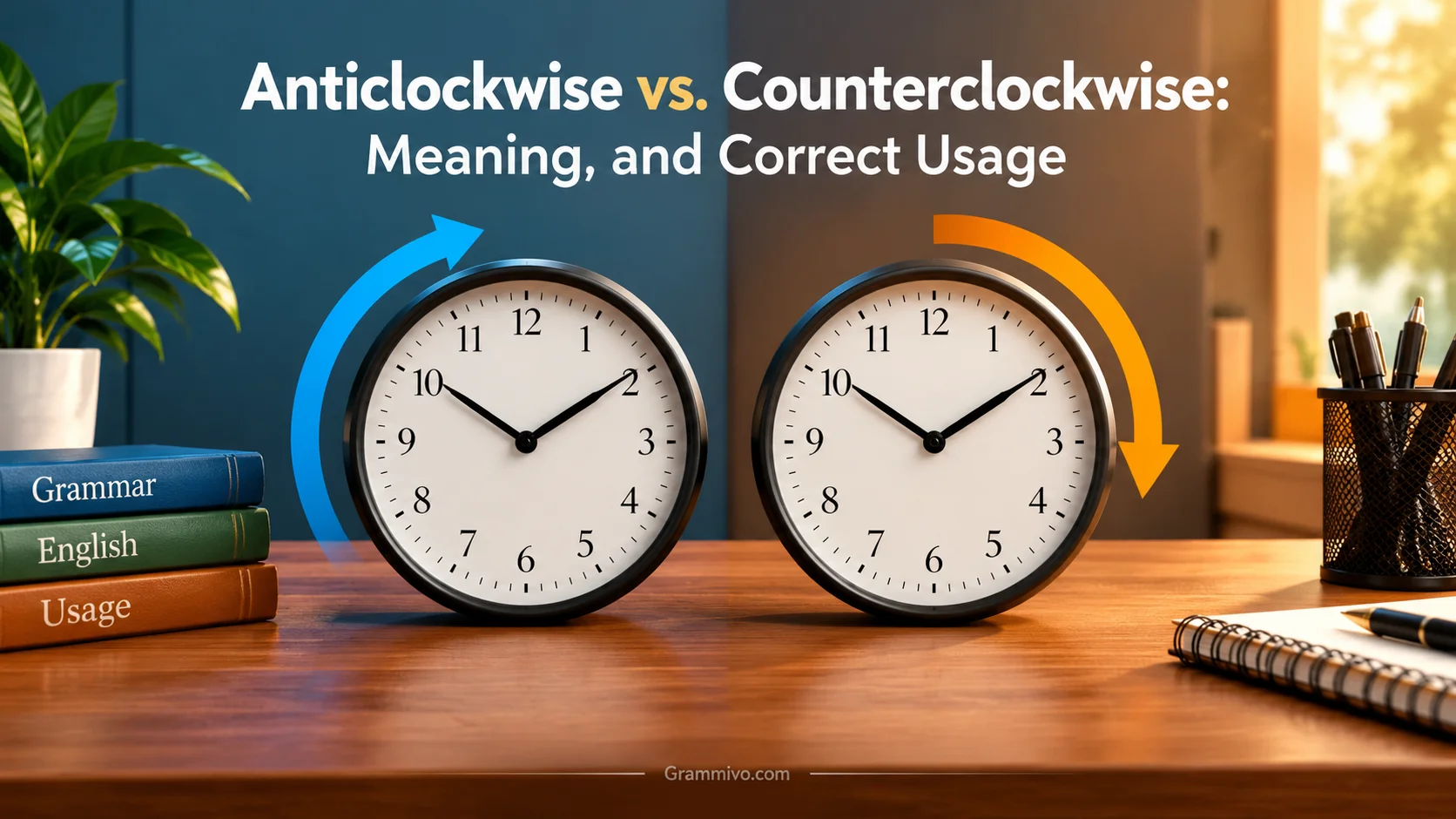
Have you ever wondered whether to write anticlockwise or counterclockwise? Both words describe the same direction of rotation, yet writers often wonder which spelling is correct. The answer mainly depends on where you live and which variety of English you use.
In British English, anticlockwise is the preferred term. In American English, counterclockwise is the standard choice. Both words describe movement opposite to the direction in which a clock’s hands normally turn.
You might encounter these terms in everyday instructions, mathematics lessons, engineering manuals, science textbooks, and conversations about rotating objects. For example, someone in Britain might tell you to turn a knob anticlockwise, while an American instruction manual might say to turn it counterclockwise.
Although the words look different, their meanings remain essentially identical. Neither is inherently more correct than the other. The important thing is to understand their regional preferences, grammatical uses, and practical applications so you can choose the right word for your audience.
Quick Answer
Anticlockwise vs. counterclockwise: Both words mean moving in the direction opposite to clockwise rotation. Anticlockwise is more common in British English, while counterclockwise is standard in American English.
- Anticlockwise: Preferred in British English and commonly used in British-style publications.
- Counterclockwise: Preferred in American English and widely used in American educational and technical materials.
- Meaning: Both describe rotation opposite to the direction of a clock’s hands.
- Part of speech: Both can function as adjectives and adverbs.
- Spelling: Both are conventionally written as single words.
- Correct choice: Use the word that matches your audience and maintain consistency throughout your writing.
For example:
- British English: Turn the handle anticlockwise to loosen the valve.
- American English: Turn the handle counterclockwise to loosen the valve.
Both sentences communicate the same instruction.
Comparison Overview
The following table highlights the main similarities and differences between anticlockwise and counterclockwise.
| Feature | Anticlockwise | Counterclockwise |
| Meaning | Opposite to clockwise rotation | Opposite to clockwise rotation |
| Preferred variety | British English | American English |
| Part of speech | Adjective and adverb | Adjective and adverb |
| Spelling | One word | One word |
| Typical instruction | Turn the dial anticlockwise. | Turn the dial counterclockwise. |
| Common contexts | Everyday directions, education, technical writing | Everyday directions, education, technical writing |
| Opposite term | Clockwise | Clockwise |
| Correctness | Correct | Correct |
The central distinction is regional usage rather than meaning. If you’re writing for an American audience, counterclockwise will usually sound more natural. If your readers expect British English, anticlockwise is generally the better option.
Neither term changes the physical direction of an object. A wheel turning anticlockwise follows the same rotational direction as a wheel turning counterclockwise.
Main Differences Between Anticlockwise and Counterclockwise
Although anticlockwise and counterclockwise describe the same movement, several details distinguish their usage. Understanding these differences helps you write clearly without mixing regional conventions.
Meaning and Definition of Anticlockwise vs. Counterclockwise
The word anticlockwise describes movement in the opposite direction to the normal rotation of a clock’s hands. When you look directly at a traditional clock, its hands move from the top toward the right, then downward, and finally toward the left before returning to the top.
Movement in the opposite direction is anticlockwise.
The word counterclockwise describes exactly the same movement. The prefix counter- conveys opposition, so counterclockwise refers to movement against the usual direction of a clock’s hands.
Imagine a circular dial with a pointer at the top. If the pointer moves toward the left first, it travels anticlockwise or counterclockwise.
Here are a few practical examples:
- Turning a knob in the direction opposite to a clock’s hands.
- Moving around a circular track in the reverse direction.
- Rotating a wheel in the opposite direction from its usual clockwise movement.
- Drawing a circular arrow that curves from the top toward the left.
The key point: The words describe the same direction. Your choice depends on regional English preferences, not on a difference in physical movement.
Anticlockwise vs. Counterclockwise in British and American English
English has several regional differences, and anticlockwise versus counterclockwise is one of them. Both terms are standard, but their popularity varies across English-speaking regions.
British English generally favors anticlockwise. You may see it in British schoolbooks, instructions, everyday conversations, and technical documents. For example, a British instruction might tell you to rotate a control anticlockwise to reduce a setting.
American English generally favors counterclockwise. American dictionaries, educational resources, and product instructions commonly use this term. An American manual might tell you to rotate a dial counterclockwise to adjust a device.
Consider these examples:
| British English | American English |
| Turn the key anticlockwise. | Turn the key counterclockwise. |
| Rotate the wheel anticlockwise. | Rotate the wheel counterclockwise. |
| Move anticlockwise around the circle. | Move counterclockwise around the circle. |
| Turn the control anticlockwise to loosen it. | Turn the control counterclockwise to loosen it. |
Notice that the sentence structure and meaning remain unchanged. Only the preferred term differs.
Other English-speaking regions may follow British or American conventions, depending on their educational systems, publications, and local usage. These preferences are not absolute rules for every speaker.
If you write for a particular country, follow its common conventions. When writing for an international audience, either term can work as long as readers understand the instruction.
Part of Speech: Anticlockwise and Counterclockwise as Adjectives and Adverbs
Both words can function as adjectives and adverbs. Their grammatical role depends on how you use them in a sentence.
Anticlockwise as an adverb
An adverb explains how an action happens. When anticlockwise describes the direction of an action, it functions as an adverb.
Examples:
- Turn the handle anticlockwise.
- The wheel rotates anticlockwise.
- Move the pointer anticlockwise around the dial.
- The dancers moved anticlockwise around the room.
In each example, the word describes the direction of movement.
Anticlockwise as an adjective
An adjective describes a noun. When anticlockwise identifies the direction or type of rotation associated with something, it functions as an adjective.
Examples:
- The anticlockwise movement stopped suddenly.
- The machine uses an anticlockwise rotation setting.
- An anticlockwise turn will release the mechanism.
Counterclockwise as an adverb
American English commonly uses counterclockwise in the same adverbial role.
Examples:
- Turn the knob counterclockwise.
- The fan blade moved counterclockwise.
- Rotate the wheel counterclockwise.
- The runners traveled counterclockwise around the track.
Counterclockwise as an adjective
The word also describes nouns associated with that direction.
Examples:
- The counterclockwise rotation increased in speed.
- The diagram shows a counterclockwise turn.
- A counterclockwise movement activates the mechanism.
A quick way to identify the difference is to examine the sentence. If the word describes how something moves, it usually functions as an adverb. If it describes a noun, it functions as an adjective.
Pronunciation and Word Formation
Although the two words share a meaning, their construction differs.
Anticlockwise combines the prefix anti- with clockwise. The prefix anti- generally means against, opposite to, or in opposition to something.
Counterclockwise combines counter- with clockwise. The prefix counter- can also convey opposition or movement against a direction.
Both prefixes communicate the same basic idea in this context.
Their pronunciations are also straightforward:
- Anticlockwise: AN-tee-KLOK-wyze
- Counterclockwise: KOWN-ter-KLOK-wyze
Pronunciation can vary slightly by accent, but the main stress patterns are easy to recognize.
Both terms are written as single words in standard usage. Avoid splitting them into forms such as anti clockwise or counter clockwise when you mean the established directional terms.
The word clockwise itself comes from the direction in which the hands of a traditional clock move. Adding either prefix reverses that direction.
Anticlockwise vs. Counterclockwise in Everyday Instructions
These terms frequently appear in instructions because people often need to turn, rotate, or adjust objects. The distinction becomes especially useful when an action requires a specific direction.
For example, you might encounter these instructions when using household items:
- Turn the faucet handle counterclockwise to open it.
- Rotate the lid anticlockwise to loosen it.
- Turn the dial counterclockwise to lower the setting.
- Move the circular selector anticlockwise to reach the previous option.
However, the direction does not always determine the result. Turning a knob counterclockwise may loosen one mechanism but tighten another. The design of the object determines what happens.
For example, many conventional threaded fasteners loosen when turned counterclockwise and tighten when turned clockwise. However, some specialized fasteners use reverse threads, which work differently.
This is why clear instructions should explain the intended action whenever confusion could cause a problem.
Consider a simple household example. You’re trying to remove a tightly closed jar lid. Someone tells you to turn it counterclockwise. If you’re accustomed to British English, the same person could say anticlockwise, and you’d follow the same movement.
The wording changes, but your hand moves in the same direction.
Anticlockwise vs. Counterclockwise in Mathematics, Science, and Engineering
In mathematics and technical fields, these terms describe rotational direction. They help explain how points, lines, wheels, and other objects move around a center.
In geometry, anticlockwise or counterclockwise movement can describe how a point travels around a circle. A diagram may use a curved arrow to indicate the direction.
In physics, the terms can describe rotational motion, angular displacement, and the movement of rotating bodies. For example, a disk may rotate counterclockwise around its central axis.
In engineering, directional instructions help people understand how to operate mechanisms, adjust controls, and interpret technical drawings. The appropriate word depends partly on the document’s language conventions.
One important detail deserves attention: counterclockwise does not automatically mean mathematically negative.
In the standard Cartesian coordinate plane, mathematicians usually measure positive angles counterclockwise from the positive horizontal axis. Negative angles generally represent clockwise rotation.
For instance:
- A rotation of 90 counterclockwise is a positive quarter-turn.
- A rotation of -90 represents a clockwise quarter-turn under the same convention.
- A rotation of 180 reaches the opposite direction regardless of whether the path proceeds clockwise or counterclockwise through a half-turn.
However, these conventions depend on the coordinate system and the direction from which you view the rotation. In three-dimensional mechanics, the chosen axis and the right-hand rule help establish the sign of angular quantities.
For practical writing, distinguish between the everyday direction of rotation and the mathematical sign assigned to it. They are related, but they are not interchangeable in every context.
Read More: Whether vs. Whether or Not: Meaning, and Correct Usage
Anticlockwise vs. Counterclockwise Examples
Examples make the difference easier to remember. The following sentences show how both words work in everyday and technical contexts.
Examples Using Anticlockwise
These examples follow British English conventions.
- Turn the handle anticlockwise to open the valve.
- The wheel rotated anticlockwise before coming to a stop.
- Move the pointer anticlockwise until it reaches the marked position.
- The runners traveled anticlockwise around the circular track.
- Turn the lid anticlockwise to remove it from the jar.
- The diagram illustrates an anticlockwise rotation around the center.
- Rotate the control anticlockwise to reduce the pressure.
In each sentence, anticlockwise identifies the direction of movement or rotation. The word fits naturally into instructions, descriptions, and technical explanations.
Examples Using Counterclockwise
These examples follow American English conventions.
- Turn the knob counterclockwise to release the lock.
- The wheel rotates counterclockwise around its central axis.
- Move the pointer counterclockwise to select the previous setting.
- The runners moved counterclockwise around the track.
- Rotate the lid counterclockwise to open the container.
- The diagram shows a counterclockwise rotation.
- Turn the control counterclockwise to decrease the pressure.
The meaning matches the British examples. American writers simply prefer counterclockwise in these situations.
Side-by-Side Anticlockwise and Counterclockwise Sentences
The easiest way to understand these words is to compare them in identical contexts.
| Anticlockwise | Counterclockwise |
| Turn the dial anticlockwise. | Turn the dial counterclockwise. |
| The wheel spins anticlockwise. | The wheel spins counterclockwise. |
| Move the pointer anticlockwise. | Move the pointer counterclockwise. |
| The diagram shows anticlockwise movement. | The diagram shows counterclockwise movement. |
| Rotate the handle anticlockwise to loosen it. | Rotate the handle counterclockwise to loosen it. |
Each pair communicates the same instruction or observation. Neither version changes the direction, the action, or the intended result.
When editing an article, however, avoid switching between the terms without a reason. A consistent regional style makes your writing feel more polished.
Is Anticlockwise or Counterclockwise More Common?
The answer depends on the region you’re considering. Counterclockwise is the usual choice in American English, while anticlockwise is preferred in British English.
These preferences reflect broader differences between the two varieties of English. Words, spellings, and expressions sometimes develop distinct regional patterns even when they describe the same thing.
For example, American English generally uses color, while British English uses colour. Similarly, American writers usually choose counterclockwise, whereas British writers commonly choose anticlockwise.
Neither preference makes the other word incorrect.
Here are a few practical guidelines:
- For American readers: Use counterclockwise in articles, instructions, and educational materials.
- For British readers: Use anticlockwise to match familiar local usage.
- For international readers: Choose either term and make the direction clear through context.
- For technical documents: Follow the terminology required by your organization or publication.
- For academic writing: Maintain consistent regional conventions throughout the document.
Avoid claiming that one word is universally more popular without specifying a region or consulting relevant usage data. Language preferences vary, and a regional distinction provides a more accurate explanation than a blanket ranking.
Common Mistakes to Avoid
Although the distinction is simple, a few common mistakes can create confusion.
Treating Anticlockwise and Counterclockwise as Different Directions
The most common misunderstanding is assuming that the words describe opposite movements. They don’t.
Both terms describe movement opposite to clockwise rotation. The difference lies in regional preference, not physical direction.
Assuming One Word Is Incorrect
Some writers believe anticlockwise is wrong because they primarily encounter counterclockwise. Others assume the reverse.
Both are established English words. The appropriate choice depends on your audience and the conventions you follow.
Mixing British and American Terminology
Switching between the terms unnecessarily can make an article feel inconsistent.
For example:
Turn the dial anticlockwise. Next, rotate it counterclockwise until the arrow points upward.
Although the sentence isn’t inherently ungrammatical, it uses two regional alternatives for the same direction without a clear reason.
A more consistent version would be:
Turn the dial counterclockwise. Next, rotate it counterclockwise until the arrow points upward.
Choose the term that fits your audience and use it throughout the article.
Confusing Clockwise With Counterclockwise
Clockwise and counterclockwise describe opposite directions when viewed from the same reference point.
Imagine looking directly at a clock face. Its hands normally move clockwise. Moving in the reverse direction is counterclockwise or anticlockwise.
Remember that the viewing angle matters, especially when discussing three-dimensional objects. Rotation that appears clockwise from one side may appear counterclockwise from the opposite side.
Assuming Counterclockwise Always Means Negative
In standard two-dimensional Cartesian coordinates, counterclockwise rotation usually corresponds to a positive angular direction. However, the sign depends on the coordinate convention and reference axis.
Don’t automatically replace counterclockwise with negative in technical writing. Describe the direction and specify the mathematical convention when necessary.
Writing the Terms as Two Words
In standard usage, both anticlockwise and counterclockwise are written as single words.
Use these forms:
- Anticlockwise movement
- Counterclockwise rotation
- An anticlockwise turn
- A counterclockwise adjustment
Avoid anti clockwise and counter clockwise when you intend these established terms.
FAQs:
Is anticlockwise the same as counterclockwise?
Yes. Both words describe movement opposite to clockwise rotation. The main difference is regional usage: anticlockwise is preferred in British English, while counterclockwise is standard in American English.
Is anticlockwise British English?
Yes. Anticlockwise is widely used in British English, including everyday conversation, educational materials, and instructions. It describes the same rotational direction as the American-preferred word counterclockwise.
Is counterclockwise American English?
Yes. Counterclockwise is the standard and more familiar term in American English. Writers commonly use it when describing rotating objects, turning knobs, and explaining circular movement.
Which is correct: anticlockwise or counterclockwise?
Both are correct. Neither word is inherently better in every situation. Choose counterclockwise for American English and anticlockwise for British English, then maintain consistency throughout your writing.
Is anticlockwise one word or two?
Anticlockwise is conventionally written as one word. The standard spelling combines anti- and clockwise without a space or hyphen.
Conclusion:
The difference between anticlockwise and counterclockwise comes down to regional English usage. Both words describe movement opposite to the direction of a clock’s hands, and both are correct. Use anticlockwise for British English and counterclockwise for American English. Either word can describe rotation in everyday instructions, mathematics, science, and engineering.
When choosing between them, consider your readers and the conventions of your publication. Keep your terminology consistent, explain the direction clearly when needed, and remember that different wording doesn’t mean a different movement.
