
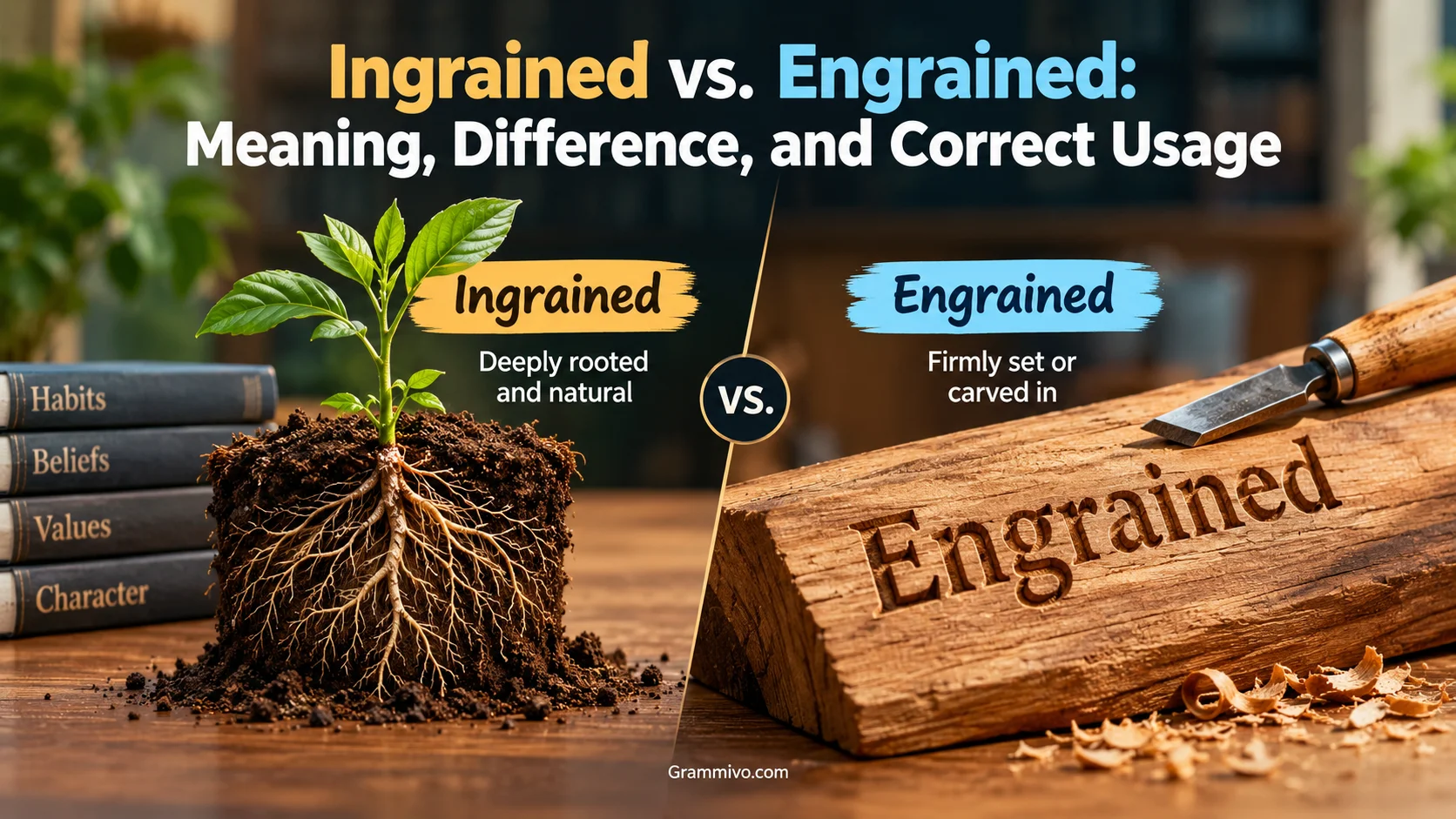
Have you ever wondered whether to write ingrained or engrained? You’re not alone. These two spellings often confuse writers because they look slightly different but carry essentially the same meaning.
Both words describe something deeply embedded, firmly established, or difficult to change. You might use either spelling when discussing a lifelong habit, a strong belief, a cultural attitude, or dirt trapped in fabric. However, one form appears more frequently in modern writing.
The good news is that you don’t need to memorize two separate definitions. Instead, you need to understand how the words work, why both spellings exist, and which one makes the most sense for your audience.
Whether you’re writing an academic paper, a professional email, or an everyday message, this guide explains the differences with clear definitions, practical examples, and useful comparisons.
Quick Answer
Ingrained and engrained are both correct spellings with essentially the same meaning. Both describe something deeply rooted in a person’s mind, firmly established as a habit, or embedded in a material. However, ingrained is generally the more common spelling in modern American English.
For example:
- Ingrained: Checking her phone before bed had become an ingrained habit.
- Engrained: Checking her phone before bed had become an engrained habit.
Both sentences communicate the same idea. If you’re unsure which spelling to choose, use ingrained. It’s the more familiar option for most readers and a practical default for American English writing.
Comparison Overview
| Feature | Ingrained | Engrained |
| Correct spelling | Yes | Yes |
| Meaning | Deeply rooted or embedded | Deeply rooted or embedded |
| Grammatical role | Adjective; also the past participle of ingrain | Adjective; also the past participle of engrain |
| Use with habits | Yes | Yes |
| Use with beliefs | Yes | Yes |
| Use with dirt or stains | Yes | Yes |
| Commonness | Generally more common | Less common |
| American English | Preferred general choice | Accepted variant |
| Difference in meaning | No standard distinction | No standard distinction |
The central distinction is spelling frequency, not meaning. Although engrained is valid, ingrained is usually the safer choice when you want the more familiar form.
Main Differences Between Ingrained vs. Engrained
The differences between these words become clearer when you examine their spelling, usage, and place in everyday English.
Meaning and Definition
Both ingrained and engrained describe something that has become deeply established or embedded. The idea can be physical, such as dirt trapped in carpet fibers, or figurative, such as a belief that influences someone’s decisions.
Consider these examples:
- Ingrained belief: His ingrained belief in fairness influenced every decision he made.
- Engrained belief: His engrained belief in fairness influenced every decision he made.
- Ingrained dirt: The cleaner struggled to remove ingrained dirt from the upholstery.
- Engrained dirt: The cleaner struggled to remove engrained dirt from the upholstery.
The spelling changes, but the intended meaning remains the same.
Neither word has an established modern definition that restricts it exclusively to habits, emotions, or physical substances. You can use either form in these contexts.
Spelling and Word Usage
The two spellings differ by only one letter at the beginning. Both developed around the idea of something becoming deeply embedded or established.
Ingrained is the form most readers will recognize. It appears frequently in discussions of behavior, psychology, workplace culture, education, and everyday habits.
Engrained also appears in published English. However, readers may encounter it less often, and some spell-checking tools or editorial preferences may favor ingrained.
Here is a practical way to choose:
- Use ingrained when writing general articles, essays, business documents, or educational content.
- Use engrained when preserving a source’s original wording or following a publication’s established style.
- Keep your spelling consistent throughout the same document.
Remember that a less common spelling isn’t automatically an incorrect one.
American English vs. British English
American and British English sometimes use different spellings, as seen in color and colour or organizing and organising. However, ingrained versus engrained doesn’t follow that same clear regional pattern.
Both forms occur in English on both sides of the Atlantic. The choice is better understood as a difference in spelling preference and frequency than as a strict American-versus-British distinction.
For American English, ingrained is the recommended default because it is the more familiar and commonly used form.
If you’re writing for a British audience, you can still use ingrained. You don’t need to switch to engrained simply because of the audience’s location.
Which Spelling Is More Common?
Ingrained is generally more common in contemporary English. It appears widely in expressions such as ingrained habits, ingrained attitudes, and ingrained beliefs.
Frequency matters because familiar wording helps readers process your message without stopping to question an unfamiliar spelling. In professional writing, the more common form can also make your work feel more consistent with standard editorial practice.
However, frequency alone doesn’t determine correctness. English contains many words with accepted variants, and one spelling can be more common without making the other invalid.
For a reliable comparison, you can examine dictionary entries and searchable text collections, such as book corpora. These resources help distinguish established usage from a spelling that merely looks plausible.
What Does Ingrained Mean?
Ingrained Definition
Ingrained is an adjective that describes something deeply rooted, firmly established, or difficult to remove or change. It often refers to habits, beliefs, attitudes, behaviors, and physical substances.
The word can describe something that has developed gradually through repetition, experience, or prolonged exposure. Once something becomes ingrained, changing it may require considerable time and effort.
For example, a person who exercises every morning might have an ingrained routine. Similarly, someone raised with a strong belief in honesty may carry that value into adulthood.
The word also applies to physical materials. Ingrained dirt, for instance, has settled deeply into carpet fibers or upholstery, making it harder to remove than surface dust.
Here are the two primary ways to understand ingrained:
- Figurative meaning: A habit, belief, attitude, or behavior that has become firmly established.
- Literal meaning: A substance, such as dirt or grime, that has become deeply embedded in a material.
Read More: Labeling vs. Labelling: Meaning, Difference, and Correct Usage
Examples of Ingrained in Sentences
The following examples demonstrate how ingrained works in different situations.
Habits and routines
- Waking up early became an ingrained habit after years of practice.
- Her ingrained routine helped her stay productive during busy mornings.
- Checking his work twice was an ingrained behavior he developed during training.
Beliefs and attitudes
- His ingrained belief in fairness influenced how he treated others.
- Years of experience shaped her ingrained understanding of customer service.
- The community worked to challenge ingrained stereotypes about certain professions.
Emotions and psychological responses
- An ingrained fear of failure prevented him from taking reasonable risks.
- Her ingrained anxiety made unfamiliar situations feel more threatening.
- The experience challenged an ingrained assumption about human behavior.
Physical substances
- The carpet cleaner removed ingrained dirt from the living room rug.
- Years of cooking left ingrained grease around the kitchen exhaust fan.
- The mechanic used a specialized brush to loosen ingrained grime.
Notice how the word connects these situations. Whether you’re discussing a mental habit or stubborn dirt, ingrained suggests something has settled deeply and won’t disappear easily.
Common Expressions With Ingrained
Certain combinations appear frequently in everyday English. Learning them can help you use the word naturally.
| Expression | Meaning | Example |
| Ingrained habit | A routine that’s difficult to change | Biting his nails was an ingrained habit. |
| Ingrained belief | A firmly held idea | Her ingrained belief in equality guided her choices. |
| Ingrained behavior | An established way of acting | The training helped change ingrained behavior. |
| Ingrained prejudice | A deeply rooted unfair judgment | Education can help challenge ingrained prejudice. |
| Ingrained fear | A persistent, deeply rooted fear | His ingrained fear of rejection affected his relationships. |
| Ingrained attitude | A firmly established outlook | The manager worked to change ingrained attitudes toward teamwork. |
| Ingrained dirt | Dirt embedded in a surface | The detergent loosened the ingrained dirt. |
| Ingrained pattern | A repeated or established tendency | She recognized an ingrained pattern in her spending habits. |
These expressions work in casual conversation, professional writing, and academic discussions. The best choice depends on what you want to describe.
What Does Engrained Mean?
Engrained Definition
Engrained is an accepted spelling variant of ingrained. It describes something deeply embedded, firmly established, or difficult to change.
Like ingrained, it can refer to physical substances and abstract ideas. You might describe engrained dirt in a floor or engrained attitudes within an organization.
For example:
- His engrained habits made the new schedule difficult to follow.
- The workers removed engrained dust from the old machinery.
- Years of experience reinforced her engrained commitment to quality.
Each sentence uses engrained in a way that closely matches the corresponding use of ingrained.
The word doesn’t have a separate, universally recognized meaning that makes it appropriate only for specific situations. Instead, it functions as a spelling variant with essentially the same meaning.
Examples of Engrained in Sentences
Here are additional examples showing how engrained can appear in different contexts.
Daily routines
- His engrained habit of procrastinating often delayed important projects.
- An engrained morning routine helped her manage a demanding schedule.
- The team’s engrained work habits developed over several years.
Beliefs and values
- Her engrained belief in honesty shaped her professional relationships.
- The family’s engrained traditions continued across several generations.
- The organization struggled to change engrained assumptions about leadership.
Physical dirt and grime
- The cleaning solution softened the engrained grime on the tiles.
- A stiff brush removed some of the engrained mud from the boots.
- The technician cleaned engrained residue from the equipment.
Social and professional situations
- The company introduced training to address engrained workplace attitudes.
- His engrained preference for careful planning helped prevent costly mistakes.
- The school examined engrained assumptions about student achievement.
These sentences are grammatically understandable and use engrained according to its accepted meaning. Still, many editors would choose ingrained because readers encounter that form more frequently.
Is Engrained a Real Word?
Yes. Engrained is a real, recognized English word, not merely a typographical error.
Its less frequent appearance can make it look suspicious to readers who are accustomed to ingrained. However, uncommon usage doesn’t automatically make a spelling incorrect.
English includes numerous accepted variants. Some occur with nearly equal frequency, while others have one dominant form. In this case, ingrained generally leads in modern usage.
If a colleague writes engrained, you don’t need to correct it automatically. Consider the publication’s style guide, the intended audience, and the importance of consistency.
For everyday American English, choosing ingrained remains the simplest approach.
Why Are Ingrained and Engrained Both Accepted?
The Origin of Ingrained
The history of ingrained connects to the word grain. Historically, grain could refer to the natural structure, texture, or fibers of a material.
The verb ingrain developed with the sense of working something into a material’s grain. Over time, the word also acquired a figurative meaning: fixing something deeply in the mind or character.
That development explains why ingrained works in both physical and abstract contexts.
Think about a wooden table. Dirt that settles into its tiny grooves can be harder to remove than dust resting on top. The same basic image helps explain an ingrained belief: it has settled deeply into someone’s thinking.
The meaning expanded beyond physical materials, but the central idea remained recognizable.
How Engrained Developed
Engrained developed as a variant associated with ingrained and the same underlying concept of deep embedding.
English spelling has never been entirely uniform. Words can develop alternative forms through historical usage, pronunciation, analogy with other words, and differences in editorial preference.
The existence of engrained doesn’t mean that writers must assign it a different definition. Modern usage generally treats the two forms as equivalent.
It’s also important not to confuse historical spelling variation with a modern rule. A word’s origin can explain how a form developed, but current usage determines how readers understand it today.
The Connection Between Grain and Meaning
The idea of grain offers a useful way to remember the word’s meaning.
In materials such as wood, grain refers to the pattern or arrangement of fibers. Something worked deeply into that structure can become difficult to remove.
The figurative meaning follows a similar pattern:
- A repeated action becomes an ingrained habit.
- A long-held idea becomes an ingrained belief.
- A persistent social attitude becomes an ingrained assumption.
- Dirt lodged deep within fabric becomes ingrained dirt.
In each case, the word describes something that has gone beyond the surface.
This connection also helps distinguish ingrained from engraved. Although both words can suggest depth or permanence, they describe different processes.
FAQs:
Is Ingrained or Engrained Correct?
Both spellings are correct. Ingrained is generally more common, while engrained is an accepted variant with essentially the same meaning.
Is Ingrained More Common Than Engrained?
Yes. Ingrained generally appears more frequently in contemporary English. It’s the preferred default for most American English writing, although engrained remains acceptable.
Is Engrained Acceptable in American English?
Yes. American English accepts engrained as a variant of ingrained. However, most writers will find ingrained the more familiar and practical choice.
Do Ingrained and Engrained Mean the Same Thing?
Yes. Both describe something deeply embedded in a material or firmly established in a person’s habits, beliefs, or attitudes. There is no standard modern distinction that requires using one spelling for a particular meaning.
What Is the Difference Between Ingrained and Engraved?
Ingrained and engrained mean deeply embedded or firmly established. Engraved usually means cut, etched, or carved into a surface. For example, a name can be engraved on a ring, while a belief can become ingrained in someone’s thinking.
Conclusion:
The difference between ingrained and engrained comes down to spelling preference rather than meaning. Both are accepted English forms that describe something deeply embedded or firmly established. However, ingrained is the better default for most modern American English writing because it’s more common and familiar to readers. Use it when discussing established habits, persistent beliefs, cultural attitudes, or dirt embedded in a material.
