
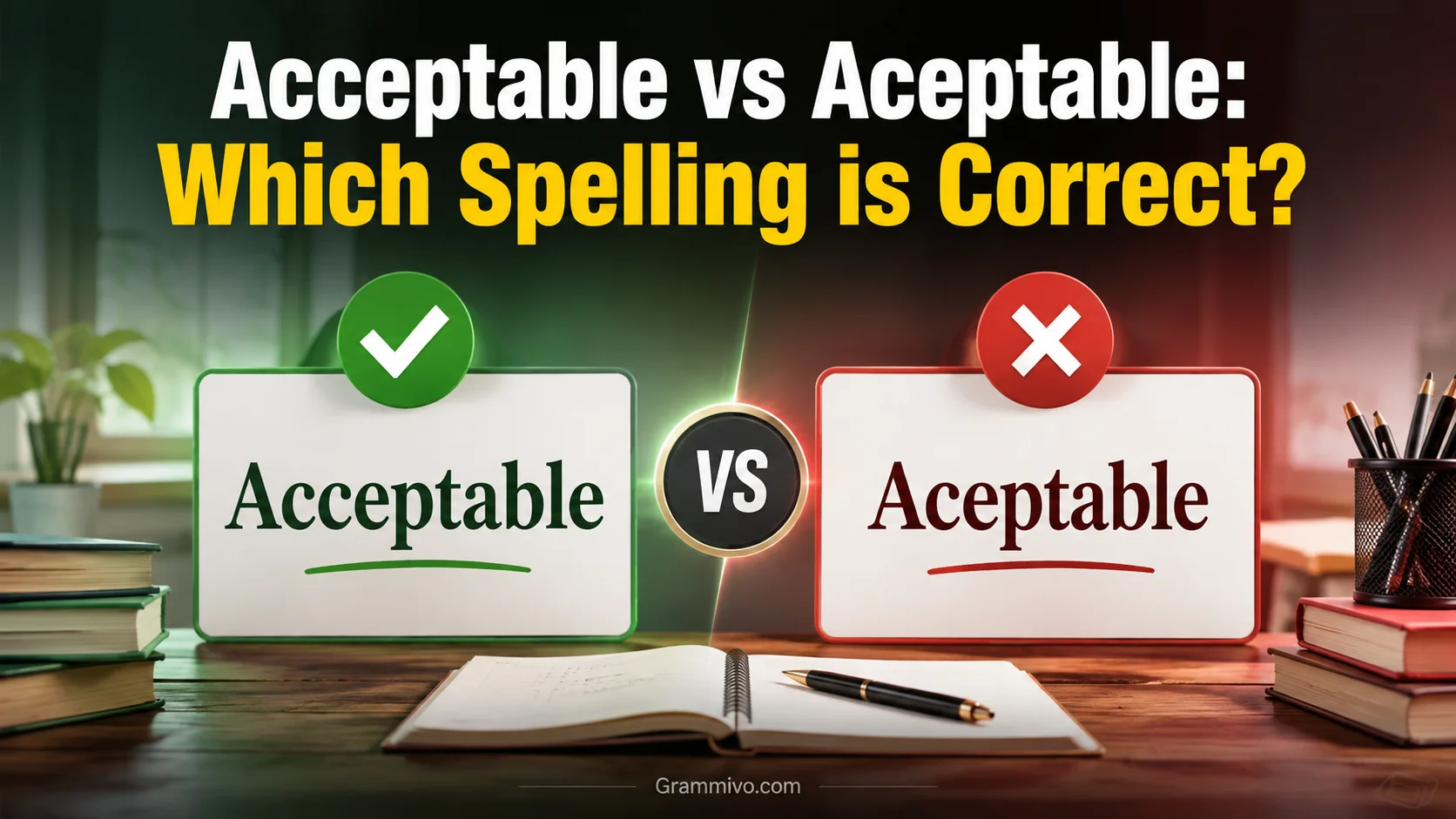
If you’ve ever hesitated between acceptable vs aceptable, you’re not alone. The two spellings look almost identical, and the difference comes down to just one letter. Yet that small difference matters when you’re writing in English.
The correct English spelling is acceptable. The spelling aceptable is not the standard English form. However, there’s an important twist: aceptable is a real Spanish word. In Spanish, aceptable means “acceptable,” “satisfactory,” or “good enough.” That cross-language similarity explains why you may see the shorter spelling in bilingual writing, translations, or language-learning contexts.
In English, however, you need the double c: acceptable.
The word describes something that meets a required standard, seems suitable, receives approval, or is good enough for a particular purpose. It doesn’t necessarily mean excellent. A restaurant meal can be acceptable without being memorable. A job application can be acceptable without being outstanding. A proposed solution can be acceptable because it satisfies everyone involved.
Quick Answer:
Acceptable is the correct spelling in standard English.
Aceptable is not the standard English spelling. It is the Spanish form of the word and can be correct when you’re writing in Spanish.
| Spelling | Language | Correct? | Meaning |
| acceptable | English | Yes | Satisfactory, suitable, or worthy of approval |
| aceptable | English | No | Not the standard English spelling |
| aceptable | Spanish | Yes | Acceptable or satisfactory |
For example:
- Correct: The quality of the work is acceptable.
- Incorrect in English: The quality of the work is aceptable.
- Correct in Spanish: El resultado es aceptable.
The easiest way to remember the English spelling is to start with accept:
accept + able = acceptable
That double c stays in the word.
Acceptable: The Correct English Spelling
The standard English spelling is acceptable, written with two c’s:
A-C-C-E-P-T-A-B-L-E
The word contains the verb accept followed by the suffix -able. This connection gives you a useful spelling clue. If you already know how to spell accept, you have most of the word in front of you.
For example:
- accept → acceptable
- adapt → adaptable
- predict → predictable
- respect → respectable
English spelling doesn’t always follow perfectly predictable patterns, but this one gives you a practical shortcut.
Consider these examples:
The revised proposal is acceptable to both departments.
Her academic performance is acceptable, although she could improve her writing.
We need an acceptable solution before the deadline.
In each sentence, acceptable suggests that something meets a minimum or required standard. It doesn’t automatically praise the thing as exceptional.
That distinction matters. If someone says, “Your work is acceptable,” they may be saying, “Your work meets the requirements.” That’s quite different from saying, “Your work is excellent.”
Aceptable: Why Does This Spelling Appear?
Aportable? No. Aceptable? Yes—but in Spanish.
The spelling aceptable isn’t simply a meaningless collection of missing letters. It’s a legitimate Spanish word.
That’s why English learners may encounter both forms.
The distinction becomes especially important for bilingual writers and people translating between English and Spanish. Someone who knows the Spanish spelling may naturally transfer it into an English sentence without noticing the missing c.
Compare the two:
- English: acceptable
- Spanish: aceptable
The difference is tiny visually, but the language context changes everything.
This is similar to other words that look remarkably alike across English and Spanish while having slightly different spellings. When you switch languages, familiar spelling patterns can sometimes follow you into the wrong sentence.
So if you’re writing an English email, essay, report, application, or social media post, use acceptable.
What Does Acceptable Mean?
Acceptable is an adjective that describes something considered satisfactory, suitable, appropriate, or good enough according to a particular standard.
The word can carry several related meanings.
Acceptable as Satisfactory
The most common meaning is good enough to meet a requirement.
For example:
The final draft is acceptable, but it still needs some editing.
Here, the draft meets the basic standard. The speaker isn’t necessarily saying it’s excellent.
A useful scale might look like this:
unacceptable → barely acceptable → acceptable → good → excellent
The exact boundaries depend on the situation. What counts as acceptable in one setting might fall short in another.
A five-minute delay might be acceptable when meeting a friend. The same delay might not be acceptable for an airline departure or a critical business presentation.
Acceptable as Suitable
Acceptable can also mean appropriate for a particular situation.
For example:
Jeans are acceptable for the casual event.
The sentence doesn’t necessarily say jeans are fashionable or ideal. It simply says they fit the event’s expected standard.
Likewise:
This form of identification is acceptable for entry.
Here, acceptable means that the identification satisfies the relevant requirement.
Acceptable as Approved
The word can also describe something that people or organizations are willing to approve.
The proposed changes are acceptable to the board.
In this construction, the board accepts the changes as satisfactory or suitable.
This use often appears in professional, academic, legal, and diplomatic contexts.
Acceptable as Tolerable
Sometimes acceptable means something is tolerable rather than ideal.
For example:
The noise level was acceptable during the afternoon.
That doesn’t necessarily mean the noise was pleasant. It means it remained within a level the speaker could tolerate.
This subtle difference explains why acceptable can sound positive in one sentence and lukewarm in another.
Acceptable vs Aceptable: The Key Difference
The biggest difference between acceptable and aceptable isn’t meaning. It’s language and spelling.
| Feature | Acceptable | Aceptable |
| Standard English spelling | Yes | No |
| Standard Spanish spelling | No | Yes |
| English pronunciation | /əkˈsep.tə.bəl/ | Not standard English |
| Basic meaning | Satisfactory or suitable | Satisfactory or suitable |
| Double “c” | Yes | No |
| Common English use | Correct | Misspelling |
The important point is simple: don’t treat aceptable as an alternative English spelling of acceptable.
If you’re writing in English, choose acceptable.
If you’re writing in Spanish, aceptable is the correct Spanish form.
Why Is There a Double C in Acceptable?
The double c becomes easier to remember when you look at the base word.
The foundation is:
accept
Add -able:
accept + able = acceptable
That produces:
acceptable
The spelling therefore keeps the two c’s found in accept.
This is a useful strategy because memorizing every word letter by letter can become frustrating. Instead, look for a familiar word hiding inside the longer word.
For example:
- accept → acceptable
- comfort → comfortable
- reason → reasonable
- predict → predictable
- value → valuable
These examples aren’t all formed through exactly the same historical process, but they demonstrate a useful spelling-learning habit: identify recognizable word parts.
A Simple Memory Trick
Think:
I accept it, so it’s acceptable.
The word accept has two c’s. Keep those two c’s when you add -able.
ACCEPT → ACCEPTABLE
If you write aceptable, pause and ask yourself:
“Where did the second c from accept go?”
That quick question can prevent the mistake.
How to Pronounce Acceptable
In American English, acceptable is commonly pronounced approximately:
uh-SEP-tuh-buhl
Cambridge gives the pronunciation using the International Phonetic Alphabet as /əkˈsep.tə.bəl/. You can hear the word spoken in American English through.
The main stress falls on the second syllable:
ac-CEPT-a-ble
The pronunciation explains part of the spelling problem. When you say the word naturally, you don’t hear a clear pause between the two c’s.
That’s common in English. A word’s pronunciation doesn’t always reveal every letter in its spelling.
For that reason, pronunciation alone isn’t a reliable way to decide whether acceptable contains one c or two.
Acceptable in Example Sentences
Seeing the word in real sentences makes its meaning easier to understand.
Everyday Examples
This seat is acceptable if you don’t mind sitting near the door.
The room was small but perfectly acceptable for one night.
Is this time acceptable to you?
The replacement product is acceptable, although it’s not as good as the original.
Workplace Examples
The manager said the revised schedule was acceptable.
Your performance has been acceptable, but the team expects stronger results next quarter.
We need an acceptable explanation for the delay.
The company rejected the proposal because the financial terms weren’t acceptable.
Academic Examples
The professor considered the paper acceptable after the revisions.
The student’s answer was acceptable because it demonstrated the required concept.
This source may be acceptable for background research, but a peer-reviewed study would be stronger.
Social and Behavioral Examples
That kind of language isn’t acceptable in the workplace.
The behavior was not acceptable under the school’s code of conduct.
Wearing casual clothes is acceptable at this event.
These examples show why context matters. Acceptable doesn’t always mean “good.” Sometimes it means “allowed.” Sometimes it means “satisfactory.” Sometimes it means “appropriate.”
Acceptable vs. Good: Are They the Same?
Not quite.
Acceptable generally establishes a threshold. Good often expresses a stronger positive judgment.
Imagine you’re reviewing three products:
| Product | Assessment |
| Product A | Unacceptable |
| Product B | Acceptable |
| Product C | Excellent |
Product B meets the basic standard. Product C goes beyond it.
That’s why the sentence “The food was acceptable” can sound less enthusiastic than “The food was good.”
In everyday conversation, acceptable may even sound deliberately restrained.
If a friend asks, “How was the movie?” and you answer, “It was acceptable,” they may reasonably assume you weren’t impressed.
The word carries a subtle sense of meeting the bar rather than raising it.
Common Misspellings of Acceptable
The missing c isn’t the only problem writers encounter. Several other forms appear because English spelling can make the ending confusing.
| Common form | Correct? | Correct form |
| aceptable | No in English | acceptable |
| acceptible | No | acceptable |
| accepable | No | acceptable |
| acceptabel | No | acceptable |
| acceptible | No | acceptable |
Aceptable
This form usually results from dropping one of the two c’s.
Wrong: aceptable
Right: acceptable
Remember the base word:
accept → acceptable
Acceptible
This spelling changes the ending from -able to -ible.
Wrong: acceptible
Right: acceptable
The correct word uses -able.
Accepable
This version drops the t.
Wrong: accepable
Right: acceptable
The base word accept helps here, too.
Acceptabel
This version rearranges the final letters.
Wrong: acceptabel
Right: acceptable
The ending is -able, not -abel.
Acceptable vs Acceptible: What’s Correct?
One especially common question is whether the word should end in -able or -ible.
The correct spelling is:
acceptable
Not:
acceptible
That gives you the pattern:
accept + able
A useful approach is to avoid guessing the suffix from pronunciation. Instead, remember the whole word or connect it directly to accept.
Read More: Amateur vs. Amatuer: Which Spelling Is Correct and Why?
Acceptable Prepositions: Acceptable To, For, and As
The word acceptable frequently appears with prepositions. The correct choice depends on what you want to express.
Acceptable to
Use acceptable to when you mean that someone or a group approves of something or considers it satisfactory.
The proposal is acceptable to the committee.
That explanation wasn’t acceptable to her.
Here, the person or group evaluates the thing.
Acceptable for
Use acceptable for when you’re talking about suitability for a purpose, situation, or person.
This level of noise isn’t acceptable for a library.
The material is acceptable for outdoor use.
The focus is often on whether something meets the requirements of a particular setting.
Acceptable as
Use acceptable as when something can serve in a particular role or capacity.
The document is acceptable as proof of identity.
The substitute is acceptable as a temporary solution.
These structures aren’t interchangeable in every sentence, so context determines which preposition sounds natural.
Synonyms for Acceptable
English offers many alternatives to acceptable, but each carries a slightly different shade of meaning.
| Synonym | Typical emphasis |
| Satisfactory | Meets expectations or requirements |
| Suitable | Fits a particular purpose |
| Appropriate | Fits a situation, behavior, or context |
| Adequate | Meets the minimum necessary standard |
| Tolerable | Can be endured or accepted |
| Permissible | Allowed by rules or authority |
| Agreeable | Pleasing or acceptable to someone |
| Passable | Just good enough |
| Reasonable | Fair, sensible, or within acceptable limits |
Consider the difference:
The solution is adequate.
This suggests it meets the minimum need.
The solution is suitable.
This emphasizes that it fits the purpose.
The solution is permissible.
This focuses on whether rules allow it.
The solution is acceptable.
This broadly suggests that it meets the relevant standard or receives approval.
Synonyms can overlap, but replacing one with another may subtly change the sentence.
Acceptable and Unacceptable: Natural Opposites
The direct opposite of acceptable is unacceptable.
The prefix un- reverses the meaning:
acceptable → unacceptable
For example:
The first proposal was acceptable.
The second proposal was unacceptable.
The distinction can be important in formal settings because unacceptable often signals that something falls below a defined standard.
You’ll commonly see the word in:
- Workplace policies
- School rules
- Terms and conditions
- Safety guidelines
- Professional standards
- Customer service policies
- Legal or regulatory language
For instance:
Harassment is unacceptable in any workplace.
The sentence doesn’t merely say harassment is undesirable. It establishes a clear boundary.
A Short Case Study: Why One Letter Matters
Imagine an English-speaking employee sends a report to an international client.
The report says:
“The proposed timeline is aceptable to our team.”
The client will probably understand the intended meaning. However, aceptable is still incorrect in standard English.
Now imagine the employee writes:
“The proposed timeline is acceptable to our team.”
The meaning stays exactly the same, but the spelling follows standard English usage.
This small correction matters because professional writing communicates more than information. Spelling also signals attention to detail, language proficiency, and familiarity with standard usage.
The same principle applies to résumés, cover letters, academic assignments, websites, reports, and formal correspondence.
A one-letter mistake won’t necessarily destroy communication. Still, correcting it costs almost nothing.
FAQs:
Is acceptable the correct spelling?
Yes. Acceptable is the standard English spelling. It contains two c’s and ends in -able.
Is aceptable a word?
Yes, but aceptable is the Spanish spelling. It isn’t the standard spelling of the English word.
Is aceptable correct in English?
No. In standard English, use acceptable with two c’s.
Why do people spell acceptable as aceptable?
The error can happen because the second c isn’t obvious in pronunciation. Spanish speakers and bilingual writers may also transfer the Spanish spelling aceptable into English.
What does acceptable mean?
Acceptable means satisfactory, suitable, appropriate, tolerable, or worthy of approval in a particular context.
Conclusion:
When you’re writing in English, the correct choice is acceptable. Aceptable belongs to Spanish. It means essentially the same thing, but it isn’t the standard English spelling. If you’re writing an English email, essay, report, application, article, or everyday message, use acceptable. If you’re writing in Spanish, aceptable is the appropriate form.
