
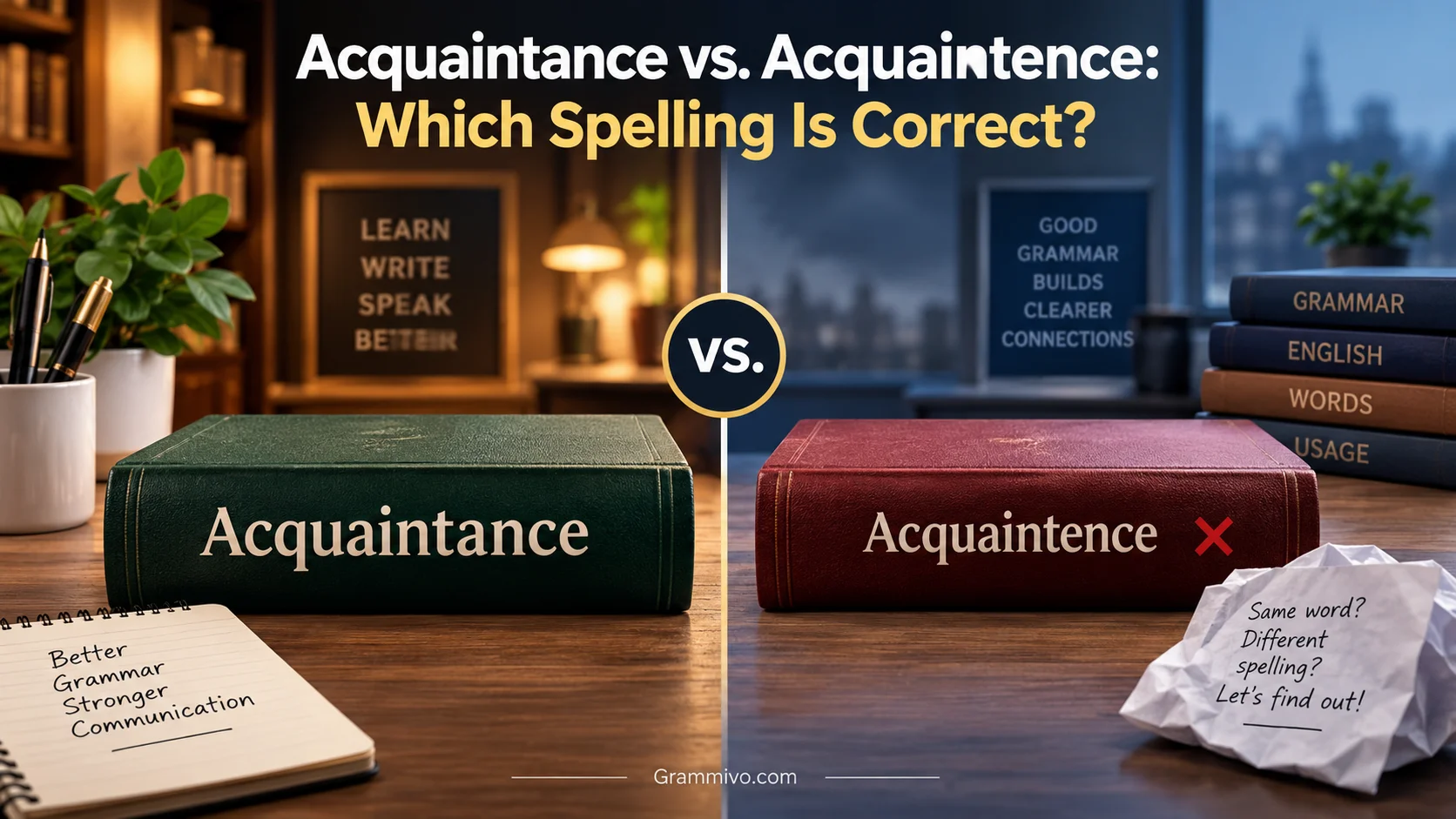
Have you ever typed “acquaintence” and wondered whether it looked right? You’re not alone. This spelling mistake happens because acquaintance contains several letters that don’t sound exactly the way they appear. The ending is especially easy to misremember.
The good news is that the difference between acquaintance vs. acquaintence is straightforward once you see the pattern. Acquaintance is the correct spelling. Acquaintence is a misspelling and isn’t a standard alternative spelling in American English.
The word itself has two closely related uses. It can describe a person you know but aren’t especially close to, or it can refer to knowledge or familiarity with something. For example, you might call a former coworker an acquaintance, while you could also say that you have some acquaintance with accounting.
Quick Answer: Acquaintance or Acquaintence?
Acquaintance is the correct spelling.
Acquaintence is incorrect. It results from using -ence where the standard word requires -ance.
| Spelling | Correct? | Meaning |
| Acquaintance | Yes | A person you know casually or familiarity with something |
| Acquaintence | No | A misspelling of acquaintance |
A useful way to remember it is to start with acquaint:
acquaint + ance = acquaintance
Don’t replace the a in -ance with an e.
For example:
- Correct: Maria is an acquaintance from college.
- Incorrect: Maria is an acquaintence from college.
The same spelling applies in American and British English. There isn’t a standard regional variation that changes acquaintance to acquaintence.
Acquaintance vs. Acquaintence: What’s the Difference?
The simplest answer is that these aren’t two different words with different meanings. Acquaintance is the established English word, while acquaintence is a spelling error.
The confusion usually centers on the final syllable. When people hear the word, the ending can sound like it might be written -ence. English spelling doesn’t always follow pronunciation closely, though. That’s particularly true with words that contain unstressed vowels.
The correct spelling is:
A-C-Q-U-A-I-N-T-A-N-C-E
The incorrect form is:
A-C-Q-U-A-I-N-T-E-N-C-E
Notice the important difference:
acquaint-ance
acquaint-ence
That single vowel changes the spelling from standard to incorrect.
Acquaintance
Acquaintance is a noun. It commonly means someone you know without having a close personal relationship with that person.
For example:
I ran into an old acquaintance at the airport.
The speaker knows the person, but the relationship isn’t necessarily close.
The word can also describe familiarity with a subject, activity, or area of knowledge.
She has a good acquaintance with classical literature.
This second use is somewhat more formal. In everyday American conversation, people are more likely to say familiarity with or knowledge of.
Acquaintence
Acquaintence isn’t the standard spelling of the word. If you encounter it in an email, article, social media post, résumé, or other piece of writing, the intended word is almost certainly acquaintance.
So there’s no need to memorize two definitions. You only need to remember one correct spelling.
What Does Acquaintance Mean?
Acquaintance has two major dictionary meanings.
The first describes a person you know casually. This is the meaning you’ll encounter most often in everyday English.
An acquaintance might be someone you:
- Say hello to at work
- Know from school
- Meet through a mutual friend
- See regularly at a community event
- Know from a professional setting
- Follow up with occasionally
- Have spoken with several times without becoming friends
The second meaning refers to knowledge or familiarity with something. This usage tends to sound more formal.
For example:
He has a basic acquaintance with computer programming.
Here, acquaintance doesn’t refer to a person. It means that he has some familiarity with programming.
The recognizes both the person-related and familiarity-related uses of the word.
Acquaintance as a Person
When you call someone an acquaintance, you’re placing that person somewhere between a stranger and a close friend.
Imagine that you attend a weekly community class. You regularly talk with another student, exchange jokes, and know their name. You might know what they do for work, too. Yet you don’t spend time together outside the class.
That person could reasonably be described as an acquaintance.
The term doesn’t necessarily mean you dislike the person. It simply suggests that the relationship isn’t particularly close.
For example:
- John is an acquaintance from my old office.
- I met several acquaintances at the conference.
- She’s a longtime acquaintance of the family.
- He was more of an acquaintance than a close friend.
Acquaintance as Familiarity
The other meaning appears in expressions involving knowledge or familiarity.
For example:
She has a passing acquaintance with Spanish.
This means she has some limited knowledge of Spanish, but she isn’t highly proficient.
You can also encounter phrases such as:
- an acquaintance with history
- a passing acquaintance with the subject
- some acquaintance with the law
- a working acquaintance with the software
This use is more formal than the everyday meaning of acquaintance as a person.
Why Is Acquaintence Incorrect?
The spelling acquaintence looks plausible because English contains many words ending in -ence.
Consider words such as:
- difference
- reference
- existence
- experience
- confidence
- independence
That pattern can make acquaintence feel natural. Unfortunately, the spelling of acquaintance doesn’t follow that pattern.
The standard ending is -ance.
The base word acquaint also gives you a useful spelling anchor. Instead of trying to remember the entire word as one long sequence of letters, recognize its structure:
acquaint + ance
This doesn’t mean every English noun can be formed by simply adding -ance to a verb. English word formation is much more complicated than that. It does give you a practical memory aid for this particular word, though.
Incorrect and Correct Examples
Incorrect:
He is an acquaintence of mine.
Correct:
He is an acquaintance of mine.
Another example:
Incorrect:
I met an old acquaintence yesterday.
Correct:
I met an old acquaintance yesterday.
The pronunciation remains essentially the same. The correction happens in writing.
How to Spell Acquaintance Correctly
Long words become easier to spell when you stop treating them as an intimidating string of letters.
Break acquaintance into two useful parts:
acquaint + ance
Then remember the spelling of acquaint:
A-C-Q-U-A-I-N-T
Add:
A-N-C-E
Together:
A-C-Q-U-A-I-N-T-A-N-C-E
The Important Spelling Pattern
The part that causes the most trouble is:
-ance
Not:
-ence
So when you’re proofreading your writing, look specifically at the letters immediately after acquaint.
| Version | Ending | Result |
| acquaint + ance | -ance | Correct |
| acquaint + ence | -ence | Incorrect |
This small visual check can catch the error before you publish an article, send a professional email, or submit an assignment.
Common Misspellings to Watch For
Acquaintence isn’t the only spelling error people make.
You may also see forms such as:
- aquaintance
- acquiantance
- acquaintanse
- acquaintence
The first three usually involve misplaced, omitted, or substituted letters. The fourth replaces the correct a in -ance with e.
The standard spelling is always:
acquaintance
A Simple Trick to Remember Acquaintance
Here’s a practical mnemonic:
“Acquaint has an A, so acquaintance keeps the A in -ance.”
You can also remember the word as:
ACQUAINT + ANCE
Think of acquaint as the anchor. Once you’ve spelled that part correctly, the ending becomes much easier.
Another useful trick is to associate the word with acquainted:
- acquaint
- acquainted
- acquaintance
These words belong to the same word family.
For example:
I’m acquainted with Sarah.
and:
Sarah is an acquaintance.
Seeing the relationship between these forms can make the spelling easier to recall.
Acquaintance in Example Sentences
Seeing the word in different contexts is more useful than memorizing a dictionary definition in isolation.
Examples About People
- I made an acquaintance at the conference who works in publishing.
- She’s an acquaintance from my college days.
- He’s a business acquaintance rather than a close friend.
- I bumped into an old acquaintance downtown.
- Several acquaintances attended the wedding.
- We started as acquaintances and eventually became good friends.
- He’s only a casual acquaintance, so I don’t know much about him.
Each sentence uses acquaintance to describe a person known casually.
Examples About Knowledge
The word can also refer to familiarity with a subject.
- She has a strong acquaintance with modern art.
- He has only a passing acquaintance with economics.
- The course requires some acquaintance with basic statistics.
- Her acquaintance with the software helped her solve the problem.
- I have little acquaintance with that particular legal system.
These sentences use acquaintance in a more formal sense.
Acquaintance vs. Friend
Calling someone an acquaintance instead of a friend can communicate an important difference in closeness.
A friend usually has a more developed personal relationship. You may spend leisure time together, share personal information, or rely on each other for support.
An acquaintance is generally someone you know, but the relationship remains more limited.
| Relationship | Typical Level of Familiarity | Example |
| Stranger | Little or none | Someone you’ve never met |
| Acquaintance | Casual | A coworker you occasionally talk with |
| Friend | Close | Someone you regularly spend time with |
| Close friend | Very close | Someone you trust with personal matters |
These categories aren’t rigid boxes. Human relationships don’t come with perfectly measured boundaries.
Someone you call an acquaintance today could become a close friend next year.
Is an Acquaintance a Friend?
Not necessarily.
An acquaintance is someone you know casually. A friend generally has a closer relationship with you.
For instance, you might know a neighbor well enough to discuss the weather, local events, and work. If you rarely interact beyond those conversations, acquaintance may fit better than friend.
However, the distinction depends on context and personal usage. There isn’t a universal rule that determines exactly when an acquaintance becomes a friend.
Common Phrases With Acquaintance
Several established expressions use acquaintance in ways that are worth knowing.
Make Someone’s Acquaintance
Make someone’s acquaintance means to meet or become acquainted with someone.
Example:
It was a pleasure to make your acquaintance.
This expression is grammatically correct, but it often sounds formal or old-fashioned in casual American conversation. In many situations, you’d simply say:
It was nice to meet you.
A Passing Acquaintance
A passing acquaintance means limited or slight familiarity.
It can describe a person:
He’s only a passing acquaintance.
It can also describe knowledge:
She has a passing acquaintance with the subject.
The second use means she knows something about the subject without having deep expertise.
Casual Acquaintance
A casual acquaintance is someone you know in a limited or informal way.
Example:
We were casual acquaintances during college.
Business Acquaintance
A business acquaintance is someone you know through professional dealings.
For example:
I met several business acquaintances at the trade show.
This phrase helps distinguish a professional relationship from a personal friendship.
Be Acquainted With
Be acquainted with means to know someone or be familiar with something.
Examples:
Are you acquainted with Dr. Miller?
She is acquainted with the company’s hiring process.
Acquaintance vs. Acquainted
These words are closely related, but they don’t perform the same grammatical job.
Acquaintance is a noun.
Acquainted is an adjective or participial form used to describe familiarity.
Compare these sentences:
David is an acquaintance of mine.
I am acquainted with David.
The first sentence identifies David as a person you know casually.
The second says you know David.
The same distinction works with subjects:
She has some acquaintance with accounting.
She is acquainted with accounting software.
Both communicate familiarity, although their grammar and style differ.
The construction acquainted with is particularly common when talking about knowledge of a subject, system, process, or person.
Read More: Pretty vs. Prety: Which Spelling Is Correct?
Common Misspellings of Acquaintance
Because acquaintance contains an unusual sequence of letters, several misspellings appear regularly.
| Misspelling | Problem | Correct Form |
| acquaintence | Uses -ence instead of -ance | acquaintance |
| aquaintance | Omits the c after a | acquaintance |
| acquiantance | Transposes letters | acquaintance |
| acquaintanse | Uses s instead of c | acquaintance |
The most relevant comparison for this article is acquaintance vs. acquaintence. That’s the spelling pair most likely to cause confusion because both versions look visually plausible.
Why Do People Misspell Acquaintance?
Several factors can contribute to the error.
Pronunciation: The unstressed ending doesn’t make the spelling immediately obvious.
Length: Longer words create more opportunities for a letter to move, disappear, or change.
English spelling patterns: English uses both -ance and -ence, so writers sometimes choose the wrong ending.
Visual familiarity: If you’ve seen a misspelling repeatedly online, your brain may start treating it as familiar.
That last point matters more than it sounds. Familiarity can make an incorrect spelling look right at first glance.
Acquaintance vs. Acquaintence in American English
In standard American English, acquaintance is the correct spelling.
You don’t need to switch to acquaintence when writing for a US audience. In fact, doing so introduces a spelling error.
There is also no meaningful American-versus-British spelling distinction here. Unlike words such as color/colour or center/centre, this isn’t a case where English varieties use different standard spellings.
So whether you’re writing a:
- College paper
- Business email
- Resume
- Blog post
- Social media caption
- Personal letter
- Academic assignment
- Professional report
Use acquaintance.
How to Pronounce Acquaintance
The word acquaintance is commonly pronounced approximately like:
uh-KWAYN-tuhns
Cambridge Dictionary gives the US pronunciation as /əˈkweɪn.təns/.
The pronunciation helps explain why spelling can be tricky. The final -ance isn’t pronounced like the full written sequence might suggest to an English learner.
That’s a useful reminder about English spelling: pronunciation can guide you, but it doesn’t always tell you exactly which letters to write.
For spelling, rely on the visual form:
acquaintance
not:
acquaintence
Is Acquaintence Ever Correct?
No. Acquaintence isn’t an accepted standard spelling of the English word.
If you encounter it in informal writing, a website, a message, or a document, it’s almost certainly a misspelling of acquaintance.
Consider this example:
She is an acquaintence from work.
The correct version is:
She is an acquaintance from work.
The meaning doesn’t change. Only the spelling needs correction.
If you’re proofreading someone else’s writing, you can safely replace acquaintence with acquaintance when the intended word is clear.
FAQs:
Is acquaintance or acquaintence correct?
Acquaintance is correct. Acquaintence is a misspelling.
Why is acquaintence wrong?
The standard word uses the -ance ending, not -ence. The correct spelling is acquaintance.
What does acquaintance mean?
An acquaintance can mean someone you know casually. It can also mean familiarity or knowledge of something.
Is an acquaintance a friend?
Not necessarily. An acquaintance is usually someone you know less closely than a friend. However, an acquaintance can eventually become a friend.
How do you spell acquaintance?
Spell it:
A-C-Q-U-A-I-N-T-A-N-C-E
A useful breakdown is acquaint + ance.
Conclusion:
The choice between acquaintance vs. acquaintence isn’t really a choice at all. Acquaintance is the correct spelling, while acquaintence is a misspelling. An acquaintance can be someone you know casually, such as a former coworker, neighbor, or person you met through friends. In more formal contexts, the word can also describe familiarity with a subject or field.
