
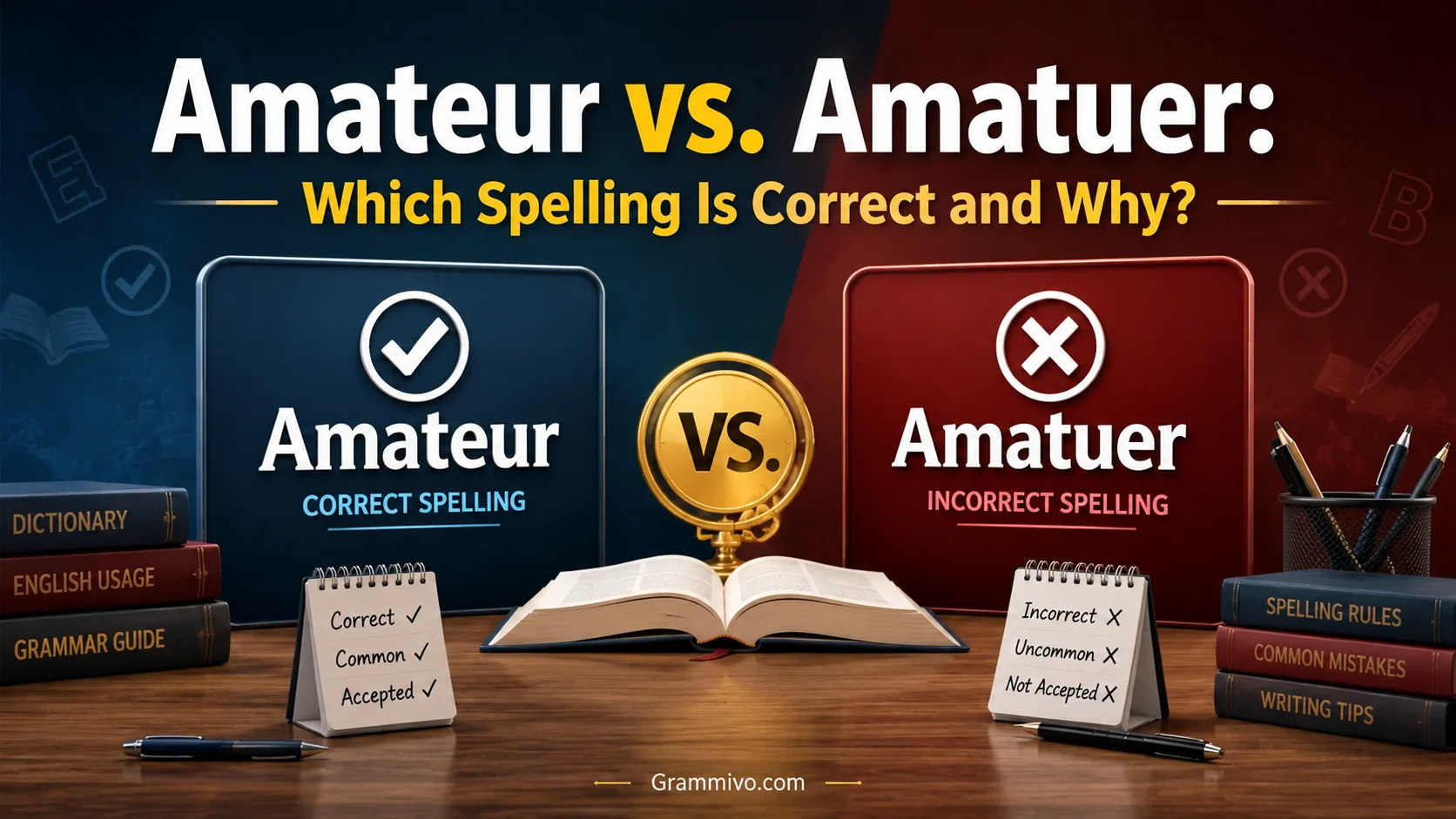
If you’ve ever paused over amateur vs. amatuer, you’re dealing with one of those spelling mistakes that looks surprisingly believable. The two forms contain exactly the same letters, but their order changes the result. Only one belongs in standard English: amateur.
The spelling amatuer is incorrect. It usually happens when writers remember the sounds of amateur but place the e and u in the wrong order. Once you recognize the troublesome -teur sequence, the word becomes much easier to remember.
This guide explains the difference between amateur and amatuer, what amateur means, how to pronounce it, where it came from, and how to use it naturally in American English. You’ll also find examples, common misspellings, practical memory tricks, and a detailed comparison with professional.
Quick Answer: Amateur or Amatuer?
Amateur is the correct spelling. Amatuer is a misspelling and isn’t a standard English spelling.
The correct sequence is:
A-M-A-T-E-U-R
The most common mistake reverses the e and u:
- Correct: amateur
- Incorrect: amatuer
For example:
She is an amateur photographer who spends every weekend taking pictures of wildlife.
The word amateur can describe someone who takes part in an activity for enjoyment rather than as a profession. It doesn’t necessarily mean that person lacks talent or experience.
Amateur vs. Amatuer: Which Spelling Is Correct?
When comparing amateur vs. amatuer, the answer is straightforward: amateur is the accepted spelling in standard English.
The spelling amatuer doesn’t represent a separate American or British variant. It’s simply a common misspelling.
| Spelling | Status | Example |
| amateur | Correct | He is an amateur musician. |
| amatuer | Incorrect | He is an amatuer musician. |
| amature | Incorrect | She joined an amature league. |
| ameteur | Incorrect | He’s an ameteur photographer. |
| amataur | Incorrect | The website used the word amataur. |
The mistake is easy to spot when you slow the word down. The middle sequence is -teur, not -tuer.
Think of it this way:
ama + teur = amateur
Not:
ama + tuer = amatuer
That tiny difference changes a correct word into a spelling error.
Why Is “Amatuer” Incorrect?
The spelling amatuer is incorrect because standard English uses amateur, with e appearing before u in the final part of the word.
The confusion often comes from pronunciation. English spelling and pronunciation don’t always line up neatly. A word can sound one way while its written form preserves a spelling inherited from another language.
That’s exactly what makes amateur tricky.
Compare these forms:
- ama-teur — correct
- ama-tuer — incorrect
The letters e and u are reversed in amatuer. Nothing about that reversal creates a new meaning. It simply produces a misspelling.
You may encounter amatuer in social media posts, informal comments, search queries, or user-generated content. Its appearance online doesn’t make it acceptable standard spelling.
A useful rule is simple: if you’re writing an essay, résumé, article, email, report, application, or professional document, use “amateur.”
What Does Amateur Mean?
The word amateur has a broader meaning than simply “beginner.”
An amateur is generally someone who takes part in an activity without doing it as a professional occupation. The activity may be a hobby, personal interest, sport, creative pursuit, or specialized field.
For example, someone can be an:
- amateur photographer
- amateur astronomer
- amateur musician
- amateur athlete
- amateur chef
- amateur historian
- amateur gardener
- amateur painter
Importantly, amateur doesn’t automatically mean inexperienced or untalented.
An amateur photographer might spend ten years learning photography, own expensive equipment, and produce extraordinary images. If photography isn’t their professional occupation, amateur can still describe them.
That distinction matters because people sometimes treat amateur and bad as synonyms. They aren’t.
The word can describe someone’s professional status, while context determines whether it also carries a criticism about skill.
Amateur Can Have a Positive Meaning
Although amateur sometimes sounds negative, the word can also carry a warm and positive meaning.
Consider someone who spends evenings studying astronomy simply because they’re fascinated by the night sky. That person might be called an amateur astronomer.
There is nothing insulting about that description.
In fact, amateurs have contributed to many fields through curiosity, persistence, and independent study. Amateur astronomers, birdwatchers, historians, photographers, and naturalists can make valuable observations and share information with professional communities.
The word’s history helps explain this positive association. Amateur ultimately connects to a Latin root associated with loving or having an interest in something.
So an amateur isn’t necessarily someone who doesn’t care. Often, it’s someone who cares enough to pursue an activity without making it a career.
Amateur as a Noun
Amateur can function as a noun when it refers directly to a person.
For example:
- The tournament attracted several talented amateurs.
- She started as an amateur before becoming a professional.
- The club welcomes both amateurs and experienced players.
- He’s an amateur who has studied the subject for years.
In these sentences, amateur identifies the person.
The plural form is amateurs.
Notice that you don’t need an apostrophe to make the plural:
- Correct: amateurs
- Incorrect: amateur’s when you simply mean more than one amateur
An apostrophe changes the grammatical function. For example, the amateur’s camera means the camera belonging to the amateur.
Amateur as an Adjective
Amateur also works as an adjective. In this role, it describes a person, activity, organization, competition, or other noun associated with nonprofessional participation.
Common combinations include:
| Phrase | Meaning |
| amateur photographer | A nonprofessional photographer |
| amateur athlete | An athlete who competes outside professional sport |
| amateur musician | Someone who makes music without doing it professionally |
| amateur competition | A competition intended for nonprofessional participants |
| amateur theater | Theater produced or performed by nonprofessionals |
| amateur astronomer | Someone who studies astronomy as a nonprofessional pursuit |
For example:
My brother is an amateur photographer, but his wildlife pictures look professional.
Here, amateur describes his relationship to photography rather than automatically judging his ability.
That distinction makes the word more precise than simply calling someone a beginner.
Amateur vs. Beginner: Are They the Same?
Amateur and beginner overlap, but they aren’t interchangeable.
A beginner is someone who has only recently started learning or doing something.
An amateur is generally someone who participates outside a professional capacity.
A person can therefore be an amateur without being a beginner.
Imagine a tennis player who has practiced for fifteen years but never competes professionally. That person may be an amateur tennis player, but calling them a beginner would be inaccurate.
The difference becomes clearer in this comparison:
| Term | Main idea |
| Beginner | New to an activity |
| Amateur | Participates outside professional practice |
| Professional | Works in the activity as a profession |
| Expert | Has a high level of knowledge or skill |
These categories can overlap.
Someone can be an amateur expert in a particular subject. They can also be a professional beginner when entering a new area of their career.
Amateur vs. Professional: What’s the Difference?
The clearest opposite of amateur in many contexts is professional.
A professional generally earns money from an activity or performs it as an occupation. An amateur usually participates without making that activity their profession.
| Amateur | Professional |
| Often participates for enjoyment | Often performs the activity as a career |
| May have another primary occupation | Usually works in the relevant field |
| Can be highly skilled | Typically has professional experience or training |
| Often treats the activity as a hobby | Usually depends on the activity professionally |
| Doesn’t necessarily earn income from it | Usually receives payment for the work |
However, the line isn’t always perfectly rigid.
A photographer might sell occasional photographs while maintaining another full-time career. Whether amateur or professional fits can depend on the context and how the person describes their work.
That’s why these words shouldn’t be treated as simple labels for skill.
How Do You Pronounce “Amateur”?
The pronunciation of amateur varies somewhat between American and British English.
In common US English, the word is often pronounced approximately like:
AM-uh-chur
Cambridge Dictionary gives US pronunciation information for amateur and records regional pronunciation differences.
The spelling may look intimidating, but the spoken form is usually much shorter than learners expect.
This is one reason amatuer becomes tempting. If you learn the word primarily through conversation, you may know exactly what it sounds like while having less certainty about the letters.
That’s a classic English spelling trap.
Where Does the Word “Amateur” Come From?
The history of amateur gives the spelling a useful anchor.
English borrowed the word through French amateur, which ultimately traces back to Latin roots connected with amare, meaning “to love.”
That background fits the original idea surprisingly well. An amateur traditionally pursues something because they have an interest or passion for it rather than because it provides their profession.
Merriam-Webster dates the word’s English use to the 18th century and identifies its French and Latin connections.
The word therefore carries more history than its modern spelling suggests.
You don’t need to memorize the entire etymology to spell it correctly, but remembering the connection between amateur and the idea of loving an activity can make the word easier to retain.
Why Is “Amateur” So Easy to Misspell?
Several features make amateur a spelling challenge.
First, its spelling isn’t completely predictable from its common American pronunciation. Second, the -teur ending looks unfamiliar to many English learners. Finally, the letters e and u are easy to reverse.
The most common error is therefore:
amateur → amatuer
It’s a classic transposition error.
You know the correct letters. Your brain simply puts them in the wrong order.
Similar mistakes happen with many English words because readers often remember the overall visual shape of a word rather than every individual letter.
The solution isn’t to stare at the word repeatedly. Instead, isolate the difficult section:
ama-TEUR
Once TEUR becomes familiar, the entire spelling becomes easier.
Common Misspellings of Amateur
Although amatuer is the focus of this article, several other incorrect forms appear occasionally.
| Common misspelling | Correct form |
| amatuer | amateur |
| amature | amateur |
| ameteur | amateur |
| amataur | amateur |
| amature | amateur |
| ameteur | amateur |
These forms don’t function as standard spelling variants in modern American English.
If you’re unsure, don’t choose the spelling that “looks familiar.” Check the sequence:
A-M-A-T-E-U-R
That six-part visual pattern is more reliable than trying to reconstruct the word from its pronunciation.
Read More: Acquaintance vs. Acquaintence: Which Spelling Is Correct?
How to Remember the Spelling of Amateur
The easiest memory trick focuses on the troublesome ending.
Remember “TEUR,” Not “TUER”
Break the word into two parts:
AMA + TEUR
Now compare it with the common error:
AMA + TUER
The difference is only one letter position, but that small detail determines whether the spelling is correct.
Another useful trick is to connect amateur with the idea of loving an activity. Its etymological history comes from roots associated with love.
So you can remember:
An amateur does something because they love it.
That isn’t a rule for spelling, but it gives the word a meaningful mental hook.
Write the Word in Chunks
Instead of memorizing nine individual letters, remember:
AMA | TEUR
Then combine them:
AMATEUR
This chunking method works especially well when you’re learning English vocabulary with unusual letter patterns.
Examples of “Amateur” in Sentences
Seeing the word in real contexts makes both its meaning and spelling easier to remember.
- She’s an amateur photographer who specializes in landscapes.
- He plays soccer at an amateur level.
- The museum hosts lectures for amateur historians.
- My father is an amateur gardener with an impressive vegetable patch.
- She started playing the violin as an amateur and eventually joined an orchestra.
- The competition is open to amateur athletes.
- He’s an amateur astronomer who regularly observes meteor showers.
- The club welcomes both professionals and amateurs.
- Her work may be amateur photography, but the composition is excellent.
- He has remained an amateur musician despite decades of experience.
Notice how none of these sentences requires amatuer. The correct form always remains amateur.
Amateur vs. Amatuer in a Sentence
The easiest way to see the difference is to put the two forms side by side.
| Incorrect | Correct |
| She is an amatuer photographer. | She is an amateur photographer. |
| He’s an amatuer musician. | He’s an amateur musician. |
| I joined an amatuer league. | I joined an amateur league. |
| She’s an amatuer astronomer. | She’s an amateur astronomer. |
| The event is for amatuer athletes. | The event is for amateur athletes. |
In every example, the correction involves spelling rather than a change in meaning.
The key is the middle sequence:
amateur
not
amatuer
Is “Amatuer” Ever Correct?
In standard English, amatuer is not the correct spelling.
You may see it in informal online writing, comments, usernames, archived pages, or other places where people make ordinary typing and spelling mistakes. That doesn’t establish it as an accepted spelling.
It’s useful to distinguish between frequency and correctness.
A misspelling can appear thousands of times online and still remain a misspelling. Search engines index what people write, not just what dictionaries approve.
For formal writing, use amateur.
That includes:
- school assignments
- resumes and résumés
- cover letters
- business writing
- websites
- academic papers
- professional emails
- applications
- published articles
When accuracy matters, there’s no reason to choose the incorrect form.
Does Amateur Mean Unskilled?
Not necessarily.
This is one of the most important points about the word.
An amateur may have limited experience, but the word itself primarily distinguishes nonprofessional participation from professional work. Context determines whether the term carries a negative judgment.
For example:
She’s an amateur photographer.
This could simply mean photography is her hobby.
But:
That was an amateur mistake.
Here, amateur carries a clearly negative meaning. The speaker is suggesting that the mistake was careless or below an expected standard.
The same word can therefore be neutral in one sentence and critical in another.
FAQs:
Is “amatuer” a word?
Amatuer is not the standard spelling of the English word. The correct form is amateur.
Is “amateur” the correct spelling?
Yes. Amateur is the standard spelling used in American English and other varieties of standard English.
How do you spell amateur?
Spell it:
A-M-A-T-E-U-R
The tricky sequence is TEUR.
Why do people spell amateur as “amatuer”?
The mistake usually comes from reversing the e and u in the -teur sequence. Pronunciation can also make the written form harder to remember.
What does amateur mean?
An amateur is generally someone who participates in an activity without making it their profession. Depending on context, the word can also suggest limited skill or experience.
Conclusion:
When you’re choosing between amateur vs. amatuer, there’s only one correct spelling for standard English: amateur. The common error amatuer switches the e and u. It may look convincing, especially because the pronunciation doesn’t make the spelling obvious, but it isn’t an accepted spelling variant. The word itself has a richer meaning than “beginner.” An amateur may simply be someone who pursues an activity outside professional work. In many cases, that person can be remarkably skilled.
