
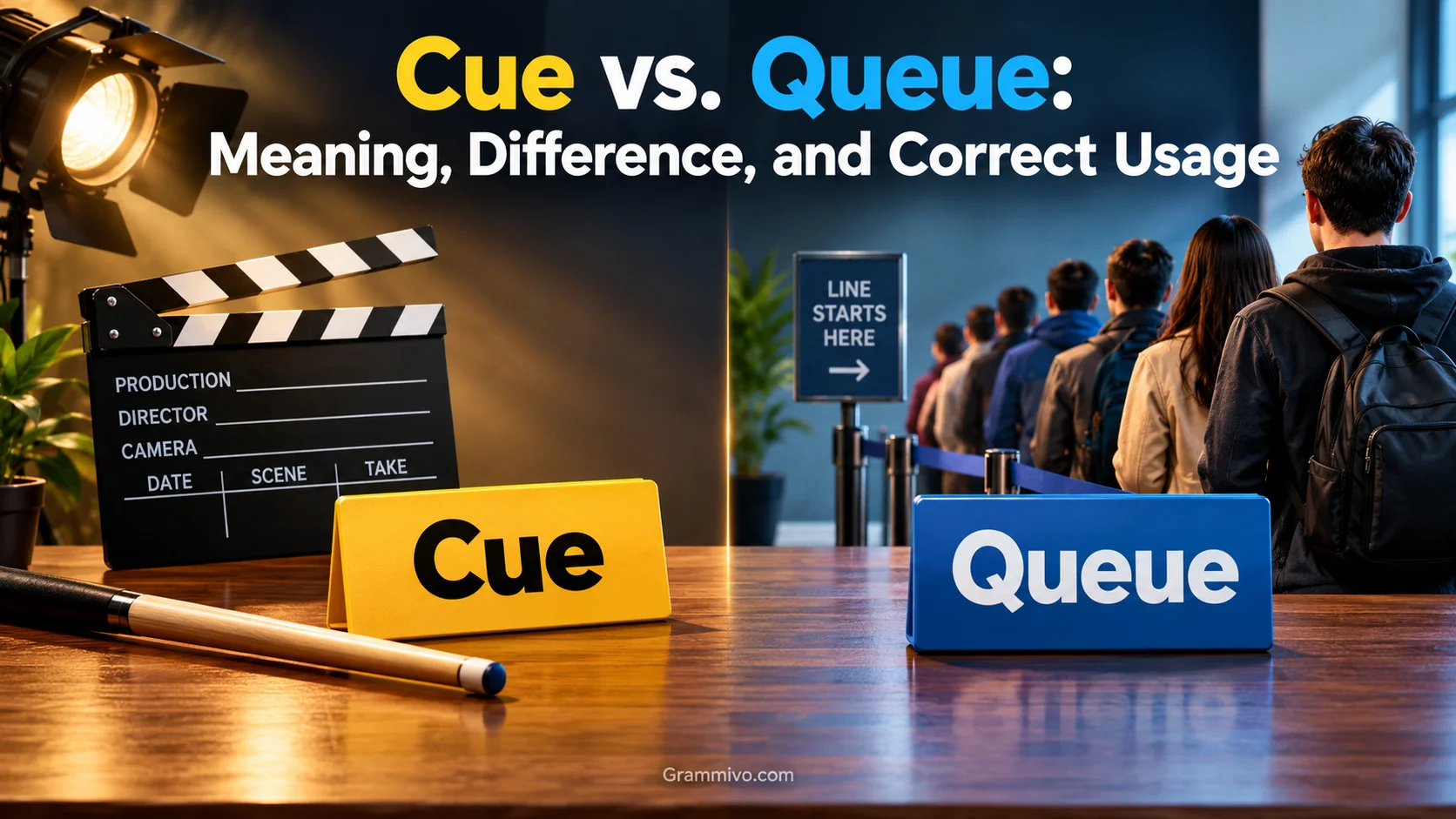
Have you ever wondered whether to write cue or queue when describing a signal or a line of waiting people? These two words often confuse writers because they sound exactly alike. However, their meanings and uses are entirely different.
The confusion makes sense. Both words share the same pronunciation, /kjuː/, but their spellings give little hint about their meanings. One refers to a signal or prompt that tells someone when to act. The other describes a line of people or things waiting their turn.
For example, an actor waits for a cue before speaking while audience members stand in a queue to enter the theater. Both words fit naturally into the same situation, yet you cannot switch them.
Understanding the difference between cue vs. queue helps you avoid spelling mistakes in everyday writing, professional communication, and formal documents. Let’s explore their meanings, grammatical roles, examples, and common expressions so you can use each word confidently.
Quick Answer
Cue means a signal, hint, or prompt that tells someone when to do something. It can also function as a verb meaning to signal or prompt another person.
Queue means a line of people or things waiting for their turn. It can also function as a verb meaning to form a line or arrange something in a waiting sequence.
Both words sound identical, but their meanings differ:
- Cue: The actor waited for his cue before delivering the next line.
- Queue: The customers formed a queue outside the grocery store.
Easy trick to remember: A cue tells you when to act. A queue gives you a place to wait your turn.
Comparison Overview
Although cue and queue share the same pronunciation, they serve different purposes in English. One focuses on signals and timing while the other focuses on order and waiting.
The following table highlights their essential differences.
| Feature | Cue | Queue |
| Meaning | A signal, hint, or prompt | A line or waiting sequence |
| Pronunciation | /kjuː/ | /kjuː/ |
| Part of speech | Noun and verb | Noun and verb |
| Main purpose | Indicates when someone should act | Organizes people or things in order |
| Common contexts | Theater, sports, conversations, performances | Stores, airports, computers, public places |
| Verb meaning | To signal or prompt someone | To form a line or arrange something for processing |
| Common phrases | On cue, cue someone in | Queue up, join the queue |
| Example | The music was my cue to dance. | We waited in the queue for tickets. |
The biggest distinction comes down to their functions. A cue communicates a signal or instruction while a queue organizes people or things according to their order.
Main Differences Between Cue and Queue
To understand these words completely, you need to look beyond their spellings. Their grammatical roles and everyday applications reveal why each word belongs in a different context.
Meaning of Cue
The word cue refers to a signal, indication, hint, or prompt that tells someone when to perform an action. It often helps people understand what they should do next.
A cue can come from a person, an object, a sound, or an event. Sometimes it’s planned in advance. Other times, you recognize it naturally through someone’s behavior.
For example, imagine you’re giving a presentation. Your colleague nods from across the room to indicate that you should move to the next slide. That nod acts as your cue.
Similarly, an actor might wait for a specific line from another performer before entering the scene. The spoken line provides the necessary signal.
Common situations involving cues include:
- Theater: An actor receives a cue to deliver a particular line.
- Music: A conductor gives musicians a signal to begin playing.
- Sports: A coach gives players visual or verbal cues during practice.
- Conversation: Someone’s expression signals that it’s time to change the subject.
- Public speaking: A presenter uses notes as cues to remember important points.
- Daily life: Dark clouds serve as a cue that rain may be approaching.
The important thing to remember is that a cue helps someone recognize when or how to respond.
Meaning of Queue
The word queue refers to an organized line of people, vehicles, or things waiting for their turn. It describes an arrangement in which individuals or items usually receive attention according to their position.
For example, when you visit a bank, you might find several customers waiting behind one another. Each person waits until the employee serves the customer ahead of them.
That arrangement is called a queue.
However, queues aren’t limited to people standing in public places. The word also appears in technology, transportation, customer service, and business operations.
Consider these examples:
- Shopping: Customers form a queue at the checkout counter.
- Airports: Passengers wait in a queue to board their flights.
- Restaurants: Guests join a queue while waiting for available tables.
- Transportation: Vehicles form a queue at a traffic signal.
- Computing: Documents wait in a printer queue until the printer processes them.
- Customer service: Support requests enter a queue until representatives handle them.
A queue establishes an order. The first person or item in the line usually receives attention before those behind it.
However, not every queue follows a simple first-in, first-out arrangement. Some computer systems prioritize urgent tasks or process items according to specific rules.
Cue as a Noun
As a noun, cue describes a signal, prompt, or indication that helps someone decide when to act.
This is one of its most common grammatical uses. You might encounter it in conversations, entertainment, education, and professional environments.
For instance, a stage manager may give an actor a visual signal when it’s time to enter. A teacher might use a hand gesture to tell students when to begin an activity.
In both situations, the cue communicates useful information.
Examples of cue as a noun:
- The director gave the actor a cue to begin speaking.
- Her raised eyebrows were my cue to stop talking.
- The final whistle served as a cue for the players to leave.
- The presenter glanced at her notes for the next cue.
- The sound of the alarm was our cue to evacuate.
Notice that the word identifies something that prompts an action. It doesn’t describe a line of waiting people or objects.
Read More: Fourth vs. Forth: Meaning, Difference, and Correct Usage
Cue as a Verb
When used as a verb, cue means to signal, prompt, or indicate that someone should do something.
The verb often appears in entertainment and performance settings. However, people also use it in ordinary conversations and professional situations.
For example, a television producer might cue a presenter to begin speaking when the camera starts recording. Similarly, a theater director might cue the lighting team to change the stage atmosphere.
The verb can also appear in expressions such as cue someone in, which means to inform someone about something or bring them up to date.
Examples of cue as a verb:
- The director cued the actors to enter the stage.
- Please cue the opening music when the lights go down.
- She cued me to introduce the next speaker.
- The producer will cue the presenter after the commercial break.
- Someone needs to cue him in about the latest changes.
The verb changes according to tense:
| Tense | Example |
| Present | The director cues the actors. |
| Past | The director cued the actors. |
| Present participle | The director is cueing the actors. |
| Past participle | The actors have been cued. |
A useful distinction is that cue can describe both the signal itself and the action of giving that signal.
Queue as a Noun
As a noun, queue means an organized line of people or things waiting for attention, service, or processing.
The word is especially common in British English. However, American English speakers also use it regularly in computing, customer service, and other technical contexts.
In everyday situations, a queue usually forms when several people want the same service or opportunity.
For example, imagine arriving at a popular coffee shop during the morning rush. Several customers stand behind one another waiting to place their orders. That line is a queue.
The same concept applies to digital systems. When you send multiple documents to a printer, they may wait in a printer queue until the machine becomes available.
Examples of queue as a noun:
- We joined the queue outside the movie theater.
- There was a long queue at the airport security checkpoint.
- My document is still waiting in the printer queue.
- The restaurant had a queue of customers waiting outside.
- Several support requests remain in the service queue.
A queue creates an organized system for handling demand. Instead of allowing everyone to compete for immediate attention, it establishes an order.
Queue as a Verb
As a verb, queue means to form a line, wait in an organized sequence, or arrange something for later processing.
You’ll often see it in the expressions queue up and queue for.
For example, people might queue outside a stadium before a concert. Similarly, someone might queue several songs in a music application so they play one after another.
In computing, users can queue tasks, downloads, or documents for processing.
Examples of queue as a verb:
- Hundreds of fans queued outside the stadium.
- We queued for nearly an hour to buy tickets.
- The passengers are queuing to board the aircraft.
- She queued several songs for the road trip.
- The system will queue incoming requests automatically.
Like other regular verbs, queue follows standard tense patterns:
| Tense | Example |
| Present | Customers queue outside the store. |
| Past | Customers queued outside the store. |
| Present participle | Customers are queuing outside the store. |
| Past participle | Customers have queued outside the store. |
In American English, you may also encounter the spelling queuing. The spelling retains the final e when adding -ing.
Cue vs. Queue: Key Differences at a Glance
The easiest way to distinguish these words is to focus on what they communicate.
A cue provides information about an action. A queue establishes an order for people or things waiting their turn.
Here are their key differences:
| Difference | Cue | Queue |
| Basic idea | A signal or prompt | A waiting line |
| Main function | Helps someone know when to act | Organizes people or items |
| Typical example | A signal from a director | Customers waiting at a counter |
| Noun usage | A hint or indication | A line or sequence |
| Verb usage | To signal someone | To form or arrange a line |
| Related concept | Timing | Order |
| Common expression | Right on cue | Jump the queue |
Consider this simple example:
“The singer waited for her cue while the audience stood in a queue.”
Here, cue refers to the signal that tells the singer when to begin. Meanwhile, queue describes the line of people waiting to enter.
Both words appear correctly because they perform separate grammatical functions.
When to Use Cue vs. Queue
Choosing between these words becomes easier when you consider the situation. Ask yourself whether you’re describing a signal or an organized line.
Use Cue When Someone Receives a Signal
Choose cue when something indicates that a person should act, speak, respond, or begin an activity.
For example, a teacher might clap twice to signal that students should stop talking. Those claps provide a cue.
You should also use cue when discussing hints, reminders, or signs that suggest a particular response.
Use cue in situations such as:
- An actor receives a signal to enter the stage.
- A speaker gets a reminder to introduce the next topic.
- A musician receives a signal to start playing.
- A player recognizes an opponent’s movement as a sign.
- Someone uses a facial expression to communicate an intention.
Example: The sudden silence was my cue to start the presentation.
Use Queue When People or Things Wait Their Turn
Choose queue when describing a line or sequence of people, vehicles, tasks, or objects waiting for attention.
For example, customers waiting outside a restaurant form a queue. Likewise, several files waiting for a printer create a print queue.
The word also works when people arrange themselves in an orderly line for a particular purpose.
Use queue in situations such as:
- Customers wait at a checkout counter.
- Passengers line up before boarding.
- Cars wait behind one another at a toll booth.
- Computer tasks wait for processing.
- People arrange themselves outside an event venue.
Example: We joined the queue before the concert doors opened.
FAQs:
What Is the Main Difference Between Cue and Queue?
The main difference is their meaning and purpose. Cue refers to a signal, hint, or prompt that tells someone when to act. Queue describes a line of people or things waiting for their turn.
For example, an actor waits for a cue before speaking while customers wait in a queue outside a store.
Are Cue and Queue Pronounced the Same?
Yes. Both words have the same pronunciation: /kjuː/. They sound like the letter name Q.
However, their spellings and meanings differ significantly. This makes them homophones, which are words that share pronunciation but have different meanings.
Is It Cue or Queue When Waiting in Line?
Use queue when describing people waiting in line.
For example:
“We joined the queue outside the movie theater.”
The word describes an organized line of people waiting for their turn. Using cue in this context would be incorrect.
Is It Cue or Queue When Someone Gives You a Signal?
Use cue when someone gives you a signal, prompt, or indication to act.
For example:
“The director gave me a cue to begin speaking.”
The signal tells you when to perform an action. That’s exactly what cue means.
Can Cue and Queue Both Be Used as Verbs?
Yes. Both words can function as verbs, although their meanings remain different.
Cue means to signal or prompt someone.
Example: The producer cued the presenter to begin.
Queue means to form a line or arrange something in a waiting sequence.
Example: The passengers queued outside the boarding gate.
Conclusion:
Understanding cue vs. queue becomes simple once you recognize what each word describes. Although they sound identical, their meanings serve completely different purposes. Use cue when referring to a signal, hint, or prompt that tells someone when to act. Choose queue when describing people, vehicles, or things waiting in an organized line. Once you understand this distinction, you’ll find it much easier to choose the correct spelling. Whether you’re writing an email, describing a performance, or discussing computer systems, the right word will keep your message clear and accurate.
