
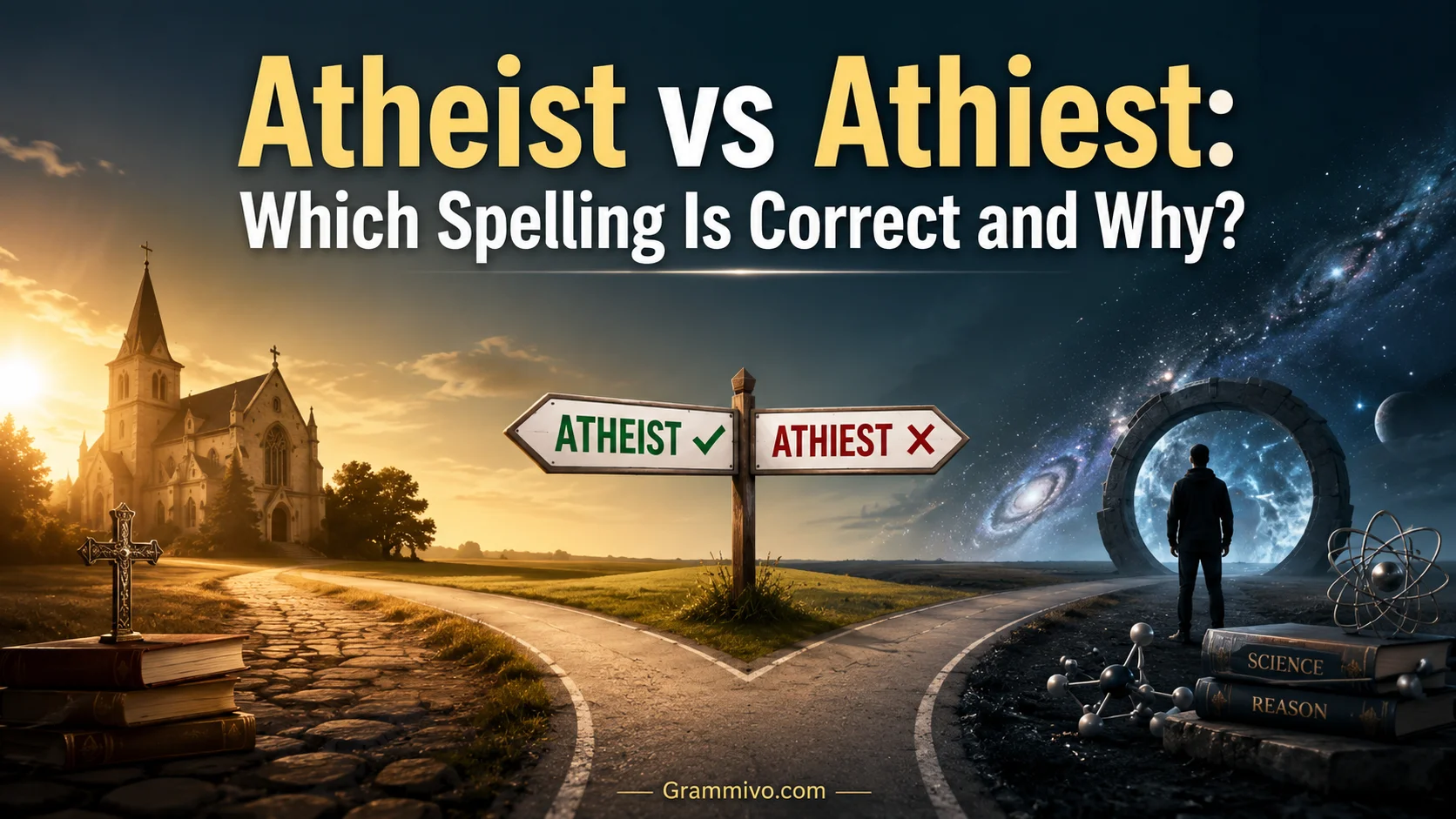
If you’ve ever hesitated between atheist vs athiest, you’re not alone. The two spellings look almost identical, yet only one is correct in standard English. The correct spelling is atheist, while athiest is a common misspelling.
The confusion usually comes from the order of the vowels. When people hear the word pronounced, the “ei” sequence isn’t always obvious. As a result, it’s easy to write athiest by instinct. However, there’s a simple way to avoid the mistake: connect atheist with the word theist.
This distinction matters in school assignments, professional writing, articles, emails, and everyday communication. A single misplaced vowel can make an otherwise polished sentence look careless.
The good news is that the spelling becomes much easier once you understand where the word comes from and how it relates to theist, theism, and atheism.
Quick Answer:
Atheist is the correct spelling. Athiest is a misspelling.
An atheist is generally a person who doesn’t believe in the existence of God or gods. Major English dictionaries recognize atheist as the standard spelling.
| Spelling | Correct? | Meaning |
| atheist | Yes | A person who doesn’t believe in God or gods |
| athiest | No | A common misspelling of atheist |
The easiest way to remember the correct spelling is to start with theist:
a + theist = atheist
Notice the important letter sequence: thei.
That’s the part people often reverse when they write athiest. The correct spelling keeps e before i:
atheist
a-t-h-e-i-s-t
Not:
athiest
a-t-h-i-e-s-t
So, if you’re wondering “Is atheist or athiest correct?”, the answer is straightforward: atheist.
Why Is “Atheist” the Correct Spelling?
The spelling atheist makes more sense when you look at its relationship with theist. A theist is a person who believes in the existence of God or gods. The word atheist is built from an element meaning “without” plus a form connected to theist.
That relationship gives you a useful spelling shortcut.
Think of the words as a small family:
- theist
- atheist
- theism
- atheism
- theistic
- atheistic
The sequence thei remains especially useful when remembering theist and atheist.
A Simple Spelling Breakdown
Write the word in parts:
A + THEIST = ATHEIST
Now compare the two spellings:
Correct: a-t-h-e-i-s-t
Incorrect: a-t-h-i-e-s-t
The mistake happens when the e and i switch places.
This isn’t a difference in meaning. Athiest doesn’t represent another accepted form of the word. It’s simply a spelling error that appears because the correct vowel sequence can be easy to misremember.
Merriam-Webster lists atheist as the standard English word, while dictionaries such as Oxford also use atheist as the established spelling.
What Does “Atheist” Mean?
An atheist is generally a person who doesn’t believe that God or gods exist. The exact way people describe their atheism can vary, though, so the word shouldn’t automatically be treated as a complete description of someone’s broader philosophical or religious views.
For example, one person might simply say, “I don’t believe in God.” Another might identify more strongly with atheism as a philosophical position.
The important point for English learners is grammatical: atheist is primarily a noun referring to a person.
Here are a few natural examples:
- He identifies as an atheist.
- She described herself as an atheist.
- The book examines the arguments of several atheist philosophers.
- The word atheist has a long history in English.
The adjective form is generally atheistic.
For example:
- The article discusses atheistic philosophy.
- The writer presented an atheistic argument.
That distinction helps you choose the right word when writing formally.
Is “Athiest” Ever Correct?
No. Athiest isn’t the standard English spelling of the word.
You may encounter it on social media, discussion boards, comments, informal messages, or even in otherwise carefully written material. Frequent online use doesn’t make it a correct dictionary spelling.
It’s best treated as a misspelling of atheist.
Compare these sentences:
- Incorrect: He is an athiest.
- Correct: He is an atheist.
- Incorrect: She called herself an athiest.
- Correct: She called herself an atheist.
- Incorrect: The author discusses athiest philosophy.
- Correct: The author discusses atheist philosophy.
The same principle applies whether you’re writing casually or professionally. If you’re preparing an essay, article, application, report, or academic assignment, use atheist.
Atheist vs Athiest: What’s the Difference?
The difference between atheist vs athiest is purely a matter of spelling in standard English.
Atheist is the established word.
Athiest is the misspelled version.
The mistake centers on one tiny detail: the order of e and i.
| Detail | Atheist | Athiest |
| Letter sequence | thei | thie |
| Standard English | Yes | No |
| Dictionary spelling | Yes | No |
| Meaning | Person who doesn’t believe in God or gods | No separate standard meaning |
| Correct in formal writing | Yes | No |
This is a good example of why spelling accuracy can depend on recognizing a word’s structure rather than relying only on pronunciation.
How Do You Spell “Atheist” Correctly?
The correct spelling is:
A-T-H-E-I-S-T
A useful trick is to avoid memorizing all seven letters separately. Instead, remember the word theist.
Start here:
THEIST
Then add A to the beginning:
A + THEIST
You get:
ATHEIST
That approach works because it gives the spelling a logical structure. You’re not simply trying to remember whether the word contains ei or ie. You’re connecting it to a related word you already know.
Remember “Theist” First
If you can spell theist, you can usually spell atheist.
- theist
- atheist
The difference is the initial a.
You can extend the same idea to related vocabulary:
- theist
- theism
- atheist
- atheism
The shared structure provides a useful mental anchor.
Watch the “Thei” Sequence
The biggest spelling trap is this:
thei
People sometimes change it to:
thie
That’s exactly what produces athiest.
When writing the word, pause briefly after ath and remember:
atheist = ath + eist
The correct sequence is e-i, not i-e.
How Do You Pronounce “Atheist”?
The word atheist is commonly pronounced approximately AY-thee-ist.
A dictionary-style pronunciation is represented as /ˈeɪθiɪst/ in many pronunciation systems, although pronunciation details can vary slightly by accent.
Breaking it into sounds can help:
AY + thee + ist
The first part sounds like the letter A.
The middle sound contains the familiar th sound found in words such as think.
The final portion sounds like ist.
However, pronunciation isn’t a perfect spelling guide here. You can hear the word correctly and still write the vowels in the wrong order. That’s why the a + theist memory trick works better than trying to spell the word purely from sound.
Atheist vs Theist: What’s the Difference?
The relationship between atheist and theist provides one of the best clues for remembering the spelling.
A theist generally believes in the existence of God or gods.
An atheist generally doesn’t believe in the existence of God or gods.
The two terms therefore describe different positions concerning belief in deities.
| Word | Basic meaning |
| theist | A person who believes in God or gods |
| atheist | A person who doesn’t believe in God or gods |
From a spelling perspective, the connection is even more useful:
theist → atheist
Once you recognize that relationship, athiest becomes easier to spot as the incorrect version.
Atheist vs Agnostic: Are They the Same?
Atheist and agnostic describe different concepts, although people sometimes use them together.
Atheism generally concerns belief in God or gods. Agnosticism traditionally concerns knowledge, particularly whether God’s existence can be known.
An atheist might say:
“I don’t believe that God exists.”
An agnostic might say:
“I don’t know whether God exists.”
Those statements aren’t necessarily contradictory. A person can describe themselves as both agnostic and atheist, depending on how they understand the two terms.
For example, someone might believe that there isn’t sufficient evidence to believe in a deity while also saying they can’t know with absolute certainty whether a deity exists.
This distinction matters because online discussions often treat atheist and agnostic as simple opposites. They aren’t necessarily opposites in that way.
Atheist, Atheism, and Atheistic: What’s the Difference?
These related words look similar, but they serve different grammatical roles.
| Word | Part of speech | Basic use |
| atheist | Noun | Refers to a person |
| atheism | Noun | Refers to the position or concept |
| atheistic | Adjective | Describes something related to atheism |
| theist | Noun | Refers to a person who believes in God or gods |
| theism | Noun | Refers to belief in God or gods |
| theistic | Adjective | Describes something related to theism |
Consider these examples:
Atheist:
The author is an atheist.
Atheism:
The book examines atheism.
Atheistic:
The essay presents an atheistic argument.
The spelling differences become much easier when you see how the words fit together.
Examples of “Atheist” in Sentences
Seeing the word in context can make the correct spelling stick.
Everyday Examples
- He identifies as an atheist.
- She said that she was an atheist.
- The speaker discussed atheism during the interview.
- The writer described an atheist character in the novel.
Formal Writing Examples
- The study examines attitudes toward atheists in different societies.
- The philosopher developed several arguments associated with atheism.
- The article distinguishes atheist and agnostic positions.
- The author discusses the historical use of the term atheist.
Incorrect and Correct Examples
| Incorrect | Correct |
| He is an athiest. | He is an atheist. |
| She became an athiest. | She became an atheist. |
| The book discusses athiesm. | The book discusses atheism. |
| They described him as athiestic. | They described him as atheistic. |
Notice that the problem doesn’t disappear when you move to related words. The same spelling pattern needs attention in atheism and atheistic.
Common Spelling Mistakes With “Atheist”
The most common mistake is straightforward:
athiest → atheist
However, related words can create similar problems.
Some incorrect forms you might encounter include:
- athiest → atheist
- athiestm → atheism
- athiesm → atheism
- athiestic → atheistic
The safest strategy isn’t to memorize every possible error. Instead, remember the core word family.
THEIST → ATHEIST
THEISM → ATHEISM
Once that pattern becomes familiar, several related spellings become easier.
Read More: Acquire vs Aquire: Which Spelling Is Correct?
The Origin of the Word “Atheist”
The history of atheist explains why its spelling has the form it does.
The word ultimately traces back to the Greek atheos, which was formed from a-, meaning roughly “without,” and theos, meaning “god.”
That Greek root connects the word to the broader family surrounding theism and theist.
English later adopted forms related to the Greek and Latin vocabulary, eventually producing the modern English atheist.
Merriam-Webster gives 1551 as the first known use of atheist in English. That doesn’t mean the underlying concept began in 1551. It means that this is the date associated with the dictionary’s record of the word’s use in English.
That distinction matters. A word’s first recorded English use isn’t necessarily the beginning of the idea it describes.
The Root Connection
The historical relationship can be simplified like this:
Greek theos → words related to theism → theist → atheist
The prefix a- often carries a meaning such as “without,” “not,” or “lacking” in Greek-derived vocabulary.
You can see a similar pattern in other English words derived from Greek:
- amoral — without morality
- asymmetrical — not symmetrical
- atypical — not typical
The exact meaning of a prefix depends on the word and its historical development, but recognizing common roots can make vocabulary easier to understand.
Is “Atheist” a Noun or Adjective?
Atheist is primarily a noun when it refers to a person.
For example:
She is an atheist.
Here, atheist identifies the person.
The related adjective is atheistic.
For example:
The book explores atheistic philosophy.
This distinction is useful because English learners sometimes try to use atheist as an adjective in places where atheistic would be more appropriate.
Compare:
- Noun: He is an atheist.
- Adjective: He presented an atheistic argument.
However, English usage can be flexible in some contexts. Modern writing may also use atheist attributively, especially in phrases such as atheist author, atheist organization, or atheist philosophy.
That doesn’t make atheist an ordinary adjective in every grammatical situation. Context determines the most natural construction.
At-A-Glance: The Atheist Word Family
The easiest way to understand the vocabulary is to see it together.
| Word | Meaning | Example |
| atheist | A person who doesn’t believe in God or gods | He identifies as an atheist. |
| atheism | A position involving disbelief or lack of belief in God or gods | The book examines atheism. |
| atheistic | Relating to or characterized by atheism | The essay presents an atheistic argument. |
| theist | A person who believes in God or gods | She describes herself as a theist. |
| theism | Belief in God or gods | The course examines different forms of theism. |
| theistic | Relating to theism | The philosopher developed a theistic argument. |
This table also gives you a powerful spelling lesson. The thei sequence appears throughout the family.
Why Do People Spell “Atheist” as “Athiest”?
The misspelling athiest is understandable because English spelling doesn’t always map neatly onto pronunciation.
When you hear atheist, the vowel sounds can blend together quickly. If you don’t already know the written form, your brain may reconstruct the letters in the order that seems natural.
The problem becomes especially easy to understand when you compare the two forms:
atheist: a-th-e-i-s-t
athiest: a-th-i-e-s-t
Only two letters have switched positions. Yet that tiny change turns the standard word into a spelling error.
Another factor is the misleading nature of English vowel patterns. Learners often rely on familiar spelling rules such as “i before e except after c.” Unfortunately, English has enough exceptions that this rule can’t reliably solve every spelling problem.
Here, the better strategy is structural:
Remember “theist.”
Then add a.
That’s faster and more reliable.
FAQs:
Is atheist or athiest correct?
Atheist is correct. Athiest is a common misspelling.
How do you spell atheist?
Spell it A-T-H-E-I-S-T. The easiest memory trick is a + theist = atheist.
Why do people spell atheist as athiest?
The pronunciation can make the vowel order difficult to identify. People often swap the e and i, producing athiest.
Is athiest a real word?
Athiest isn’t the standard spelling of a separate English word. In ordinary English usage, it’s a misspelling of atheist.
What does atheist mean?
An atheist is generally a person who doesn’t believe in the existence of God or gods.
Conclusion:
When comparing atheist vs athiest, there isn’t a competition between two accepted spellings. Atheist is the correct standard English spelling, while athiest is a common misspelling. Remember the “thei” sequence, and the spelling becomes much harder to get wrong. If you’re writing an essay, article, email, or school assignment, choose atheist. When you see athiest, treat it as a spelling error rather than an alternative form.
