
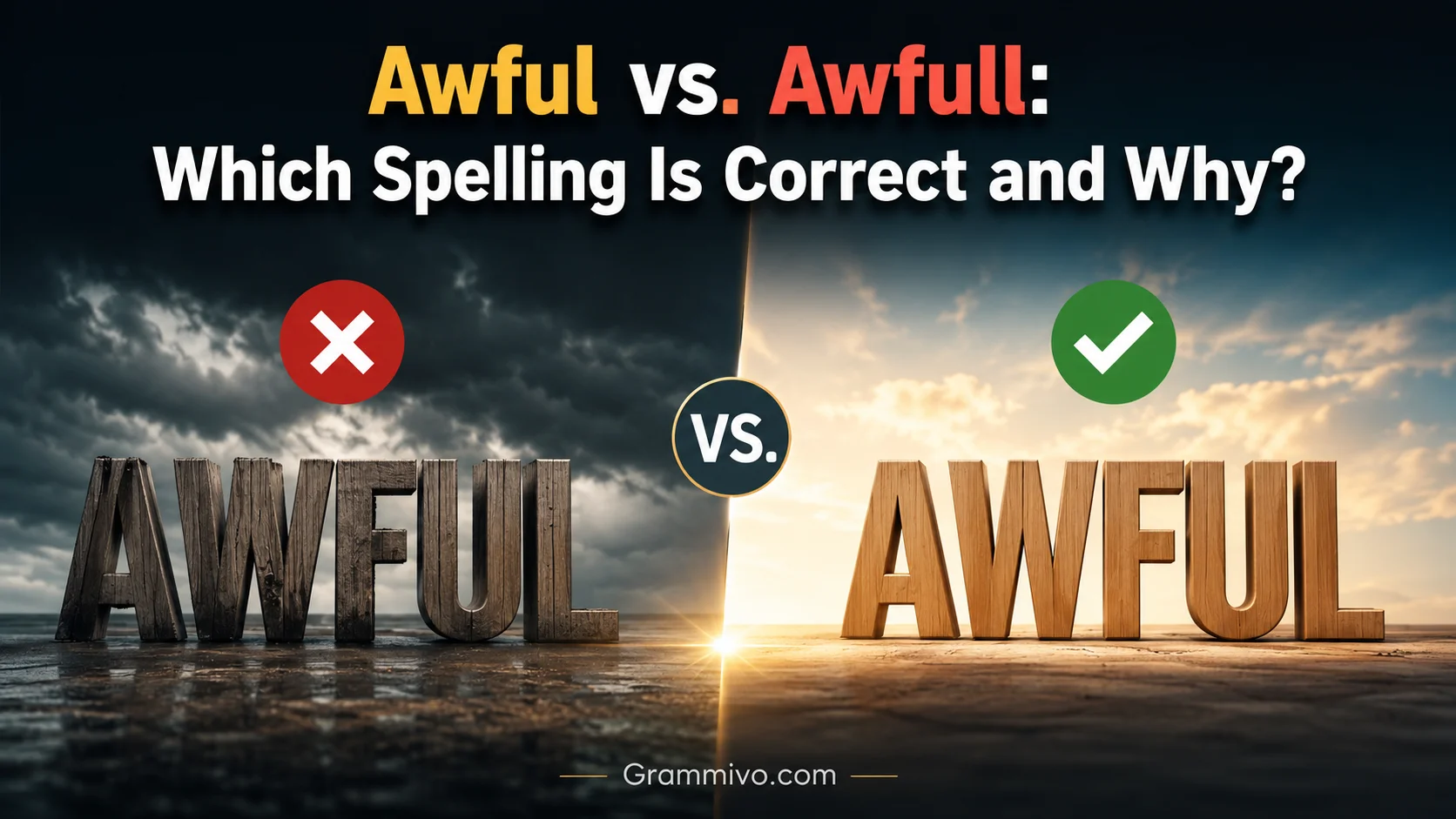
If you’ve ever hesitated between awful and awfull, you’re not alone. The confusion makes sense at first glance because the English word full has two Ls, while awful looks as though it could be built from awe + full. That tempting logic, however, leads to the wrong modern spelling.
The correct spelling in contemporary American English is awful, with one L. Awfull is not the standard modern spelling, although historical English sources contain forms such as awfull. Today, if you’re writing an email, essay, article, text, or business document, use awful.
The difference becomes much easier to remember once you understand how the word developed. Awful isn’t simply the word awe attached to the modern word full. Its spelling reflects an older English suffix and centuries of language change.
Quick Answer:
Awful is the correct spelling in modern English.
Awfull is not the standard modern spelling. It does appear as a historical spelling variant in older English texts, but you shouldn’t use it in ordinary contemporary writing.
| Spelling | Correct in modern English? | Meaning |
| awful | Yes | Very bad, unpleasant, terrible, or extremely unpleasant |
| awfull | No | Historical spelling variant of awful |
| aweful | No | Historical/obsolete form or modern misspelling |
| awefull | No | Not standard modern English |
For example:
- Correct: The weather was awful yesterday.
- Incorrect in modern writing: The weather was awfull yesterday.
The simplest rule is worth memorizing:
Awful has one L. Full has two.
That small distinction solves the entire spelling problem.
Awful vs. Awfull: What’s the Difference?
The main difference is modern spelling status, not meaning.
Awful is the established modern English word. It functions primarily as an adjective and commonly describes something extremely bad, unpleasant, or distressing.
Awfull, on the other hand, isn’t a separate modern English word with a different definition. It represents an older spelling of the same word and now generally appears as a misspelling when used in contemporary writing.
Consider these examples:
- That was an awful experience.
- The food tasted awful.
- We had awful weather during our vacation.
- He made an awful mistake.
In each sentence, awful means something negative or unpleasant.
The spelling awfull doesn’t create a new meaning. It simply uses an outdated spelling pattern.
This distinction matters because English contains many historical spellings that no longer belong to standard modern usage. Seeing an old form in a historical document doesn’t mean you should reproduce it in everyday writing.
What Does Awful Mean?
The modern word awful usually means very bad, unpleasant, terrible, or extremely disagreeable.
You can use it for physical experiences, emotional situations, objects, events, behavior, and general conditions.
For example:
- The traffic was awful this morning.
- That movie was awful.
- I had an awful headache.
- She felt awful after hearing the news.
- The restaurant received awful reviews.
- We got caught in some awful weather.
The exact shade of meaning depends on context.
When you say “The smell is awful,” you’re saying the smell is extremely unpleasant. If you say “That was an awful mistake,” you’re emphasizing how serious or bad the mistake was.
Cambridge Dictionary defines awful with meanings including extremely unpleasant or bad and extremely serious or severe.
Merriam-Webster likewise records the modern meanings and traces the word’s history back to awe.
Why Is Awful Spelled With One L?
Here’s where the confusion usually starts.
The word full contains two Ls:
F-U-L-L
However, the suffix -ful normally contains only one L:
-F-U-L
You can see the same pattern in many familiar English words:
| Word | Spelling |
| careful | -ful |
| helpful | -ful |
| useful | -ful |
| beautiful | -ful |
| hopeful | -ful |
| wonderful | -ful |
| awful | -ful |
This doesn’t mean that awful is simply awe + full. The modern spelling reflects the suffix -ful, which historically developed from the Old English word full and came to function as a productive suffix.
So the visual resemblance can mislead you.
Think of -ful as a grammatical building block rather than the standalone word full. Once you make that distinction, the one-L spelling becomes much easier to understand.
Why Do People Spell Awful as Awfull?
The mistake has a surprisingly logical source.
When people hear awful, they may mentally divide it into:
awe + full
That produces the tempting spelling:
awefull
Another person may recognize the beginning as aw- and then attach full:
aw + full = awfull
Both approaches feel reasonable if you rely on modern word shapes rather than historical word formation.
Several factors make the error especially easy:
- Full has two Ls.
- -ful sounds almost identical to full.
- English spelling doesn’t always reveal a word’s history.
- Pronunciation gives you little help.
- The spelling awfull looks visually plausible.
- Older English actually used forms containing two Ls.
That last point is important. The error isn’t completely random. Historical records help explain why someone might encounter awfull and assume it is legitimate.
The History of Awful and Awfull
The history of awful is more interesting than its modern meaning suggests.
The word developed from awe, a noun associated with feelings of profound reverence, fear, wonder, or overwhelming respect. Earlier forms of the word carried a meaning closer to “inspiring awe” than today’s common meaning of “very bad.”
That older sense helps explain expressions such as “awe-inspiring.”
Over time, the meaning of awful shifted. Instead of primarily describing something that inspired awe, the word increasingly developed negative associations and came to mean something extremely bad, unpleasant, or dreadful.
English spelling also changed over the centuries.
Historical sources record forms including awfull. The Oxford English Dictionary lists awfull among historical forms associated with awful.
This gives us an important language lesson:
A spelling can be historically real without being correct in modern English.
Shakespearean English, Middle English, Early Modern English, and contemporary American English don’t share identical spelling systems. A form found in an old manuscript shouldn’t automatically be treated as acceptable modern usage.
Was Awfull Ever a Correct Spelling?
Yes, in a historical sense.
Awfull appears among older spellings of the word. Historical English wasn’t governed by today’s standardized spelling conventions, and writers often used forms that later disappeared.
That doesn’t make awfull appropriate for modern writing.
Think about it this way: a historical spelling is like an old road sign. It tells you something about the past, but it doesn’t necessarily tell you which route you should take today.
The Oxford English Dictionary is particularly useful here because it documents historical forms rather than pretending English spelling has always been fixed.
This distinction is valuable for researchers, genealogists, historians, and readers of older literature. If you encounter awfull in an old source, you shouldn’t assume the writer made the same spelling mistake a modern student might make.
The form may reflect the spelling conventions of that period.
How to Spell Awful Correctly
The modern spelling is straightforward:
A-W-F-U-L
It has five letters and ends with a single L.
A useful memory trick is:
Awful has one L. Full has two.
You can also remember the suffix:
aw + ful → awful
Compare it with:
- helpful
- harmful
- useful
- thoughtful
- wonderful
- successful
The suffix -ful generally uses one L when attached to another word.
Don’t let the standalone word full trick you into doubling the final consonant.
Awful Spelling Practice
Try correcting these examples:
- awfull → awful
- aweful → awful
- awefull → awful
- awfully → awfully
The last example deserves attention. Awfully is correctly spelled with the sequence awful + ly, which gives you two Ls in total because the original word already ends in one L and the suffix -ly begins with another L.
So:
awful → awfully
But:
awfull → incorrect
That distinction often helps learners who remember that awfully contains two Ls.
Awful in a Sentence: Correct Examples
Seeing the word in real sentences makes its usage clearer.
Describing Something Very Bad
The hotel room was awful.
Here, awful means extremely unpleasant or poor in quality.
We had an awful experience at the airport.
The adjective describes a strongly negative experience.
Describing Physical Discomfort
I felt awful after eating too much.
In this context, awful describes how the person felt physically or emotionally.
She has an awful headache.
The word emphasizes the severity of the headache.
Describing Poor Quality
That was an awful movie.
Here, awful expresses a strongly negative opinion about the movie.
The customer service was awful.
The adjective describes very poor service.
Describing Serious Situations
They received some awful news.
The word can emphasize the emotional seriousness of information or circumstances.
These examples show why context matters. Awful doesn’t always describe the same kind of unpleasantness. It can describe quality, emotion, physical discomfort, events, conditions, and experiences.
Awfull in a Sentence: What Should You Avoid?
In contemporary standard English, avoid awfull.
| Incorrect | Correct |
| The weather is awfull. | The weather is awful. |
| That was an awfull mistake. | That was an awful mistake. |
| The food tastes awfull. | The food tastes awful. |
| I feel awfull today. | I feel awful today. |
| It was an awfull experience. | It was an awful experience. |
A spell-checker will generally recognize awfull as a misspelling in modern English. Still, automated correction shouldn’t replace understanding.
Once you know why the word has one L, you’ll be less likely to make the mistake again.
Can Awful Mean “Very” or “Extremely”?
Yes.
Although awful commonly means “very bad,” English also uses it as an intensifier in certain expressions.
The clearest example is:
an awful lot
This means a very large amount or number.
For example:
We have an awful lot of work to finish.
The sentence doesn’t mean the work itself is necessarily terrible. An awful lot functions as an informal intensifying expression meaning “a great deal.”
Other examples include:
- It took an awful long time.
- She has an awful lot of patience.
- There were an awful lot of people at the concert.
Cambridge Dictionary also records this intensifying use.
This is one reason context matters so much with English vocabulary. A single word can develop several related uses over centuries.
Awful vs. Awfully
Awful and awfully are related, but they don’t perform exactly the same grammatical job.
Awful is usually an adjective:
The weather is awful.
Awfully is an adverb:
The weather is awfully cold.
The first sentence describes the weather as very bad. The second uses awfully to intensify the adjective cold.
Interestingly, awfully doesn’t always have a negative meaning.
Consider:
She’s awfully kind.
Here, awfully means very or extremely. The sentence is positive.
Likewise:
That was awfully nice of you.
The speaker isn’t saying the person’s kindness was terrible. Instead, awfully acts as an informal intensifier.
This illustrates how English words can drift away from their original literal meanings.
Awful vs. Full: Why the Double L Causes Confusion
The spelling becomes clearer when you compare the two words directly.
| Word | Part of speech | Meaning | Spelling |
| full | Adjective | Containing as much as possible | F-U-L-L |
| awful | Adjective | Very bad or unpleasant | A-W-F-U-L |
| awfully | Adverb | Very or extremely | A-W-F-U-L-L-Y |
The key point is that full and the suffix -ful aren’t spelled identically.
Compare:
- full
- careful
- useful
- hopeful
- awful
The standalone word full keeps two Ls. The suffix -ful uses one.
That’s why awfull looks plausible but remains incorrect in current standard English.
Read More: Atheist vs Athiest: Which Spelling Is Correct and Why?
Awful vs. Aweful: Which One Is Correct?
Awful is the standard modern spelling.
Aweful sometimes appears because writers connect the word to awe. That connection isn’t entirely unreasonable because awful historically relates to awe. However, modern spelling has settled on awful.
So if you’re writing contemporary American English, use:
awful
Not:
aweful
And not:
awfull
The historical relationship between awe and awful explains some of the spelling confusion, but it doesn’t change the modern standard.
Awful vs. Awfull vs. Aweful vs. Awefull
Readers searching for awful vs. awfull often encounter several other spellings. Here’s the complete picture.
| Form | Modern standard? | Explanation |
| awful | Yes | Standard modern spelling |
| awfull | No | Historical spelling; not standard today |
| aweful | No | Historical/obsolete form or modern misspelling |
| awefull | No | Not standard modern spelling |
The safest choice for modern writing is therefore simple:
Use awful.
If you’re quoting an original historical document, preserve its spelling when accuracy requires it. Otherwise, use the modern form.
Is Awful Always a Negative Word?
Not necessarily in every expression.
The basic adjective awful usually carries a negative meaning:
- awful food
- awful weather
- awful mistake
- awful pain
- awful experience
However, related intensifying uses can produce a different emotional effect.
For example:
You were awfully helpful.
Here, awfully strengthens a positive adjective.
Similarly:
That’s awfully generous of you.
The word doesn’t reverse the meaning of generous. Instead, it intensifies it.
This distinction is another reason to avoid treating dictionary definitions as rigid one-word substitutions. Meaning depends on grammar, context, tone, and established expressions.
Awful vs. Terrible: Are They the Same?
Awful and terrible often overlap, but they’re not interchangeable in every sentence.
Both can describe something extremely bad:
- The movie was awful.
- The movie was terrible.
Both sound natural.
You can also say:
- an awful experience
- a terrible experience
- awful weather
- terrible weather
- an awful mistake
- a terrible mistake
The difference is usually one of tone and context rather than a strict grammatical rule.
Other related words include horrible, dreadful, atrocious, and appalling. Each carries its own level of intensity and stylistic flavor.
For a spelling question, though, you don’t need to replace awful with another adjective. The important point is simply that awful is the correct modern spelling.
FAQs:
Is “awfull” a word?
Awfull is recorded as a historical spelling variant of awful, but it isn’t the standard spelling in modern English. Use awful in contemporary writing.
Is awful spelled with one L or two?
Awful is spelled with one L.
The correct spelling is:
A-W-F-U-L
Why isn’t awful spelled awfull?
Because awful uses the suffix -ful, which is spelled with one L. The standalone adjective full has two Ls, but that doesn’t mean every word ending in -ful takes two.
Is aweful correct?
No. Awful is the standard modern spelling.
Aweful can appear in historical material, but it isn’t the normal spelling in contemporary American English.
Does awful mean very bad?
Yes. In modern English, awful commonly means very bad, unpleasant, terrible, or extremely disagreeable.
Conclusion:
The awful vs. awfull confusion comes from a spelling pattern that looks more logical than it really is. Because full has two Ls and awful has a similar sound at the end, awfull can seem perfectly reasonable.
The word also has a fascinating history. It developed from language associated with awe, and older English sources recorded forms such as awfull. Over time, both spelling and meaning changed. Today, awful most often means very bad, unpleasant, or terrible, while expressions such as “an awful lot” use the word as an intensifier.
