
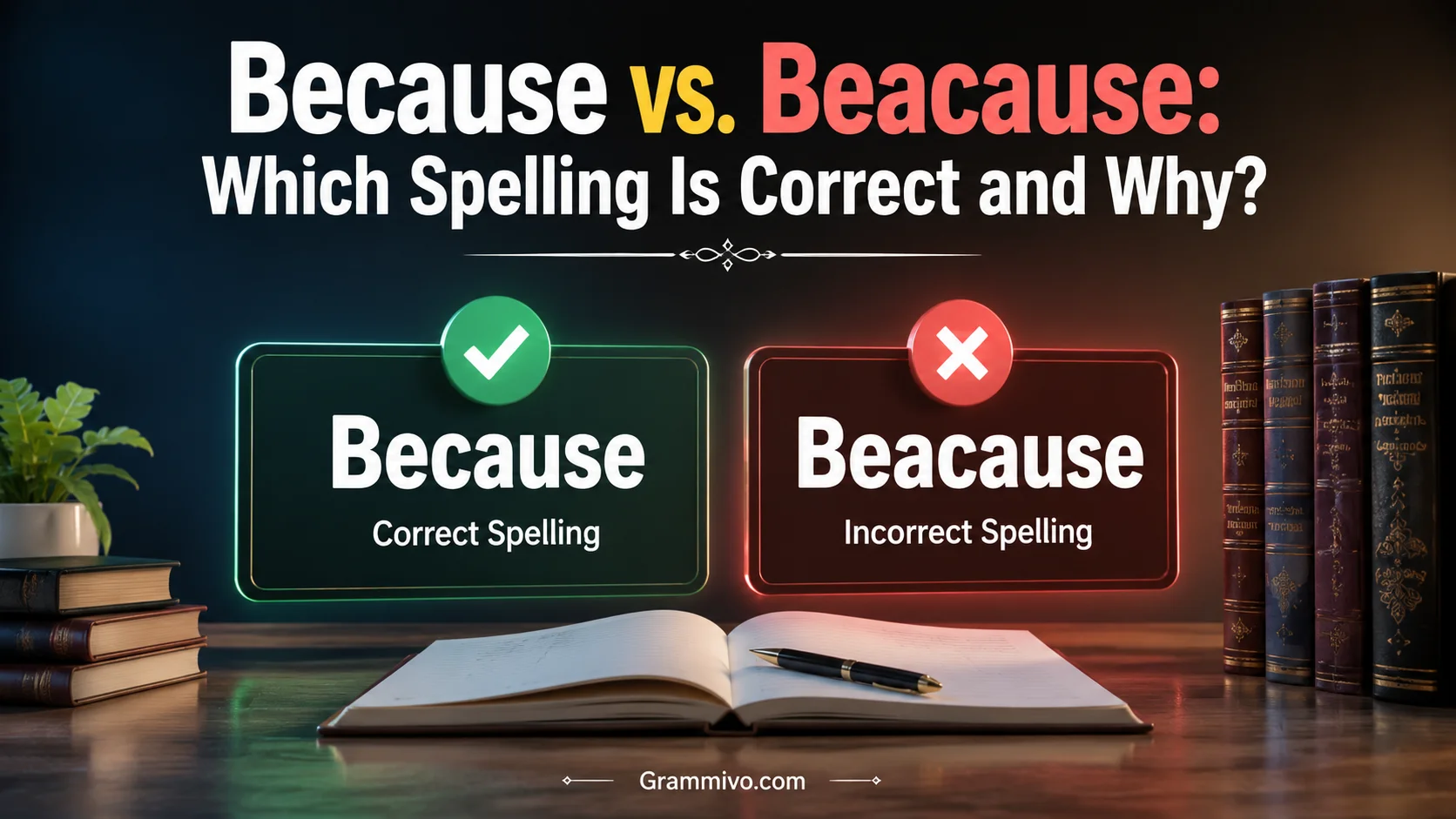
If you’ve ever hesitated between because vs. beacause, you’re not alone. The two spellings look remarkably similar, especially when you’re typing quickly or writing from memory. However, there’s an important difference: because is the correct standard English spelling, while beacause is a misspelling.
The confusion usually comes from the way because sounds when spoken. English spelling doesn’t always follow pronunciation perfectly, so it’s easy to place an extra a after the first few letters. Once you know the correct spelling and understand how the word works grammatically, the mistake becomes much easier to avoid.
This guide explains because vs. beacause in detail, including their meanings, grammar, spelling, common mistakes, examples, history, and practical ways to remember the correct form.
Quick Answer
Because is the correct spelling. Beacause is an incorrect spelling and shouldn’t be used in standard English.
Correct:
I stayed home because I wasn’t feeling well.
Incorrect:
I stayed home beacause I wasn’t feeling well.
The correct spelling is:
B-E-C-A-U-S-E
A useful way to remember it is to notice the word cause inside because:
be + cause = because
The word because introduces a reason or explanation. For example, in “She left early because she felt tired,” the second clause explains why she left early.
Because vs. Beacause at a Glance
The difference between because and beacause is straightforward once you separate spelling from meaning.
| Spelling | Correct? | Function | Meaning |
| because | Yes | Conjunction | Introduces a reason or cause |
| beacause | No | None in standard English | Misspelling of because |
There isn’t a different definition hiding behind beacause. It isn’t a formal alternative, an older spelling commonly used today, or a different grammatical form.
If you see beacause in a text, the writer almost certainly intended because.
For example:
- Correct: We canceled the picnic because it rained.
- Incorrect: We canceled the picnic beacause it rained.
The mistake doesn’t change what the sentence is trying to say. It simply creates a spelling error.
What Does “Because” Mean?
Because is a conjunction that introduces the reason for an action, event, condition, or statement. It answers the question why?
Consider this sentence:
Maya stayed home because she was sick.
The first part tells you what happened. The second part tells you why it happened.
- Result: Maya stayed home.
- Reason: She was sick.
- Connecting word: because.
This cause-and-effect relationship makes because one of the most useful words in everyday English.
You can use it in casual conversation, academic writing, professional communication, journalism, and countless other settings.
Examples of “Because” in Everyday English
Here are several natural examples:
- I went to bed early because I was exhausted.
- She bought an umbrella because the forecast predicted rain.
- We took the highway because it was faster.
- He apologized because he realized his mistake.
- They moved closer to work because the commute was too long.
- I called you because I needed some advice.
In every example, because connects an action or situation with its reason.
Why Is “Beacause” Incorrect?
Beacause is a misspelling of because. Standard English dictionaries recognize because as the correct spelling of the conjunction.
The most obvious problem is the extra a.
Compare the two forms:
because
beacause
The incorrect version inserts a after be:
- Correct: b-e-c-a-u-s-e
- Incorrect: b-e-a-c-a-u-s-e
That small difference can be surprisingly easy to miss while reading.
Spelling mistakes like this often happen when someone remembers the general sound or shape of a word rather than its exact sequence of letters. Since because contains the familiar word cause, remembering that internal structure can help.
Why Do People Spell “Because” as “Beacause”?
The spelling beacause most likely comes from a simple letter-order or memory error. English learners and native speakers alike can make these mistakes when typing quickly.
Pronunciation can also contribute to confusion. Spoken English compresses words, and because can sound quite different depending on emphasis, accent, and speaking speed.
For instance, in casual speech, because may be pronounced with a reduced vowel sound. When someone then tries to reconstruct the spelling from memory, the letters don’t always fall into the correct order.
Other common misspellings include:
- beacuse
- becuase
- becouse
- becase
- becaus
- beacause
All of these should be replaced with because in standard English writing.
A Simple Spelling Breakdown
One of the easiest ways to remember the word is:
BE + CAUSE = BECAUSE
The ending cause is especially helpful because it’s already a familiar English word.
Instead of memorizing seven letters as one long sequence, mentally divide the word:
be | cause
That gives you:
b-e | c-a-u-s-e
This technique works particularly well if you frequently type beacause by accident.
The History Behind the Spelling of “Because”
The modern spelling of because has a long history. The word developed from an expression involving by cause, referring to the cause or reason behind something.
Over time, English spelling and word formation changed, eventually producing the modern conjunction because.
The historical connection also explains why the word contains cause. That relationship isn’t merely a convenient spelling trick. The word’s meaning has always been tied to explaining a cause or reason.
Modern English doesn’t treat because as two separate words, though. You should write it as one word:
because
Not:
be cause
And certainly not:
beacause
Knowing a little about the word’s structure can make the modern spelling easier to remember without requiring you to memorize a complicated history lesson.
How to Use “Because” Correctly
The most common grammatical use of because is to introduce a clause that explains a reason.
A clause normally contains a subject and a verb.
For example:
We left because it was getting dark.
The clause it was getting dark contains:
- Subject: it
- Verb: was getting
- Connector: because
The structure is simple:
Main clause + because + reason clause
You can also reverse the order:
Because + reason clause + main clause
For example:
Because it was getting dark, we left.
Both sentences communicate essentially the same relationship.
Because + Clause
Use because when a complete clause follows it.
Examples:
She stayed home because she felt sick.
I brought an umbrella because it looked like rain.
They postponed the meeting because several people were unavailable.
Notice the pattern. The material following because contains a subject and a verb.
This distinction becomes particularly important when comparing because with because of.
Because of + Noun or Noun Phrase
Because of works differently. It normally comes before a noun, pronoun, or noun phrase rather than a complete clause.
Compare these sentences:
We stayed home because it was raining.
We stayed home because of the rain.
Both sentences explain the same basic reason, but their grammatical structures differ.
| Expression | What follows it | Example |
| because | Clause | We left because it was late. |
| because of | Noun/noun phrase | We left because of the late hour. |
This distinction is useful because people sometimes treat the two expressions as interchangeable in every situation. They aren’t.
Because at the Beginning of a Sentence
You can absolutely begin a sentence with because.
For example:
Because the roads were icy, school closed early.
The because clause explains the reason for the main clause.
When the dependent clause comes first, a comma commonly separates it from the main clause.
Compare:
Because I was tired, I went home.
and:
I went home because I was tired.
The second version doesn’t normally need a comma before because because the reason clause follows the main clause naturally.
Because in Short Answers
In everyday conversation, people often answer a why question with because.
For example:
“Why did you leave?”
“Because I wasn’t feeling well.”
This is perfectly natural in conversation.
A short answer like this doesn’t need to contain a complete independent clause. The context already supplies the missing information.
Because vs. Because of
The difference between because and because of deserves special attention because it’s a common grammar issue.
Because generally introduces a clause:
The flight was delayed because the weather was bad.
Because of introduces a noun or noun phrase:
The flight was delayed because of the bad weather.
Both are grammatical. The construction changes.
Here are more examples:
| Because | Because of |
| We stayed inside because it was raining. | We stayed inside because of the rain. |
| She was late because her car broke down. | She was late because of a car problem. |
| The game ended early because the storm became severe. | The game ended early because of the severe storm. |
A quick test can help. If what follows contains a subject and verb, because is usually the right choice. If you’re introducing a noun or noun phrase, because of may fit better.
Common “Because” Mistakes to Avoid
Most errors involving because aren’t difficult grammar problems. They’re usually spelling or sentence-structure mistakes.
Writing “Beacause” Instead of “Because”
This is the main issue addressed by because vs. beacause.
Incorrect:
I didn’t go beacause I was busy.
Correct:
I didn’t go because I was busy.
The correction is simple: remove the extra a after be.
Writing “Beacuse”
This variation swaps the position of letters.
Incorrect:
She stayed home beacuse she was sick.
Correct:
She stayed home because she was sick.
The correct sequence is b-e-c-a-u-s-e.
Read More: Acreage vs. Acrage: Which Spelling Is Correct and Why?
Confusing “Because” With “Because of”
Incorrect:
We canceled the event because of it was raining.
Correct:
We canceled the event because it was raining.
Or:
We canceled the event because of the rain.
The problem occurs because because of can’t normally be followed directly by a complete clause in standard constructions.
Forgetting the Second “E”
Some writers produce forms such as becaus.
Correct spelling:
because
The word ends with -use, not simply -us.
Because vs. Beacause Examples
Seeing the correction in context makes the difference easier to remember.
| Incorrect | Correct |
| I stayed home beacause I was sick. | I stayed home because I was sick. |
| She left beacause it was late. | She left because it was late. |
| We canceled the trip beacause of the storm. | We canceled the trip because of the storm. |
| He was upset beacause nobody called. | He was upset because nobody called. |
| They won beacause they practiced. | They won because they practiced. |
| I couldn’t attend beacause I was working. | I couldn’t attend because I was working. |
In School Writing
If you’re writing an essay, report, or assignment, always use because.
Incorrect:
The experiment failed beacause the temperature changed.
Correct:
The experiment failed because the temperature changed.
A spelling error may look minor, but repeated errors can distract readers from otherwise strong writing.
In Professional Communication
The same rule applies to emails, reports, applications, and workplace messages.
Incorrect:
The shipment arrived late beacause of the weather.
Correct:
The shipment arrived late because of the weather.
There’s no special informal spelling of because that becomes acceptable in professional writing.
In Text Messages
Casual communication gives people more freedom to shorten words, but beacause still isn’t the standard spelling.
You might see someone type:
cuz
or
bc
in an informal text.
Those are intentional abbreviations. Beacause, however, is simply a misspelling.
Is “Beacause” Ever Correct?
No. Beacause isn’t the standard English spelling of the conjunction because.
If you encounter it online, in a message, or in an old draft, don’t interpret it as an alternative spelling you can freely use. In ordinary standard English, replace it with because.
This applies across contexts:
- Academic writing
- Business writing
- Emails
- Resumes
- Reports
- Articles
- School assignments
- Edited publications
- Formal correspondence
The spelling doesn’t become correct because a large number of people make the same mistake.
Because vs. Beacause in Formal and Informal Writing
Because works in virtually every level of standard English.
In formal writing:
The project was delayed because several permits were unavailable.
In everyday conversation:
I left because I was tired.
In a casual message:
I didn’t call because I was busy.
The surrounding vocabulary and sentence structure can change with the situation. The spelling of because doesn’t.
That makes this one of those useful words you can confidently use almost anywhere.
How to Remember the Correct Spelling of Because
The best spelling trick is also the simplest:
Remember “cause.”
The word is:
be + cause = because
If you often write beacause, pause after the first two letters:
BE | CAUSE
Then write the second part as the familiar word cause.
A Useful Mnemonic
Some learners remember because with the mnemonic:
Big Elephants Can Always Understand Small Elephants
The first letters produce:
B E C A U S E
It’s memorable, although the be + cause method is arguably more meaningful because it connects directly to the word’s structure.
Another practical trick is to say:
“Because contains cause.”
Whenever you’re unsure, look for cause inside the word.
FAQs:
Is “beacause” a word?
No. Beacause is a misspelling of because in standard English.
Is it “because” or “beacause”?
The correct spelling is because.
How do you spell “because” correctly?
Spell it:
B-E-C-A-U-S-E
A useful memory aid is be + cause.
Why do people spell “because” as “beacause”?
The error usually comes from confusing the order of letters, typing quickly, or remembering the pronunciation rather than the exact spelling. The extra a is the key error.
What does “because” mean?
Because introduces a reason or cause. It commonly answers the question why?
For example:
I stayed home because I was tired.
Conclusion:
The because vs. beacause question has a clear answer: because is correct, while beacause is a misspelling. Also keep because and because of separate in your mind. Because normally introduces a clause, while because of introduces a noun or noun phrase. Once you recognize the pattern, beacause becomes an easy mistake to catch. When proofreading, look for that extra a, remember cause, and use because every time.
