
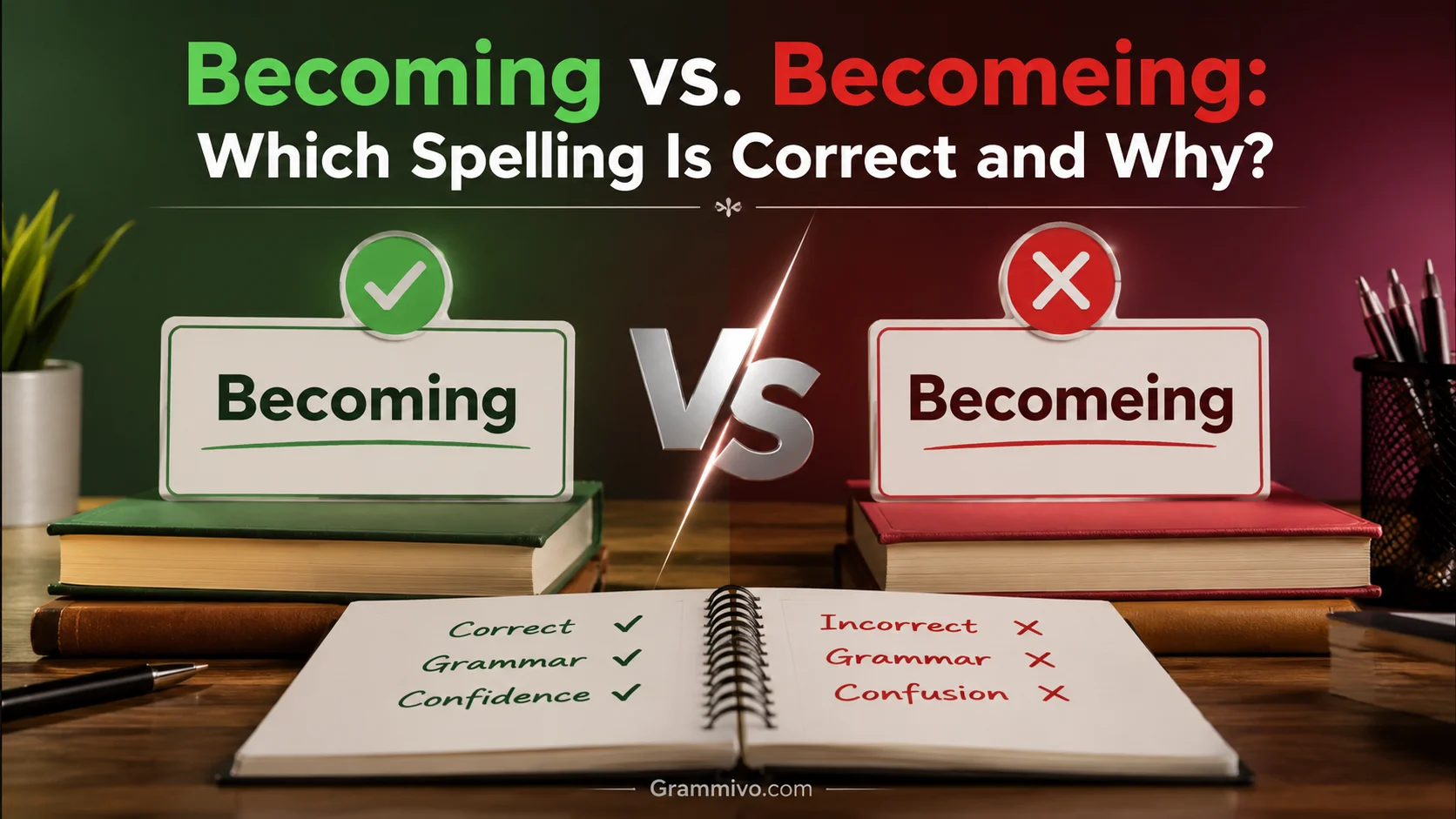
If you’ve ever hesitated between becoming and becomeing, you’re not alone. The two forms look almost identical, and the mistake makes sense at first glance. After all, the verb is become, so adding -ing might seem like it should produce becomeing. English spelling has a different plan.
The correct spelling is becoming. The form becomeing is incorrect in standard English.
This small spelling difference comes from an important English spelling rule: when many verbs end in a silent e, you usually drop that final e before adding -ing. So become becomes becoming, just as make becomes making and write becomes writing.
There’s more to the word than spelling, though. Becoming can function as the present participle of become, a gerund, or an adjective. Understanding those uses will help you avoid both spelling and grammar mistakes.
Quick Answer:
Becoming is correct. Becomeing is incorrect.
The correct formation is:
become + -ing → becoming
Not:
become + -ing → becomeing
The reason is simple. Become ends in a silent e, and that final e is removed before the -ing ending is added.
| Form | Correct? | Example |
| becoming | Yes | She is becoming more confident. |
| becomeing | No | She is becomeing more confident. |
| becomming | No | He is becomming impatient. |
Major dictionaries list becoming as the present participle of become. Merriam-Webster gives the verb forms as “became; become; becoming,” while Cambridge likewise identifies becoming in examples describing an ongoing change.
So if you’re writing an email, essay, resume, article, school assignment, or social media post, use becoming.
Why Is “Becoming” Correct?
The spelling follows a common pattern in English.
When a verb ends in a final silent e, English often removes that e before adding -ing. This keeps the spelling consistent with the pronunciation and established spelling conventions.
Consider these examples:
- make → making
- take → taking
- write → writing
- drive → driving
- hope → hoping
- use → using
- become → becoming
The same basic pattern applies to become.
You can think of the transformation like this:
BECOME → BECOM + ING → BECOMING
The final e doesn’t survive the trip.
That’s why becomeing looks logical but isn’t standard English. It treats the spelling as a simple matter of attaching -ing to the complete base word. English spelling doesn’t always work that mechanically.
For example, you wouldn’t normally write makeing. You write making. Likewise, you don’t write takeing. You write taking. Becoming follows the same principle.
Why Is “Becomeing” Incorrect?
Becomeing is a misspelling because it retains the final e before the -ing ending.
The error usually comes from a straightforward assumption:
become + ing = becomeing
That calculation looks reasonable if you’re simply adding letters. However, standard English spelling changes the base before adding the suffix.
The correct process is:
become → becom + ing → becoming
This distinction matters because becomeing isn’t an alternative spelling used in American English. It isn’t a British-versus-American spelling difference either.
If a spell checker flags becomeing, it’s identifying a genuine spelling error.
Common Incorrect Forms
Several mistakes can appear when people try to spell this word:
- becomeing
- becomming
- becominng
- becoming
The correct form has:
- one m after the o
- no final e before -ing
- the ending -ing
The visual pattern is worth memorizing:
becom + ing = becoming
Once that pattern becomes familiar, the spelling becomes much easier to recognize.
What Does “Becoming” Mean?
Becoming usually means changing into, developing into, or starting to be something.
It is the present participle of the verb become. Merriam-Webster defines become in part as “to come to be” and also describes it as undergoing change or development.
For example:
She is becoming more confident.
This sentence describes a change that is happening over time. She isn’t simply confident in a fixed sense. Her confidence is developing.
Another example:
The weather is becoming colder.
The weather is changing from warmer conditions toward colder conditions.
Cambridge uses similar constructions, including examples such as “The days are becoming shorter” and “It’s becoming obvious,” showing how becoming describes a developing state or condition.
Becoming as a Present Participle
In sentences such as:
The situation is becoming serious.
Becoming is the present participle of become.
It works with the auxiliary verb is to form a progressive construction:
is + becoming
Other forms include:
- am becoming
- is becoming
- are becoming
- was becoming
- were becoming
Examples:
- I am becoming more comfortable with the process.
- She is becoming a strong leader.
- They are becoming increasingly concerned.
- He was becoming frustrated.
- We were becoming more familiar with the neighborhood.
Becoming as a Gerund
Becoming can also function as a gerund, which means the -ing form acts grammatically like a noun.
Consider:
Becoming a parent changes your priorities.
Here, becoming a parent functions as the subject of the sentence.
Another example:
Becoming fluent takes consistent practice.
The word describes an activity or process rather than serving as the main verb of a progressive construction.
This distinction is useful because an -ing word doesn’t always have the same grammatical job. Context determines how it functions.
Becoming vs. Become: What’s the Difference?
Become is the base form of the verb, while becoming is its present participle and gerund form.
The difference becomes clear when you place both words in complete sentences.
| Word | Grammatical role | Example |
| become | Base form | People can become more confident. |
| becoming | Present participle | She is becoming more confident. |
| becoming | Gerund | Becoming confident takes practice. |
The base form become often appears after modal verbs and other structures:
- can become
- will become
- may become
- should become
- to become
Examples:
You can become better with practice.
The situation will become clearer soon.
It may become necessary to change the plan.
By contrast, becoming commonly appears in progressive constructions:
The situation is becoming clearer.
The two forms aren’t interchangeable simply because they describe related ideas.
Becoming vs. Became: What’s the Difference?
A second common source of confusion involves became.
The three forms are:
| Verb form | Meaning/use | Example |
| become | Base form/present | They become tired after work. |
| became | Simple past | She became a doctor in 2020. |
| becoming | Present participle/gerund | She is becoming a doctor. |
The important distinction is time and grammatical structure.
Compare these sentences:
She became a doctor.
This describes a completed change in the past.
She is becoming a doctor.
This describes a process that is underway or developing.
The difference can be subtle in everyday conversation, but grammar makes the distinction meaningful.
Cambridge identifies became as the past tense of become and become as its past participle.
How to Use “Becoming” in a Sentence
The easiest way to understand becoming is to see how it behaves in real sentence patterns.
Be + Becoming + Adjective
This structure describes a developing condition or quality.
Examples:
- The weather is becoming colder.
- She is becoming impatient.
- The project is becoming difficult.
- He is becoming more confident.
- The problem is becoming serious.
Here, the adjective describes the new state that is developing.
Be + Becoming + Noun Phrase
You can also use becoming when someone or something is developing into a particular role or identity.
Examples:
- She is becoming a skilled designer.
- He is becoming a respected leader.
- The company is becoming a major competitor.
- The child is becoming an independent thinker.
The noun phrase identifies what the subject is developing into.
Becoming + Noun Phrase as a Gerund
The word can also introduce an activity or process:
- Becoming a parent changes your priorities.
- Becoming a better writer takes regular practice.
- Becoming familiar with the software may take several days.
- Becoming financially independent requires planning.
In these sentences, becoming doesn’t need an auxiliary such as is or was. The entire phrase functions as a noun-like unit.
Becoming Can Also Be an Adjective
Here’s where the word gets more interesting.
Becoming can also function as an adjective meaning attractive, suitable, or flattering. Merriam-Webster defines the adjective as “suitable, fitting,” especially something attractively suitable.
For example:
That jacket is very becoming on you.
Here, becoming doesn’t mean “changing into.” It means the jacket looks attractive or suits the person wearing it.
Cambridge gives the same general adjective meaning, describing something as attractive or suitable for the person wearing or doing it.
This use is less common in everyday modern American English than the verb form, but it remains a legitimate dictionary definition.
Two Different Uses of “Becoming”
| Use | Meaning | Example |
| Verb form | Changing or developing | She is becoming stronger. |
| Gerund | The process of becoming | Becoming stronger takes time. |
| Adjective | Attractive or suitable | That color is becoming on you. |
Context tells you which meaning applies.
Becoming vs. Becomeing Examples
Seeing the incorrect and correct forms side by side makes the spelling rule easier to remember.
| Incorrect | Correct | Why |
| She is becomeing confident. | She is becoming confident. | Drop the final e before -ing. |
| The weather is becomeing colder. | The weather is becoming colder. | Become changes to becoming. |
| He is becomeing impatient. | He is becoming impatient. | The final e is removed. |
| They are becomeing more successful. | They are becoming more successful. | Use the standard present participle. |
| Becomeing a leader takes time. | Becoming a leader takes time. | The gerund is spelled becoming. |
Notice something important: become itself isn’t wrong.
For example:
They become tired after long walks.
That’s perfectly grammatical.
The problem arises when you need the -ing form and incorrectly write becomeing.
Read More: Because vs. Beacause: Which Spelling Is Correct and Why?
Common Mistakes With “Becoming”
Most mistakes fall into a few predictable categories.
Writing “Becomeing”
This is the main spelling error.
Incorrect:
She is becomeing more confident.
Correct:
She is becoming more confident.
The final e disappears before -ing.
Writing “Becomming”
Some writers remove the final e but accidentally double the m.
Incorrect:
The situation is becomming difficult.
Correct:
The situation is becoming difficult.
The word become contains only one m, and that remains true in becoming.
Using “Become” Instead of “Becoming”
Sometimes the spelling is correct but the grammatical form isn’t.
Incorrect in this structure:
She is become more confident.
Correct:
She is becoming more confident.
After is in this progressive construction, the -ing form is needed.
However, become works perfectly in other structures:
She wants to become more confident.
So don’t treat become as an incorrect word. The issue is choosing the right form for the sentence.
Confusing “Became” With “Becoming”
These forms express different grammatical relationships.
Became:
She became a manager last year.
Becoming:
She is becoming a manager.
The first describes a completed past change. The second presents the change as a developing process.
Why Does the Final “E” Disappear Before “-ing”?
The spelling rule behind becoming is part of a broader English pattern.
Many verbs ending in a silent e drop that e when -ing is added.
Examples include:
| Base verb | + -ing | Correct form |
| make | make + ing | making |
| take | take + ing | taking |
| write | write + ing | writing |
| drive | drive + ing | driving |
| hope | hope + ing | hoping |
| use | use + ing | using |
| become | become + ing | becoming |
This pattern helps prevent awkward spellings and reflects long-established English conventions.
Still, English spelling has exceptions. That’s why it’s better to learn the common pattern rather than assume every verb follows one universal formula.
For become, though, the rule is straightforward:
become → becoming
A Useful Way to Remember “Becoming”
Here’s a simple memory trick:
Think of “becoming” as “becom + ing.”
Don’t mentally attach -ing to the complete spelling become. Remove the final e first.
You can also connect it to coming:
come → coming
Since become contains come, the same spelling behavior helps:
become → becoming
That gives you a quick visual anchor.
If you remember only one thing, remember this:
Drop the silent e before adding -ing.
That single rule will also help with many other verbs.
Is “Becoming” the Same in American and British English?
Yes. Becoming is the standard spelling in both American and British English.
There isn’t an American spelling becoming and a British spelling becomeing.
Both varieties use:
becoming
Cambridge lists the same spelling in its American English dictionary material, and Merriam-Webster lists becoming among the standard forms of become.
So if you’re writing for an American audience, becoming is unquestionably the form to use.
Becoming in Everyday English
You’ll encounter becoming frequently because people constantly describe change, development, and gradual transformation.
Consider these everyday examples:
- Your skills are becoming stronger.
- The days are becoming shorter.
- The traffic is becoming heavier.
- She is becoming more independent.
- The project is becoming more complicated.
- He is becoming comfortable with his new role.
- The issue is becoming harder to ignore.
- The neighborhood is becoming more popular.
- The child is becoming curious about science.
- The company is becoming more competitive.
The word often signals that something isn’t static. A condition is moving toward another state.
That makes becoming especially useful when discussing personal growth, weather, business, relationships, education, careers, and changing circumstances.
FAQs:
Is “becomeing” a word?
No. Becomeing isn’t the standard spelling of the -ing form of become. The correct form is becoming.
Is “becoming” grammatically correct?
Yes. Becoming is the present participle of become and can also function as a gerund. It can additionally work as an adjective meaning attractive or suitable.
Why do we spell it “becoming” instead of “becomeing”?
Because the final silent e in become is dropped before the -ing suffix is added.
become → becom + ing → becoming
What is the past tense of “become”?
The simple past tense is became.
Example:
She became a teacher after graduating.
Cambridge and Merriam-Webster both list became as the past form of become.
What is the present participle of “become”?
The present participle is becoming.
Example:
He is becoming more experienced.
Conclusion:
The answer is clear: becoming is correct, while becomeing is incorrect. The spelling follows the familiar pattern of dropping a final silent e before adding. The word can describe an ongoing change, function as a gerund, or serve as an adjective meaning attractive or suitable. Its related verb forms are also worth remembering: So the next time you find yourself staring at becoming vs. becomeing, there’s no need to second-guess the spelling. Drop the final e, add -ing, and you’re done.
