
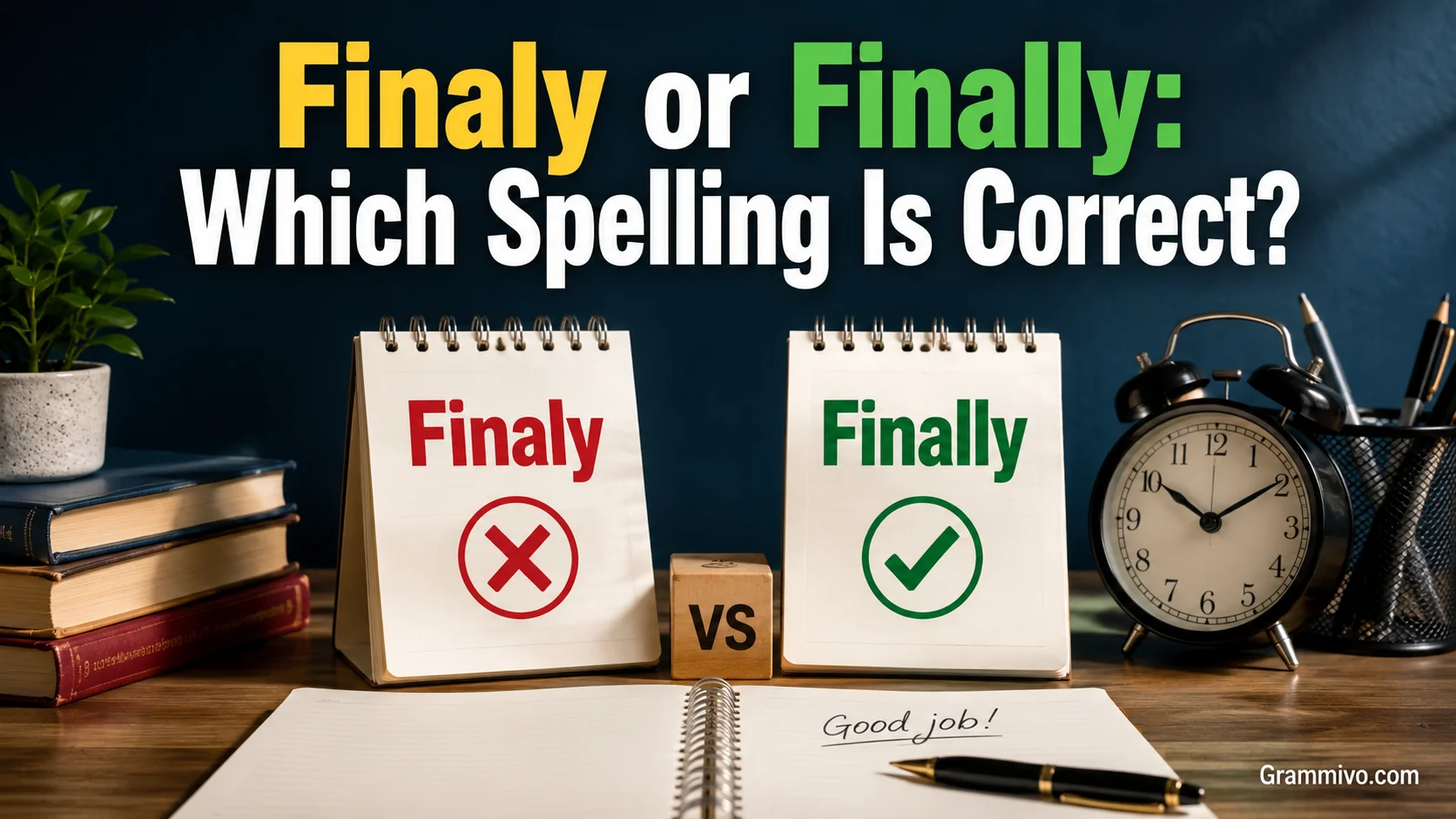
Have you ever typed finaly instead of finally and wondered whether both spellings were acceptable? You’re not alone. This small spelling mistake happens frequently because the word sounds the same whether you write it with one L or two. However, English spelling follows specific patterns that determine which form is correct.
The difference between finaly and finally comes down to one letter. Finally is the correct spelling in standard English while finaly is a misspelling. Although the incorrect version may appear in text messages, online searches, and casual writing, it doesn’t have a recognized meaning as a standard English word.
Understanding this difference helps you write more confidently in emails, school assignments, professional documents, and everyday conversations. Beyond spelling, it’s also useful to understand what finally means and how to use it naturally in different situations.
Quick Answer:
Finally is the correct spelling. Finaly is incorrect because it leaves out one of the two Ls in the standard spelling.
The correct word contains eight letters:
- Finally: F-I-N-A-L-L-Y
- Finaly: F-I-N-A-L-Y (incorrect)
The word finally is an adverb that describes something happening after a long wait, at the end of a process, or as the last point in a discussion.
Examples:
- Correct: I finally finished my homework.
- Incorrect: I finaly finished my homework.
Remember this simple rule: When you mean something happened at last or reached its final stage, always write finally with two Ls.
Comparison Overview
Although finaly and finally look almost identical, only one follows standard English spelling conventions. The extra L makes all the difference.
| Comparison | Finaly | Finally |
| Spelling | Incorrect | Correct |
| Standard English word | No | Yes |
| Part of speech | Not applicable | Adverb |
| Meaning | No standard meaning | At last or ultimately |
| Number of letters | 7 | 8 |
| Pronunciation | Intended as finally | FIN-uh-lee |
| Usage | Misspelling | Standard usage |
| Suitable for formal writing | No | Yes |
The important distinction: Finally is the established English adverb. Finaly is simply a spelling error, not an alternative spelling you can use in formal or informal writing.
Main Differences Between Finaly and Finally
The main difference between these two forms isn’t their pronunciation or intended meaning. It’s their spelling and acceptance in standard English.
Finally Is the Correct Spelling
The word finally appears in standard English dictionaries and serves several important purposes. You can use it to describe the completion of an activity, the end of a waiting period, or the last point in a sequence.
For example:
- We finally reached our destination after driving for six hours.
- Finally, everyone agreed on the new schedule.
- She finally received the promotion she had worked toward.
In each sentence, finally communicates that something has reached an expected or concluding point.
Finaly Is a Common Misspelling
The spelling finaly is incorrect in standard English. Writers sometimes leave out one L because they mistakenly assume the word follows the same spelling pattern as other words ending in Y.
However, the correct spelling retains both Ls.
You might encounter finaly in:
- Informal text messages.
- Social media comments.
- Search queries.
- Unedited online content.
- Handwritten notes.
Seeing the incorrect spelling online doesn’t make it acceptable. When writing an assignment, business email, article, or professional document, always use finally.
Why Do People Confuse Finaly and Finally?
The confusion usually develops from a simple typing or spelling mistake. Both versions look similar and represent the same intended pronunciation.
Several factors contribute to this error:
- Missing double letters: People sometimes forget that finally contains two Ls.
- Fast typing: When writing quickly, it’s easy to skip a repeated letter.
- Unfamiliar spelling patterns: Some writers don’t recognize the connection between final and finally.
- Autocorrect habits: Depending on the keyboard or software, a typing mistake might not receive immediate attention.
The easiest solution is to remember the correct spelling rather than relying entirely on spell-checking tools.
What Does Finally Mean?
The word finally is an adverb that describes something happening at the end of a period, process, or sequence. It often suggests that someone has waited, worked, or experienced several events before reaching a particular outcome.
However, its meaning depends on the context. It generally serves three main purposes.
Finally Means After a Long Wait
One common use of finally describes something that happens after someone has waited for a considerable amount of time.
For example, imagine waiting several weeks for an important job application result. When the company eventually sends its decision, you might say:
“I finally received the job offer!”
Here, finally emphasizes the waiting period before the result arrived.
More examples:
- The doctor finally called with the test results.
- After months of preparation, we finally launched the business.
- My brother finally arrived at the airport.
- She finally found the apartment she wanted.
In these examples, the word highlights the completion of something that took time.
Finally Means At the End of a Process
You can also use finally to introduce the last action or stage in a sequence.
Consider a cooking recipe. You prepare the ingredients, mix everything together, and bake the mixture. The final instruction might say:
“Finally, allow the cake to cool before serving.”
Here, finally introduces the last step rather than describing a long wait.
Other examples include:
- First, wash the vegetables. Next, chop them. Finally, cook them until tender.
- Add the remaining ingredients and finally stir the mixture.
- Finally, save your document before closing the application.
This usage makes instructions easier to follow because readers understand the order of actions.
Finally Means As the Last Point in a Discussion
Writers and speakers often use finally when introducing their last argument, suggestion, or observation.
For example:
“Finally, we should consider how these changes will affect our customers.”
The sentence introduces the final point in a discussion. It doesn’t necessarily suggest that anyone waited a long time.
You might also write:
- Finally, I’d like to thank everyone who contributed.
- Finally, let’s review the most important findings.
- Finally, we must remember that customer satisfaction matters.
This use appears frequently in presentations, reports, essays, and professional discussions.
Read More: Using or Useing: Which Spelling Is Correct?
How to Use Finally in a Sentence
Understanding a word’s definition is helpful, but knowing how to use it naturally makes your writing stronger. The position of finally can change depending on the sentence structure and intended meaning.
Finally to Describe Something Happening After a Long Wait
When you want to emphasize that something happened after a delay, place finally before the main verb or after an appropriate helping verb.
Examples:
- I finally completed my college application.
- They finally agreed to our proposal.
- The package has finally arrived.
- We finally understand what caused the problem.
- After several attempts, he finally solved the puzzle.
Notice how the word emphasizes the time or effort required to reach an outcome.
Writing tip: Use finally when the waiting period matters to your message. If the timing isn’t important, a simpler sentence may sound more natural.
Finally to Introduce the Last Step in a Process
When explaining instructions or describing a sequence, place finally at the beginning of the last step.
Examples:
- Finally, turn off the power before removing the cover.
- Finally, submit your completed application.
- Finally, place the finished product inside its packaging.
- Finally, check your work for spelling mistakes.
This placement helps readers recognize that the sequence is ending.
Finally to Present a Concluding Point
In essays, presentations, and discussions, finally can introduce the last major idea.
Examples:
- Finally, education plays an important role in economic development.
- Finally, we should examine the long-term effects of this decision.
- Finally, I want to recognize everyone who supported the project.
However, don’t use finally repeatedly throughout a short paragraph. Doing so can make your writing feel repetitive.
Finally to Express Relief or Satisfaction
Sometimes, finally communicates emotion rather than simply describing time or order.
For example:
“I finally passed my driving test!”
This sentence expresses relief and excitement after repeated effort.
Other examples:
- Finally, the weekend is here!
- I finally got some time to relax.
- We finally found a solution to the problem.
- After a stressful week, I can finally enjoy a quiet evening.
In these situations, finally adds emotional weight to the sentence.
Finally in Different Contexts
The word finally works in everyday conversations and formal writing. However, its tone and placement may change depending on your audience.
Finally in Everyday Conversations
People frequently use finally when discussing completed plans, personal achievements, or delayed events.
Examples:
- I finally cleaned my room.
- We finally booked our vacation.
- He finally answered my message.
- My favorite show finally returned.
- I finally have time to relax.
In casual conversation, the word often expresses excitement, impatience, or relief.
Example conversation:
“Did you finish your assignment?”
“Yes! I finally submitted it this morning.”
The second speaker uses finally to emphasize that completing the assignment took time or effort.
Finally in Professional and Workplace Writing
In professional communication, finally helps organize ideas and explain completed tasks.
For example:
- Finally, we recommend reviewing the proposed budget.
- The development team finally resolved the software issue.
- Finally, please confirm that all documents are complete.
- We have finally reached an agreement with the supplier.
You can use the word in business emails, meeting summaries, reports, and presentations.
However, consider your intended tone. If you’re introducing a final recommendation, lastly may sometimes sound more structured. If you’re describing a delayed result, finally is usually more natural.
Finally in Academic and Formal Writing
Academic writers use finally to introduce the last point in an argument or explain the concluding stage of a process.
Examples:
- Finally, the findings demonstrate a clear relationship between the two variables.
- Finally, the researchers examined the long-term effects of the treatment.
- Finally, the study identifies several limitations that require further investigation.
In academic writing, use transitions carefully. If every paragraph begins with finally, the writing will quickly become repetitive.
Choose transitions that accurately reflect the relationship between your ideas.
Finally in Emails and Messages
The word also appears naturally in personal and professional messages.
For example:
Professional email:
“Finally, I’ve completed the requested revisions and attached the updated document.”
Personal message:
“I finally got tickets for the concert!”
Workplace update:
“We’ve finally resolved the technical issue. Everything is working properly now.”
These examples show how one word can communicate completion, relief, or the last stage of an activity.
Finaly vs. Finally: Examples of Correct and Incorrect Usage
Examples make spelling differences easier to recognize. Since finaly is a misspelling, you should replace it with finally whenever you encounter it.
| Incorrect Sentence | Correct Sentence |
| I finaly finished my homework. | I finally finished my homework. |
| She finaly understood the lesson. | She finally understood the lesson. |
| We finaly reached the hotel. | We finally reached the hotel. |
| He finaly received his payment. | He finally received his payment. |
| They finaly completed the project. | They finally completed the project. |
| I finaly found my keys. | I finally found my keys. |
| The meeting finaly ended. | The meeting finally ended. |
| We finaly made a decision. | We finally made a decision. |
More Examples of Finally in Different Sentences
Here are additional examples showing how finally works in different situations.
Everyday examples:
- My parents finally arrived for dinner.
- The rain finally stopped.
- I finally learned how to drive.
- We finally found a good restaurant.
Professional examples:
- The company finally approved the new proposal.
- Our team finally completed the annual report.
- The client finally confirmed the meeting date.
- We finally resolved the scheduling conflict.
Academic examples:
- Finally, the experiment produced consistent results.
- The student finally understood the mathematical concept.
- Finally, the researchers presented their conclusions.
Emotional examples:
- I finally achieved my biggest goal.
- After so much hard work, she finally succeeded.
- We finally received the good news.
Frequently Asked Questions
Is Finaly a Real Word?
No. Finaly isn’t a recognized standard English spelling. It’s a common misspelling of finally. If you want to describe something happening at last or at the end of a process, use finally.
Is Finally Spelled With One L or Two?
Finally is spelled with two consecutive Ls. The correct spelling is F-I-N-A-L-L-Y. Writing it with one L produces the incorrect form finaly.
Why Does Finally Have Two Ls?
The spelling comes from the base word final combined with the suffix -ly. The original L remains when the suffix is added, producing the double L in finally.
What Is the Difference Between Final and Finally?
Final is an adjective that describes something occurring at the end of a series. Finally is an adverb that describes something happening at last or introduces the last point in a sequence.
Examples:
- This is the final chapter.
- I finally finished reading the book.
Can Finally Be Used at the Beginning of a Sentence?
Yes. You can begin a sentence with finally when introducing the last point in a sequence or emphasizing that something happened after waiting.
Examples:
- Finally, we reached an agreement.
- Finally, the results arrived.
When finally introduces a sentence as a transition, a comma usually follows it.
Conclusion:
When choosing between finaly or finally, remember that finally is the only correct standard English spelling. The alternative finaly is a common spelling mistake that leaves out one L. The word finally works in several situations. You can use it to describe something happening after a long wait, introduce the last step in a process, or present your concluding point. Remember the simple spelling trick: FINAL + LY = FINALLY. The two Ls belong together.
