
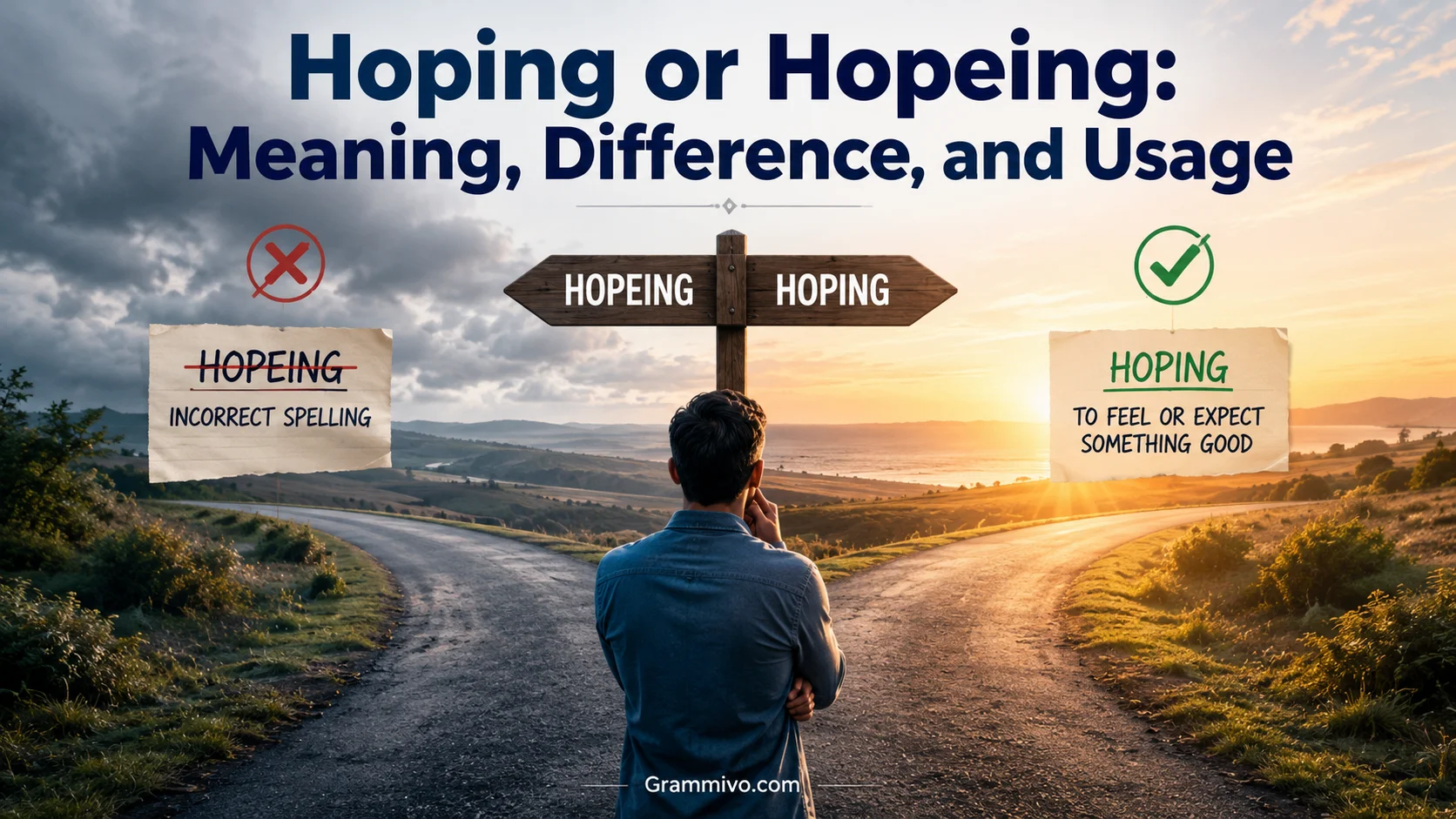
Have you ever stopped while writing because you weren’t sure whether to use hoping or hopeing? You’re not alone. This spelling confusion happens because the verb hope ends with a silent e, which can make adding the suffix -ing seem tricky.
Although both forms might look reasonable at first glance, only one follows standard English spelling rules. The correct spelling is hoping, while hopeing is a common misspelling.
Understanding this small spelling difference can help you write more confidently in emails, text messages, school assignments, and professional documents. The good news? Once you understand the silent-e rule, you’ll find this pattern much easier to remember.
Quick Answer:
Hoping is the correct spelling. Hopeing is incorrect in standard English.
When you add -ing to the verb hope, you must remove its final silent e before adding the suffix. This creates hoping, not hopeing.
For example:
- Correct: I’m hoping to hear from you soon.
- Incorrect: I’m hopeing to hear from you soon.
The word hoping means expecting or wishing for something positive to happen. You can use it when discussing personal wishes, future plans, expectations, or desired outcomes.
Remember: Hope + ing = Hoping.
Comparison Overview:
The easiest way to understand these spellings is to compare their grammatical and spelling characteristics. Although they look similar, they don’t have the same status in standard English.
| Feature | Hoping | Hopeing |
| Correct spelling | Yes | No |
| Base word | Hope | Hope |
| Meaning | Wishing or expecting something | No separate standard meaning |
| Part of speech | Verb form | Incorrect spelling |
| Suffix | -ing | -ing |
| Spelling rule | Drops the final e | Incorrectly retains the e |
| Standard English usage | Accepted | Not accepted |
| Example | I’m hoping for good news. | I’m hopeing for good news. |
The important difference comes down to one letter. When adding -ing to hope, you remove the final silent e.
For example:
- Hope becomes hoping.
- Smile becomes smiling.
- Write becomes writing.
- Make becomes making.
These words follow the same spelling pattern. Once you recognize it, choosing hoping becomes straightforward.
Main Differences Between Hoping and Hopeing
The difference between hoping and hopeing isn’t related to meaning, pronunciation, or regional English. It comes from standard spelling rules.
Hoping Is the Correct Spelling
Hoping is the standard English spelling of the present participle and gerund form of the verb hope.
You use it when expressing a wish, desire, or expectation about something that may happen. It can describe your feelings, thoughts, or expectations about a future event.
For example:
- I’m hoping to get the job.
- She’s hoping for better weather tomorrow.
- We’re hoping everything goes smoothly.
- They are hoping to visit their grandparents soon.
In each sentence, hoping communicates an expectation or desire.
The word can also appear in different grammatical structures. For instance, you can say, “Hoping for a better opportunity, he continued applying for jobs.”
Here, hoping introduces a participial phrase that explains his motivation.
Hopeing Is an Incorrect Spelling
Hopeing is not the accepted spelling in standard modern English dictionaries. It results from keeping the final e in hope when adding -ing.
English spelling rules generally require you to remove a silent final e before adding this suffix.
For example:
- Incorrect: She is hopeing for a promotion.
- Correct: She is hoping for a promotion.
Although readers can usually understand what hopeing means, that doesn’t make it correct.
Using the incorrect spelling in professional emails, academic assignments, or published content can make your writing appear careless. Therefore, always choose hoping.
What Does Hoping Mean?
Hoping means wishing for something or expecting a particular outcome that you would like to happen.
It comes from the verb hope, which describes a feeling of desire or expectation. When you use hoping, you’re expressing that feeling as an ongoing action or state.
For example, imagine you’ve applied for your dream job. You haven’t received a response yet, but you believe you have a good chance.
You might say:
“I’m hoping to receive a positive response from the hiring manager.”
This sentence communicates your expectation without suggesting that the outcome is guaranteed.
The Meaning of Hoping in Different Contexts
The meaning of hoping remains connected to desire and expectation, but its context can change slightly.
Personal situations
You can use hoping to express wishes about your relationships, family, or personal goals.
Examples:
- I’m hoping my family enjoys the surprise.
- She’s hoping to make new friends.
- We’re hoping for a peaceful weekend.
Professional situations
In workplace communication, hoping can express expectations politely without sounding demanding.
Examples:
- I’m hoping we can finalize the agreement today.
- We’re hoping to receive your feedback soon.
- I’m hoping to discuss the proposal with you.
Future expectations
You can also use hoping when discussing plans or possible future events.
Examples:
- They’re hoping to move next summer.
- I’m hoping to finish the project by Friday.
- She’s hoping to travel abroad next year.
Is Hoping a Verb or a Noun?
Hoping can function as both a verb form and a gerund, depending on how you use it.
As a verb form, it often appears in continuous tenses.
- I am hoping for good news.
- They were hoping to meet the deadline.
As a gerund, it functions as a noun within a sentence.
- Hoping for success keeps her motivated.
- His hoping for a different result changed nothing.
The grammatical role depends on the sentence structure rather than the spelling.
What Does Hopeing Mean?
Hopeing doesn’t have a separate accepted meaning in standard English. It’s simply an incorrect spelling of hoping.
People sometimes write it because they assume they should preserve the original spelling of hope when adding the suffix -ing.
However, English doesn’t work that way with most verbs ending in a silent final e.
Consider these examples:
| Incorrect spelling | Correct spelling |
| Hopeing | Hoping |
| Makeing | Making |
| Writeing | Writing |
| Smileing | Smiling |
| Danceing | Dancing |
| Driveing | Driving |
| Bakeing | Baking |
Notice how each correct form removes the final e before adding -ing.
Why Do People Write Hopeing?
There are several reasons why this spelling mistake happens.
The original word contains an e. People sometimes assume that adding a suffix means keeping every letter of the original word.
The spelling rule isn’t familiar. Someone who hasn’t learned the silent-e rule may naturally write hopeing.
Typing mistakes happen. When writing quickly, people may follow the pronunciation or spelling pattern they imagine rather than checking the correct form.
The spelling looks reasonable. Since hope becomes hopeful and hopeless, retaining the e in hopeing might seem logical.
However, suffixes follow different spelling patterns. You need to consider the specific suffix before changing a word.
The Spelling Rule: Why Do You Drop the Final E?
English has several spelling rules that explain how words change when you add suffixes. One of the most useful involves verbs ending in a silent e.
When you add -ing to most verbs ending in a silent final e, you drop that final letter.
The basic formula is:
Verb ending in silent e − e + ing = New word
For example:
- Hope + ing = Hoping
- Write + ing = Writing
- Make + ing = Making
- Dance + ing = Dancing
The final e disappears because the spelling convention doesn’t require it before -ing.
How the Silent E Rule Works
The silent e often affects the pronunciation of the preceding vowel. For example, the final e in hope helps create the long vowel sound in the base word.
However, when you add -ing, the spelling changes.
Compare:
- Hope: The final e is silent.
- Hoping: The final e disappears, but the long vowel sound remains.
The pronunciation changes slightly in its ending, but the main vowel sound stays consistent.
This pattern also appears in other common English verbs.
Examples of Verbs That Drop the Final E
Here are some everyday examples that follow the same spelling rule.
| Base verb | Add -ing | Example sentence |
| Hope | Hoping | I’m hoping for good news. |
| Make | Making | She’s making dinner. |
| Write | Writing | He’s writing an email. |
| Drive | Driving | They’re driving home. |
| Smile | Smiling | The baby is smiling. |
| Dance | Dancing | We are dancing together. |
| Bake | Baking | I’m baking a cake. |
| Take | Taking | She’s taking a break. |
| Give | Giving | He’s giving a presentation. |
| Save | Saving | We’re saving money. |
These examples make the pattern easier to recognize. When you encounter a similar verb, check whether its final e should disappear before adding -ing.
Are There Exceptions to the Silent E Rule?
Yes. English has exceptions, so you shouldn’t apply the rule blindly to every word ending in e.
Some verbs keep the final e to preserve pronunciation or distinguish their spelling.
For example:
- See → Seeing
- Agree → Agreeing
- Be → Being
These words retain their final letters or follow different spelling patterns.
There’s also a special case involving verbs ending in -ie.
For example:
- Lie → Lying
- Die → Dying
- Tie → Tying
Here, ie changes to y before adding -ing.
However, hope follows the regular silent-e dropping pattern. Its correct form is always hoping in standard English.
How to Use Hoping in a Sentence
Knowing the correct spelling is only the first step. You should also understand how hoping works in different sentence structures.
The word commonly appears in continuous verb tenses, participial phrases, and gerund constructions.
Hoping With Helping Verbs
You can use hoping with helping verbs such as am, is, are, was, and were.
These combinations often describe an ongoing wish or expectation.
Examples:
- I am hoping to hear from the university.
- She is hoping for a better opportunity.
- They are hoping to finish the work today.
- We were hoping to see you at the event.
In these examples, the helping verb combines with hoping to create a continuous verb construction.
Hoping With To
You can also use hoping to before another verb in its base form.
This construction expresses a desired action or future possibility.
Examples:
- I’m hoping to visit New York.
- She’s hoping to become a doctor.
- They’re hoping to win the competition.
- He’s hoping to improve his English.
Notice that the verb following to stays in its base form.
You write hoping to visit, not hoping to visiting.
Hoping With For
Another common construction is hoping for, followed by a noun or noun phrase.
Use this structure when describing the outcome or thing you want.
Examples:
- I’m hoping for good news.
- She’s hoping for a promotion.
- They’re hoping for better results.
- We’re hoping for a peaceful holiday.
This construction works particularly well in everyday conversations and professional communication.
Hoping at the Beginning of a Sentence
You can begin a sentence with hoping when using a participial phrase.
This structure adds context and explains someone’s intention or motivation.
Examples:
- Hoping for a positive result, she checked her email repeatedly.
- Hoping to avoid traffic, we left early.
- Hoping to impress the interviewer, he prepared carefully.
Make sure the person performing the action in the introductory phrase matches the subject of the main clause.
For example:
- Correct: Hoping to win the race, Maria trained every morning.
- Incorrect: Hoping to win the race, the finish line came into view.
The second sentence incorrectly suggests that the finish line was hoping to win.
Common Situations Where You Can Use Hoping
Hoping fits naturally into many everyday situations. Its meaning stays consistent, but the surrounding words help communicate your specific intention.
Hoping to Express a Wish
When you want something positive to happen, hoping provides a natural way to express that desire.
Examples:
- I’m hoping everything works out.
- She’s hoping her friends remember her birthday.
- We’re hoping for a wonderful celebration.
- He’s hoping his parents understand his decision.
Hoping for a Positive Outcome
You can use hoping when waiting for results or expecting a particular outcome.
Examples:
- I’m hoping the test results are positive.
- We’re hoping the weather improves tomorrow.
- They’re hoping their team wins the championship.
- She’s hoping the application gets approved.
Hoping in Professional Emails
In professional communication, hoping can help you express expectations politely.
It often sounds less demanding than directly asking someone to do something.
Examples:
- I’m hoping to receive your feedback by Thursday.
- We’re hoping to schedule a meeting next week.
- I’m hoping we can discuss the proposal soon.
- I’m hoping this email finds you well.
However, consider the tone of your message. In some situations, direct language sounds clearer and more confident.
For example, instead of writing “I’m hoping you can send the report,” you might write “Could you please send the report by Friday?”
Hoping in Casual Conversations
People frequently use hoping when discussing everyday plans and expectations.
Examples:
- I’m hoping we can grab lunch tomorrow.
- She’s hoping to see the new movie.
- We’re hoping to spend the weekend outdoors.
- I’m hoping you have a great day.
These expressions sound natural because they communicate wishes without making promises.
Hoping When Talking About Future Plans
You can also use hoping when discussing goals that haven’t happened yet.
Examples:
- I’m hoping to start my business next year.
- They’re hoping to buy a new house.
- She’s hoping to study abroad.
- We’re hoping to move closer to our family.
Remember that hoping expresses a desire rather than a confirmed plan. Someone can hope to accomplish something without knowing whether it’ll happen.
Frequently Asked Questions
Is Hoping or Hopeing Correct?
Hoping is correct, while hopeing is a spelling mistake in standard English. The verb hope loses its final silent e before the suffix -ing is added.
Why Does Hoping Not Have an E?
Hoping doesn’t contain the final e because English spelling rules generally remove a silent final e before adding -ing. Therefore, hope becomes hoping rather than hopeing.
Is Hopeing Ever a Correct Word?
No. Hopeing isn’t an accepted standard spelling of the verb hope. You should always write hoping in formal and informal English.
What Is the Difference Between Hoping and Hopping?
Hoping means wishing or expecting something to happen. Hopping means jumping or moving with short leaps. For example, “I’m hoping to win” expresses an expectation, while “The rabbit is hopping” describes movement.
What Is the Present Tense of Hope?
The base verb is hope. Its simple present forms include hope and hopes.
Examples:
- I hope everything goes well.
- She hopes to become a teacher.
The present participle is hoping, as in “I am hoping for good news.”
Conclusion:
When choosing between hoping and hopeing, hoping is always the correct spelling in standard English. The difference comes from a simple spelling rule: drop the final silent e before adding -ing. That’s why hope becomes hoping, just as make becomes making and write becomes writing. You can use hoping to express wishes, expectations, and desires in everyday conversations, professional emails, and academic writing.
