
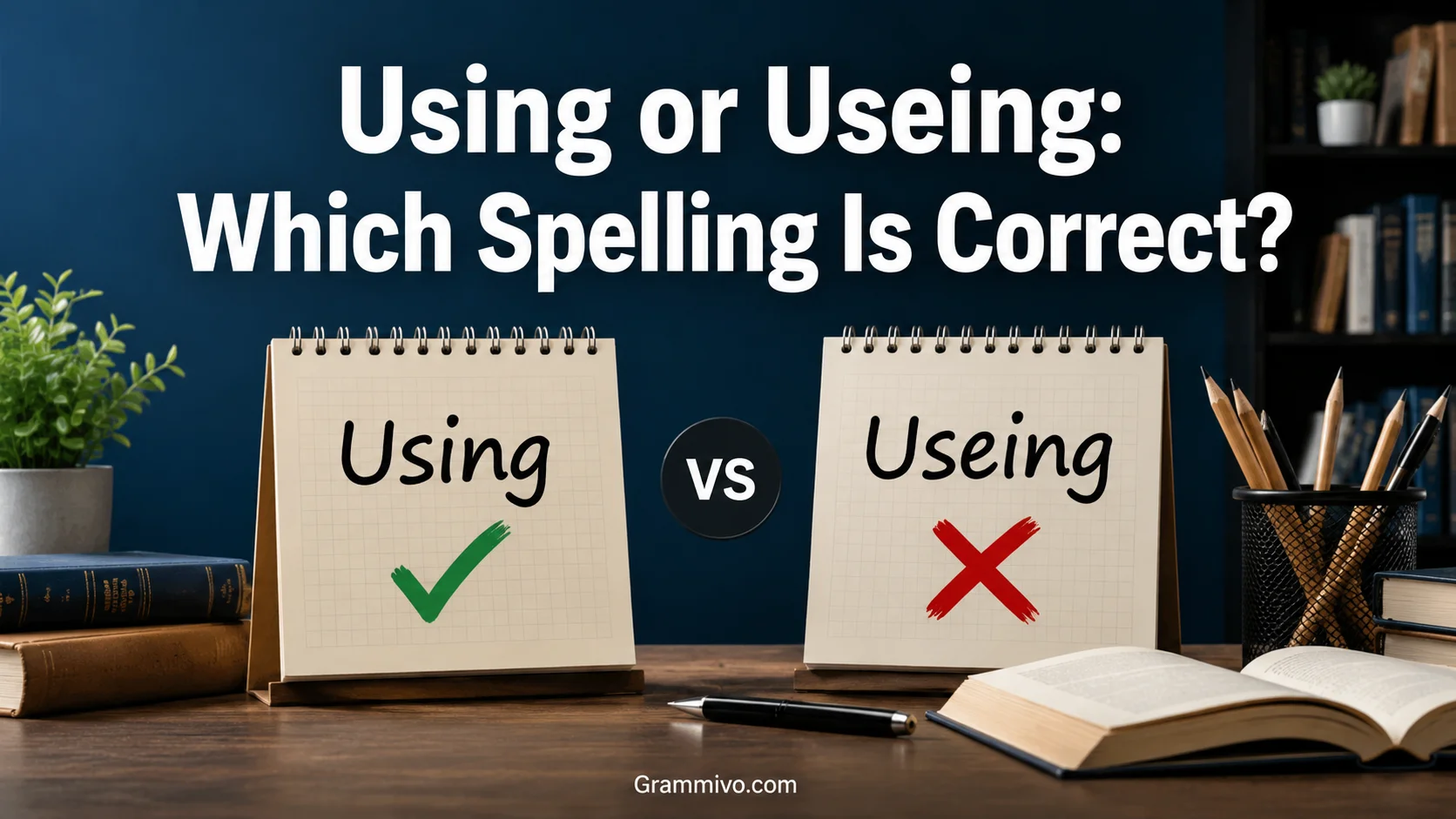
Have you ever wondered whether the correct spelling is using or useing? You’re not alone. Many English writers struggle with this spelling because the base word use ends with the letter e. When adding the suffix -ing, it may seem natural to keep the original spelling and write useing. However, English spelling follows a specific rule that changes the word’s ending.
The correct spelling is using, while useing is incorrect in standard English. When you add -ing to a verb that ends in a silent e, you generally drop the final e before adding the suffix. That’s why use becomes using rather than useing.
Understanding this simple spelling pattern can help you avoid similar mistakes in everyday writing, school assignments, emails, and professional communication. Once you recognize how silent-e verbs work, you’ll find it easier to spell many other English words correctly.
Quick Answer:
Using is the correct spelling, while useing is a misspelling. The word using comes from the verb use and describes the action of putting something into service or employing it for a particular purpose.
When you add -ing to use, you remove the final silent e and attach the suffix. This spelling rule also applies to words such as make, write, and take.
Correct: She is using my laptop to finish her assignment.
Incorrect: She is useing my laptop to finish her assignment.
Remember this simple rule: Use + ing = Using.
Comparison Overview
The difference between using and useing comes down to one spelling rule. Although both forms may look reasonable at first glance, only one follows standard English spelling conventions.
| Feature | Using | Useing |
| Correct spelling | Yes | No |
| Base word | Use | Use |
| Word formation | Use + ing | Incorrect formation |
| Part of speech | Verb form and gerund | No standard grammatical use |
| Meaning | Employing or making use of something | No accepted meaning |
| Standard English | Accepted | Misspelled |
| Example | He is using a calculator. | He is useing a calculator. |
The distinction becomes clearer when you understand how English treats verbs ending in silent e. Instead of keeping every letter from the original word, English spelling often removes the final e before adding certain suffixes.
For example:
- Make → Making
- Write → Writing
- Drive → Driving
- Use → Using
This pattern explains why using is correct. The spelling useing incorrectly retains the final e.
Main Differences Between Using and Useing
Although using and useing contain nearly identical letters, they don’t have equal standing in English. One is a correctly formed verb form, while the other results from misunderstanding a spelling rule.
Using Is the Correct Spelling
Using is the accepted spelling of the present participle and gerund form of use. It describes the action of employing something for a particular purpose.
You can use this word in different situations. For example, someone might be using a computer, using a particular method, or using their experience to solve a problem.
Consider these examples:
- Maria is using her phone to contact her friend.
- The mechanic is using a special tool to repair the engine.
- We’re using a different approach to complete the project.
- He enjoys using his creativity to solve problems.
In each sentence, using describes an action or functions as a noun-like verb form.
Useing Is an Incorrect Spelling
Useing is not a standard English word. It appears when someone adds -ing to use without removing the final silent e.
The mistake usually happens because writers assume they must preserve every letter in the original verb. However, English spelling doesn’t always work that way.
For example:
- Incorrect: She is useing a new application.
- Correct: She is using a new application.
- Incorrect: They are useing the wrong equipment.
- Correct: They are using the wrong equipment.
Even though readers can usually understand the intended meaning, the incorrect spelling can make your writing look careless. It’s especially important to use the standard form in academic papers, business documents, resumes, and professional emails.
Why Is Using the Correct Spelling?
The spelling using follows an established English spelling convention for verbs ending in a silent e. Understanding this rule helps explain why the original word changes when you add -ing.
The Silent-E Spelling Rule
Many English verbs end with a silent e. Although the letter appears in the written word, it doesn’t have a separate pronounced sound in the final position.
When you add a suffix beginning with a vowel, such as -ing, you generally remove the silent e.
The basic pattern looks like this:
Base verb + -ing = Remove final silent e + -ing
Examples include:
| Base Verb | Adding -ing | Correct Form |
| Use | Use + ing | Using |
| Make | Make + ing | Making |
| Write | Write + ing | Writing |
| Take | Take + ing | Taking |
| Drive | Drive + ing | Driving |
| Dance | Dance + ing | Dancing |
| Give | Give + ing | Giving |
| Come | Come + ing | Coming |
Notice that the final e disappears in each example. The remaining letters combine with -ing to create the correct spelling.
Why Does English Remove the Final E?
The silent e often helps establish how a preceding vowel sounds. For instance, the final e in use helps indicate the pronunciation of the vowel before the consonant.
However, when you add -ing, the spelling structure changes. The suffix begins with a vowel, so the final silent e generally becomes unnecessary.
Removing it also keeps the spelling consistent with a long-established English convention.
Compare these forms:
- Use → Using
- Hope → Hoping
- Smile → Smiling
- Bake → Baking
The final e doesn’t need to remain when the word takes the -ing suffix.
Does This Rule Apply to Every Verb Ending in E?
No. English spelling has exceptions, so you shouldn’t remove the final e automatically from every verb.
For example:
- See → Seeing
- Agree → Agreeing
- Free → Freeing
- Flee → Fleeing
These verbs retain their final e because removing it would create awkward or misleading letter combinations.
However, use follows the regular silent-e pattern. Therefore, using is the correct form.
Why Is Useing Incorrect?
The spelling useing comes from a common misunderstanding about suffixes. Writers sometimes assume that adding -ing simply means attaching those letters to the complete original word.
That approach works for some words but not for verbs ending in a silent e.
It Retains an Unnecessary Letter
The biggest problem with useing is that it keeps the final e when standard spelling requires its removal.
The correct formation follows this process:
- Start with the base verb: Use
- Identify the final silent letter: e
- Remove the final e.
- Add the suffix -ing.
- Get the correct spelling: Using.
The incorrect formation skips the third step and produces useing.
It Doesn’t Follow Standard English Conventions
English spelling relies on established patterns that help readers recognize words and understand their grammatical forms.
Although useing looks understandable, it doesn’t follow the accepted spelling convention. Dictionaries and standard writing references recognize using as the correct form.
You’ll also find that spell-checking tools typically flag useing because it doesn’t match the standard spelling.
It Can Affect Professional Writing
A single spelling mistake might seem insignificant. However, repeated errors can distract readers and reduce confidence in your writing.
Imagine submitting a business proposal that repeatedly uses useing instead of using. The reader may understand your message, but the mistake creates an unnecessary distraction.
Use the correct spelling in:
- Business emails and reports
- Academic assignments and research papers
- Professional presentations
- Job applications and resumes
- Website content and blog articles
- Everyday messages when correct spelling matters
What Does Using Mean?
The word using is the present participle and gerund form of the verb use. It generally means employing something, applying a method, or making something serve a particular purpose.
The word can describe physical actions as well as abstract activities.
For example, you might be using a pen to write a letter. You could also be using your knowledge to solve a difficult problem.
Using as a Present Participle
A present participle is a verb form that ends in -ing. It commonly appears in continuous verb tenses to describe an action that is happening or was happening at a particular time.
When using functions as a present participle, it often follows a form of the helping verb be.
Examples:
- She is using my computer right now.
- They are using the conference room.
- I was using your calculator yesterday.
- We were using an older version of the software.
- The company has been using this system for years.
In these sentences, using helps express an ongoing action. The helping verb establishes the tense while using describes the activity.
Using as a Gerund
A gerund is a verb form ending in -ing that functions as a noun.
Although it comes from a verb, a gerund can act as the subject or object of a sentence.
Examples:
- Using public transportation saves money.
- She enjoys using creative techniques.
- Using a calculator makes complicated calculations easier.
- He dislikes using outdated equipment.
In the first example, using public transportation acts as the subject of the sentence. In the second, using creative techniques functions as the object of the verb enjoys.
The word looks the same in both grammatical roles. Its function depends on how you use it in the sentence.
Using in Participial Phrases
A participial phrase contains a participle along with other words that provide additional information.
When using begins such a phrase, it can describe how someone performs an action.
Examples:
- Using a detailed map, we found the correct destination.
- Using the latest software, the designer completed the project.
- Using simple ingredients, the chef prepared a delicious meal.
- Using her previous experience, Sarah solved the problem.
These phrases add useful details without requiring another complete sentence.
Make sure the phrase clearly refers to the correct person or thing. Otherwise, you might create a dangling modifier.
How to Use Using in a Sentence
The word using appears in everyday conversations, professional communication, academic writing, and technical explanations.
Its meaning stays relatively consistent, but the context determines what someone is employing or applying.
Using in Everyday Conversations
In everyday English, using commonly describes ordinary activities involving objects, tools, and resources.
Examples:
- I’m using your charger because mine stopped working.
- Are you using this chair?
- She’s using her phone to take pictures.
- We’re using the kitchen to prepare dinner.
- He’s using my headphones right now.
These sentences sound natural because they describe familiar situations.
Using in Professional and Workplace Writing
In professional communication, using often describes methods, equipment, software, and available resources.
Examples:
- We’re using customer feedback to improve our services.
- The marketing team is using new strategies to attract customers.
- Our department is using updated reporting software.
- The company is using employee training to improve productivity.
- The analyst is using recent figures to prepare the report.
The word works well in workplace writing because it communicates actions directly.
Using in Academic Writing
Academic writing frequently uses using to describe research methods, analytical techniques, and evidence.
Examples:
- The researchers are using a different sampling method.
- Students can improve their understanding by using practical examples.
- The study examines results using statistical analysis.
- The experiment was conducted using standardized equipment.
In academic contexts, using can introduce a method or explain how researchers obtained particular results.
Using in Technology-Related Contexts
Technology provides countless examples of how people use the word using.
You might use it to describe software, digital devices, online platforms, or automated systems.
Examples:
- I’m using a spreadsheet to organize the information.
- The developer is using artificial intelligence to analyze data.
- Customers are using mobile applications to manage their accounts.
- She learned programming by using online tutorials.
- The team is using cloud storage to share files.
These examples demonstrate how naturally using fits into modern communication.
Using in Different Grammatical Forms
Understanding the grammatical functions of using helps you use it accurately. Although its spelling never changes, its role depends on the sentence structure.
Using in Continuous Verb Tenses
Continuous tenses describe actions that are ongoing or were ongoing at a particular time.
The present participle using combines with helping verbs to form these tenses.
| Tense | Example |
| Present Continuous | She is using the computer. |
| Past Continuous | She was using the computer. |
| Future Continuous | She will be using the computer. |
| Present Perfect Continuous | She has been using the computer. |
| Past Perfect Continuous | She had been using the computer. |
Notice that using stays the same in every example. The helping verbs change to express different time relationships.
Using After Prepositions
Gerunds commonly appear after prepositions. In these situations, using functions as a noun-like form rather than the main verb of a continuous tense.
Examples:
- You can improve your results by using better techniques.
- She succeeded without using expensive equipment.
- He learned the process through using practical examples.
- They discussed the benefits of using renewable energy.
A useful grammatical point is that English generally uses the gerund after a preposition when the following expression describes an action.
Using After Certain Verbs
Some verbs naturally take gerunds as their objects. Common examples include enjoy, avoid, consider, finish, and suggest.
Examples:
- I enjoy using creative approaches.
- She avoids using unnecessary applications.
- They considered using a different strategy.
- He finished using the equipment.
- We recommend using fresh ingredients.
This pattern is especially useful when constructing natural English sentences.
Using in Participial Phrases
You can also place using at the beginning of a sentence to introduce an action or method.
Examples:
- Using the available information, we identified the problem.
- Using a simple formula, the teacher explained the calculation.
- Using modern equipment, the technicians completed the inspection.
These constructions make sentences more concise while providing additional context.
Frequently Asked Questions
Is Using or Useing Correct?
Using is correct, while useing is incorrect. The word using follows the standard spelling rule that removes the final silent e before adding -ing. You should always use using in standard English writing.
Why Does Use Become Using?
The verb use ends with a silent e. When you add the suffix -ing, you remove that final letter and attach the suffix. This produces using rather than useing.
The same pattern appears in words such as making, writing, and taking.
What Is the Spelling Rule for Words Ending in Silent E?
Most verbs ending in a silent e drop that letter before adding a suffix that begins with a vowel. For example, make becomes making and hope becomes hoping.
However, some words retain the final e, including seeing, agreeing, and freeing.
Is Useing Ever Acceptable in English?
No. Useing isn’t an accepted standard English spelling. It’s generally considered a spelling mistake rather than an alternative form of using.
You should avoid it in formal writing, academic work, business communication, and everyday messages.
What Is the Difference Between Use and Using?
Use is the base form of the verb, while using is its present participle and gerund form.
For example:
- Use: I use this computer every day.
- Using: I am using this computer right now.
- Gerund: Using this computer is easy.
The word use describes the basic action, while using can describe an ongoing activity or function as a noun.
Conclusion:
The difference between using and useing is straightforward once you understand the silent-e spelling rule. Using is the correct spelling, while useing is an incorrect form that retains an unnecessary letter. When you add -ing to most verbs ending in a silent e, you remove the final letter first. That’s why use becomes using, just as make becomes making and write becomes writing. Keep this simple rule in mind whenever you’re writing. It will help you avoid common spelling mistakes and make your English clearer, more accurate, and more professional.
