
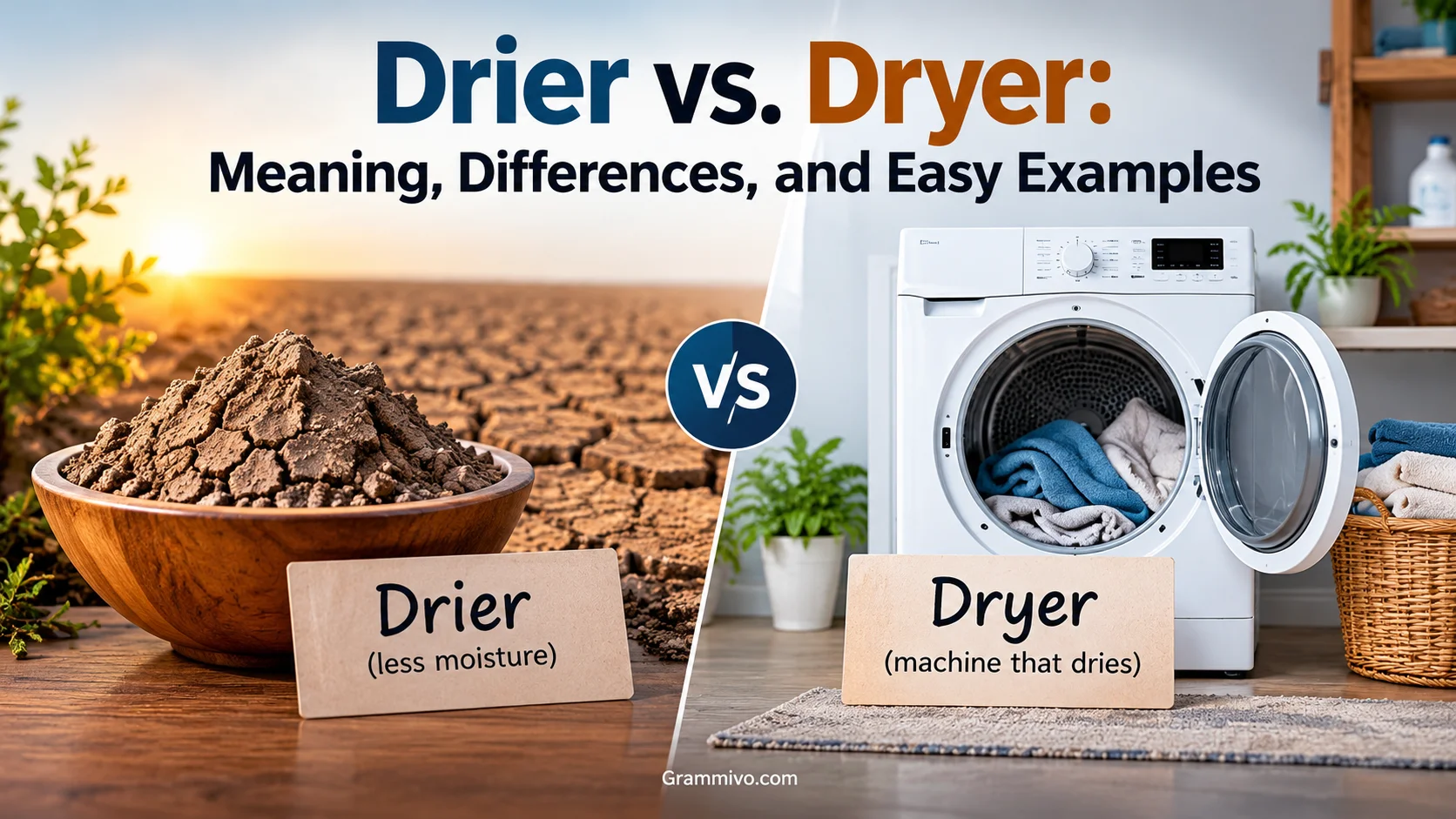
Drier vs. Dryer can confuse students, learners, bloggers, and professional writers because the words look similar and mean different things. In English, drier usually means more dry, while dryer commonly means a machine, device, or appliance that dries something by removing moisture.
For example, drier weather describes less moist weather, while a hair dryer dries hair. You may also encounter hair drier in some contexts. This key difference becomes simple when you recognize the pattern. Drier describes a condition or thing that is becoming dry, whereas dryer commonly names a machine.
These terms can appear in discussions about climate change, skin, clothes, cooking, and household appliances. In real-life examples, “The air is drier today” uses drier as a comparison, while “The clothes are in the dryer” uses dryer for a machine. The distinction can also matter when shopping online, especially when comparing washing machines, tumble dryers, and prices.
Quick Answer
Drier usually means more dry. It is the standard comparative form of the adjective dry in common US English.
Dryer most commonly means a machine or device used for drying something, such as a clothes dryer or hair dryer.
Here’s the easiest way to remember them:
- Drier = more dry
- Dryer = something that dries
Examples
- “The desert climate is drier than the coastal climate.”
- “My skin becomes drier during winter.”
- “Put the towels in the dryer.”
- “The bathroom has a hand dryer.”
So, if you’re comparing levels of dryness, drier is usually the word you want. If you’re talking about an appliance or device, dryer is the natural choice.
Comparison Overview
| Word | Common Function | Meaning | Example |
| Drier | Comparative adjective | More dry | “This towel is drier than that one.” |
| Dryer | Noun | A device that dries something | “The dryer is running.” |
| Dryer | Comparative adjective in some usage | More dry | “The soil is dryer this year.” |
| Dry | Adjective | Having little or no moisture | “The towel is dry.” |
| Driest | Superlative adjective | Most dry | “This is the driest month.” |
The biggest source of confusion comes from the fact that drier and dryer can sometimes overlap when dryer functions as a comparative adjective.
Still, their everyday roles are easy to separate. Drier generally describes a greater degree of dryness. Dryer usually names the thing doing the drying.
Main Differences Between Drier vs. Dryer
The distinction between drier vs. dryer becomes much easier when you focus on meaning rather than spelling.
Drier normally compares two things based on their dryness. Dryer, on the other hand, usually identifies a machine, appliance, or device that removes moisture.
Consider these two sentences:
“The air is drier today.”
“The clothes are in the dryer.”
In the first sentence, drier compares today’s air with an earlier or different condition. In the second, dryer names an appliance.
Drier Means “More Dry”
The word drier is the comparative form of dry. It tells you that one thing has less moisture than another.
For example:
- “This towel is drier than the one on the floor.”
- “The climate becomes drier as you travel west.”
- “My hands feel drier after washing them frequently.”
- “The soil is drier this week.”
- “The paint looks drier near the window.”
The comparison can be explicit or implied.
You don’t always need the word than. In “My skin feels drier today,” the comparison is understood from context. The speaker means the skin has become more dry than it was before.
Dryer Usually Means a Drying Machine
Dryer is most commonly a noun. It describes something designed to remove moisture.
The most familiar example is a clothes dryer, an appliance that uses heated or unheated air to remove moisture from clothing and other fabrics.
You might also encounter:
- Hair dryer
- Hand dryer
- Food dryer
- Boot dryer
- Dish dryer
- Industrial dryer
- Grain dryer
For example:
- “The clothes are still in the dryer.”
- “She used a hair dryer before leaving.”
- “The restaurant installed a high-speed hand dryer.”
- “The manufacturer uses an industrial dryer to remove moisture.”
Here, dryer doesn’t mean “more dry.” It identifies an object that performs the drying process.
What Does “Drier” Mean?
Drier describes something that has become more dry or contains less moisture compared with something else.
It comes from the adjective dry.
The basic pattern is:
dry → drier → driest
These forms represent increasing degrees of dryness.
- Dry = little or no moisture
- Drier = more dry
- Driest = most dry
Drier as a Comparative Adjective
A comparative adjective compares two people, objects, places, conditions, or states.
For example:
“Arizona is generally drier than Florida.”
The sentence compares the climates of two states.
Other examples include:
- “This bread is drier than yesterday’s loaf.”
- “The winter air feels drier indoors.”
- “The towel on the rack is drier.”
- “The northern region is drier during summer.”
- “This soil is drier than the soil near the river.”
Notice how drier always describes a condition in these examples.
It doesn’t name a device. Instead, it tells you about the degree of dryness.
Why Does “Dry” Become “Drier”?
English spelling rules can make short words ending in y behave differently when you add a suffix.
When the y follows a consonant, it commonly changes to i before certain suffixes.
That gives us:
- dry → drier
- dry → driest
The same general pattern appears in other words:
- happy → happier
- busy → busier
- easy → easier
- heavy → heavier
So drier follows a familiar English spelling pattern.
What Does “Dryer” Mean?
The most common meaning of dryer is a machine or device that dries something.
You probably encounter the word most often when talking about laundry.
Dryer as a Noun
A dryer removes moisture from an object or material.
A household clothes dryer typically tumbles clothing while circulating air through the drum. Depending on the model and setting, the machine may use heated air to speed up evaporation.
Common examples include:
- Clothes dryer: dries garments, towels, sheets, and other washable fabrics.
- Hair dryer: blows air across wet hair to help remove moisture.
- Hand dryer: blows air over hands after washing.
- Food dryer: removes moisture from food for preservation.
- Boot dryer: circulates air through footwear to dry it.
- Industrial dryer: removes moisture from materials during manufacturing.
For example:
“The clothes dryer finished its cycle.”
Here, dryer clearly refers to an appliance.
Dryer as a Comparative Adjective
This is where things get slightly more complicated.
Dryer can also be used as a comparative form of dry. Some dictionaries recognize this usage, and you may encounter it in published writing.
For example:
“The climate is getting dryer.”
In this sentence, dryer means “more dry.” It doesn’t refer to an appliance.
However, drier remains the more familiar and widely preferred form when you simply mean “more dry” in standard US English.
That distinction matters for clear writing. If your goal is to make the sentence immediately understandable, drier avoids the possibility that readers will interpret dryer as a machine.
Drier vs. Dryer Examples
Context makes these words much easier to distinguish.
Examples With “Drier”
Use drier when you’re describing something that has become more dry or comparing its dryness.
- “The air is drier in the desert.”
- “This towel is drier than that one.”
- “My skin feels drier in cold weather.”
- “The ground became drier after several sunny days.”
- “The bread is drier than I expected.”
- “The climate becomes drier farther inland.”
- “The paint looks drier now.”
- “The leaves become drier during the fall.”
Each example describes a condition rather than a machine.
Examples With “Dryer”
Use dryer when you’re talking about a device designed to dry something.
- “The dryer is making a strange noise.”
- “Put the wet towels in the dryer.”
- “My hair is still wet, so I need a dryer.”
- “The hand dryer isn’t working.”
- “The clothes came out of the dryer warm.”
- “The food dryer removes moisture slowly.”
- “The boot dryer runs overnight.”
- “The industrial dryer operates at high temperatures.”
Here, dryer functions as a noun.
Drier and Dryer in the Same Sentence
One of the easiest ways to understand the distinction is to use both words together.
Consider this sentence:
“The air is drier, so the clothes dry faster in the dryer.”
The two words perform completely different jobs.
- Drier describes the air.
- Dryer names the appliance.
Another example:
“Because the towels were drier, they didn’t need as much time in the dryer.”
Again, the first word describes moisture level. The second identifies the machine.
This is a useful trick because it shows that spelling alone doesn’t determine meaning. Context does.
Drier vs. Dryer in American English
In US English, drier is the standard, straightforward comparative form when you mean more dry.
For example:
- “The air is drier today.”
- “This towel is drier than that one.”
- “The climate is becoming drier.”
Meanwhile, dryer is overwhelmingly familiar as the noun for a drying appliance.
That makes the following distinction especially useful for everyday American writing:
Drier → degree of dryness
Dryer → drying device
This isn’t a claim that dryer can never describe a degree of dryness. English usage contains variation, and dictionaries record some overlap. However, choosing drier for the comparative adjective keeps your meaning unmistakable.
Why Context Matters
Imagine reading this sentence:
“The clothes are getting dryer.”
At first glance, many readers will wonder whether the writer means the clothes are becoming drier or whether dryer refers to an appliance.
Now compare:
“The clothes are getting drier.”
The intended meaning is immediately clear.
That’s why spelling isn’t merely cosmetic. A small letter can change how quickly your reader understands a sentence.
Drier vs. Dryer in British English
The basic distinction also exists in British English, although vocabulary for drying appliances can differ.
For example, British English commonly uses tumble dryer for the appliance used to dry clothes. American English generally uses clothes dryer.
Compare:
| Meaning | US English | British English |
| Machine for drying clothes | Clothes dryer | Tumble dryer |
| Machine for drying hair | Hair dryer | Hair dryer |
| More dry | Drier | Drier |
The comparative adjective drier remains a natural choice when expressing a greater degree of dryness.
So if you’re writing for a broad English-speaking audience, drier is a useful and clear choice when you mean “more dry.”
Read More: Labeler vs. Labeller: Which Spelling Is Correct?
Common Mistakes With Drier and Dryer
Because the words differ by only one letter, mistakes happen easily.
Using “Dryer” When You Mean “More Dry”
A common mistake is writing:
“The desert is dryer than the forest.”
For standard US usage, the clearer choice is:
“The desert is drier than the forest.”
The reason is straightforward. You’re comparing the dryness of two environments. You’re not talking about a machine.
Using “Drier” for an Appliance
Another mistake reverses the problem:
“Put the clothes in the drier.”
If you’re referring to the laundry appliance, the standard spelling is:
“Put the clothes in the dryer.”
The appliance is a dryer because its purpose is to dry.
Confusing the Comparative and the Noun
The best way to avoid confusion is to identify the word’s job.
Ask yourself:
Am I describing something as more dry?
If yes, drier is generally the best choice.
Am I naming a machine or device that dries something?
If yes, use dryer.
This simple question works in most everyday situations.
Drier vs. Dryer: Grammar Breakdown
| Form | Word | Grammatical Role | Meaning |
| Base form | Dry | Adjective | Having little or no moisture |
| Comparative | Drier | Adjective | More dry |
| Superlative | Driest | Adjective | Most dry |
| Appliance/device | Dryer | Noun | Something that dries |
Understanding the grammar makes the spelling easier to remember.
Dry
Dry describes something with little or no moisture.
“The towel is dry.”
Drier
Drier compares one degree of dryness with another.
“This towel is drier than the other one.”
Driest
Driest identifies the highest degree of dryness among multiple things.
“August is usually the driest month here.”
Dryer
Dryer commonly names a device that removes moisture.
“The dryer is full of towels.”
These four words belong to related territory, but they don’t perform the same grammatical job.
Drier vs. Dryer: A Simple Memory Trick
Here’s an easy mnemonic:
Drier describes. Dryer dries.
If you’re describing something as more dry, think drier.
If you’re naming something that does the drying, think dryer.
You can also remember it this way:
Drier = condition
Dryer = equipment
For example:
“The clothes are drier now.”
That’s a condition.
“The clothes are in the dryer.”
That’s equipment.
The distinction is small but surprisingly powerful.
Drier, Dryer, and Driest: How They Differ
These three forms often appear together when discussing dryness.
Dry
Dry is the basic adjective.
“The towel is dry.”
It tells you that the towel contains little or no moisture.
Drier
Drier is the comparative form.
“The towel is drier than the shirt.”
You’re comparing two items.
Driest
Driest is the superlative form.
“This is the driest towel in the basket.”
You’re identifying the item with the greatest degree of dryness.
Dryer
Dryer is usually a noun when it refers to an appliance.
“The dryer is beside the washing machine.”
Putting these forms side by side makes the pattern clear:
Dry → Drier → Driest
Dryer → A device that dries
Real-World Case Study: Laundry
Imagine you’ve just finished washing several towels.
You place them inside the dryer and start the cycle. Afterward, you notice that some towels feel slightly damp while others feel completely dry.
You might say:
“The towels from the second load are drier.”
Here, drier compares the condition of the towels.
But you’d say:
“The dryer finished the cycle.”
Here, dryer identifies the machine.
One situation gives you both words naturally. The meaning changes because their grammatical roles change.
FAQs:
Is drier or dryer correct?
Both drier and dryer are correct, but they usually have different meanings. Drier generally means “more dry,” while dryer commonly refers to a machine or appliance that dries something.
Is it drier weather or dryer weather?
Drier weather is the usual choice when you mean weather with less moisture. Here, drier is the comparative form of dry.
Is it hair dryer or hair drier?
Hair dryer is the common term in standard everyday US English. Hair drier can also be found, but it is less common.
Can dryer mean more dry?
Yes. Dryer can function as a comparative form of dry in some dictionaries and usage contexts. However, drier is the clearer everyday choice when you mean “more dry” in US English.
How can I remember the difference between drier and dryer?
Think of dryer as a machine that dries clothes or hair. Use drier when comparing dryness, such as “The air is drier today.”
Conclusion:
The difference between drier vs. dryer becomes easier when you focus on meaning and context. Use drier when you mean “more dry,” and use dryer when referring to a machine or appliance that removes moisture. Although dryer can sometimes work as a comparative, drier is generally the clearest choice for everyday US English.
