
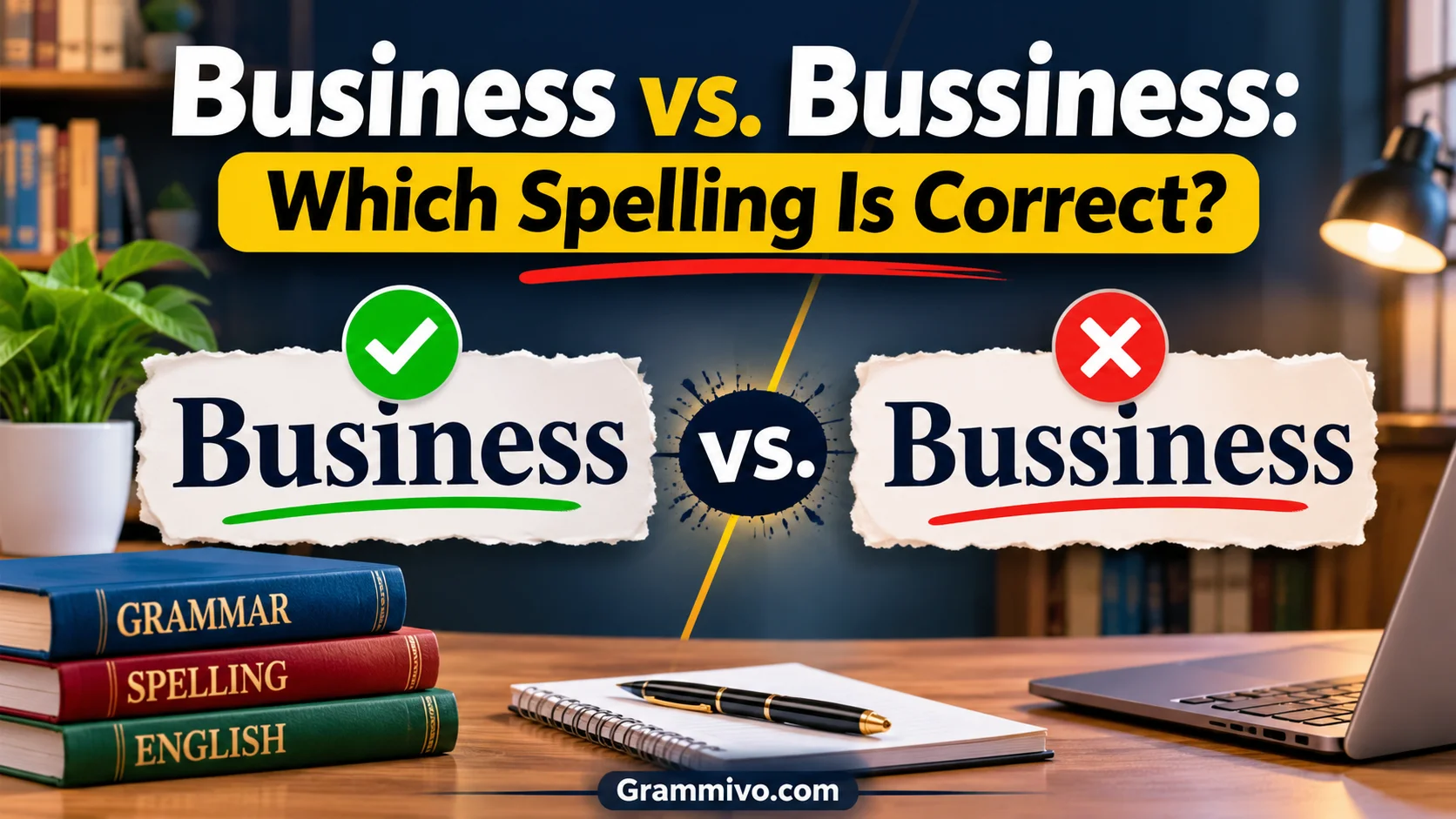
When writing about companies, professional activities, or commercial matters, spelling matters. One small mistake can make an otherwise polished sentence look unprofessional. A common example is the confusion between business and bussiness. Both spellings look similar at first glance, so it’s easy to understand why people mix them up.
However, only one spelling is correct in standard English. The word business appears everywhere, from company descriptions and professional emails to everyday conversations. Meanwhile, bussiness is a frequent spelling mistake that often happens when someone adds an unnecessary letter.
Understanding the difference helps you avoid embarrassing typos and communicate more confidently. Whether you’re writing a business proposal, preparing a school assignment, or sending a professional email, knowing the correct spelling makes a difference.
Quick Answer
Business is the correct spelling. Bussiness is incorrect and isn’t recognized as a standard English word.
The correct spelling is B-U-S-I-N-E-S-S. It contains eight letters and ends with two consecutive S’s.
- Business: Correct spelling.
- Bussiness: Incorrect spelling.
- Pronunciation: BIZ-niss.
- Part of speech: Noun.
- Plural: Businesses.
Example: She wants to start her own business next year.
Comparison Overview
The easiest way to understand business vs. bussiness is to compare their spelling, meaning, and usage. Although the two forms look almost identical, only one belongs in standard English writing.
| Feature | Business | Bussiness |
| Spelling | Correct | Incorrect |
| Number of letters | 8 | 9 |
| Dictionary recognition | Standard English word | Not a standard English word |
| Part of speech | Noun | None |
| Meaning | Company, commercial activity, or professional affairs | No recognized standard meaning |
| Pronunciation | BIZ-niss | No standard pronunciation |
| Example | She owns a small business. | Incorrect spelling |
| Plural form | Businesses | No standard plural form |
The important distinction is the letter sequence. Business contains one S after the initial BU and two S’s at the end. The incorrect version adds another S before the letter I.
Remember this simple rule: write BUSINESS, not BUSSINESS.
Main Differences Between Business vs. Bussiness
The main difference between these two spellings comes down to correctness. Business is an established English noun with several meanings. Bussiness, on the other hand, is simply a spelling error.
Let’s examine the correct word and understand how to use it.
Business: Meaning and Definition
The word business refers to commercial activities, companies, professional work, or matters that require someone’s attention. Its exact meaning depends on the sentence and surrounding context.
For example, someone might use business to describe a company that sells products. Another person might use it when discussing professional responsibilities or private matters.
According to standard English usage, business functions primarily as a noun.
Here are its main meanings:
A company or commercial organization: A business can be an organization that sells products or provides services to customers.
Example: My uncle owns a successful construction business.
Commercial activity: The word can describe buying, selling, producing, or providing goods and services to earn money.
Example: International business creates opportunities for companies in different countries.
Professional work or responsibilities: Business can refer to someone’s occupation, duties, or activities related to their job.
Example: I have some important business to finish before Friday.
Personal affairs or private matters: In everyday conversation, business can refer to personal concerns that other people shouldn’t interfere with.
Example: You shouldn’t interfere in someone else’s business.
These meanings make business a versatile word in professional and everyday English.
Bussiness: Is It a Correct Word?
No. Bussiness isn’t the correct spelling in standard American English or British English.
People sometimes write it with an extra S because they confuse the spelling pattern. The mistake often happens when typing quickly or remembering the word incorrectly.
Consider these examples:
- Incorrect: My father owns a small bussiness.
- Correct: My father owns a small business.
- Incorrect: She wants to study bussiness management.
- Correct: She wants to study business management.
- Incorrect: Their bussiness is growing rapidly.
- Correct: Their business is growing rapidly.
Notice that the meaning remains clear in each incorrect sentence. However, the spelling error makes the writing look less polished.
Remember: Bussiness doesn’t become correct simply because people use it frequently online. Standard spelling remains business.
Why Is Business Commonly Misspelled as Bussiness?
Even though business is a familiar word, many people struggle to remember its exact spelling. The problem usually comes from the unusual relationship between its pronunciation and written form.
Several factors contribute to this confusion.
Confusion About the Number of S’s
The most obvious reason involves the letter S. Business already contains two consecutive S’s at the end, so writers sometimes add another one unnecessarily.
The correct spelling follows this sequence:
- B
- U
- S
- I
- N
- E
- S
- S
The incorrect spelling adds an extra S after the U.
This small difference creates a nine-letter misspelling instead of the correct eight-letter word.
Pronunciation and Spelling Differences
Another reason involves pronunciation. Most American English speakers pronounce business as BIZ-niss, not as each individual letter suggests.
The written form doesn’t perfectly match the spoken sound. As a result, someone unfamiliar with the spelling may guess incorrectly.
English has several words with unusual spelling patterns. For example, Wednesday contains a silent D in its traditional spelling, while colonel has a pronunciation that looks very different from its written form.
Business creates a similar challenge because its pronunciation doesn’t make the spelling immediately obvious.
Typing Mistakes and Repeated Letters
Fast typing can also produce spelling errors. Sometimes, your fingers repeat a letter without you noticing.
For instance, someone typing a professional email might accidentally write bussiness proposal instead of business proposal.
These mistakes are especially common when writers don’t review their work before sending it.
Read More: Ability vs. Abillity: Which Spelling Is Correct?
Confusion With Other English Words
English contains several words ending in -ness, including:
- Happiness
- Kindness
- Darkness
- Sadness
- Weakness
Because these words follow a recognizable spelling pattern, writers sometimes incorrectly assume that business follows a similar construction.
However, business has its own established spelling. You should memorize it rather than trying to build it from another word.
How to Spell Business Correctly
Learning the correct spelling becomes easier when you break the word into smaller parts.
The correct spelling is:
B-U-S-I-N-E-S-S
It contains eight letters:
| Position | Letter |
| First | B |
| Second | U |
| Third | S |
| Fourth | I |
| Fifth | N |
| Sixth | E |
| Seventh | S |
| Eighth | S |
The most important detail is the position of the letters.
- The word starts with BU.
- One S follows the U.
- The middle contains IN.
- The word ends with ESS.
A useful way to remember it is to divide the word into three visual parts:
BUS + I + NESS
This isn’t necessarily its historical or linguistic origin. It’s simply a practical spelling aid.
A Simple Trick to Remember Business vs. Bussiness
Try remembering this sentence:
“One S in the beginning, two S’s at the end.”
This reminder helps you avoid adding an extra S before the I.
You can also practice with familiar expressions:
- Business owner
- Business partner
- Business meeting
- Business account
- Business opportunity
Writing the word in different contexts helps reinforce its correct letter sequence.
How to Pronounce Business
The standard American English pronunciation of business is:
BIZ-niss
Its IPA pronunciation is /ˈbɪz.nəs/.
The word has two syllables:
- BIZ: The first syllable carries the primary stress.
- NISS: The second syllable receives less emphasis.
When speaking naturally, the word sounds like “BIZ-niss” rather than “BUS-i-ness.”
The unusual pronunciation explains why some learners struggle with its spelling. They may expect the written letters to represent sounds more directly.
However, pronunciation doesn’t change the correct spelling. Whether you’re speaking casually or presenting a professional proposal, the word remains business.
Business in Different Contexts
The word business appears in many situations. Its meaning changes depending on whether someone discusses a company, commercial activity, professional responsibilities, or personal affairs.
Understanding these contexts helps you use the word naturally.
Business as a Company
In commercial settings, business commonly refers to an organization that sells products or provides services.
Businesses range from small independent shops to multinational corporations with thousands of employees.
Examples include:
- A family-owned restaurant.
- An online clothing store.
- A software development company.
- A construction firm.
- A financial consulting agency.
Example sentences:
- My sister runs a successful clothing business.
- Their family business has served the community for decades.
- He plans to open a new business in Chicago.
In these examples, business refers to an actual company or commercial organization.
Business as Commercial Activity
Business can also describe the activities involved in producing, buying, and selling goods or services.
For example, international business involves commercial relationships between companies or individuals in different countries.
Other common examples include:
- Online business.
- International business.
- Business transactions.
- Business development.
- Business operations.
Example: International business allows companies to reach customers across national borders.
Here, business refers to commercial activity rather than one particular company.
Business as Work or Professional Responsibility
People also use business when discussing professional duties, meetings, and workplace activities.
You’ll often encounter the word in common expressions such as:
- Business meeting.
- Business hours.
- Business trip.
- Business partner.
- Business proposal.
- Business correspondence.
Example sentences:
- I have a business meeting at 10 a.m.
- She traveled to New York on a business trip.
- Please send the business proposal before Thursday.
In these situations, business relates to professional or commercial responsibilities.
Business as Personal or Private Matters
Outside professional settings, business can refer to someone’s private affairs.
This meaning appears frequently in everyday American English.
Consider these expressions:
Mind your own business: A direct way to tell someone not to interfere in your personal affairs.
Example: I don’t want to discuss my relationship, so please mind your own business.
None of your business: A phrase used when something is private and doesn’t concern another person.
Example: How much money I earn is none of your business.
It’s my business: An expression showing that something is your responsibility or personal concern.
Example: What I do with my free time is my business.
These expressions demonstrate that business doesn’t always involve companies or money.
Business vs. Bussiness: Example Sentences
Examples make spelling differences easier to recognize. The following sentences show how to use business correctly in different situations.
| Incorrect sentence | Correct sentence |
| She started a new bussiness. | She started a new business. |
| My father owns a bussiness. | My father owns a business. |
| He studies bussiness management. | He studies business management. |
| Their bussiness is expanding. | Their business is expanding. |
| We discussed the bussiness plan. | We discussed the business plan. |
| I have an important bussiness meeting. | I have an important business meeting. |
| They want to grow their bussiness. | They want to grow their business. |
| She works in the bussiness sector. | She works in the business sector. |
More Examples Using Business Correctly
Here are additional examples that demonstrate the word’s everyday and professional uses.
In professional communication:
- Our business needs a stronger marketing strategy.
- Please review the business agreement before signing it.
- The company organized a business conference for its employees.
In everyday conversation:
- My brother wants to start his own business.
- That’s none of your business.
- Business has been good this month.
In education:
- She earned a degree in business administration.
- Students can study business management at university.
- He enjoys learning about international business.
Each example uses the same correct spelling, even though the meaning changes.
Frequently Asked Questions
Is Bussiness or Business Correct?
Business is correct. Bussiness is a misspelling and isn’t recognized as a standard English word. Use business when referring to a company, commercial activity, professional work, or personal affairs.
Why Do People Spell Business as Bussiness?
People often add an extra S because they forget the correct letter sequence. Fast typing, pronunciation differences, and unfamiliarity with the word’s spelling can also contribute to the mistake.
Does Business Have One S or Two S’s?
Business contains three S letters in total. One appears after the initial B and U, while two consecutive S’s appear at the end.
The correct spelling is B-U-S-I-N-E-S-S.
How Do You Spell Business Correctly?
The correct spelling is business. It contains eight letters and follows this sequence: B, U, S, I, N, E, S, S.
What Is the Plural of Business?
The plural form of business is businesses.
Example:
- Singular: She owns one business.
- Plural: They own three businesses.
The plural adds -es to the singular form.
Conclusion:
The difference between business vs. bussiness is simple: business is correct, while bussiness is a spelling mistake. The correct word contains eight letters and ends with two consecutive S’s. It refers to companies, commercial activities, professional responsibilities, and personal affairs. Remember the spelling B-U-S-I-N-E-S-S whenever you write about work or commerce. If you ever feel unsure, check the letter sequence before submitting your writing.
