
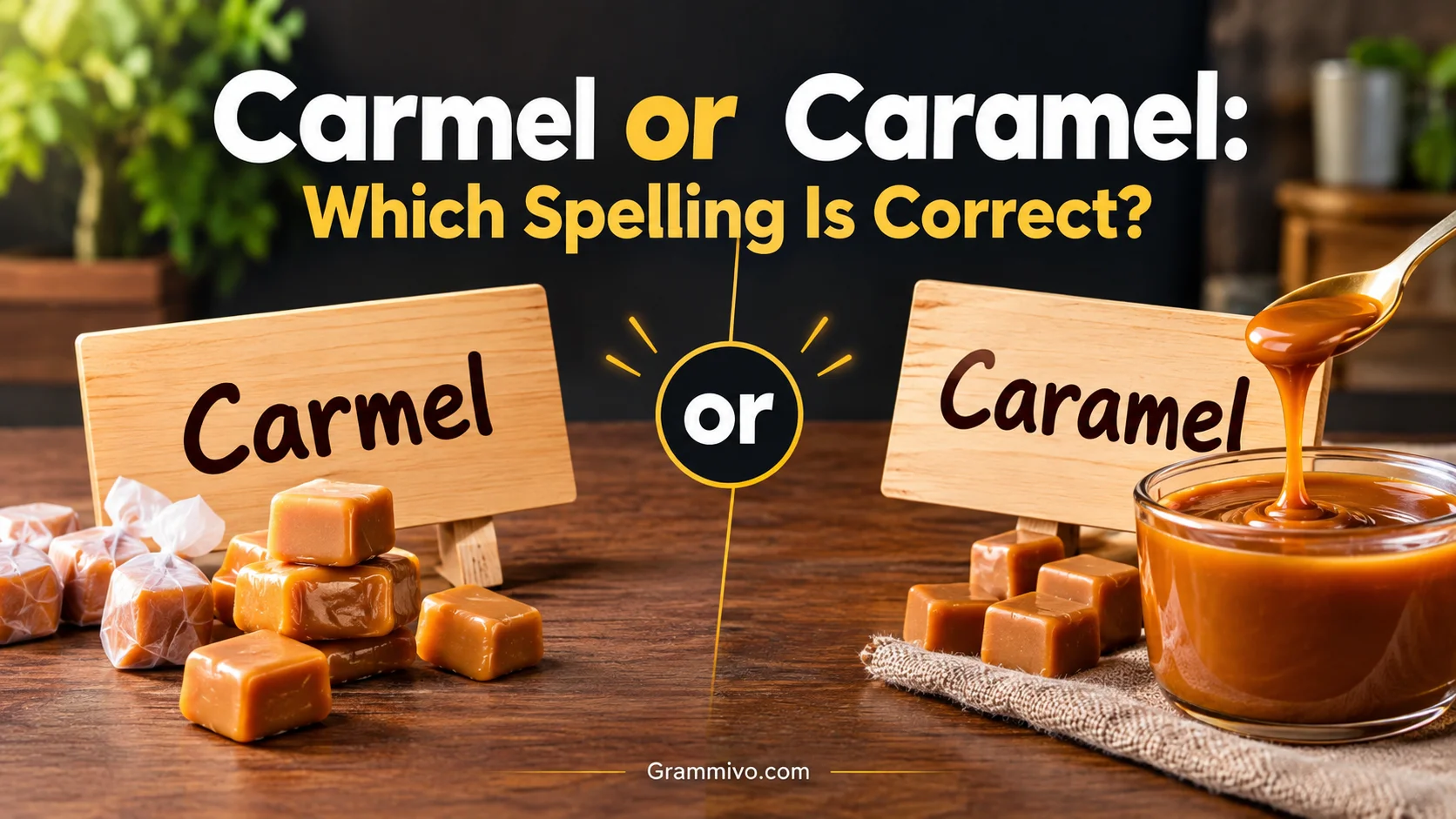
If you’ve ever written caramel and wondered whether that extra a belongs there, you’re not alone. The confusion becomes even stronger when you hear someone pronounce caramel in a way that sounds almost identical to Carmel. In everyday American English, pronunciation can vary quite a bit. The spelling, however, depends on what you mean.
Caramel is the standard spelling for the sweet substance made by heating sugar. It also describes related flavors, sauces, candies, colors, and cooking processes. Carmel, on the other hand, is generally a proper name. You’ll see it in names such as Carmel, California, Mount Carmel, and in personal names.
That small extra a carries a surprisingly important distinction. If you’re talking about a caramel apple, latte, sauce, or candy, caramel is the word you want. If you’re referring to a specific place or person called Carmel, keep the shorter spelling.
The tricky part is pronunciation. Some speakers pronounce caramel with three syllables, while others use two. The two-syllable pronunciation can sound much like Carmel. That similarity explains much of the spelling confusion.
Quick Answer
Caramel is the correct spelling when you mean the sweet food, flavor, sauce, color, or related culinary term. Carmel is generally used as a proper name, including places, people, and religious names.
For example:
- Correct: I ordered a caramel latte.
- Correct: She made caramel apples for the party.
- Correct: They visited Carmel, California.
- Correct: Mount Carmel appears in several historical and religious contexts.
- Incorrect: I ordered a Carmel latte.
- Incorrect: They visited Caramel, California.
A useful rule makes the difference easy:
Food or flavor = caramel. Name or place = Carmel.
Pronunciation doesn’t change this basic spelling distinction.
Comparison Overview
| Feature | Caramel | Carmel |
| Main meaning | A cooked sugar product, flavor, color, or related culinary term | A proper name |
| Common use | Food, drinks, desserts, cooking | Places, people, religious names, organizations |
| Usually capitalized? | No | Yes, when used as a proper noun |
| Example | Caramel sauce | Carmel, California |
| Example phrase | Salted caramel | Mount Carmel |
| Common confusion | Pronunciation varies | Sounds like some pronunciations of caramel |
| Standard spelling for the candy | Caramel | No |
The distinction is mostly about meaning and context, not pronunciation. A speaker might say caramel with two syllables, yet still spell it caramel when referring to the confection.
Main Differences Between Carmel or Caramel
The biggest difference between Carmel and caramel is what each word represents. Although they can sound similar, they don’t normally serve the same grammatical or semantic purpose.
Caramel is an ordinary English word. It refers to a substance, taste, color, or cooking-related concept.
Carmel is usually a proper noun. It identifies a particular person, place, institution, or religious reference.
Consider these two sentences:
- The chef drizzled caramel over the ice cream.
- The family spent the weekend in Carmel.
The first sentence concerns food. The second identifies a place. Changing the spelling would change the intended meaning.
Spelling Difference
The visual difference is tiny:
Carmel → C-a-r-m-e-l
Caramel → C-a-r-a-m-e-l
The word caramel contains an additional a after the first r.
That extra letter isn’t optional when you’re using the standard spelling for the confection. If you’re writing about caramel sauce, caramel candy, or caramel flavor, dropping the second a produces a misspelling.
However, Carmel isn’t simply a shortened spelling of caramel. It’s an established proper name with its own history and uses.
Meaning Difference
The meanings are even more important than the letters.
Caramel commonly refers to sugar that has been heated until it develops a deeper color and characteristic flavor. The word also extends to foods, beverages, sauces, and other products containing or resembling caramel.
Carmel commonly refers to a proper name. One well-known example is Carmel-by-the-Sea, a city on California’s central coast.
So, if you write:
She added Carmel to the ice cream.
A reader may wonder whether Carmel is a person’s name, a brand, or another proper noun.
If you write:
She added caramel to the ice cream.
The meaning is immediately clear.
Capitalization Difference
Capitalization provides another useful clue.
When caramel refers to the food, flavor, or culinary process, it normally appears in lowercase:
- caramel sauce
- caramel candy
- caramel popcorn
- caramel flavor
- caramelized onions
Carmel, when it identifies a proper noun, normally begins with a capital letter:
- Carmel, California
- Mount Carmel
- Carmel Valley
- Carmel Avenue
Capitalization doesn’t create the difference by itself. Instead, it reflects the difference in how the word functions.
What Does Caramel Mean?
Caramel is primarily associated with heated sugar and the distinctive flavor and color that result from the process.
When sugar is heated sufficiently, it undergoes chemical changes that create new flavor compounds and pigments. This process is known as caramelization.
The result can range from pale golden syrup to a much darker substance with a stronger, sometimes bitter flavor. Temperature, cooking time, moisture, and the type of sugar all influence the final result.
Caramel as a Sweet Food
Caramel can refer to a confection made by cooking sugar, often with other ingredients such as butter, cream, or milk.
Depending on the recipe, caramel can become:
- A soft candy
- A chewy confection
- A sauce
- A syrup
- A filling
- A coating
- A topping
For example, a caramel sauce may combine cooked sugar with butter and cream. The final product has a smooth texture and rich flavor.
Caramel candy takes the concept further by cooking the mixture to a texture that can be cut, wrapped, or chewed.
Caramel as a Flavor
The word also describes a recognizable flavor profile.
You’ll find caramel flavor in products such as:
- Coffee drinks
- Ice cream
- Cakes
- Cookies
- Chocolate
- Pudding
- Milkshakes
- Sauces
- Candy
This doesn’t always mean the product contains traditional caramel made entirely through cooking sugar. Food manufacturers can also use flavoring ingredients designed to produce a caramel-like taste.
Caramel as a Color
Caramel can also describe a warm brown or golden-brown color.
For example:
The cake developed a beautiful caramel color as it baked.
The related term caramel color has a more specific meaning in food production. Caramel coloring is produced by controlled heating of carbohydrates and is widely used to give certain foods and beverages a brown appearance.
It shouldn’t automatically be confused with caramel candy or caramel sauce.
Caramel in Cooking
Caramelization plays an important role in cooking because heating sugars can create complex aromas and flavors.
You can see related browning in foods such as:
- Roasted vegetables
- Caramelized onions
- Baked fruit
- Toasted sugar
- Certain baked goods
One important detail deserves attention: caramelization and the Maillard reaction aren’t the same process. Both can contribute to browning and flavor development, but they involve different chemical pathways.
That distinction matters when you’re discussing cooking scientifically rather than simply describing a browned food.
What Does Carmel Mean?
Carmel is generally a proper noun rather than the standard spelling for the sweet food.
Its uses include geographical names, personal names, religious references, and names of organizations or institutions.
Carmel as a Place Name
One of the best-known American examples is Carmel-by-the-Sea, a city in California.
The city’s official name uses Carmel, not Caramel. Writing Caramel-by-the-Sea would therefore be incorrect.
Other geographical names also contain Carmel. The exact spelling matters because proper names aren’t normally changed to match another word that happens to sound similar.
Carmel as a Religious Name
Mount Carmel is another major use of the word.
Mount Carmel is a mountain range in northwestern Israel that has important biblical and religious associations. The name also appears in Christian traditions, including references connected with Our Lady of Mount Carmel.
In these contexts, Carmel is a name. It isn’t referring to sugar, candy, or a dessert topping.
Carmel as a Personal Name
Carmel can also be used as a given name.
When a person is named Carmel, the spelling should remain Carmel even if the pronunciation happens to resemble one common pronunciation of caramel.
That’s a useful lesson for proper names generally: spelling follows the established name.
Read More: Naive or Nieve: Which Spelling Is Correct?
Why Do People Confuse Carmel and Caramel?
The confusion largely comes from sound.
English spelling and pronunciation don’t always maintain a neat one-to-one relationship. A word can have multiple accepted pronunciations while retaining one conventional spelling.
Pronunciation Makes the Difference Easy to Miss
In American English, caramel is commonly pronounced in more than one way.
Some speakers use a pronunciation with three syllables:
CAR-uh-mel
Others use a pronunciation with two syllables that can sound closer to:
CAR-mel
That second pronunciation is one major reason people sometimes assume that Carmel is an acceptable spelling for the food.
It isn’t.
Think of it like a person’s nickname. Someone named Benjamin might be called Ben, but the nickname doesn’t automatically become the person’s official name. Similarly, pronunciation can vary without changing the standard written form.
Regional Pronunciation Differences
English has considerable regional variation, especially in the United States.
You may hear people pronounce caramel differently depending on where they grew up, what speech communities they belong to, and what pronunciation they encountered at home.
Neither common pronunciation requires a different spelling.
This is why listening carefully isn’t always enough when you’re trying to spell the word. If you hear something that sounds like Carmel while someone discusses candy, the intended written word is still caramel.
Hearing the Word Before Seeing It
Imagine hearing someone say:
“I bought a caramel apple.”
If the speaker uses the two-syllable pronunciation, the word may sound almost indistinguishable from Carmel.
Someone learning the spelling could reasonably wonder which version belongs on the page.
The solution is simple: identify the meaning before choosing the spelling.
If it’s a candy, sauce, flavor, or cooking term, use caramel.
If it’s a place, person, or other proper name, check the established spelling.
Carmel vs. Caramel Pronunciation
Pronunciation is where the two words become especially deceptive.
How to Pronounce Caramel
Caramel has more than one commonly heard pronunciation in American English.
A three-syllable pronunciation may sound like:
CAR-uh-mel
A two-syllable pronunciation may sound closer to:
CAR-mel
Both forms occur in American speech.
The important point is that pronunciation variation doesn’t create two standard spellings for the confection. In written English, caramel remains the conventional spelling.
How to Pronounce Carmel
Carmel generally has two syllables and can sound similar to the two-syllable pronunciation of caramel.
For example:
Carmel → CAR-mel
Because the sounds overlap, context becomes crucial.
When someone says Carmel aloud, you may need additional information to know whether they mean the proper name or the food word.
Why Pronunciation Doesn’t Change the Spelling
English contains many examples where pronunciation and spelling don’t line up perfectly.
The same written word may have different pronunciations across regions. Likewise, two different words can sound alike or nearly alike while having different spellings and meanings.
Carmel and caramel demonstrate both problems at once.
The words can sound similar while carrying different meanings.
Carmel or Caramel Examples
Examples make this distinction much easier to remember.
Correct Examples With Caramel
- The baker poured caramel sauce over the cheesecake.
- She ordered a caramel latte before work.
- We made caramel apples for the fall festival.
- The recipe calls for caramelized sugar.
- He bought a box of caramel candies.
- The ice cream contains a salted caramel swirl.
- The onions became deeply caramelized during cooking.
In each sentence, caramel relates to food, flavor, cooking, or appearance.
Correct Examples With Carmel
- They planned a trip to Carmel, California.
- Carmel-by-the-Sea is known for its coastal setting.
- The book discusses Mount Carmel.
- Carmel is also used as a personal name.
- The business has an office on Carmel Avenue.
Here, Carmel functions as part of a proper name.
Incorrect vs. Correct Examples
| Incorrect | Correct | Why? |
| Carmel sauce | Caramel sauce | The word refers to a food |
| Carmel candy | Caramel candy | The confection is caramel |
| Carmel latte | Caramel latte | The flavor is caramel |
| Caramel, California | Carmel, California | The city has the established name Carmel |
| Caramel-by-the-Sea | Carmel-by-the-Sea | The official place name uses Carmel |
| Mount Caramel | Mount Carmel | The proper name is Carmel |
These errors often happen because the writer remembers the sound rather than the spelling.
Common Phrases With Caramel
Certain combinations appear constantly in menus, recipes, packaging, and everyday conversation.
Common examples include:
- Caramel sauce
- Caramel candy
- Caramel apples
- Caramel popcorn
- Caramel corn
- Caramel latte
- Caramel syrup
- Caramel flavor
- Salted caramel
- Caramelized sugar
- Caramelized onions
- Caramel dessert
If the word describes a sweet flavor or cooking result, caramel is almost certainly the spelling you need.
Salted Caramel
Salted caramel deserves special mention because it has become a common food phrase.
It combines the rich sweetness of caramel with salt. The contrast can make the caramel taste more pronounced because salt influences how people perceive sweetness and other flavors.
You might see the phrase in:
- Chocolate
- Ice cream
- Cookies
- Cakes
- Coffee
- Sauces
- Candy
The spelling remains caramel, regardless of how the word is pronounced.
Is Carmel Ever Correct?
Absolutely.
Carmel is correct when it’s the established spelling of a proper name.
For example:
- Carmel, California
- Carmel-by-the-Sea
- Mount Carmel
- Carmel as a personal name
- Institutions or businesses officially named Carmel
The mistake occurs when Carmel replaces caramel in a sentence about food.
For example:
We drizzled Carmel over the brownies.
Unless Carmel is deliberately being used as a brand or other proper name, this is incorrect.
The standard sentence is:
We drizzled caramel over the brownies.
FAQs:
Is Carmel or caramel the correct spelling?
Both spellings can be correct, but they have different uses. Caramel is the standard spelling for the sweet substance, flavor, candy, sauce, and related culinary terms. Carmel is generally used for proper names, such as Carmel, California, or Mount Carmel.
Is Carmel an accepted spelling of caramel?
Carmel isn’t the standard spelling for the sweet food. Although some pronunciations of caramel sound similar to Carmel, the conventional written form remains caramel.
Why do Americans pronounce caramel as Carmel?
American English has regional and individual pronunciation differences. Some speakers pronounce caramel with three syllables, while others use two. The two-syllable pronunciation can sound similar to Carmel, which contributes to the spelling confusion.
Is caramel spelled differently in American and British English?
The basic spelling caramel is used for the sweet substance in both American and British English. Pronunciation may vary, but Carmel isn’t the standard British or American spelling of the confection.
What is the difference between Carmel and caramel?
Caramel refers to a sweet substance, flavor, color, or related cooking concept. Carmel is generally a proper name used for people, places, and religious or historical references. The two words can sound similar, but their meanings and spellings differ.
Conclusion:
The Carmel vs. caramel confusion mostly comes from pronunciation. Some speakers pronounce caramel in a way that sounds very close to Carmel, yet the written distinction remains clear. Use caramel when you’re talking about the sweet substance, candy, sauce, flavor, color, or cooking process. Use Carmel when you’re referring to an established proper name such as Carmel, California, Carmel-by-the-Sea, or Mount Carmel.
