Have you ever typed “dilema” and wondered whether something looked slightly off? You’re not alone. The words dilemma vs dilema often cause confusion because both forms sound nearly identical when spoken. However, only one is the standard spelling in English.
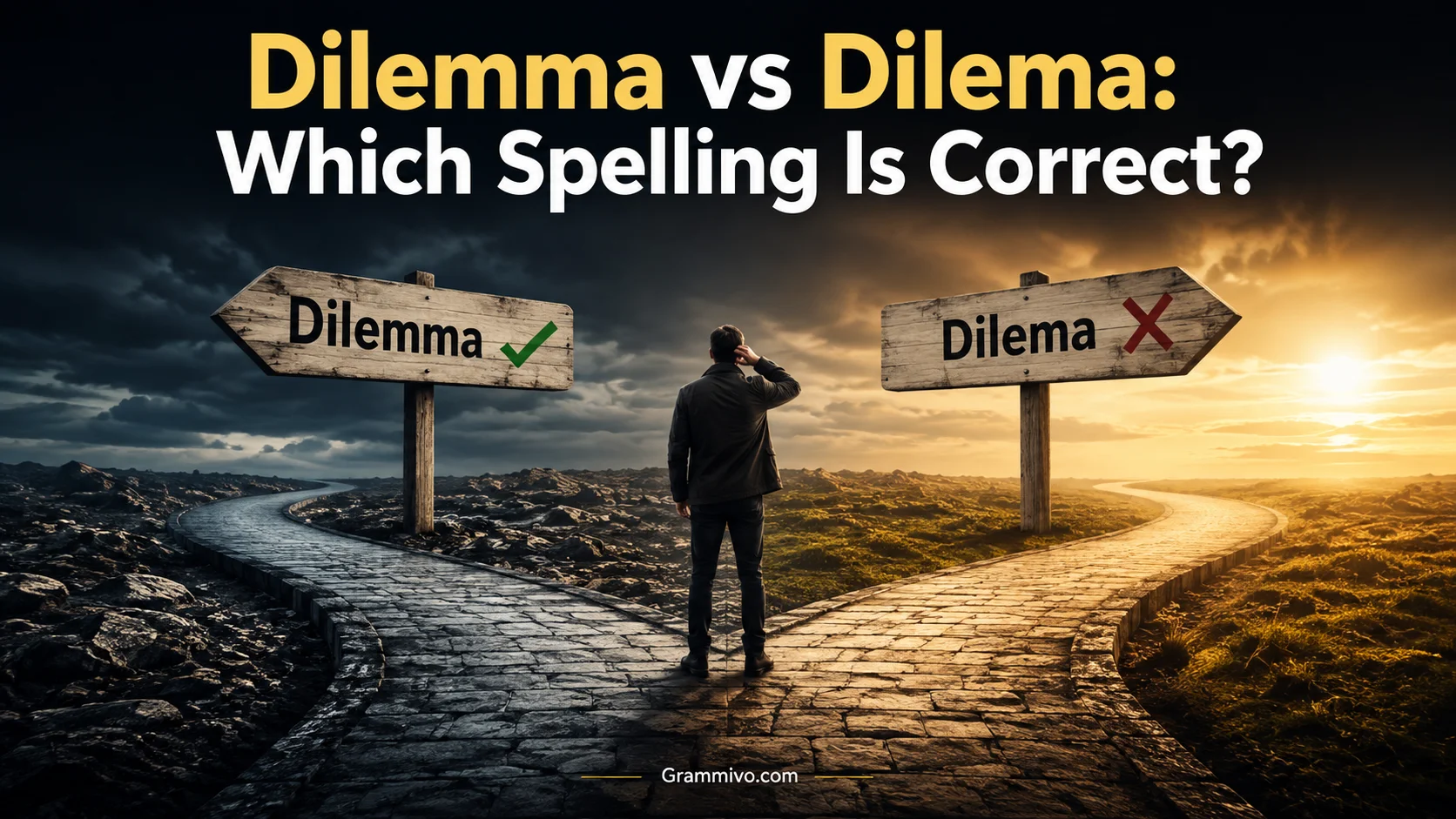
The correct spelling is dilemma, with two m’s. Dilema is a misspelling in standard English. The word dilemma describes a difficult situation in which someone faces competing choices, often with no obviously good solution.
The spelling becomes easier to remember once you connect the word with its history and meaning. In this guide, you’ll learn the difference between dilemma and dilema, how to pronounce and use dilemma, why it has two m’s, and how it differs from related words such as problem, choice, predicament, and quandary.
Quick Answer
Dilemma is the correct spelling.
Dilema is a common misspelling and should generally be avoided in standard English writing.
| Spelling | Correct? | Meaning |
| Dilemma | Yes | A difficult situation involving competing choices or alternatives |
| Dilema | No | A misspelling of dilemma |
Correct: I faced a difficult dilemma about whether to accept the job.
Incorrect: I faced a difficult dilema about whether to accept the job.
The easiest way to remember it is simple: dilemma has two m’s.
What Does Dilemma Mean?
A dilemma is a difficult situation in which you must choose between two or more alternatives. Each option may have drawbacks, risks, or unwanted consequences.
For example, imagine that you receive an excellent job offer in another city. The salary is much higher, but accepting it means moving away from your family. You have two appealing but conflicting priorities: career growth and staying close to the people you love.
That situation creates a dilemma.
The word doesn’t simply mean “a choice.” Every day, you make choices that aren’t dilemmas. Choosing between coffee and tea might be a choice, but it usually isn’t a dilemma.
A dilemma involves a meaningful conflict that makes the decision difficult.
Simple Definition of Dilemma
You can think of a dilemma as:
A difficult choice between competing options, especially when neither option seems ideal.
The word is a noun, so you can use it to name the difficult situation itself.
Examples include:
- She faced a difficult dilemma at work.
- Choosing between the two universities created a dilemma.
- His dilemma was whether to tell the truth or protect his friend.
- The company faced a serious ethical dilemma.
- I’m in a dilemma about which offer to accept.
Dilemma vs Dilema: What’s the Difference?
The difference between dilemma vs dilema is primarily a matter of spelling.
Dilemma is the accepted standard English spelling. Dilema is generally an error caused by leaving out the second m.
| Feature | Dilemma | Dilema |
| Standard English spelling | Yes | No |
| Dictionary spelling | Yes | No |
| Part of speech | Noun | — |
| Meaning | Difficult choice or situation | Intended as dilemma |
| Double m | Yes | No |
| Recommended in formal writing | Yes | No |
If you’re writing an email, essay, article, report, application, or professional document, use dilemma.
Why the Difference Is Easy to Miss
The confusion makes sense because English spelling doesn’t always match pronunciation perfectly.
When you hear dilemma, you hear an m sound, but the pronunciation doesn’t clearly announce that the written word contains two consecutive m’s.
That creates a familiar spelling trap:
dilemma → correct
dilema → missing one m
The same kind of problem occurs with many English words in which a doubled consonant isn’t obvious from speech.
Why Is Dilemma Spelled With Two Ms?
The spelling dilemma comes through Latin from Greek dílēmma, meaning a proposition involving two alternatives. The Greek word is built from elements associated with “two” and “assumption” or “premise.”
Its historical development helps explain why the modern English spelling contains mm.
English inherited many words from Greek through Latin and later stages of European languages. As those words entered English, their spellings often retained features of their earlier forms.
The double m in dilemma isn’t decorative. It’s part of the established spelling of the English word.
The Double-M Memory Trick
A useful memory device is:
A dilemma has two m’s because a dilemma involves two difficult sides.
This isn’t the historical reason for the spelling. It’s simply a convenient way to remember it.
Think:
two sides → two m’s → dilemma
That quick association can help prevent the common dilema mistake.
Why Do People Spell Dilemma as Dilema?
Several factors can make dilema look tempting.
First, English speakers usually learn words through a combination of sound and writing. When pronunciation doesn’t reveal every letter, spelling mistakes become more likely.
Second, dilemma contains a consecutive pair of identical consonants. When people write quickly, they may accidentally omit one of them.
Third, readers who encounter the word mainly in conversation may know what it means without having seen its written form often.
The result is an understandable mistake:
dilemma → dilema
However, familiarity with the incorrect form doesn’t make it an accepted spelling.
Common Reasons for the Misspelling
The error may happen because:
- The second m is easy to overlook.
- The pronunciation doesn’t emphasize both letters separately.
- The writer spells the word based on sound.
- Fast typing causes repeated letters to be dropped.
- The writer hasn’t encountered the written word frequently.
- Autocorrect or typing habits can reinforce an incorrect spelling.
The solution is straightforward: remember that dilemma always contains two m’s in standard English.
Dilemma Pronunciation: How Do You Say It?
The standard pronunciation of dilemma is commonly represented approximately as:
duh-LEM-uh
The middle syllable receives the primary stress.
Depending on accent and pronunciation system, dictionary transcriptions vary. A common American English representation is approximately /dɪˈlɛm.ə/.
The important point for spelling is that pronunciation doesn’t give you a strong clue that the word contains mm.
That’s why you shouldn’t rely entirely on sound when spelling it.
Dilemma Pronunciation vs Spelling
| Word | Approximate pronunciation | Spelling |
| Dilemma | duh-LEM-uh | dilemma |
| Dilema | Intended to sound like dilemma | Incorrect spelling |
When in doubt, focus on the written form:
D-I-L-E-M-M-A
The two m’s belong together.
Dilemma in a Sentence
Seeing dilemma in context makes its meaning easier to understand.
Here are several natural examples:
- I faced a dilemma when both companies offered me a job.
- She had a dilemma about whether to study abroad.
- The manager faced an ethical dilemma.
- His dilemma was whether to report the mistake or remain silent.
- Choosing between family obligations and career demands created a serious dilemma.
- The students discussed the moral dilemma during class.
- We found ourselves in a difficult dilemma after the original plan failed.
Notice that the word works especially well when the available choices create tension.
Dilemma in Everyday Conversation
You don’t need a dramatic situation to use dilemma. Everyday decisions can become dilemmas when the competing options genuinely matter.
For example:
“My dilemma is whether to save money for a house or take the vacation I’ve been planning for years.”
The speaker isn’t merely choosing between two activities. The decision involves competing priorities.
That distinction gives dilemma more emotional weight than the simple word choice.
Dilemma vs Choice: What’s the Difference?
A choice is any decision between alternatives. A dilemma is a particularly difficult choice or situation involving conflicting alternatives.
Consider these two sentences:
I have a choice between pizza and pasta.
I have a dilemma: should I accept my dream job if it means moving away from my family?
Both involve alternatives. Only the second clearly creates a dilemma.
| Word | Basic idea | Example |
| Choice | Selecting between alternatives | I have a choice between two restaurants. |
| Dilemma | Difficult decision involving competing concerns | I face a dilemma about moving for work. |
So, calling every choice a dilemma can make your writing less precise.
Dilemma vs Problem: What’s the Difference?
A problem is something difficult that needs to be solved. A dilemma specifically involves competing choices or courses of action.
For example:
The car won’t start.
That’s a problem.
Now consider:
I can repair the car or spend the money on a replacement.
That’s closer to a dilemma because the person must weigh competing options.
A problem can exist without a dilemma. Likewise, a dilemma can be part of a larger problem.
Problem vs Dilemma at a Glance
| Problem | Dilemma |
| Something needs solving | A difficult decision needs making |
| May have one obvious solution | Often involves competing options |
| Can be practical or technical | Often involves conflicting priorities |
| Example: broken computer | Example: repair it or replace it |
Choosing the right word helps readers understand what kind of difficulty you’re describing.
Dilemma vs Predicament: What’s the Difference?
Predicament refers to a difficult, unpleasant, or awkward situation. Dilemma focuses more specifically on the difficult alternatives someone must consider.
For example:
She was in a predicament after missing the last train.
This describes a difficult situation.
Compare that with:
She faced a dilemma about whether to call her employer or find another way home.
Here, the emphasis falls on the competing choices.
The words overlap, but they aren’t exact synonyms.
| Word | Main focus |
| Dilemma | Difficult alternatives or decisions |
| Predicament | Difficult circumstances |
| Problem | Something that requires a solution |
| Choice | An act of selecting between alternatives |
| Quandary | A state of uncertainty about what to do |
Dilemma vs Quandary
Quandary is one of the closest synonyms for dilemma.
A quandary describes a state in which you’re uncertain about what to do, especially because the available choices are difficult.
For example:
- I’m in a dilemma about whether to accept the offer.
- I’m in a quandary about whether to accept the offer.
Both sentences work.
However, dilemma often highlights the competing alternatives themselves, while quandary can emphasize the person’s uncertainty or confusion.
In everyday writing, the two words frequently overlap.
Read More: Column vs Colum: Which Spelling Is Correct?
Is “Dilema” Ever Correct?
In standard English, use dilemma, not dilema.
If you see dilema in ordinary English prose, it will generally be understood as a misspelling of dilemma.
There can always be unusual contexts involving names, titles, quotations, trademarks, usernames, or foreign-language words. Those special cases don’t change the standard English spelling.
For normal English writing, the safe rule is:
Write “dilemma.”
This applies to:
- School assignments
- Business writing
- Emails
- Blog posts
- Essays
- Reports
- Applications
- Academic writing
- Social media posts
- Professional documents
Is Dilemma a Noun or a Verb?
Dilemma is a noun.
You use it to refer to the difficult situation or choice.
Correct:
She faced a difficult dilemma.
You don’t normally use dilemma as a verb in standard English.
Instead, use verbs such as:
- face
- encounter
- confront
- experience
- consider
- resolve
For example:
He faced a serious dilemma.
The committee encountered an ethical dilemma.
She struggled to resolve the dilemma.
These constructions sound natural because they treat dilemma as the noun it is.
What Is the Plural of Dilemma?
The plural of dilemma is dilemmas.
You don’t change the spelling dramatically. Simply add s.
| Singular | Plural |
| dilemma | dilemmas |
Examples:
- She faced one difficult dilemma.
- The characters in the novel face several dilemmas.
- Modern businesses often encounter ethical dilemmas.
- The discussion explored several moral dilemmas.
The plural dilemmas is pronounced with a final z sound.
Common Mistakes With Dilemma
The most obvious mistake is dropping the second m.
Incorrect: Dilema
I don’t know how to solve this dilema.
Correct: Dilemma
I don’t know how to solve this dilemma.
Another mistake involves using dilemma for any minor decision.
I have a dilemma about which flavor of ice cream to buy.
This isn’t necessarily grammatically wrong. Context matters. However, it can sound exaggerated if the choice carries no meaningful conflict.
For precise writing, reserve dilemma for situations where the decision genuinely creates difficulty.
Quick Error Check
Before publishing or submitting your writing, remember:
- dilema
- dilemma
- dilemas
- dilemmas
The double m remains in the plural.
Dilemma in Formal and Informal Writing
The word dilemma works comfortably in both formal and informal English.
In casual conversation, you might say:
“I’m in a dilemma. I want to go out, but I also need to save money.”
In professional writing, you could write:
“The organization faces a significant ethical dilemma concerning data privacy.”
The level of formality comes from the surrounding language, not from the word dilemma itself.
Formal Examples
- The board faced a difficult financial dilemma.
- The policy creates an ethical dilemma for healthcare professionals.
- The committee must address the dilemma before reaching a final decision.
Informal Examples
- I’ve got a dilemma: beach trip or concert?
- I’m in a bit of a dilemma about what to wear.
- Here’s my dilemma: stay home or join everyone for dinner?
The word adapts easily to different situations.
Ethical Dilemma vs Moral Dilemma
You’ll often encounter the phrases ethical dilemma and moral dilemma.
An ethical dilemma generally involves competing principles, duties, or standards about what should be done.
A moral dilemma similarly involves competing moral obligations or values.
For example, imagine that an employee discovers a serious mistake made by a close colleague. Reporting the mistake may protect the organization, while staying silent may protect the colleague from serious consequences.
The conflict between these competing considerations creates a potential ethical or moral dilemma.
These phrases appear frequently in discussions of:
- Business ethics
- Medicine
- Law
- Education
- Journalism
- Technology
- Public policy
- Personal responsibility
The exact distinction between ethical and moral can depend on context, so they shouldn’t be treated as completely interchangeable in every specialized discussion.
FAQs:
Is “dilema” a correct spelling?
No. Dilemma is the standard English spelling. Dilema is generally a misspelling.
Is it “dilema” or “dilemma”?
The correct form is dilemma, with two m’s.
Why does dilemma have two m’s?
The spelling reflects the word’s historical development from Greek through Latin and other languages. In modern English, dilemma is the established spelling.
What does dilemma mean?
A dilemma is a difficult situation involving competing choices or alternatives, particularly when each option has significant disadvantages or consequences.
What is the plural of dilemma?
The plural is dilemmas.
For example:
The students discussed several moral dilemmas.
Conclusion:
When choosing between dilemma vs dilema, the answer is clear: dilemma is the correct standard English spelling. The word dilemma refers to a difficult situation involving competing choices, which makes it different from a simple choice or an ordinary problem. It can describe personal decisions, workplace conflicts, ethical questions, family situations, and many other circumstances.
